About the Report
Base Year 2024Listen to the audio summary
Thailand Opioid Market Overview
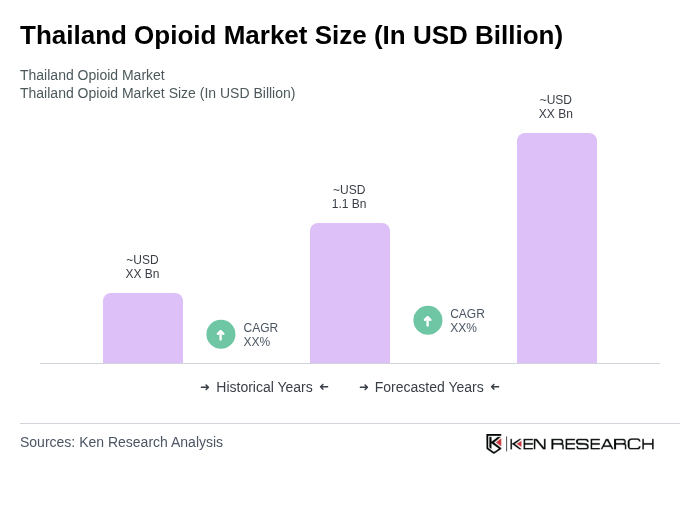
- The Thailand Opioid Market is valued at USD 1.1 billion, based on a five-year historical analysis and alignment with regional opioid market benchmarks in Asia Pacific, where demand is rising but remains moderate compared to North America and Europe. This growth is primarily driven by the increasing prevalence of chronic pain conditions, cancer, and the rising demand for effective pain management solutions, consistent with broader Asia Pacific trends in opioid utilization. The market is also influenced by the expanding healthcare infrastructure, universal health coverage, and the gradual integration of opioids into standardized pain management guidelines in tertiary and oncology centers in Thailand.
- Key cities such as Bangkok, Chiang Mai, and Pattaya dominate the market due to their advanced healthcare facilities and higher patient populations. Bangkok, as the capital, serves as a hub for pharmaceutical companies and healthcare providers, with a concentration of tertiary and oncology hospitals that require opioid analgesics for cancer and post-surgical pain. Chiang Mai and Pattaya have seen increased medical tourism and specialized private hospitals, which support demand for pain management, including opioid medications as part of post-operative and palliative care protocols.
- In 2021, the Thai government revised and consolidated the Narcotics Code through the Narcotics Code, B.E. 2564 (2021), issued by the Office of the Council of State and enforced by the Ministry of Public Health and related agencies, which regulates the manufacture, prescription, dispensing, and distribution of opioids. This legislation aims to ensure the safe use of opioids while preventing misuse and addiction by classifying opioids as controlled narcotics, defining licensing requirements, and specifying record-keeping and storage obligations for healthcare facilities and pharmacies. The code mandates that authorized prescribers use special narcotic prescription forms, maintain detailed logs, and comply with inspection and reporting requirements, thereby enhancing monitoring of opioid prescriptions and promoting responsible prescribing practices in hospital and community settings.
Thailand Opioid Market Segmentation
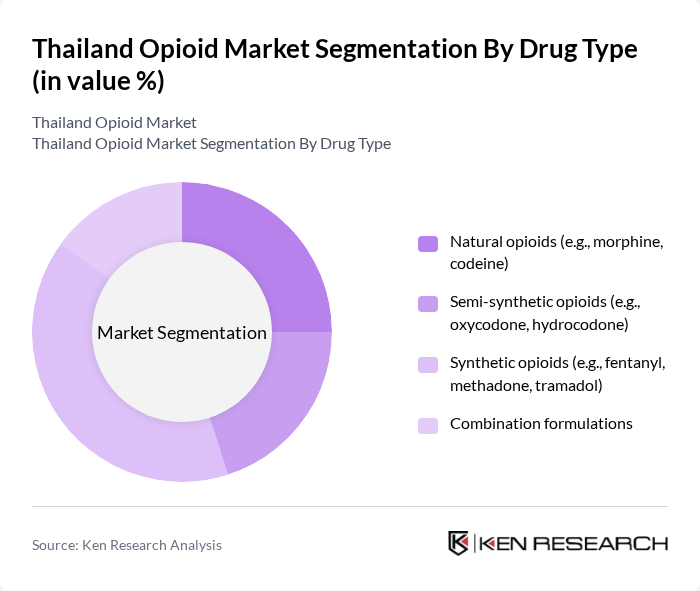
By Drug Type:The market is segmented into various drug types, including natural opioids, semi-synthetic opioids, synthetic opioids, and combination formulations. In hospital and palliative care practice, natural opioids such as morphine and codeine remain the backbone of moderate-to-severe cancer pain treatment under World Health Organization pain ladder recommendations adopted in Thailand. Semi-synthetic and synthetic opioids, particularly fentanyl, methadone, and tramadol, are increasingly used for severe pain, anesthesia, and opioid substitution therapy, with tramadol widely prescribed in Asia Pacific due to its perceived lower abuse potential. The increasing awareness of pain management options, expansion of palliative care services, and a growing number of oncology and surgical patients in Thailand are driving demand across these drug types, while hospital protocols and national narcotic controls shape the mix between injectable and oral formulations.
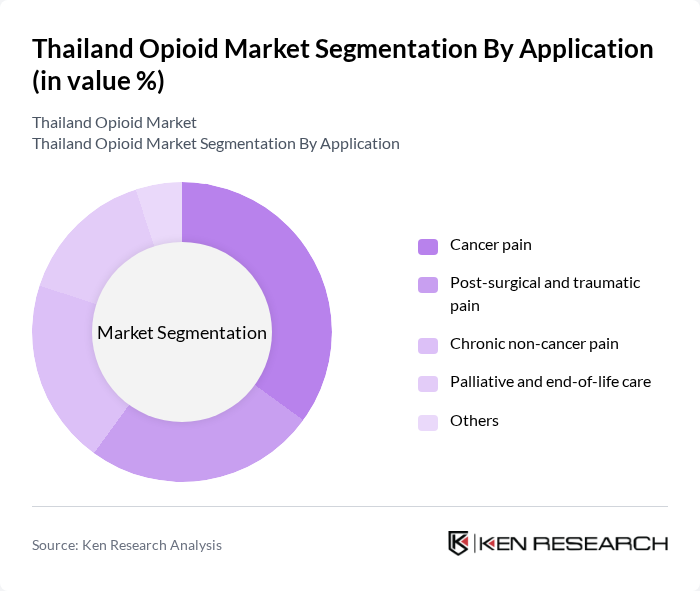
By Application:The opioid market is also segmented by application, including cancer pain, post-surgical and traumatic pain, chronic non-cancer pain, palliative and end-of-life care, and others. Cancer pain management is a significant driver, as Thailand has experienced steady growth in cancer incidence and mortality, with opioids recommended as essential medicines for moderate-to-severe cancer pain. Post-surgical and traumatic pain represent another major application segment, supported by a high volume of surgical procedures in tertiary hospitals and medical tourism centers that rely on opioids as part of perioperative analgesia. Chronic non-cancer pain and palliative and end-of-life care are expanding segments as Thailand strengthens its palliative care network, integrates pain control into universal health coverage, and trains clinicians in multimodal pain management approaches that include carefully controlled opioid use.
Thailand Opioid Market Competitive Landscape
The Thailand Opioid Market is characterized by a dynamic mix of regional and international players. Leading participants such as Government Pharmaceutical Organization (GPO), Biopharm Chemicals Co., Ltd., Greater Pharma Co., Ltd., Siam Bheasach Co., Ltd., Bangkok Drug Co., Ltd., Atlantic Laboratories Corporation Ltd., T.O. Chemicals (1979) Co., Ltd., Pfizer (Thailand) Ltd., Johnson & Johnson (Thailand) Ltd., Sanofi (Thailand) Ltd., Novartis (Thailand) Ltd., AstraZeneca (Thailand) Ltd., Merck Ltd. (Thailand), Mundipharma (Thailand) Ltd., Takeda (Thailand) Ltd. contribute to innovation, geographic expansion, and service delivery in this space.
Thailand Opioid Market Industry Analysis
Growth Drivers
- Increasing Prevalence of Chronic Pain:Chronic pain affects approximately 20% of the Thai population, translating to around 14 million individuals. This rising prevalence is driven by an aging population, with about 20% of Thais projected to be over 60 years old in future. The demand for effective pain management solutions, including opioids, is expected to increase significantly, as healthcare providers seek to address the needs of this growing demographic, thereby driving market growth.
- Rising Demand for Palliative Care:The Thai government has recognized the importance of palliative care, with a reported increase in funding for related services by 30% in future. This funding aims to improve access to pain relief for terminally ill patients, leading to a higher demand for opioids. As palliative care becomes more integrated into the healthcare system, the opioid market is likely to expand, catering to the needs of patients requiring effective pain management.
- Expanding Healthcare Infrastructure:Thailand's healthcare expenditure is projected to reach THB 1.5 trillion (approximately USD 45 billion) in future, reflecting a 10% increase from previous levels. This expansion includes the development of hospitals and clinics, particularly in underserved areas. Improved healthcare infrastructure facilitates better access to opioid prescriptions and pain management services, thereby driving the growth of the opioid market as healthcare providers become more equipped to manage chronic pain effectively.
Market Challenges
- Regulatory Restrictions on Opioid Prescriptions:Thailand has stringent regulations governing opioid prescriptions, with only 5% of healthcare providers authorized to prescribe these medications. This limitation is a significant barrier to access for patients in need of pain relief. The regulatory environment is influenced by concerns over misuse and addiction, which complicates the prescribing process and restricts the availability of opioids in the market.
- Stigma Associated with Opioid Use:There is a prevalent stigma surrounding opioid use in Thailand, with 60% of the population expressing concerns about addiction. This societal perception discourages patients from seeking necessary pain management solutions. Healthcare providers also face challenges in prescribing opioids due to fear of backlash from patients and families, which ultimately hinders the growth of the opioid market and limits access to effective treatments.
Thailand Opioid Market Future Outlook
The Thailand opioid market is poised for significant transformation as healthcare policies evolve to address pain management more effectively. With an increasing focus on personalized medicine and the integration of technology in treatment protocols, the market is likely to see innovative approaches to opioid use. Additionally, the expansion of telemedicine services will enhance access to pain management solutions, particularly in rural areas, fostering a more inclusive healthcare environment for patients suffering from chronic pain.
Market Opportunities
- Development of New Opioid Formulations:There is a growing opportunity for pharmaceutical companies to invest in the development of new opioid formulations that minimize addiction risks. Innovations such as abuse-deterrent formulations can cater to the needs of patients while addressing regulatory concerns, potentially increasing market acceptance and usage among healthcare providers.
- Expansion of Telemedicine for Pain Management:The rise of telemedicine presents a unique opportunity to enhance access to pain management services. With an estimated 30% of the population lacking access to specialized pain care, telemedicine can bridge this gap, allowing patients to receive consultations and prescriptions remotely, thus driving opioid market growth in underserved regions.
Scope of the Report
| Segment | Sub-Segments |
|---|---|
| By Drug Type | Natural opioids (e.g., morphine, codeine) Semi-synthetic opioids (e.g., oxycodone, hydrocodone) Synthetic opioids (e.g., fentanyl, methadone, tramadol) Combination formulations |
| By Application | Cancer pain Post-surgical and traumatic pain Chronic non-cancer pain Palliative and end-of-life care Others |
| By Route of Administration | Oral Parenteral / IV Transdermal Others (e.g., sublingual, nasal) |
| By Distribution Channel | Hospital pharmacies Retail pharmacies Online pharmacies Others |
| By End-User | Public hospitals Private hospitals Pain clinics and specialty centers Home healthcare and hospices Others |
| By Formulation | Immediate-release formulations Extended-release / long-acting formulations Abuse-deterrent formulations Others |
| By Regulatory Control | Essential narcotic drugs Specially controlled opioids Opioids for substitution / dependence therapy Others |
Key Target Audience
Investors and Venture Capitalist Firms
Government and Regulatory Bodies (e.g., Ministry of Public Health, Food and Drug Administration Thailand)
Pharmaceutical Manufacturers and Producers
Distributors and Wholesalers
Healthcare Providers and Hospitals
Pharmacy Chains and Retail Pharmacies
Industry Associations (e.g., Pharmaceutical Association of Thailand)
Health Insurance Companies
Players Mentioned in the Report:
Government Pharmaceutical Organization (GPO)
Biopharm Chemicals Co., Ltd.
Greater Pharma Co., Ltd.
Siam Bheasach Co., Ltd.
Bangkok Drug Co., Ltd.
Atlantic Laboratories Corporation Ltd.
T.O. Chemicals (1979) Co., Ltd.
Pfizer (Thailand) Ltd.
Johnson & Johnson (Thailand) Ltd.
Sanofi (Thailand) Ltd.
Novartis (Thailand) Ltd.
AstraZeneca (Thailand) Ltd.
Merck Ltd. (Thailand)
Mundipharma (Thailand) Ltd.
Takeda (Thailand) Ltd.
Table of Contents
Market Assessment Phase
1. Executive Summary and Approach
2. Thailand Opioid Market Overview
2.1 Key Insights and Strategic Recommendations
2.2 Thailand Opioid Market Overview
2.3 Definition and Scope
2.5 Timeline of Key Regulatory Milestones
2.6 Value Chain & Stakeholder Mapping
2.7 Business Cycle Analysis
2.8 Policy & Incentive Landscape
3. Thailand Opioid Market Analysis
3.1 Growth Drivers
3.1.1 Increasing prevalence of chronic pain
3.1.2 Rising demand for palliative care
3.1.3 Expanding healthcare infrastructure
3.1.4 Government initiatives for pain management
3.2 Market Challenges
3.2.1 Regulatory restrictions on opioid prescriptions
3.2.2 Stigma associated with opioid use
3.2.3 Risk of addiction and misuse
3.2.4 Limited access in rural areas
3.3 Market Opportunities
3.3.1 Development of new opioid formulations
3.3.2 Expansion of telemedicine for pain management
3.3.3 Increased awareness and education on pain management
3.3.4 Collaborations with healthcare providers
3.4 Market Trends
3.4.1 Shift towards personalized medicine
3.4.2 Growth of non-opioid alternatives
3.4.3 Integration of technology in pain management
3.4.4 Focus on patient-centered care
3.5 Government Regulation
3.5.1 Prescription monitoring programs
3.5.2 Guidelines for opioid prescribing
3.5.3 Restrictions on opioid manufacturing
3.5.4 Education requirements for prescribers
4. SWOT Analysis
5. Stakeholder Analysis
6. Porter's Five Forces Analysis
7. Thailand Opioid Market Market Size, 2019-2024
7.1 By Value
7.2 By Volume
7.3 By Average Selling Price
8. Thailand Opioid Market Segmentation
8.1 By Drug Type
8.1.1 Natural opioids (e.g., morphine, codeine)
8.1.2 Semi-synthetic opioids (e.g., oxycodone, hydrocodone)
8.1.3 Synthetic opioids (e.g., fentanyl, methadone, tramadol)
8.1.4 Combination formulations
8.2 By Application
8.2.1 Cancer pain
8.2.2 Post-surgical and traumatic pain
8.2.3 Chronic non-cancer pain
8.2.4 Palliative and end-of-life care
8.2.5 Others
8.3 By Route of Administration
8.3.1 Oral
8.3.2 Parenteral / IV
8.3.3 Transdermal
8.3.4 Others (e.g., sublingual, nasal)
8.4 By Distribution Channel
8.4.1 Hospital pharmacies
8.4.2 Retail pharmacies
8.4.3 Online pharmacies
8.4.4 Others
8.5 By End-User
8.5.1 Public hospitals
8.5.2 Private hospitals
8.5.3 Pain clinics and specialty centers
8.5.4 Home healthcare and hospices
8.5.5 Others
8.6 By Formulation
8.6.1 Immediate-release formulations
8.6.2 Extended-release / long-acting formulations
8.6.3 Abuse-deterrent formulations
8.6.4 Others
8.7 By Regulatory Control
8.7.1 Essential narcotic drugs
8.7.2 Specially controlled opioids
8.7.3 Opioids for substitution / dependence therapy
8.7.4 Others
9. Thailand Opioid Market Competitive Analysis
9.1 Market Share of Key Players
9.2 Cross Comparison of Key Players
9.2.1 Company Name
9.2.2 Market share by revenue
9.2.3 3-year CAGR of Thailand opioid revenues
9.2.4 EBITDA margin from Thailand opioid portfolio
9.2.5 R&D spend on opioid and pain assets (% of sales)
9.2.6 Average selling price index vs. market
9.2.7 Portfolio mix (branded vs generic; IR vs ER)
9.2.8 Geographic coverage within Thailand (tier-1/2/3 provinces)
9.2.9 Hospital formulary penetration (share of target hospitals listed)
9.2.10 Regulatory and pharmacovigilance compliance record
9.2.11 Tender win rate with public institutions
9.2.12 KOL and guideline inclusion score
9.3 SWOT Analysis of Top Players
9.4 Pricing Analysis
9.5 Detailed Profile of Major Companies
9.5.1 Government Pharmaceutical Organization (GPO)
9.5.2 Biopharm Chemicals Co., Ltd.
9.5.3 Greater Pharma Co., Ltd.
9.5.4 Siam Bheasach Co., Ltd.
9.5.5 Bangkok Drug Co., Ltd.
9.5.6 Atlantic Laboratories Corporation Ltd.
9.5.7 T.O. Chemicals (1979) Co., Ltd.
9.5.8 Pfizer (Thailand) Ltd.
9.5.9 Johnson & Johnson (Thailand) Ltd.
9.5.10 Sanofi (Thailand) Ltd.
9.5.11 Novartis (Thailand) Ltd.
9.5.12 AstraZeneca (Thailand) Ltd.
9.5.13 Merck Ltd. (Thailand)
9.5.14 Mundipharma (Thailand) Ltd.
9.5.15 Takeda (Thailand) Ltd.
10. Thailand Opioid Market End-User Analysis
10.1 Procurement Behavior of Key Ministries
10.1.1 Ministry of Public Health
10.1.2 Ministry of Finance
10.1.3 Ministry of Social Development and Human Security
10.1.4 Others
10.2 Corporate Spend on Infrastructure & Energy
10.2.1 Healthcare infrastructure investments
10.2.2 Pain management programs
10.2.3 Training and education initiatives
10.2.4 Others
10.3 Pain Point Analysis by End-User Category
10.3.1 Hospitals
10.3.2 Clinics
10.3.3 Home healthcare providers
10.3.4 Others
10.4 User Readiness for Adoption
10.4.1 Awareness of opioid therapies
10.4.2 Training for healthcare providers
10.4.3 Patient education programs
10.4.4 Others
10.5 Post-Deployment ROI and Use Case Expansion
10.5.1 Cost savings in pain management
10.5.2 Improved patient outcomes
10.5.3 Expansion of service offerings
10.5.4 Others
11. Thailand Opioid Market Future Size, 2025-2030
11.1 By Value
11.2 By Volume
11.3 By Average Selling Price
Go-To-Market Strategy Phase
1. Whitespace Analysis + Business Model Canvas
1.1 Market Gaps Identification
1.2 Business Model Development
2. Marketing and Positioning Recommendations
2.1 Branding strategies
2.2 Product USPs
3. Distribution Plan
3.1 Urban retail vs rural NGO tie-ups
4. Channel & Pricing Gaps
4.1 Underserved routes
4.2 Pricing bands
5. Unmet Demand & Latent Needs
5.1 Category gaps
5.2 Consumer segments
6. Customer Relationship
6.1 Loyalty programs
6.2 After-sales service
7. Value Proposition
7.1 Sustainability
7.2 Integrated supply chains
8. Key Activities
8.1 Regulatory compliance
8.2 Branding
8.3 Distribution setup
9. Entry Strategy Evaluation
9.1 Domestic Market Entry Strategy
9.1.1 Product mix
9.1.2 Pricing band
9.1.3 Packaging
9.2 Export Entry Strategy
9.2.1 Target countries
9.2.2 Compliance roadmap
10. Entry Mode Assessment
10.1 JV
10.2 Greenfield
10.3 M&A
10.4 Distributor Model
11. Capital and Timeline Estimation
11.1 Capital requirements
11.2 Timelines
12. Control vs Risk Trade-Off
12.1 Ownership vs Partnerships
13. Profitability Outlook
13.1 Breakeven analysis
13.2 Long-term sustainability
14. Potential Partner List
14.1 Distributors
14.2 JVs
14.3 Acquisition targets
15. Execution Roadmap
15.1 Phased Plan for Market Entry
15.1.1 Market Setup
15.1.2 Market Entry
15.1.3 Growth Acceleration
15.1.4 Scale & Stabilize
15.2 Key Activities and Milestones
15.2.1 Milestone tracking
15.2.2 Activity scheduling
Research Methodology
Phase 1: Approach1
Desk Research
- Analysis of government reports on opioid usage and regulations in Thailand
- Review of academic journals and publications on opioid market trends and health impacts
- Examination of industry reports from health organizations and pharmaceutical associations
Primary Research
- Interviews with healthcare professionals, including pharmacists and pain management specialists
- Surveys conducted with patients using opioids for chronic pain management
- Focus groups with addiction recovery specialists and support groups
Validation & Triangulation
- Cross-validation of data from multiple sources, including government and healthcare providers
- Triangulation of findings from primary interviews and secondary research data
- Sanity checks through expert panel reviews comprising industry veterans and researchers
Phase 2: Market Size Estimation1
Top-down Assessment
- Estimation of total opioid consumption based on national health statistics and prescription data
- Segmentation of the market by therapeutic use, including pain management and palliative care
- Incorporation of regulatory impacts on opioid availability and usage patterns
Bottom-up Modeling
- Collection of sales data from major pharmaceutical distributors and manufacturers
- Analysis of pricing trends for various opioid formulations in the Thai market
- Volume estimates based on patient demographics and treatment protocols
Forecasting & Scenario Analysis
- Multi-factor regression analysis considering factors such as population aging and chronic disease prevalence
- Scenario modeling based on potential changes in regulations and public health initiatives
- Development of baseline, optimistic, and pessimistic market projections through 2030
Phase 3: CATI Sample Composition1
| Scope Item/Segment | Sample Size | Target Respondent Profiles |
|---|---|---|
| Chronic Pain Management | 140 | Healthcare Providers, Pain Specialists |
| Opioid Prescription Practices | 110 | Pharmacists, General Practitioners |
| Addiction Recovery Insights | 80 | Recovery Counselors, Support Group Leaders |
| Patient Experience with Opioids | 130 | Chronic Pain Patients, Caregivers |
| Regulatory Impact Assessment | 70 | Policy Makers, Health Economists |
Frequently Asked Questions
What is the current value of the Thailand Opioid Market?
The Thailand Opioid Market is valued at approximately USD 1.1 billion. This valuation is based on a five-year historical analysis and aligns with regional benchmarks in the Asia Pacific, where demand for opioids is rising but remains moderate compared to North America and Europe.
What factors are driving the growth of the Thailand Opioid Market?
Which cities in Thailand dominate the opioid market?
What types of opioids are available in the Thailand market?
Other Regional/Country Reports
Other Adjacent Reports
Germany Pain Management Market
Thailand Oncology Drugs Market
Vietnam Palliative Care Market
Philippines Anesthesia Market
New Zealand Pharmaceutical Manufacturing Market Report Size, Share, Growth Drivers, Trends, Opportunities & Forecast 2025–2030Bahrain Medical Tourism Market Report Size, Share, Growth Drivers, Trends, Opportunities & Forecast 2025–2030Middle East Chronic Disease Management Market Size, Share, Growth Drivers, Trends, Opportunities & Forecast 2025–2030Japan Healthcare Infrastructure Market
Mexico Drug Delivery Systems Market
Why Buy From Us?

What makes us stand out is that our consultants follow Robust, Refine and Result (RRR) methodology. Robust for clear definitions, approaches and sanity checking, Refine for differentiating respondents' facts and opinions, and Result for presenting data with story.

We have set a benchmark in the industry by offering our clients with syndicated and customized market research reports featuring coverage of entire market as well as meticulous research and analyst insights.

While we don't replace traditional research, we flip the method upside down. Our dual approach of Top Bottom & Bottom Top ensures quality deliverable by not just verifying company fundamentals but also looking at the sector and macroeconomic factors.

With one step in the future, our research team constantly tries to show you the bigger picture. We help with some of the tough questions you may encounter along the way: How is the industry positioned? Best marketing channel? KPI's of competitors? By aligning every element, we help maximize success.

Our report gives you instant access to the answers and sources that other companies might choose to hide. We elaborate each steps of research methodology we have used and showcase you the sample size to earn your trust.

If you need any support, we are here! We pride ourselves on universe strength, data quality, and quick, friendly, and professional service.