Region:Middle East
Author(s):Geetanshi
Product Code:KRAD3792
Pages:85
Published On:November 2025
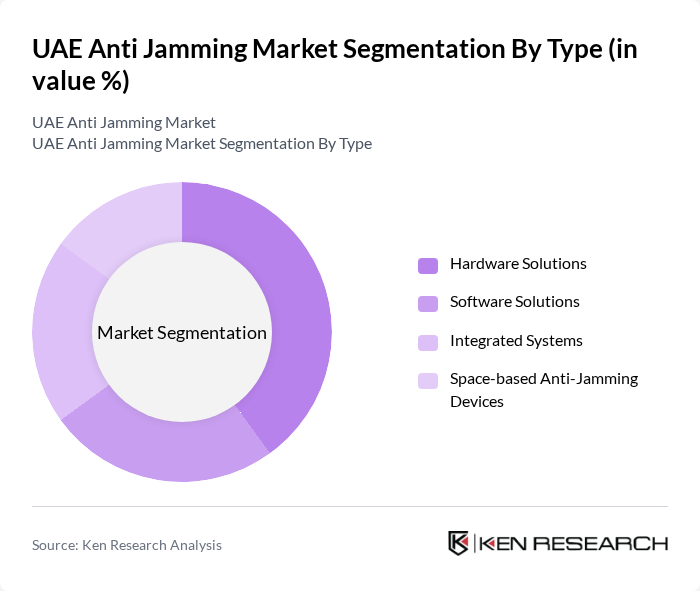
By Type:The market is segmented into Hardware Solutions, Software Solutions, Integrated Systems, and Space-based Anti-Jamming Devices. Hardware Solutions are gaining traction due to their reliability and effectiveness in mitigating jamming threats, especially in military and critical infrastructure applications. Software Solutions are increasingly adopted for their flexibility, scalability, and ease of integration into existing systems, particularly in telecommunications. Integrated Systems combine both hardware and software for comprehensive, layered protection. Space-based Anti-Jamming Devices are emerging as a niche segment, addressing the growing need for secure satellite communications in defense, navigation, and commercial satellite operations .
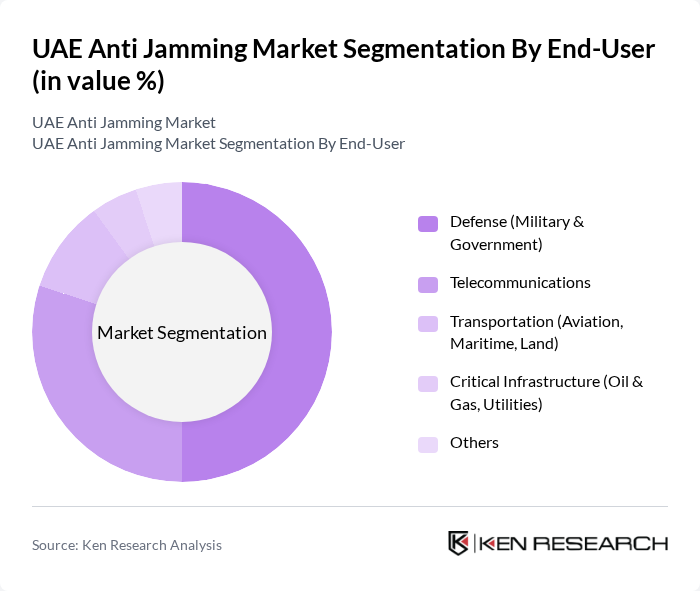
By End-User:The end-user segmentation includes Defense (Military & Government), Telecommunications, Transportation (Aviation, Maritime, Land), Critical Infrastructure (Oil & Gas, Utilities), and Others. The Defense sector is the largest consumer of anti-jamming technologies due to the critical need for secure communications, navigation, and electronic warfare capabilities in military operations. Telecommunications represent a significant market, driven by the need for reliable, interference-free communication networks. The Transportation sector, including aviation, maritime, and land, is increasingly adopting anti-jamming solutions to ensure safety and operational continuity. Critical Infrastructure (Oil & Gas, Utilities) relies on these technologies to protect essential services from disruption .
The UAE Anti Jamming Market is characterized by a dynamic mix of regional and international players. Leading participants such as Raytheon Technologies, Northrop Grumman, L3Harris Technologies, Thales Group, BAE Systems, Elbit Systems, Leonardo S.p.A., General Dynamics, Saab AB, Cobham Limited, EDGE Group (UAE), Harris Corporation, Rockwell Collins (now Collins Aerospace), ITT Inc., and Bittium Corporation contribute to innovation, geographic expansion, and service delivery in this space .
The UAE anti-jamming market is poised for significant growth, driven by increasing investments in defense and security technologies. As the demand for secure communication rises, particularly in military applications, the integration of AI and mobile systems will become more prevalent. Furthermore, the focus on user-friendly interfaces and data privacy will shape product development. Companies that adapt to these trends and address regulatory challenges will likely capture a larger share of the market, ensuring robust growth in the coming years.
| Segment | Sub-Segments |
|---|---|
| By Type | Hardware Solutions Software Solutions Integrated Systems Space-based Anti-Jamming Devices |
| By End-User | Defense (Military & Government) Telecommunications Transportation (Aviation, Maritime, Land) Critical Infrastructure (Oil & Gas, Utilities) Others |
| By Application | Position, Navigation, and Timing (PNT) Flight Control Surveillance & Reconnaissance Targeting Emergency Services Others |
| By Technology | Frequency Hopping Spread Spectrum Beamforming Nulling Technique Excision System Others |
| By Region | Abu Dhabi Dubai Sharjah Others |
| By Investment Source | Government Funding Private Investments International Aid Others |
| By Policy Support | Government Subsidies Tax Incentives Research Grants Others |
| Scope Item/Segment | Sample Size | Target Respondent Profiles |
|---|---|---|
| Military Communications | 100 | Defense Analysts, Military Procurement Officers |
| Commercial Telecommunications | 80 | Network Engineers, Telecommunications Managers |
| Governmental Security Applications | 50 | Government IT Officials, Security Consultants |
| Research and Development in Anti-Jamming | 40 | R&D Managers, Technology Innovators |
| Cybersecurity Firms | 70 | Cybersecurity Analysts, Product Managers |
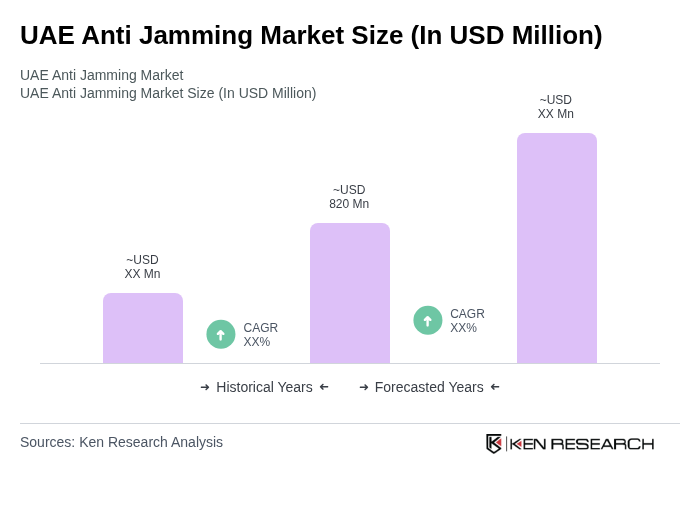
The UAE Anti Jamming Market is valued at approximately USD 820 million, reflecting a significant growth driven by the demand for secure communication systems in defense and telecommunications, as well as advancements in anti-jamming technologies.

What makes us stand out is that our consultants follow Robust, Refine and Result (RRR) methodology. Robust for clear definitions, approaches and sanity checking, Refine for differentiating respondents' facts and opinions, and Result for presenting data with story.

We have set a benchmark in the industry by offering our clients with syndicated and customized market research reports featuring coverage of entire market as well as meticulous research and analyst insights.

While we don't replace traditional research, we flip the method upside down. Our dual approach of Top Bottom & Bottom Top ensures quality deliverable by not just verifying company fundamentals but also looking at the sector and macroeconomic factors.

With one step in the future, our research team constantly tries to show you the bigger picture. We help with some of the tough questions you may encounter along the way: How is the industry positioned? Best marketing channel? KPI's of competitors? By aligning every element, we help maximize success.

Our report gives you instant access to the answers and sources that other companies might choose to hide. We elaborate each steps of research methodology we have used and showcase you the sample size to earn your trust.

If you need any support, we are here! We pride ourselves on universe strength, data quality, and quick, friendly, and professional service.













