Ken Research Logo

UAE Musical Instruments Market

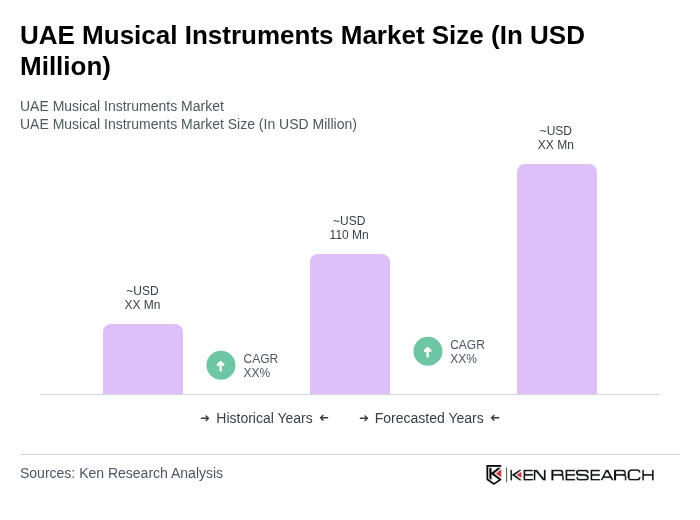
The UAE Musical Instruments Market, valued at USD 110 million, is growing due to rising music education, festivals, and digital trends, dominated by Dubai and Abu Dhabi.

Region:Middle East

Author(s):Geetanshi

Product Code:KRAD4040

Pages:80

Published On:December 2025
About the Report

Base Year 2024

UAE Musical Instruments Market Overview

  • The UAE Musical Instruments Market is valued at approximately USD 110 million, based on a five-year historical analysis of UAE revenue shares within the Middle East musical instruments industry and country?level market estimates. This growth is primarily driven by the increasing popularity of music education, cultural events, and a growing interest in music among the youth, supported by expanding music schools, academies and after?school programs across major emirates. The rise of online platforms for music learning and the proliferation of music festivals and live entertainment events, including large?scale concerts and cultural festivals, have also contributed significantly to the market’s expansion.
  • Key cities such as Dubai and Abu Dhabi dominate the market due to their vibrant cultural scenes, high disposable incomes, and a strong expatriate community that fosters diverse musical interests. The presence of numerous music schools, retail outlets, performance venues and recording studios in these cities, coupled with their roles as regional hubs for touring artists and festivals, further enhances their market dominance.
  • In 2023, the UAE government implemented a series of cultural and creative?economy initiatives under its broader national cultural strategy that indirectly promote local music production and education. These initiatives include funding and policy support for creative industries, cultural festivals, and arts education, which is expected to enhance the growth of the musical instruments market by fostering a more robust music culture and increasing demand from schools, community programs and local artists.
UAE Musical Instruments Market Size

UAE Musical Instruments Market Segmentation

By Type:The market is segmented into various types of musical instruments, including string instruments, percussion instruments, wind instruments, electronic instruments, traditional instruments, accessories, and others. Among these, electronic instruments and keyboards have gained significant traction due to technological advancements, the growth of home studios, and the increasing popularity of digital music production and DJ culture in the UAE’s nightlife and event scene. The demand for electronic instruments is driven by both professional musicians and hobbyists who seek innovative ways to create and perform music, supported by greater availability of software, recording interfaces and online tutorials.
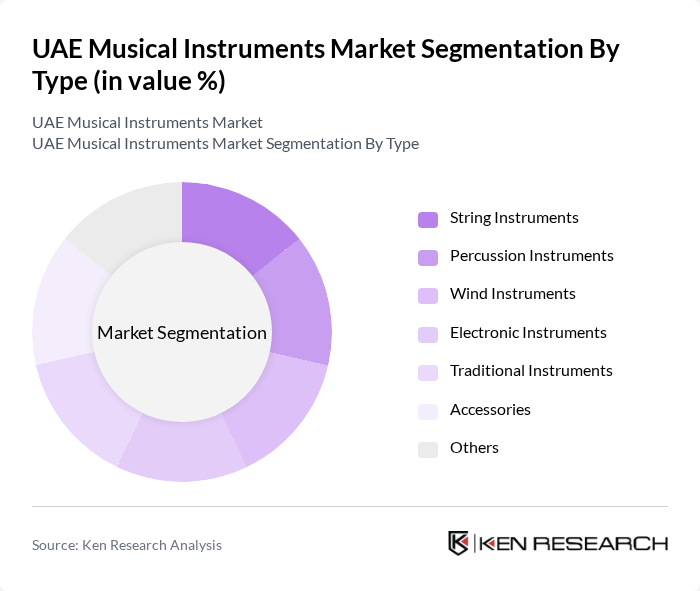
UAE Musical Instruments Market segmentation by Type.

By End-User:The end-user segmentation includes educational institutions, professional musicians, hobbyists, event organizers, and others. Educational institutions are a significant segment, as music education is increasingly integrated into school activities and extracurricular programs, supported by private international schools and specialized music academies that purchase instruments in bulk. This trend is supported by broader government and private?sector initiatives to build the creative economy and promote arts education, alongside a growing recognition among parents and schools of the importance of music in child development, leading to a higher demand for various musical instruments for classroom, ensemble and exam use.
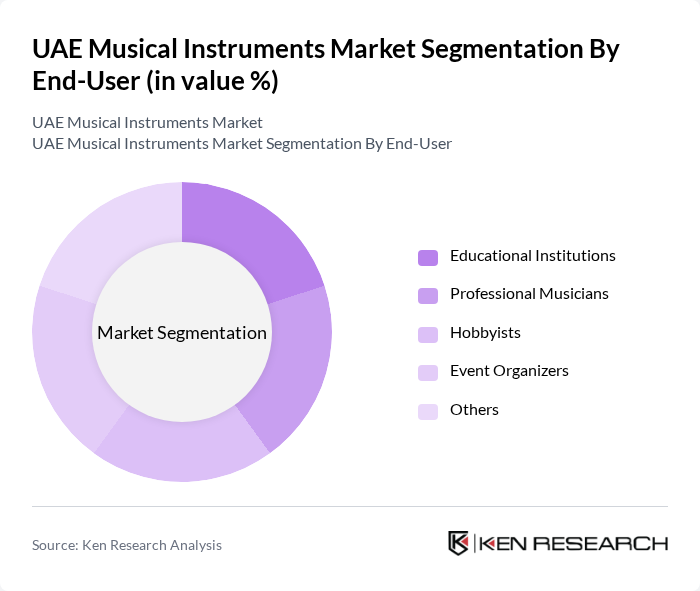
UAE Musical Instruments Market segmentation by End-User.

UAE Musical Instruments Market Competitive Landscape

The UAE Musical Instruments Market is characterized by a dynamic mix of regional and international players. Leading participants such as Yamaha Corporation, Roland Corporation, Korg Inc., Fender Musical Instruments Corporation, Gibson Brands, Inc., Casio Computer Co., Ltd., Steinway & Sons, Pearl Musical Instruments, Zildjian Company, C.F. Martin & Company, D'Addario & Company, Inc., Shure Incorporated, Behringer, Ibanez, Native Instruments, Al Nafis Musical Instruments, Music House UAE, Music World UAE, Al Ghurair Music Center, Music Zone UAE contribute to innovation, geographic expansion, and service delivery in this space through branded showrooms, dealer networks, and online sales channels.

Yamaha Corporation

1887

Hamamatsu, Japan

Roland Corporation

1972

Hamamatsu, Japan

Korg Inc.

1963

Tokyo, Japan

Fender Musical Instruments Corporation

1946

Scottsdale, Arizona, USA

Gibson Brands, Inc.

1902

Nashville, Tennessee, USA

Company

Establishment Year

Headquarters

Group Size (Large, Medium, or Small as per industry convention)

Revenue Growth Rate

Market Penetration Rate

Customer Retention Rate

Pricing Strategy

Product Diversification Index

UAE Musical Instruments Market Industry Analysis

Growth Drivers

  • Increasing Interest in Music Education:The UAE has seen a significant rise in music education, with over 200 music schools and institutions reported in future. The Ministry of Education has allocated AED 50 million to enhance music programs in schools, reflecting a commitment to cultural development. This growing interest is fostering a new generation of musicians, leading to increased demand for musical instruments, which is projected to reach 160,000 units sold in future.
  • Rise of Live Music Events and Festivals:The UAE hosted over 300 live music events in future, attracting more than 1.6 million attendees. This surge in live performances has stimulated interest in musical instruments, as both amateur and professional musicians seek to participate. The government’s investment of AED 100 million in cultural festivals is expected to further boost the local music scene, driving instrument sales to an estimated 210,000 units in future.
  • Growth of Online Music Platforms:The number of online music streaming subscribers in the UAE reached 1.3 million in future, with platforms like Anghami and Spotify leading the market. This digital shift has encouraged musicians to invest in high-quality instruments to enhance their online presence. As a result, the demand for musical instruments is projected to increase, with sales expected to hit 190,000 units in future, driven by the need for superior sound quality.

Market Challenges

  • High Import Tariffs on Musical Instruments:The UAE imposes import tariffs of up to 5% on musical instruments, which can significantly increase retail prices. This financial burden affects both retailers and consumers, limiting access to a broader range of products. In future, the total value of imported musical instruments was approximately AED 210 million, indicating that tariffs could hinder market growth by restricting affordability and variety for consumers.
  • Limited Local Manufacturing Capabilities:The UAE's local production of musical instruments is minimal, with only 10% of the market being locally manufactured. This reliance on imports creates vulnerabilities in supply chains and increases costs. In future, local manufacturers produced instruments worth AED 25 million, highlighting the need for investment in domestic production capabilities to meet growing demand and reduce dependency on foreign suppliers.

UAE Musical Instruments Market Future Outlook

The UAE musical instruments market is poised for significant growth, driven by increasing interest in music education and a vibrant live music scene. As digital platforms continue to gain traction, musicians are likely to invest in high-quality instruments, further stimulating demand. Additionally, government initiatives aimed at promoting cultural events will enhance market visibility. The combination of these factors suggests a robust future for the industry, with opportunities for innovation and expansion in both local and online markets.

Market Opportunities

  • Expansion of E-commerce Platforms:The rise of e-commerce in the UAE, with online sales projected to reach AED 25 billion in future, presents a significant opportunity for musical instrument retailers. By leveraging digital channels, businesses can reach a wider audience, enhancing sales and customer engagement. This shift is expected to increase online instrument sales by 35% in the coming period.
  • Collaborations with Educational Institutions:Partnerships between musical instrument manufacturers and educational institutions can create tailored programs that promote instrument usage among students. With over 1,200 schools in the UAE offering music programs, such collaborations could lead to increased sales, with an estimated 30% growth in instrument purchases by schools anticipated in future.

Scope of the Report

SegmentSub-Segments
By Type

String Instruments

Percussion Instruments

Wind Instruments

Electronic Instruments

Traditional Instruments

Accessories

Others

By End-User

Educational Institutions

Professional Musicians

Hobbyists

Event Organizers

Others

By Distribution Channel

Online Retail

Physical Retail Stores

Direct Sales

Wholesale Distributors

Others

By Price Range

Budget Instruments

Mid-Range Instruments

Premium Instruments

Custom Instruments

Others

By Brand Preference

International Brands

Local Brands

Emerging Brands

Others

By Usage Frequency

Daily Users

Weekly Users

Monthly Users

Occasional Users

Others

By Age Group

Children

Teenagers

Adults

Seniors

Others

Key Target Audience

Investors and Venture Capitalist Firms

Government and Regulatory Bodies (e.g., Ministry of Culture and Youth, Department of Tourism and Commerce Marketing)

Manufacturers and Producers

Distributors and Retailers

Event Organizers and Promoters

Music Schools and Training Centers

Music Festivals and Cultural Events Organizers

Financial Institutions

Players Mentioned in the Report:

Yamaha Corporation

Roland Corporation

Korg Inc.

Fender Musical Instruments Corporation

Gibson Brands, Inc.

Casio Computer Co., Ltd.

Steinway & Sons

Pearl Musical Instruments

Zildjian Company

C.F. Martin & Company

D'Addario & Company, Inc.

Shure Incorporated

Behringer

Ibanez

Native Instruments

Al Nafis Musical Instruments

Music House UAE

Music World UAE

Al Ghurair Music Center

Music Zone UAE

Table of Contents

Market Assessment Phase

1. Executive Summary and Approach


2. UAE Musical Instruments Market Overview

2.1 Key Insights and Strategic Recommendations

2.2 UAE Musical Instruments Market Overview

2.3 Definition and Scope

2.4 Evolution of Market Ecosystem

2.5 Timeline of Key Regulatory Milestones

2.6 Value Chain & Stakeholder Mapping

2.7 Business Cycle Analysis

2.8 Policy & Incentive Landscape


3. UAE Musical Instruments Market Analysis

3.1 Growth Drivers

3.1.1 Increasing interest in music education
3.1.2 Rise of live music events and festivals
3.1.3 Growth of online music platforms
3.1.4 Government support for cultural initiatives

3.2 Market Challenges

3.2.1 High import tariffs on musical instruments
3.2.2 Limited local manufacturing capabilities
3.2.3 Competition from low-cost imports
3.2.4 Fluctuating consumer spending

3.3 Market Opportunities

3.3.1 Expansion of e-commerce platforms
3.3.2 Collaborations with educational institutions
3.3.3 Development of niche markets (e.g., traditional instruments)
3.3.4 Increasing demand for high-quality instruments

3.4 Market Trends

3.4.1 Growth of digital musical instruments
3.4.2 Rising popularity of music streaming services
3.4.3 Increased focus on sustainability in production
3.4.4 Emergence of hybrid instruments

3.5 Government Regulation

3.5.1 Import regulations on musical instruments
3.5.2 Standards for quality and safety
3.5.3 Support for local music initiatives
3.5.4 Tax incentives for cultural events

4. SWOT Analysis


5. Stakeholder Analysis


6. Porter's Five Forces Analysis


7. UAE Musical Instruments Market Market Size, 2019-2024

7.1 By Value

7.2 By Volume

7.3 By Average Selling Price


8. UAE Musical Instruments Market Segmentation

8.1 By Type

8.1.1 String Instruments
8.1.2 Percussion Instruments
8.1.3 Wind Instruments
8.1.4 Electronic Instruments
8.1.5 Traditional Instruments
8.1.6 Accessories
8.1.7 Others

8.2 By End-User

8.2.1 Educational Institutions
8.2.2 Professional Musicians
8.2.3 Hobbyists
8.2.4 Event Organizers
8.2.5 Others

8.3 By Distribution Channel

8.3.1 Online Retail
8.3.2 Physical Retail Stores
8.3.3 Direct Sales
8.3.4 Wholesale Distributors
8.3.5 Others

8.4 By Price Range

8.4.1 Budget Instruments
8.4.2 Mid-Range Instruments
8.4.3 Premium Instruments
8.4.4 Custom Instruments
8.4.5 Others

8.5 By Brand Preference

8.5.1 International Brands
8.5.2 Local Brands
8.5.3 Emerging Brands
8.5.4 Others

8.6 By Usage Frequency

8.6.1 Daily Users
8.6.2 Weekly Users
8.6.3 Monthly Users
8.6.4 Occasional Users
8.6.5 Others

8.7 By Age Group

8.7.1 Children
8.7.2 Teenagers
8.7.3 Adults
8.7.4 Seniors
8.7.5 Others

9. UAE Musical Instruments Market Competitive Analysis

9.1 Market Share of Key Players

9.2 Cross Comparison of Key Players

9.2.1 Company Name
9.2.2 Group Size (Large, Medium, or Small as per industry convention)
9.2.3 Revenue Growth Rate
9.2.4 Market Penetration Rate
9.2.5 Customer Retention Rate
9.2.6 Pricing Strategy
9.2.7 Product Diversification Index
9.2.8 Brand Recognition Score
9.2.9 Distribution Efficiency
9.2.10 Customer Satisfaction Index

9.3 SWOT Analysis of Top Players

9.4 Pricing Analysis

9.5 Detailed Profile of Major Companies

9.5.1 Yamaha Corporation
9.5.2 Roland Corporation
9.5.3 Korg Inc.
9.5.4 Fender Musical Instruments Corporation
9.5.5 Gibson Brands, Inc.
9.5.6 Casio Computer Co., Ltd.
9.5.7 Steinway & Sons
9.5.8 Pearl Musical Instruments
9.5.9 Zildjian Company
9.5.10 C.F. Martin & Company
9.5.11 D'Addario & Company, Inc.
9.5.12 Shure Incorporated
9.5.13 Behringer
9.5.14 Ibanez
9.5.15 Native Instruments
9.5.16 Al Nafis Musical Instruments
9.5.17 Music House UAE
9.5.18 Music World UAE
9.5.19 Al Ghurair Music Center
9.5.20 Music Zone UAE

10. UAE Musical Instruments Market End-User Analysis

10.1 Procurement Behavior of Key Ministries

10.1.1 Budget Allocation for Music Programs
10.1.2 Preference for Local vs. International Brands
10.1.3 Evaluation Criteria for Procurement
10.1.4 Frequency of Procurement Cycles

10.2 Corporate Spend on Infrastructure & Energy

10.2.1 Investment in Music Education Facilities
10.2.2 Sponsorship of Music Events
10.2.3 Funding for Local Artists
10.2.4 Partnerships with Music Institutions

10.3 Pain Point Analysis by End-User Category

10.3.1 Accessibility to Quality Instruments
10.3.2 Affordability of Instruments
10.3.3 Availability of Music Education
10.3.4 Support for Local Musicians

10.4 User Readiness for Adoption

10.4.1 Awareness of Available Instruments
10.4.2 Willingness to Invest in Instruments
10.4.3 Interest in Music Education Programs
10.4.4 Engagement with Music Communities

10.5 Post-Deployment ROI and Use Case Expansion

10.5.1 Measurement of Success in Music Programs
10.5.2 Expansion of Music Offerings
10.5.3 Feedback Mechanisms for Improvement
10.5.4 Long-term Engagement Strategies

11. UAE Musical Instruments Market Future Size, 2025-2030

11.1 By Value

11.2 By Volume

11.3 By Average Selling Price


Go-To-Market Strategy Phase

1. Whitespace Analysis + Business Model Canvas

1.1 Market Gaps Identification

1.2 Business Model Development


2. Marketing and Positioning Recommendations

2.1 Branding Strategies

2.2 Product USPs


3. Distribution Plan

3.1 Urban Retail vs Rural NGO Tie-ups


4. Channel & Pricing Gaps

4.1 Underserved Routes

4.2 Pricing Bands


5. Unmet Demand & Latent Needs

5.1 Category Gaps

5.2 Consumer Segments


6. Customer Relationship

6.1 Loyalty Programs

6.2 After-sales Service


7. Value Proposition

7.1 Sustainability

7.2 Integrated Supply Chains


8. Key Activities

8.1 Regulatory Compliance

8.2 Branding

8.3 Distribution Setup


9. Entry Strategy Evaluation

9.1 Domestic Market Entry Strategy

9.1.1 Product Mix
9.1.2 Pricing Band
9.1.3 Packaging

9.2 Export Entry Strategy

9.2.1 Target Countries
9.2.2 Compliance Roadmap

10. Entry Mode Assessment

10.1 JV

10.2 Greenfield

10.3 M&A

10.4 Distributor Model


11. Capital and Timeline Estimation

11.1 Capital Requirements

11.2 Timelines


12. Control vs Risk Trade-Off

12.1 Ownership vs Partnerships


13. Profitability Outlook

13.1 Breakeven Analysis

13.2 Long-term Sustainability


14. Potential Partner List

14.1 Distributors

14.2 JVs

14.3 Acquisition Targets


15. Execution Roadmap

15.1 Phased Plan for Market Entry

15.1.1 Market Setup
15.1.2 Market Entry
15.1.3 Growth Acceleration
15.1.4 Scale & Stabilize

15.2 Key Activities and Milestones

15.2.1 Activity Planning
15.2.2 Milestone Tracking

Research Methodology

ApproachModellingSample

Phase 1: Approach1

Desk Research

  • Analysis of industry reports from local and international music associations
  • Review of government publications on cultural initiatives and music education
  • Examination of trade statistics and import/export data for musical instruments

Primary Research

  • Interviews with music store owners and distributors in the UAE
  • Surveys targeting music educators and instrument manufacturers
  • Field interviews with musicians and music event organizers

Validation & Triangulation

  • Cross-validation of findings through multiple data sources, including sales data and consumer surveys
  • Triangulation of insights from industry experts and market reports
  • Sanity checks through feedback from a panel of music industry professionals

Phase 2: Market Size Estimation1

Top-down Assessment

  • Estimation of market size based on national cultural spending and music industry growth rates
  • Segmentation by instrument type, including traditional and modern categories
  • Incorporation of government initiatives promoting local music and cultural events

Bottom-up Modeling

  • Volume estimates derived from sales data of leading musical instrument retailers
  • Cost analysis based on pricing strategies of various instrument categories
  • Calculation of market size using unit sales multiplied by average selling prices

Forecasting & Scenario Analysis

  • Multi-factor regression analysis incorporating demographic trends and music consumption patterns
  • Scenario planning based on potential changes in consumer preferences and economic conditions
  • Development of baseline, optimistic, and pessimistic market projections through 2030

Phase 3: CATI Sample Composition1

Scope Item/SegmentSample SizeTarget Respondent Profiles
Retail Musical Instruments120Store Owners, Sales Managers
Music Education Sector100Music Teachers, School Administrators
Local Instrument Manufacturers80Production Managers, Business Owners
Event Organizers and Musicians70Event Coordinators, Professional Musicians
Online Retail Platforms90E-commerce Managers, Marketing Directors

Frequently Asked Questions

What is the current value of the UAE Musical Instruments Market?

The UAE Musical Instruments Market is valued at approximately USD 110 million, reflecting a significant growth driven by increased interest in music education, cultural events, and a vibrant music scene, particularly in major cities like Dubai and Abu Dhabi.

What factors are driving the growth of the UAE Musical Instruments Market?

Which cities dominate the UAE Musical Instruments Market?

How is the UAE government supporting the musical instruments market?

Other Regional/Country Reports

Vietnam Musical Instruments Market Outlook to 2030

Indonesia Musical Instruments Market

Malaysia Musical Instruments Market

KSA Musical Instruments Market

APAC Musical Instruments Market

SEA Musical Instruments Market

Other Adjacent Reports

Oman Music Education Market

Oman Live Events Market

Saudi Arabia music streaming market Size, Share, Growth Drivers, Trends, Opportunities & Forecast 2025–2030UAE Audio Equipment Market

Thailand Recording Equipment Market

KSA Musical Accessories Market

Qatar E-commerce Music Retail Market

Qatar Cultural Festivals Market

Japan Performing Arts Market

UAE Entertainment Venues Market

Why Buy From Us?

Refine Robust Result (RRR) Framework

What makes us stand out is that our consultants follow Robust, Refine and Result (RRR) methodology. Robust for clear definitions, approaches and sanity checking, Refine for differentiating respondents' facts and opinions, and Result for presenting data with story.

Our Reach Is Unmatched

We have set a benchmark in the industry by offering our clients with syndicated and customized market research reports featuring coverage of entire market as well as meticulous research and analyst insights.

Shifting the Research Paradigm

While we don't replace traditional research, we flip the method upside down. Our dual approach of Top Bottom & Bottom Top ensures quality deliverable by not just verifying company fundamentals but also looking at the sector and macroeconomic factors.

More Insights-Better Decisions

With one step in the future, our research team constantly tries to show you the bigger picture. We help with some of the tough questions you may encounter along the way: How is the industry positioned? Best marketing channel? KPI's of competitors? By aligning every element, we help maximize success.

Transparency and Trust

Our report gives you instant access to the answers and sources that other companies might choose to hide. We elaborate each steps of research methodology we have used and showcase you the sample size to earn your trust.

Round the Clock Support

If you need any support, we are here! We pride ourselves on universe strength, data quality, and quick, friendly, and professional service.

Why Clients Choose Us?

400000+
Reports in repository
150+
Consulting projects a year
100+
Analysts
8000+
Client Queries in 2022








