About the Report
Base Year 2024UAE Sandalwood Oil Market Overview
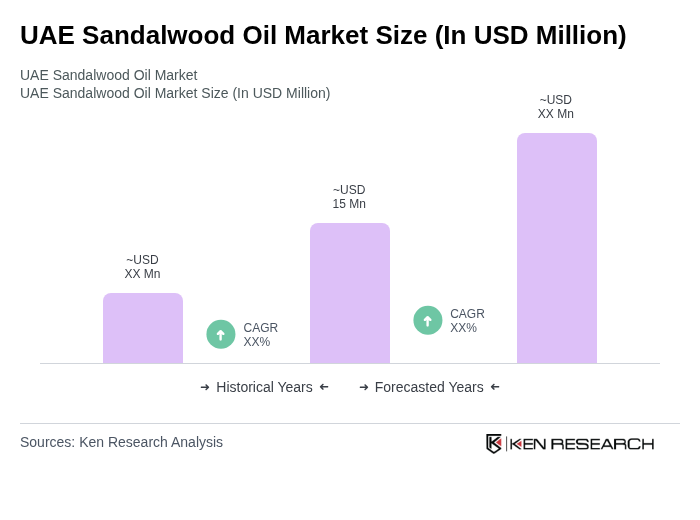
- The UAE Sandalwood Oil Market is valued at USD 15 million, based on a five-year historical analysis. This reflects the UAE's share of the Middle East sandalwood products market, which is driven by the increasing demand for natural and organic products in the cosmetics and personal care sectors, alongside a rising interest in aromatherapy and wellness practices. The market is also supported by the growing awareness of the therapeutic benefits of sandalwood oil, leading to its incorporation in various applications. Recent trends highlight a surge in premium product launches and the expansion of luxury wellness offerings in the UAE, further fueling market growth.
- Key players in this market include Dubai and Abu Dhabi, which dominate due to their strategic locations as trade hubs and robust tourism industries. The high disposable income of consumers in these cities continues to fuel demand for premium products, including sandalwood oil, which is often associated with luxury and quality. Additionally, the cultural significance of sandalwood in the region enhances its market presence. The UAE's retail and hospitality sectors are increasingly integrating sandalwood-based products into spa and wellness services, reflecting broader regional trends in luxury and experiential consumerism.
- In 2023, the UAE government implemented the “Sustainable Plant Trade Regulations, 2023” issued by the Ministry of Climate Change and Environment. This regulation mandates that all sandalwood oil sold in the UAE must be sourced from certified sustainable plantations, with suppliers required to provide documentation of sustainability certification. The regulation aims to protect endangered sandalwood species, ensure traceability, and support environmental conservation efforts, with compliance monitored through regular audits and import controls.
UAE Sandalwood Oil Market Segmentation
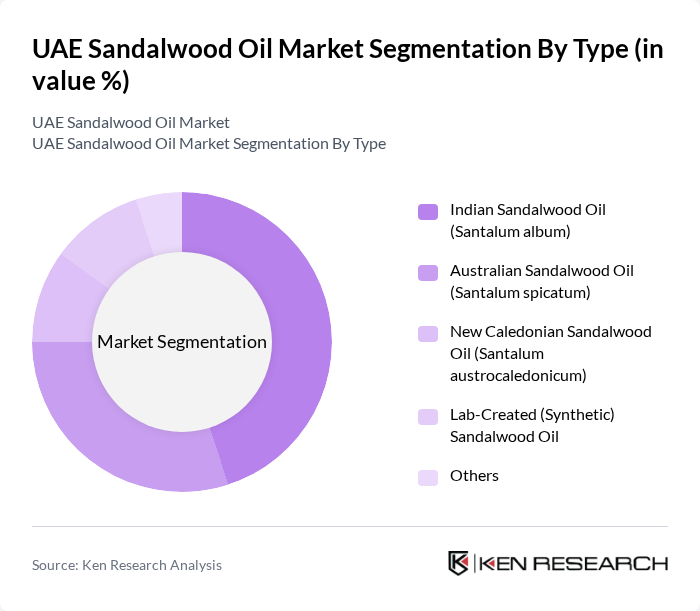
By Type:The market is segmented into various types of sandalwood oil, includingIndian Sandalwood Oil (Santalum album),Australian Sandalwood Oil (Santalum spicatum),New Caledonian Sandalwood Oil (Santalum austrocaledonicum),Lab-Created (Synthetic) Sandalwood Oil, andOthers. Each type offers distinct olfactory profiles and chemical compositions, catering to diverse consumer preferences and industry requirements. Indian Sandalwood Oil is prized for its high alpha-santalol content and traditional use in perfumery and therapeutics, while Australian Sandalwood Oil is favored for its sustainability and woody aroma. Synthetic sandalwood oils are increasingly adopted in mass-market personal care products due to cost-effectiveness and supply stability.
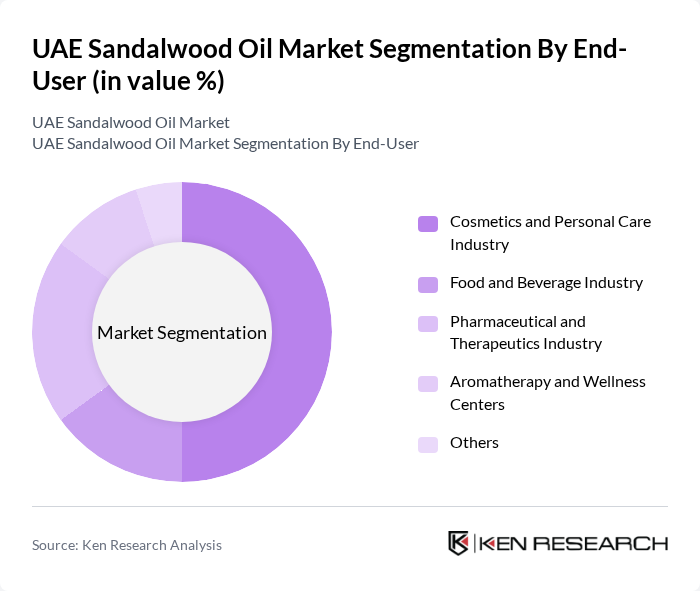
By End-User:The sandalwood oil market is further segmented by end-user industries, includingCosmetics and Personal Care Industry,Food and Beverage Industry,Pharmaceutical and Therapeutics Industry,Aromatherapy and Wellness Centers, andOthers. Cosmetics and personal care remain the dominant segment, driven by the integration of sandalwood oil in luxury skincare, fragrances, and spa products. The pharmaceutical segment leverages sandalwood oil for its anti-inflammatory and antimicrobial properties, while aromatherapy and wellness centers utilize it for relaxation and holistic therapies. The food and beverage segment is niche, primarily involving flavoring and specialty products.
UAE Sandalwood Oil Market Competitive Landscape
The UAE Sandalwood Oil Market is characterized by a dynamic mix of regional and international players. Leading participants such as Quintis (Australia) Pty Ltd., Santanol Group, Essential Oils of New Zealand, Young Living Essential Oils, doTERRA International, AOS Products Pvt. Ltd., Kanta Enterprises Pvt. Ltd., Aromaaz International, The Lebermuth Company, Inc., Givaudan SA, Firmenich SA, Symrise AG, Robertet Group, International Flavors & Fragrances Inc. (IFF), Frutarom Industries Ltd., Katyani Exports, Eden Botanicals, Meena Perfumery, Plant Therapy Essential Oils, R. K. Essential Oils Company contribute to innovation, geographic expansion, and service delivery in this space.
UAE Sandalwood Oil Market Industry Analysis
Growth Drivers
- Increasing Demand for Natural Fragrances:The UAE's fragrance market is projected to reach AED 2.5 billion in future, driven by a growing preference for natural ingredients. Consumers are increasingly seeking products free from synthetic additives, with 70% of fragrance buyers indicating a preference for natural options. This trend is bolstered by the rise of eco-conscious consumers, who are willing to pay a premium for products that align with their values, thus enhancing the demand for sandalwood oil.
- Rising Awareness of Aromatherapy Benefits:The aromatherapy market in the UAE is expected to grow to AED 1.2 billion in future, reflecting a heightened awareness of the therapeutic benefits of essential oils, including sandalwood. Approximately 80% of wellness consumers in the region are integrating aromatherapy into their routines, driven by increased stress levels and a desire for holistic health solutions. This growing interest is propelling the demand for sandalwood oil as a key ingredient in aromatherapy products.
- Expansion of the Cosmetics and Personal Care Industry:The UAE cosmetics market is anticipated to reach AED 12 billion in future, with a significant shift towards natural and organic products. Sandalwood oil is increasingly featured in skincare and haircare formulations due to its anti-inflammatory and moisturizing properties. The rising consumer preference for clean beauty products is driving brands to incorporate sandalwood oil, thus contributing to market growth and diversification in product offerings.
Market Challenges
- High Production Costs:The production of sandalwood oil is characterized by high costs, primarily due to the lengthy cultivation period of sandalwood trees, which can take up to 15 years to mature. Additionally, the extraction process is labor-intensive and requires specialized equipment, leading to production costs that can exceed AED 1,200 per liter. These high costs can limit market entry for new players and affect pricing strategies for existing companies.
- Regulatory Restrictions on Sourcing:The UAE has stringent regulations regarding the sourcing of sandalwood, particularly concerning sustainability and conservation. The Convention on International Trade in Endangered Species (CITES) restricts the trade of certain sandalwood species, impacting supply chains. Companies must navigate complex legal frameworks, which can lead to delays and increased operational costs, ultimately hindering market growth and product availability.
UAE Sandalwood Oil Market Future Outlook
The UAE sandalwood oil market is poised for significant growth, driven by increasing consumer demand for natural and organic products. As the wellness trend continues to gain momentum, the integration of sandalwood oil into various sectors, including cosmetics and aromatherapy, will likely expand. Additionally, advancements in sustainable sourcing practices will enhance the market's resilience, allowing companies to meet regulatory requirements while appealing to eco-conscious consumers. This evolving landscape presents a promising future for the sandalwood oil industry in the UAE.
Market Opportunities
- Expansion into Emerging Markets:The growing middle class in regions such as Southeast Asia presents a lucrative opportunity for UAE sandalwood oil exporters. With an increasing demand for luxury and natural products, tapping into these emerging markets can significantly boost sales and brand visibility, potentially increasing exports by 25% over the next five years.
- Development of Sustainable Sourcing Practices:Implementing sustainable sourcing practices can enhance brand reputation and consumer trust. By investing in eco-friendly cultivation and harvesting methods, companies can differentiate themselves in a competitive market. This approach not only aligns with global sustainability trends but can also lead to cost savings and improved supply chain efficiency, potentially increasing profit margins by 20%.
Scope of the Report
| Segment | Sub-Segments |
|---|---|
| By Type | Indian Sandalwood Oil (Santalum album) Australian Sandalwood Oil (Santalum spicatum) New Caledonian Sandalwood Oil (Santalum austrocaledonicum) Lab-Created (Synthetic) Sandalwood Oil Others |
| By End-User | Cosmetics and Personal Care Industry Food and Beverage Industry Pharmaceutical and Therapeutics Industry Aromatherapy and Wellness Centers Others |
| By Application | Fragrance and Perfume Manufacturing Therapeutic and Medicinal Uses Personal Care Products (Skincare, Haircare) Religious and Cultural Rituals Others |
| By Distribution Channel | Online Retail Offline Retail (Specialty Stores, Pharmacies) Direct Sales (B2B, Institutional) Others |
| By Packaging Type | Glass Bottles Plastic Bottles Bulk Packaging (Drums, Barrels) Others |
| By Region | Abu Dhabi Dubai Sharjah Northern Emirates Others |
| By Price Range | Premium Segment Mid-Range Segment Economy Segment Others |
Key Target Audience
Investors and Venture Capitalist Firms
Government and Regulatory Bodies (e.g., Ministry of Climate Change and Environment, Federal Authority for Food Safety and Security)
Manufacturers and Producers
Distributors and Retailers
Essential Oil and Fragrance Companies
Cosmetic and Personal Care Brands
Natural Product Suppliers
Export and Import Agencies
Players Mentioned in the Report:
Quintis (Australia) Pty Ltd.
Santanol Group
Essential Oils of New Zealand
Young Living Essential Oils
doTERRA International
AOS Products Pvt. Ltd.
Kanta Enterprises Pvt. Ltd.
Aromaaz International
The Lebermuth Company, Inc.
Givaudan SA
Firmenich SA
Symrise AG
Robertet Group
International Flavors & Fragrances Inc. (IFF)
Frutarom Industries Ltd.
Katyani Exports
Eden Botanicals
Meena Perfumery
Plant Therapy Essential Oils
R. K. Essential Oils Company
Table of Contents
Market Assessment Phase
1. Executive Summary and Approach
2. UAE Sandalwood Oil Market Overview
2.1 Key Insights and Strategic Recommendations
2.2 UAE Sandalwood Oil Market Overview
2.3 Definition and Scope
2.4 Evolution of Market Ecosystem
2.5 Timeline of Key Regulatory Milestones
2.6 Value Chain & Stakeholder Mapping
2.7 Business Cycle Analysis
2.8 Policy & Incentive Landscape
3. UAE Sandalwood Oil Market Analysis
3.1 Growth Drivers
3.1.1 Increasing Demand for Natural Fragrances
3.1.2 Rising Awareness of Aromatherapy Benefits
3.1.3 Expansion of the Cosmetics and Personal Care Industry
3.1.4 Growth in the Wellness and Spa Sector
3.2 Market Challenges
3.2.1 High Production Costs
3.2.2 Regulatory Restrictions on Sourcing
3.2.3 Competition from Synthetic Alternatives
3.2.4 Limited Availability of Raw Materials
3.3 Market Opportunities
3.3.1 Expansion into Emerging Markets
3.3.2 Development of Sustainable Sourcing Practices
3.3.3 Innovation in Product Formulations
3.3.4 Collaborations with Luxury Brands
3.4 Market Trends
3.4.1 Increasing Popularity of Organic Products
3.4.2 Growth of E-commerce Platforms
3.4.3 Rising Interest in Sustainable and Ethical Products
3.4.4 Customization and Personalization in Fragrance Products
3.5 Government Regulation
3.5.1 Import and Export Regulations
3.5.2 Environmental Protection Laws
3.5.3 Quality Standards for Essential Oils
3.5.4 Trade Agreements Affecting Sourcing
4. SWOT Analysis
5. Stakeholder Analysis
6. Porter's Five Forces Analysis
7. UAE Sandalwood Oil Market Market Size, 2019-2024
7.1 By Value
7.2 By Volume
7.3 By Average Selling Price
8. UAE Sandalwood Oil Market Segmentation
8.1 By Type
8.1.1 Indian Sandalwood Oil (Santalum album)
8.1.2 Australian Sandalwood Oil (Santalum spicatum)
8.1.3 New Caledonian Sandalwood Oil (Santalum austrocaledonicum)
8.1.4 Lab-Created (Synthetic) Sandalwood Oil
8.1.5 Others
8.2 By End-User
8.2.1 Cosmetics and Personal Care Industry
8.2.2 Food and Beverage Industry
8.2.3 Pharmaceutical and Therapeutics Industry
8.2.4 Aromatherapy and Wellness Centers
8.2.5 Others
8.3 By Application
8.3.1 Fragrance and Perfume Manufacturing
8.3.2 Therapeutic and Medicinal Uses
8.3.3 Personal Care Products (Skincare, Haircare)
8.3.4 Religious and Cultural Rituals
8.3.5 Others
8.4 By Distribution Channel
8.4.1 Online Retail
8.4.2 Offline Retail (Specialty Stores, Pharmacies)
8.4.3 Direct Sales (B2B, Institutional)
8.4.4 Others
8.5 By Packaging Type
8.5.1 Glass Bottles
8.5.2 Plastic Bottles
8.5.3 Bulk Packaging (Drums, Barrels)
8.5.4 Others
8.6 By Region
8.6.1 Abu Dhabi
8.6.2 Dubai
8.6.3 Sharjah
8.6.4 Northern Emirates
8.6.5 Others
8.7 By Price Range
8.7.1 Premium Segment
8.7.2 Mid-Range Segment
8.7.3 Economy Segment
8.7.4 Others
9. UAE Sandalwood Oil Market Competitive Analysis
9.1 Market Share of Key Players
9.2 Cross Comparison of Key Players
9.2.1 Company Name
9.2.2 Group Size (Large, Medium, or Small as per industry convention)
9.2.3 Revenue Growth Rate (CAGR %)
9.2.4 Market Penetration Rate (Share in UAE Sandalwood Oil Market)
9.2.5 Customer Retention Rate (%)
9.2.6 Average Selling Price (USD/kg or AED/kg)
9.2.7 Product Portfolio Breadth (Number of Sandalwood Oil SKUs)
9.2.8 Brand Recognition Index (Survey/Market Score)
9.2.9 Distribution Network Coverage (Number of UAE Retail/Wholesale Points)
9.2.10 R&D/Innovation Intensity (R&D Spend as % of Revenue)
9.3 SWOT Analysis of Top Players
9.4 Pricing Analysis
9.5 Detailed Profile of Major Companies
9.5.1 Quintis (Australia) Pty Ltd.
9.5.2 Santanol Group
9.5.3 Essential Oils of New Zealand
9.5.4 Young Living Essential Oils
9.5.5 doTERRA International
9.5.6 AOS Products Pvt. Ltd.
9.5.7 Kanta Enterprises Pvt. Ltd.
9.5.8 Aromaaz International
9.5.9 The Lebermuth Company, Inc.
9.5.10 Givaudan SA
9.5.11 Firmenich SA
9.5.12 Symrise AG
9.5.13 Robertet Group
9.5.14 International Flavors & Fragrances Inc. (IFF)
9.5.15 Frutarom Industries Ltd.
9.5.16 Katyani Exports
9.5.17 Eden Botanicals
9.5.18 Meena Perfumery
9.5.19 Plant Therapy Essential Oils
9.5.20 R. K. Essential Oils Company
10. UAE Sandalwood Oil Market End-User Analysis
10.1 Procurement Behavior of Key Ministries
10.1.1 Ministry of Health
10.1.2 Ministry of Environment and Water
10.1.3 Ministry of Economy
10.1.4 Others
10.2 Corporate Spend on Infrastructure & Energy
10.2.1 Corporate Investments in Sustainability
10.2.2 Expenditure on Essential Oils
10.2.3 Budget Allocations for R&D
10.2.4 Others
10.3 Pain Point Analysis by End-User Category
10.3.1 Quality Assurance Issues
10.3.2 Supply Chain Disruptions
10.3.3 Cost Management Challenges
10.3.4 Others
10.4 User Readiness for Adoption
10.4.1 Awareness of Benefits
10.4.2 Availability of Products
10.4.3 Training and Support Needs
10.4.4 Others
10.5 Post-Deployment ROI and Use Case Expansion
10.5.1 Measurement of Effectiveness
10.5.2 Customer Feedback Mechanisms
10.5.3 Opportunities for Upselling
10.5.4 Others
11. UAE Sandalwood Oil Market Future Size, 2025-2030
11.1 By Value
11.2 By Volume
11.3 By Average Selling Price
Go-To-Market Strategy Phase
1. Whitespace Analysis + Business Model Canvas
1.1 Market Gaps Identification
1.2 Value Proposition Development
1.3 Revenue Streams Analysis
1.4 Cost Structure Evaluation
1.5 Key Partnerships Exploration
1.6 Customer Segmentation
1.7 Channels of Distribution
2. Marketing and Positioning Recommendations
2.1 Branding Strategies
2.2 Product USPs
3. Distribution Plan
3.1 Urban Retail vs Rural NGO Tie-ups
4. Channel & Pricing Gaps
4.1 Underserved Routes
4.2 Pricing Bands
5. Unmet Demand & Latent Needs
5.1 Category Gaps
5.2 Consumer Segments
6. Customer Relationship
6.1 Loyalty Programs
6.2 After-sales Service
7. Value Proposition
7.1 Sustainability
7.2 Integrated Supply Chains
8. Key Activities
8.1 Regulatory Compliance
8.2 Branding
8.3 Distribution Setup
9. Entry Strategy Evaluation
9.1 Domestic Market Entry Strategy
9.1.1 Product Mix
9.1.2 Pricing Band
9.1.3 Packaging
9.2 Export Entry Strategy
9.2.1 Target Countries
9.2.2 Compliance Roadmap
10. Entry Mode Assessment
10.1 JV
10.2 Greenfield
10.3 M&A
10.4 Distributor Model
11. Capital and Timeline Estimation
11.1 Capital Requirements
11.2 Timelines
12. Control vs Risk Trade-Off
12.1 Ownership vs Partnerships
13. Profitability Outlook
13.1 Breakeven Analysis
13.2 Long-term Sustainability
14. Potential Partner List
14.1 Distributors
14.2 JVs
14.3 Acquisition Targets
15. Execution Roadmap
15.1 Phased Plan for Market Entry
15.1.1 Market Setup
15.1.2 Market Entry
15.1.3 Growth Acceleration
15.1.4 Scale & Stabilize
15.2 Key Activities and Milestones
15.2.1 Milestone Planning
15.2.2 Activity Tracking
Research Methodology
Phase 1: Approach1
Desk Research
- Market reports from industry associations and trade bodies focused on essential oils
- Analysis of import/export data from UAE customs and trade statistics
- Review of academic journals and publications on sandalwood oil extraction and applications
Primary Research
- Interviews with key stakeholders in the fragrance and cosmetics industries
- Surveys targeting distributors and retailers of essential oils in the UAE
- Field interviews with producers and suppliers of sandalwood oil
Validation & Triangulation
- Cross-validation of findings through multiple data sources including trade publications
- Triangulation of market size estimates from both primary and secondary research
- Sanity checks conducted through expert panels comprising industry veterans
Phase 2: Market Size Estimation1
Top-down Assessment
- Estimation of market size based on overall essential oil market growth in the UAE
- Segmentation of sandalwood oil demand by application sectors such as cosmetics and aromatherapy
- Incorporation of regional trends and consumer preferences in fragrance products
Bottom-up Modeling
- Volume estimates derived from production capacities of local sandalwood oil manufacturers
- Pricing analysis based on retail and wholesale price points in the UAE market
- Calculation of market size using volume x price methodology for sandalwood oil
Forecasting & Scenario Analysis
- Multi-variable forecasting considering factors like consumer trends and regulatory impacts
- Scenario analysis based on potential changes in import tariffs and sustainability initiatives
- Development of baseline, optimistic, and pessimistic market projections through 2030
Phase 3: CATI Sample Composition1
| Scope Item/Segment | Sample Size | Target Respondent Profiles |
|---|---|---|
| Cosmetics Industry Insights | 60 | Product Managers, Brand Directors |
| Aromatherapy Market Trends | 50 | Wellness Practitioners, Retail Owners |
| Fragrance Manufacturing Processes | 40 | Production Managers, Quality Control Specialists |
| Essential Oil Distribution Channels | 45 | Supply Chain Managers, Distribution Executives |
| Consumer Preferences in Fragrance | 55 | Market Researchers, Consumer Insights Analysts |
Frequently Asked Questions
What is the current value of the UAE Sandalwood Oil Market?
The UAE Sandalwood Oil Market is valued at approximately USD 15 million, reflecting its share of the Middle East sandalwood products market, which is driven by increasing demand for natural and organic products in cosmetics and wellness sectors.
What are the key drivers of growth in the UAE Sandalwood Oil Market?
Which cities dominate the UAE Sandalwood Oil Market?
What regulations govern the sourcing of sandalwood oil in the UAE?
Other Regional/Country Reports
Indonesia Sandalwood Oil Market
Malaysia Sandalwood Oil Market
KSA Sandalwood Oil Market
APAC Sandalwood Oil Market
SEA Sandalwood Oil Market
Vietnam Sandalwood Oil Market
Other Adjacent Reports
Bahrain Wellness and Spa Market
Thailand Pharmaceutical Ingredients Market
Global Natural Extracts Market Size, Share, Growth Drivers, Trends, Opportunities & Forecast 2025–2030South Korea Herbal Products Market
Egypt Luxury Beauty Market
Philippines Organic Skincare Market
Why Buy From Us?

What makes us stand out is that our consultants follow Robust, Refine and Result (RRR) methodology. Robust for clear definitions, approaches and sanity checking, Refine for differentiating respondents' facts and opinions, and Result for presenting data with story.

We have set a benchmark in the industry by offering our clients with syndicated and customized market research reports featuring coverage of entire market as well as meticulous research and analyst insights.

While we don't replace traditional research, we flip the method upside down. Our dual approach of Top Bottom & Bottom Top ensures quality deliverable by not just verifying company fundamentals but also looking at the sector and macroeconomic factors.

With one step in the future, our research team constantly tries to show you the bigger picture. We help with some of the tough questions you may encounter along the way: How is the industry positioned? Best marketing channel? KPI's of competitors? By aligning every element, we help maximize success.

Our report gives you instant access to the answers and sources that other companies might choose to hide. We elaborate each steps of research methodology we have used and showcase you the sample size to earn your trust.

If you need any support, we are here! We pride ourselves on universe strength, data quality, and quick, friendly, and professional service.