Region:Europe
Author(s):Geetanshi
Product Code:KRAB3368
Pages:89
Published On:October 2025
By Technology:The technology segment encompasses various methods employed for carbon capture, including post-combustion capture, pre-combustion capture, oxy-fuel combustion capture, and direct air capture. Each method has its unique applications and efficiencies, catering to different industrial needs. Post-combustion capture remains the most widely adopted due to its retrofitting capability across existing industrial plants, while pre-combustion and oxy-fuel technologies are gaining traction in sectors with high-purity CO? streams. Direct air capture, though still emerging, is being piloted for its potential in achieving negative emissions.
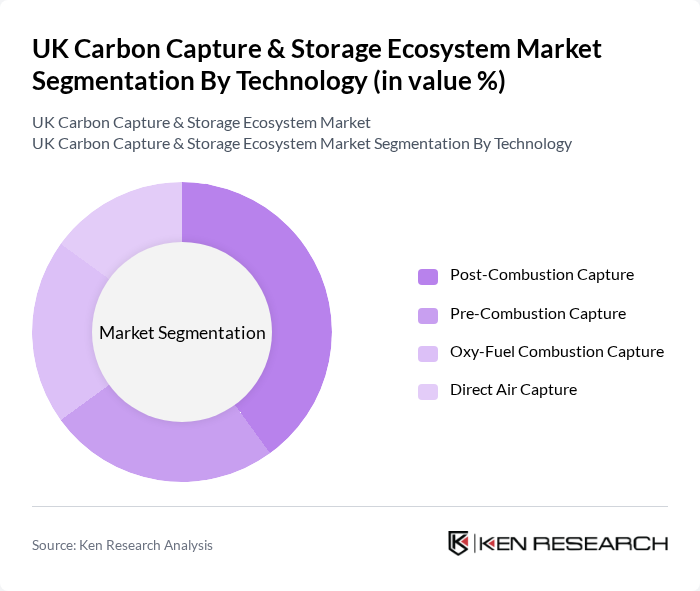
The post-combustion capture method is currently the dominant technology in the market, primarily due to its applicability across various industries, including power generation and manufacturing. This method allows for the retrofitting of existing plants, making it a cost-effective solution for many operators. The increasing regulatory pressure to reduce emissions further drives its adoption, as companies seek to comply with environmental standards while maintaining operational efficiency.
By End-User Industry:The end-user industry segment includes key sectors such as oil and gas, power generation, iron and steel, chemical and petrochemical, cement, and manufacturing. Each sector has distinct requirements and challenges regarding carbon emissions and capture technologies. The oil and gas sector leads in adoption, driven by the need to mitigate emissions from fossil fuel extraction and processing, followed by power generation, which is a major contributor to CO? emissions. Industrial clusters in Teesside and Humber exemplify collaborative efforts to decarbonize hard-to-abate sectors, with catalytic conversion and pre-combustion technologies showing particular promise for scalability and economic viability.
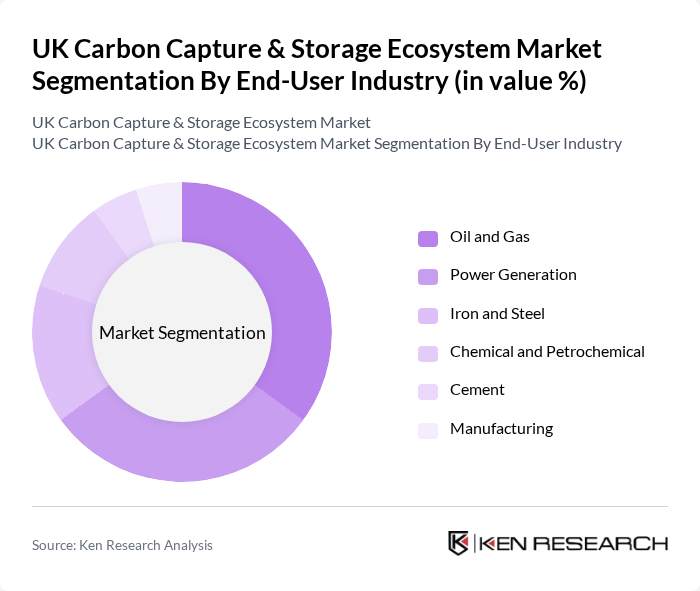
The oil and gas industry is the leading end-user of carbon capture technologies, driven by the need to mitigate emissions from fossil fuel extraction and processing. This sector is under significant scrutiny due to its environmental impact, prompting companies to invest in carbon capture solutions to enhance sustainability. Additionally, the power generation sector follows closely, as it is a major contributor to CO? emissions, making it a focal point for carbon capture initiatives.
The UK Carbon Capture & Storage Ecosystem Market is characterized by a dynamic mix of regional and international players. Leading participants such as BP plc, Shell plc, Equinor ASA, Linde plc, Schlumberger Limited, Exxon Mobil Corporation, Honeywell International Inc., Fluor Corporation, Drax Group plc, Storegga Geotechnologies Limited, Carbon Clean Solutions Limited, Aker Solutions ASA, Mitsubishi Heavy Industries, Ltd., Air Products and Chemicals, Inc., Progressive Energy Limited contribute to innovation, geographic expansion, and service delivery in this space.
The future of the UK Carbon Capture & Storage ecosystem appears promising, driven by increasing regulatory support and technological innovations. In future, the integration of AI and big data analytics is expected to optimize CCS operations, enhancing efficiency and reducing costs. Additionally, the focus on a circular economy will likely encourage industries to adopt sustainable practices, further propelling the demand for CCS solutions. As public awareness of climate change grows, the market is poised for significant advancements and investments.
| Segment | Sub-Segments |
|---|---|
| By Technology | Post-Combustion Capture Pre-Combustion Capture Oxy-Fuel Combustion Capture Direct Air Capture |
| By End-User Industry | Oil and Gas Power Generation Iron and Steel Chemical and Petrochemical Cement Manufacturing |
| By Services | Capture Transportation Utilization Storage |
| By Storage Type | Depleted Oil and Gas Reservoirs Saline Aquifers Unminable Coal Seams Enhanced Oil Recovery |
| By Project Scale | Large Scale Industrial Clusters Medium Scale Projects Small Scale and Pilot Projects |
| By Utilization Technology | Catalytic Conversion CO2-to-Fuel Pathways Carbon-to-Chemicals Concrete and Building Materials |
| By Regional Clusters | HyNet North West Net Zero Teesside Acorn Scotland Zero Carbon Humber |
| Scope Item/Segment | Sample Size | Target Respondent Profiles |
|---|---|---|
| Industrial Carbon Capture Projects | 45 | Project Managers, Environmental Engineers |
| Power Generation CCS Initiatives | 40 | Energy Analysts, Operations Directors |
| Government Policy Makers on CCS | 35 | Regulatory Affairs Specialists, Policy Advisors |
| Research Institutions Focused on CCS | 30 | Research Scientists, Academic Professors |
| Technology Providers in CCS | 40 | Business Development Managers, Technical Experts |
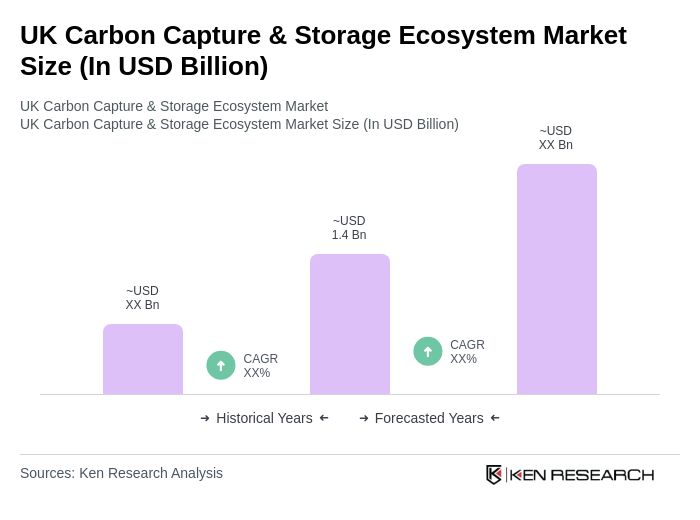
The UK Carbon Capture & Storage Ecosystem Market is valued at approximately USD 1.4 billion, reflecting significant growth driven by government initiatives and investments in sustainable technologies aimed at reducing carbon emissions.

What makes us stand out is that our consultants follow Robust, Refine and Result (RRR) methodology. Robust for clear definitions, approaches and sanity checking, Refine for differentiating respondents' facts and opinions, and Result for presenting data with story.

We have set a benchmark in the industry by offering our clients with syndicated and customized market research reports featuring coverage of entire market as well as meticulous research and analyst insights.

While we don't replace traditional research, we flip the method upside down. Our dual approach of Top Bottom & Bottom Top ensures quality deliverable by not just verifying company fundamentals but also looking at the sector and macroeconomic factors.

With one step in the future, our research team constantly tries to show you the bigger picture. We help with some of the tough questions you may encounter along the way: How is the industry positioned? Best marketing channel? KPI's of competitors? By aligning every element, we help maximize success.

Our report gives you instant access to the answers and sources that other companies might choose to hide. We elaborate each steps of research methodology we have used and showcase you the sample size to earn your trust.

If you need any support, we are here! We pride ourselves on universe strength, data quality, and quick, friendly, and professional service.













