About the Report
Base Year 2024United Arab Emirates Fuel Injection Systems Market Overview
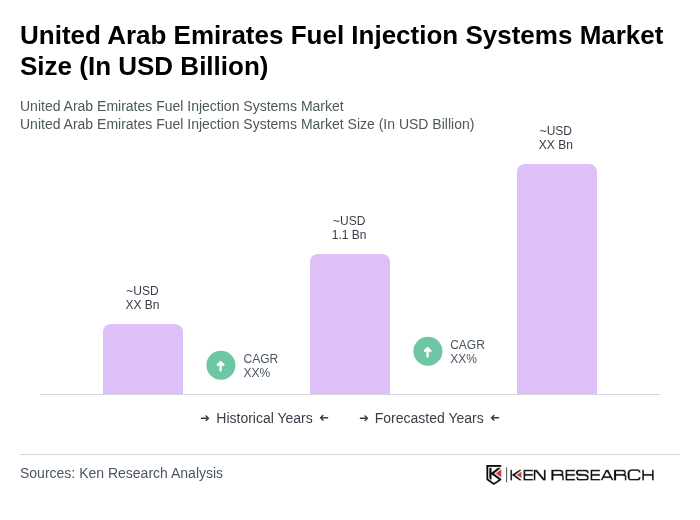
- The United Arab Emirates Fuel Injection Systems Market is valued at USD 1.1 billion, based on a five-year historical analysis of regional demand for automotive fuel delivery and injection components within the broader UAE automotive fuel delivery system market.This growth is primarily driven by the increasing demand for fuel-efficient vehicles and the progressive tightening of emission-related performance requirements, which necessitate advanced fuel injection technologies.The automotive sector's expansion, coupled with rising consumer preferences for high-performance and premium vehicles in the UAE, has further propelled market growth.
- Key cities such as Dubai and Abu Dhabi dominate the market due to their status as economic hubs with a high concentration of vehicle parc, distributors, and service networks rather than local OEM manufacturing.The presence of robust road and fuel-distribution infrastructure, coupled with a growing vehicle fleet that reached more than 4.5 million registered units by mid‑decade, rising disposable incomes, and high car-ownership rates, has led to increased vehicle usage and, consequently, a higher demand for fuel injection systems and related aftermarket components.
- The UAE government has strengthened emissions and fuel-economy requirements for new light vehicles through measures such as the Corporate Average Fuel Economy (CAFE) Regulation for Light-Duty Vehicles issued by the Emirates Authority for Standardization and Metrology (now MoIAT) and the Gulf Standardization Organization’s GSO 42/2017 and related standards on motor vehicle emissions, which are applied in the UAE.These binding rules drive the adoption of more efficient, electronically controlled fuel injection technologies in new vehicles to support national air-quality and decarbonization objectives.
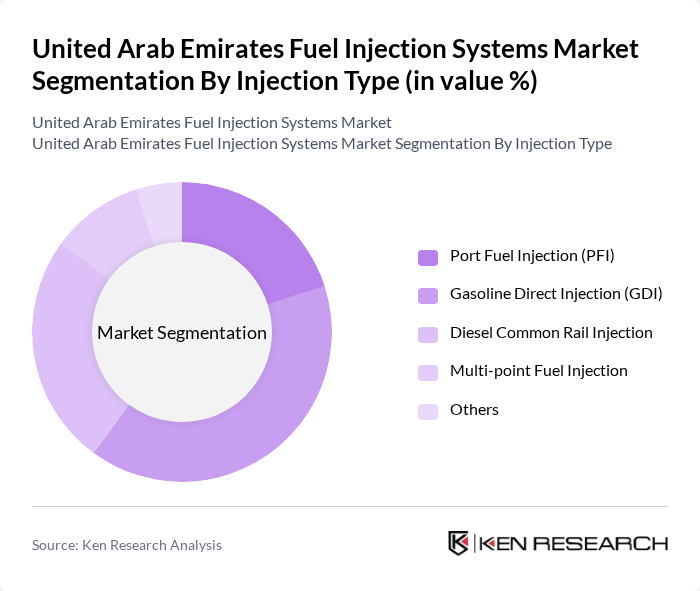
United Arab Emirates Fuel Injection Systems Market Segmentation
By Injection Type:The segmentation by injection type includes various technologies such as Port Fuel Injection (PFI), Gasoline Direct Injection (GDI), Diesel Common Rail Injection, Multi-point Fuel Injection, and others. GDI and advanced diesel common-rail systems are increasingly preferred in new platforms because they support higher injection pressures, precise metering, and better atomization, which enhance fuel economy and lower regulated pollutants and CO₂ emissions.Among these, Gasoline Direct Injection (GDI) is a leading sub-segment in the UAE light-vehicle fleet as it enables downsized turbocharged gasoline engines that deliver both performance and efficiency, aligning with consumer demand for high-performance vehicles and OEM compliance with fuel-economy norms.
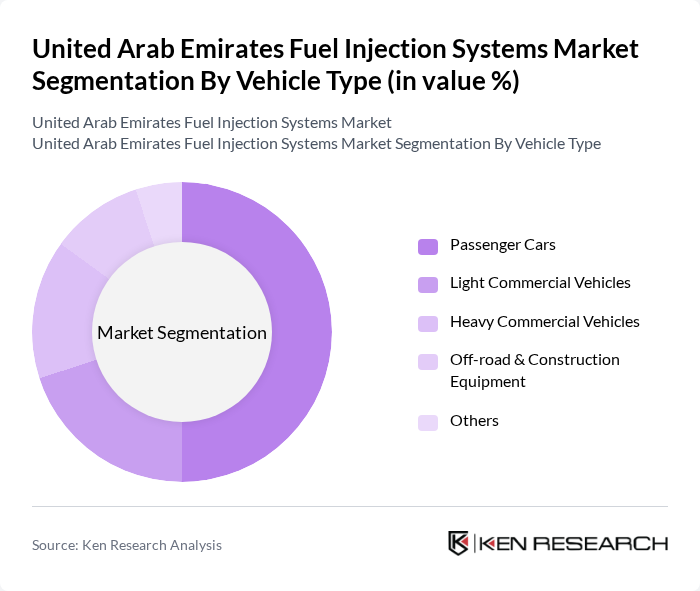
By Vehicle Type:The vehicle type segmentation encompasses Passenger Cars, Light Commercial Vehicles, Heavy Commercial Vehicles, Off-road & Construction Equipment, and others. The Passenger Cars segment is the most significant contributor to the market, reflecting the dominance of private cars and SUVs in the UAE vehicle parc and fuel consumption mix.Increasing consumer preference for personal mobility, high ownership of premium and sport-utility models, and ongoing urbanization in Dubai, Abu Dhabi, and Sharjah underpin this segment. Rising disposable income and a strong focus on fuel-efficient and low-emission vehicles, including turbocharged gasoline and modern diesel platforms, have further bolstered this segment's demand for advanced fuel injection systems.
United Arab Emirates Fuel Injection Systems Market Competitive Landscape
The United Arab Emirates Fuel Injection Systems Market is characterized by a dynamic mix of regional and international players. Leading participants such as Robert Bosch GmbH, Denso Corporation, Delphi Technologies (BorgWarner Inc.), Continental AG, Marelli Holdings Co., Ltd., Zexel Corporation, Siemens AG, Hitachi Astemo, Ltd., Parker Hannifin Corporation, Woodward, Inc., Standard Motor Products, Inc., Aisin Corporation, Valeo SA, Eaton Corporation plc, Infineon Technologies AG contribute to innovation, geographic expansion, and service delivery in this space.
United Arab Emirates Fuel Injection Systems Market Industry Analysis
Growth Drivers
- Increasing Demand for Fuel-Efficient Vehicles:The UAE's automotive sector is witnessing a significant shift towards fuel-efficient vehicles, driven by rising fuel prices and environmental concerns. In future, the demand for fuel-efficient vehicles is projected to reach 300,000 units, reflecting a 15% increase from the previous year. This trend is supported by the UAE's commitment to reducing carbon emissions by approximately 30% in future under its National Climate Change Plan, thereby boosting the fuel injection systems market.
- Technological Advancements in Fuel Injection Systems:The fuel injection systems market in the UAE is benefiting from rapid technological advancements, including the development of direct injection and multi-port fuel injection systems. In future, investments in R&D for these technologies are expected to exceed AED 500 million, enhancing performance and efficiency. This innovation is crucial as the UAE aims to position itself as a leader in automotive technology, aligning with its Vision 2021 goals for sustainable development.
- Government Initiatives Promoting Cleaner Fuels:The UAE government is actively promoting cleaner fuel technologies through various initiatives, including the introduction of the UAE Fuel Quality Standards. By future, the government plans to invest AED 1 billion in infrastructure to support cleaner fuel adoption. This initiative is expected to increase the market for advanced fuel injection systems, as manufacturers adapt to meet the new standards, thereby enhancing overall vehicle efficiency and reducing emissions.
Market Challenges
- High Initial Investment Costs:One of the significant challenges facing the fuel injection systems market in the UAE is the high initial investment required for advanced technologies. In future, the average cost of implementing new fuel injection systems is estimated at AED 200 million per manufacturer. This financial barrier can deter smaller companies from entering the market, limiting competition and innovation, which is essential for growth in this sector.
- Stringent Regulatory Requirements:The fuel injection systems market is also challenged by stringent regulatory requirements imposed by the UAE government. Compliance with the new emission standards, which are expected to be enforced in future, requires significant modifications to existing systems. The cost of compliance is projected to reach AED 150 million for major manufacturers, creating a financial strain that could hinder market growth and innovation in the sector.
United Arab Emirates Fuel Injection Systems Market Future Outlook
The future of the fuel injection systems market in the UAE appears promising, driven by technological advancements and a growing emphasis on sustainability. As the automotive industry increasingly adopts hybrid and electric vehicles, the demand for innovative fuel injection technologies will rise. Additionally, the government's commitment to cleaner fuels and emissions reduction will further stimulate market growth. Collaborations between manufacturers and technology providers are expected to enhance product offerings, ensuring the market remains competitive and aligned with global trends.
Market Opportunities
- Expansion of Electric Vehicle Market:The UAE's electric vehicle market is projected to grow significantly in future, with sales expected to reach 50,000 units. This growth presents opportunities for fuel injection system manufacturers to innovate and adapt their technologies for hybrid applications, ensuring they remain relevant in a rapidly changing automotive landscape.
- Growth in Aftermarket Services:The aftermarket services sector for fuel injection systems is anticipated to expand, with revenues expected to hit AED 300 million in future. This growth is driven by increasing vehicle ownership and the need for maintenance services, providing manufacturers with opportunities to enhance customer engagement and service offerings.
Scope of the Report
| Segment | Sub-Segments |
|---|---|
| By Injection Type | Port Fuel Injection (PFI) Gasoline Direct Injection (GDI) Diesel Common Rail Injection Multi-point Fuel Injection Others |
| By Vehicle Type | Passenger Cars Light Commercial Vehicles Heavy Commercial Vehicles Off-road & Construction Equipment Others |
| By Fuel Type | Gasoline Diesel Alternative Fuels (CNG/LPG, Biofuels, Hydrogen) Others |
| By Component | Injectors Fuel Pumps (Low-pressure & High-pressure) Electronic Control Units (ECU) Sensors & Valves Fuel Rails & Lines Others |
| By Sales Channel | OEM Aftermarket – Organized Aftermarket – Independent Garages Online & E-commerce Others |
| By Application | On-road Automotive Off-road (Agriculture, Construction & Mining) Marine Power Generation & Industrial Engines Others |
| By Region | Abu Dhabi Dubai Sharjah Northern Emirates (Ajman, UAQ, RAK, Fujairah) Others |
Key Target Audience
Investors and Venture Capitalist Firms
Government and Regulatory Bodies (e.g., Ministry of Energy and Infrastructure, Federal Authority for Nuclear Regulation)
Manufacturers and Producers
Distributors and Retailers
Automotive OEMs (Original Equipment Manufacturers)
Aftermarket Service Providers
Industry Associations (e.g., Emirates Authority for Standardization and Metrology)
Financial Institutions
Players Mentioned in the Report:
Robert Bosch GmbH
Denso Corporation
Delphi Technologies (BorgWarner Inc.)
Continental AG
Marelli Holdings Co., Ltd.
Zexel Corporation
Siemens AG
Hitachi Astemo, Ltd.
Parker Hannifin Corporation
Woodward, Inc.
Standard Motor Products, Inc.
Aisin Corporation
Valeo SA
Eaton Corporation plc
Infineon Technologies AG
Table of Contents
Market Assessment Phase
1. Executive Summary and Approach
2. United Arab Emirates Fuel Injection Systems Market Overview
2.1 Key Insights and Strategic Recommendations
2.2 United Arab Emirates Fuel Injection Systems Market Overview
2.3 Definition and Scope
2.4 Evolution of Market Ecosystem
2.5 Timeline of Key Regulatory Milestones
2.6 Value Chain & Stakeholder Mapping
2.7 Business Cycle Analysis
2.8 Policy & Incentive Landscape
3. United Arab Emirates Fuel Injection Systems Market Analysis
3.1 Growth Drivers
3.1.1 Increasing demand for fuel-efficient vehicles
3.1.2 Technological advancements in fuel injection systems
3.1.3 Government initiatives promoting cleaner fuels
3.1.4 Rising automotive production in the UAE
3.2 Market Challenges
3.2.1 High initial investment costs
3.2.2 Stringent regulatory requirements
3.2.3 Competition from alternative fuel technologies
3.2.4 Supply chain disruptions
3.3 Market Opportunities
3.3.1 Expansion of electric vehicle market
3.3.2 Growth in aftermarket services
3.3.3 Increasing focus on R&D for advanced systems
3.3.4 Collaborations with automotive manufacturers
3.4 Market Trends
3.4.1 Shift towards hybrid fuel systems
3.4.2 Integration of IoT in fuel injection systems
3.4.3 Growing emphasis on sustainability
3.4.4 Rise in consumer awareness regarding fuel efficiency
3.5 Government Regulation
3.5.1 Emission standards for vehicles
3.5.2 Incentives for adopting cleaner technologies
3.5.3 Regulations on fuel quality
3.5.4 Safety standards for automotive components
4. SWOT Analysis
5. Stakeholder Analysis
6. Porter's Five Forces Analysis
7. United Arab Emirates Fuel Injection Systems Market Market Size, 2019-2024
7.1 By Value
7.2 By Volume
7.3 By Average Selling Price
8. United Arab Emirates Fuel Injection Systems Market Segmentation
8.1 By Injection Type
8.1.1 Port Fuel Injection (PFI)
8.1.2 Gasoline Direct Injection (GDI)
8.1.3 Diesel Common Rail Injection
8.1.4 Multi-point Fuel Injection
8.1.5 Others
8.2 By Vehicle Type
8.2.1 Passenger Cars
8.2.2 Light Commercial Vehicles
8.2.3 Heavy Commercial Vehicles
8.2.4 Off-road & Construction Equipment
8.2.5 Others
8.3 By Fuel Type
8.3.1 Gasoline
8.3.2 Diesel
8.3.3 Alternative Fuels (CNG/LPG, Biofuels, Hydrogen)
8.3.4 Others
8.4 By Component
8.4.1 Injectors
8.4.2 Fuel Pumps (Low-pressure & High-pressure)
8.4.3 Electronic Control Units (ECU)
8.4.4 Sensors & Valves
8.4.5 Fuel Rails & Lines
8.4.6 Others
8.5 By Sales Channel
8.5.1 OEM
8.5.2 Aftermarket – Organized
8.5.3 Aftermarket – Independent Garages
8.5.4 Online & E-commerce
8.5.5 Others
8.6 By Application
8.6.1 On-road Automotive
8.6.2 Off-road (Agriculture, Construction & Mining)
8.6.3 Marine
8.6.4 Power Generation & Industrial Engines
8.6.5 Others
8.7 By Region
8.7.1 Abu Dhabi
8.7.2 Dubai
8.7.3 Sharjah
8.7.4 Northern Emirates (Ajman, UAQ, RAK, Fujairah)
8.7.5 Others
9. United Arab Emirates Fuel Injection Systems Market Competitive Analysis
9.1 Market Share of Key Players
9.2 Cross Comparison of Key Players
9.2.1 Company Name
9.2.2 UAE Fuel Injection Systems Revenue (USD Million)
9.2.3 3-year CAGR in UAE Market Revenue
9.2.4 EBITDA Margin from UAE Operations (%)
9.2.5 Market Share in UAE Fuel Injection Systems (%)
9.2.6 Average Selling Price Index vs Market
9.2.7 R&D Intensity (% of Global Revenue)
9.2.8 New Product Launches in Last 3 Years (Number)
9.2.9 Key OEM Relationships in the UAE / GCC (Number)
9.2.10 Local Assembly / Localization Level (%)
9.2.11 Aftermarket Network Coverage (Workshops / Outlets)
9.2.12 On-time Delivery Performance (%)
9.2.13 Warranty Claim Rate (%)
9.2.14 ESG / Sustainability Rating (If Available)
9.3 SWOT Analysis of Top Players
9.4 Pricing Analysis
9.5 Detailed Profile of Major Companies
9.5.1 Robert Bosch GmbH
9.5.2 Denso Corporation
9.5.3 Delphi Technologies (BorgWarner Inc.)
9.5.4 Continental AG
9.5.5 Marelli Holdings Co., Ltd.
9.5.6 Zexel Corporation
9.5.7 Siemens AG
9.5.8 Hitachi Astemo, Ltd.
9.5.9 Parker Hannifin Corporation
9.5.10 Woodward, Inc.
9.5.11 Standard Motor Products, Inc.
9.5.12 Aisin Corporation
9.5.13 Valeo SA
9.5.14 Eaton Corporation plc
9.5.15 Infineon Technologies AG
10. United Arab Emirates Fuel Injection Systems Market End-User Analysis
10.1 Procurement Behavior of Key Ministries
10.1.1 Ministry of Energy and Infrastructure
10.1.2 Ministry of Economy
10.1.3 Ministry of Climate Change and Environment
10.1.4 Others
10.2 Corporate Spend on Infrastructure & Energy
10.2.1 Automotive Sector Investments
10.2.2 Energy Efficiency Programs
10.2.3 Infrastructure Development Projects
10.2.4 Others
10.3 Pain Point Analysis by End-User Category
10.3.1 Automotive Manufacturers
10.3.2 Fleet Operators
10.3.3 Aftermarket Service Providers
10.3.4 Others
10.4 User Readiness for Adoption
10.4.1 Awareness of Fuel Injection Technologies
10.4.2 Training and Skill Development
10.4.3 Financial Readiness
10.4.4 Others
10.5 Post-Deployment ROI and Use Case Expansion
10.5.1 Performance Metrics
10.5.2 Cost Savings Analysis
10.5.3 User Feedback and Adaptation
10.5.4 Others
11. United Arab Emirates Fuel Injection Systems Market Future Size, 2025-2030
11.1 By Value
11.2 By Volume
11.3 By Average Selling Price
Go-To-Market Strategy Phase
1. Whitespace Analysis + Business Model Canvas
1.1 Market Gaps Identification
1.2 Business Model Framework
2. Marketing and Positioning Recommendations
2.1 Branding Strategies
2.2 Product USPs
3. Distribution Plan
3.1 Urban Retail Strategies
3.2 Rural NGO Tie-ups
4. Channel & Pricing Gaps
4.1 Underserved Routes
4.2 Pricing Bands
5. Unmet Demand & Latent Needs
5.1 Category Gaps
5.2 Consumer Segments
6. Customer Relationship
6.1 Loyalty Programs
6.2 After-sales Service
7. Value Proposition
7.1 Sustainability Initiatives
7.2 Integrated Supply Chains
8. Key Activities
8.1 Regulatory Compliance
8.2 Branding
8.3 Distribution Setup
9. Entry Strategy Evaluation
9.1 Domestic Market Entry Strategy
9.1.1 Product Mix
9.1.2 Pricing Band
9.1.3 Packaging
9.2 Export Entry Strategy
9.2.1 Target Countries
9.2.2 Compliance Roadmap
10. Entry Mode Assessment
10.1 Joint Ventures
10.2 Greenfield Investments
10.3 Mergers & Acquisitions
10.4 Distributor Model
11. Capital and Timeline Estimation
11.1 Capital Requirements
11.2 Timelines
12. Control vs Risk Trade-Off
12.1 Ownership vs Partnerships
13. Profitability Outlook
13.1 Breakeven Analysis
13.2 Long-term Sustainability
14. Potential Partner List
14.1 Distributors
14.2 Joint Ventures
14.3 Acquisition Targets
15. Execution Roadmap
15.1 Phased Plan for Market Entry
15.1.1 Market Setup
15.1.2 Market Entry
15.1.3 Growth Acceleration
15.1.4 Scale & Stabilize
15.2 Key Activities and Milestones
15.2.1 Milestone Planning
15.2.2 Activity Tracking
Research Methodology
Phase 1: Approach1
Desk Research
- Industry reports from the UAE Ministry of Energy and Infrastructure
- Market analysis publications from regional automotive associations
- Technical papers and whitepapers on fuel injection technologies
Primary Research
- Interviews with engineers and product managers at fuel injection system manufacturers
- Surveys with automotive service center owners and technicians
- Focus groups with automotive industry experts and analysts
Validation & Triangulation
- Cross-validation of data from multiple industry sources and reports
- Triangulation of insights from primary interviews and secondary data
- Sanity checks through expert panel discussions and feedback
Phase 2: Market Size Estimation1
Top-down Assessment
- Analysis of national automotive sales data to estimate fuel injection system demand
- Segmentation of the market by vehicle type and fuel type
- Incorporation of government initiatives promoting fuel efficiency and emissions reduction
Bottom-up Modeling
- Volume estimates based on production data from local automotive manufacturers
- Cost analysis of fuel injection systems across different vehicle segments
- Estimation of aftermarket sales based on service and repair trends
Forecasting & Scenario Analysis
- Multi-variable forecasting using historical sales data and economic indicators
- Scenario analysis based on potential regulatory changes and technological advancements
- Development of baseline, optimistic, and pessimistic market growth projections through 2030
Phase 3: CATI Sample Composition1
| Scope Item/Segment | Sample Size | Target Respondent Profiles |
|---|---|---|
| Passenger Vehicle Fuel Injection Systems | 120 | Automotive Engineers, Product Development Managers |
| Commercial Vehicle Fuel Injection Systems | 90 | Fleet Managers, Procurement Specialists |
| Aftermarket Fuel Injection Solutions | 80 | Service Center Owners, Automotive Technicians |
| Hybrid and Electric Vehicle Systems | 60 | R&D Managers, Sustainability Officers |
| Fuel Injection System Components | 70 | Supply Chain Managers, Quality Control Inspectors |
Frequently Asked Questions
What is the current value of the United Arab Emirates Fuel Injection Systems Market?
The United Arab Emirates Fuel Injection Systems Market is valued at approximately USD 1.1 billion, reflecting a significant demand for automotive fuel delivery and injection components driven by the need for fuel-efficient vehicles and stringent emission regulations.
What factors are driving the growth of the fuel injection systems market in the UAE?
Which cities in the UAE dominate the fuel injection systems market?
What are the main types of fuel injection systems used in the UAE?
Other Regional/Country Reports
Other Adjacent Reports
Mexico Automotive Fuel Delivery Market
Malaysia Emission Control Systems Market
Indonesia Engine Management Systems Market
Kuwait Turbocharger Systems Market
Thailand Diesel Engine Components Market
Egypt Gasoline Engine Components Market
Kuwait Automotive Electronics (ECUs, Sensors, Controllers) Market Size, Share, Growth Drivers, Trends, Opportunities, Competitive Landscape & Forecast 2025–2030Mexico Vehicle Aftermarket Services Market
South Africa Hybrid Powertrain Systems Market
Japan Electric Vehicle Components Market
Why Buy From Us?

What makes us stand out is that our consultants follow Robust, Refine and Result (RRR) methodology. Robust for clear definitions, approaches and sanity checking, Refine for differentiating respondents' facts and opinions, and Result for presenting data with story.

We have set a benchmark in the industry by offering our clients with syndicated and customized market research reports featuring coverage of entire market as well as meticulous research and analyst insights.

While we don't replace traditional research, we flip the method upside down. Our dual approach of Top Bottom & Bottom Top ensures quality deliverable by not just verifying company fundamentals but also looking at the sector and macroeconomic factors.

With one step in the future, our research team constantly tries to show you the bigger picture. We help with some of the tough questions you may encounter along the way: How is the industry positioned? Best marketing channel? KPI's of competitors? By aligning every element, we help maximize success.

Our report gives you instant access to the answers and sources that other companies might choose to hide. We elaborate each steps of research methodology we have used and showcase you the sample size to earn your trust.

If you need any support, we are here! We pride ourselves on universe strength, data quality, and quick, friendly, and professional service.