About the Report
Base Year 2024Listen to the audio summary
United States Automotive Service Market Overview
- The United States Automotive Service Market is valued at USD 190 billion, based on a five-year historical analysis. This value reflects the sustained expansion of the service/aftermarket sector as vehicle parc grows and vehicles remain in operation longer, which lifts demand for maintenance and repair services .
- Key cities such as Los Angeles, New York, and Chicago account for substantial service activity due to high populations, dense vehicle ownership, and extensive networks of franchised dealers and independent service locations; these urban markets host large dealership groups and national chains that concentrate service capacity and offer comprehensive service menus .
- Recent policy tightening on emissions and fuel economy at the federal and state levels (e.g., EPA greenhouse-gas standards and state zero-emission-vehicle programs) is prompting greater focus on compliant service procedures, diagnostics, and fluids/parts selection, aligning service providers with lower-emission and electrified vehicle requirements; this trend is cited among market growth drivers in industry analyses .

United States Automotive Service Market Segmentation
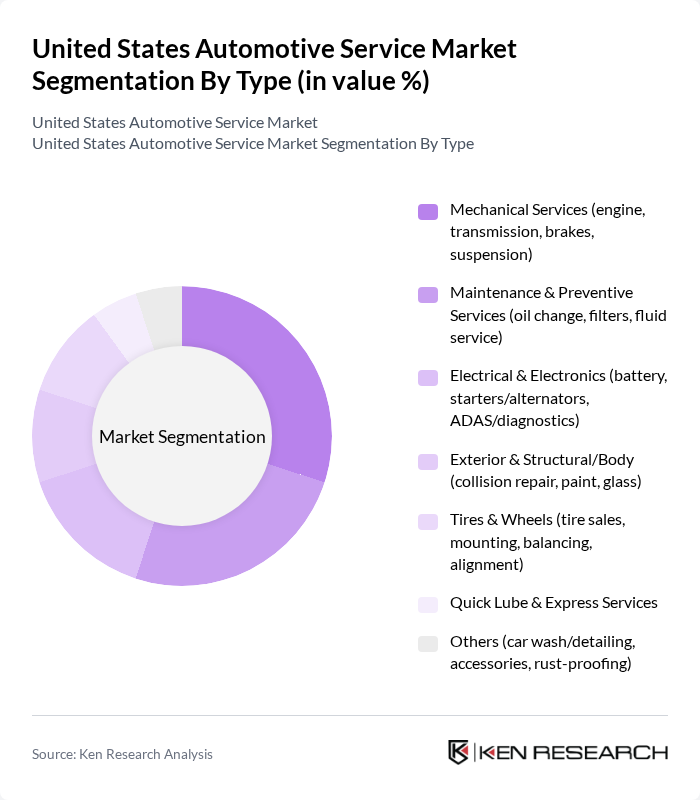
By Type:The automotive service market can be segmented into various types, including mechanical services, maintenance and preventive services, electrical and electronics, exterior and structural/body services, tires and wheels, quick lube and express services, and others. Each of these segments plays a crucial role in the overall service landscape, catering to different consumer needs and preferences. Industry sources define service scopes consistent with these segments, covering routine services (oil changes, tires) and non-routine work (collision, painting, rust-proofing) .
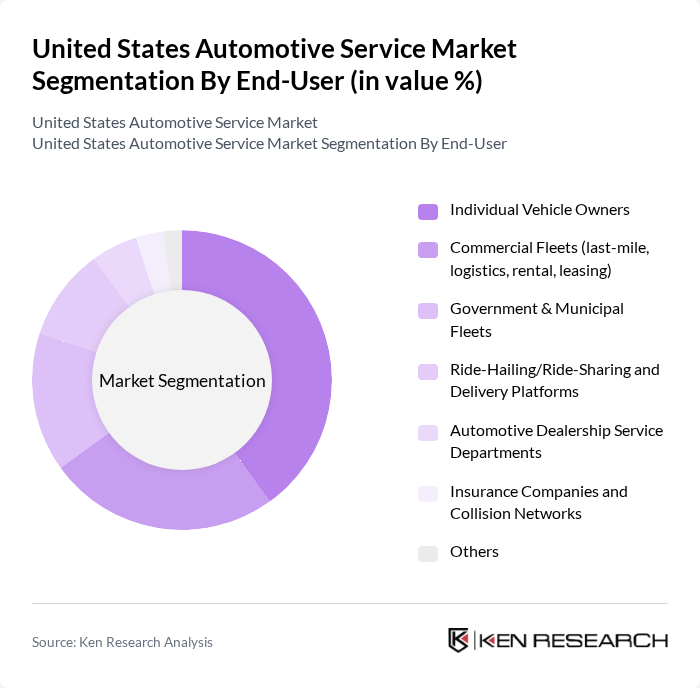
By End-User:The end-user segmentation includes individual vehicle owners, commercial fleets, government and municipal fleets, ride-hailing/ride-sharing and delivery platforms, automotive dealership service departments, insurance companies and collision networks, and others. Each segment has distinct service requirements and preferences, influencing the overall market dynamics. The aging U.S. vehicle fleet (average age reaching the highest on record) particularly sustains demand from individual owners and commercial operators, reinforcing preventive maintenance and repair intensity across these segments .
United States Automotive Service Market Competitive Landscape
The United States Automotive Service Market is characterized by a dynamic mix of regional and international players. Leading participants such as AutoNation, Inc., Lithia Motors, Inc. (Driveway; dealer service), Asbury Automotive Group, Inc., Penske Automotive Group, Inc., O’Reilly Automotive, Inc. (Professional services program), Advance Auto Parts, Inc. (CARQUEST network), Genuine Parts Company (NAPA AutoCare), The Pep Boys – Manny, Moe & Jack, Firestone Complete Auto Care (Bridgestone Retail Operations), Jiffy Lube International, Inc., Meineke Car Care Centers, LLC, Midas, LLC, AAMCO Transmissions and Total Car Care, Valvoline Inc. (Valvoline Instant Oil Change), Goodyear Auto Service (The Goodyear Tire & Rubber Company), Monro, Inc. (Monro Auto Service & Tire Centers), Caliber Collision, Safelite Group (Safelite AutoGlass), Christian Brothers Automotive, CarMax, Inc. (Service & reconditioning), Tire Kingdom/NTB (TBC Corporation), Big O Tires, LLC, AAA Car Care Centers (AAA), Tesla, Inc. (Service Centers and Mobile Service), Rivian Automotive, LLC (Service & mobile fleet) contribute to innovation, geographic expansion, and service delivery in this space .
- Validated drivers and latest trends:A record-high average vehicle age in the U.S. light-vehicle fleet is sustaining repair and maintenance intensity; stronger used-vehicle activity also supports service traffic; and evolving emissions/efficiency standards and electrified vehicle penetration are influencing service capabilities (diagnostics, batteries/tires, fluids) and investments across dealer and independent networks .
United States Automotive Service Market Industry Analysis
Growth Drivers
- Increasing Vehicle Ownership:The United States has seen a steady rise in vehicle ownership, with approximately 273 million registered vehicles in the future, up from 270 million. This growth translates to a higher demand for automotive services, as each vehicle requires regular maintenance and repairs. The average age of vehicles on the road is now over 12 years, indicating a growing need for service providers to cater to older vehicles, which often require more frequent servicing.
- Technological Advancements in Automotive Services:The automotive service industry is rapidly evolving due to technological innovations. In the future, the market for automotive repair software is expected to reach $1.6 billion, driven by the integration of advanced diagnostic tools and management systems. These technologies enhance service efficiency and accuracy, allowing service providers to better meet customer needs. As vehicles become more complex, the demand for skilled technicians proficient in these technologies is expected to rise significantly.
- Rising Demand for Electric Vehicle Maintenance:The electric vehicle (EV) market is expanding, with over 1.6 million EVs sold in the United States in the future, a 60% increase from the previous period. This surge necessitates specialized maintenance services tailored to EVs, including battery management and software updates. As more consumers transition to electric vehicles, automotive service providers must adapt their offerings to include EV-specific services, creating new revenue streams and enhancing customer loyalty in this growing segment.
Market Challenges
- Skilled Labor Shortage:The automotive service industry faces a significant skilled labor shortage, with an estimated 640,000 technician positions unfilled in the future. This shortage is exacerbated by an aging workforce and insufficient training programs. As the complexity of vehicles increases, the demand for highly skilled technicians grows, making it challenging for service providers to maintain quality and efficiency in their operations, ultimately impacting customer satisfaction and service delivery.
- Increasing Competition from Independent Shops:The automotive service market is becoming increasingly competitive, particularly from independent repair shops, which accounted for 62% of the market share in the future. These shops often offer lower prices and personalized services, attracting cost-conscious consumers. As a result, established service providers must innovate and enhance their service offerings to retain customers and compete effectively against these independent operators, which can strain resources and profitability.
United States Automotive Service Market Future Outlook
The future of the United States automotive service market appears promising, driven by technological advancements and evolving consumer preferences. As electric vehicle adoption continues to rise, service providers will need to invest in specialized training and equipment. Additionally, the integration of digital platforms for service booking is expected to streamline operations and enhance customer engagement. Companies that adapt to these trends will likely gain a competitive edge, positioning themselves for sustained growth in a dynamic market landscape.
Market Opportunities
- Expansion of Mobile Repair Services:The mobile repair service segment is gaining traction, with a projected growth rate of 22% in the future. This model offers convenience to consumers, allowing them to receive services at their location. As urbanization increases, the demand for mobile services is expected to rise, providing a lucrative opportunity for service providers to capture a broader customer base and enhance service accessibility.
- Integration of AI and Automation:The integration of artificial intelligence and automation in automotive services is set to revolutionize the industry. In the future, AI-driven diagnostic tools are expected to reduce service time by 32%, improving operational efficiency. This technological shift not only enhances service quality but also allows providers to offer personalized customer experiences, creating a significant opportunity for growth and differentiation in a competitive market.
Scope of the Report
| Segment | Sub-Segments |
|---|---|
| By Type | Mechanical Services (engine, transmission, brakes, suspension) Maintenance & Preventive Services (oil change, filters, fluid service) Electrical & Electronics (battery, starters/alternators, ADAS/diagnostics) Exterior & Structural/Body (collision repair, paint, glass) Tires & Wheels (tire sales, mounting, balancing, alignment) Quick Lube & Express Services Others (car wash/detailing, accessories, rust-proofing) |
| By End-User | Individual Vehicle Owners Commercial Fleets (last-mile, logistics, rental, leasing) Government & Municipal Fleets Ride-Hailing/Ride-Sharing and Delivery Platforms Automotive Dealership Service Departments Insurance Companies and Collision Networks Others |
| By Service Channel | OEM-Authorized/Dealer Service Centers Independent Repair Shops (general repair, specialty) National Chains/Franchises Mobile Service Providers Online-to-Offline Platforms/Marketplaces Others |
| By Vehicle Type | Passenger Cars Light Commercial Vehicles Heavy Commercial Vehicles Electric Vehicles (BEV) Hybrid & Plug-in Hybrid Vehicles (HEV/PHEV) Two-Wheelers (limited, niche services) Others |
| By Geographic Distribution | Urban Areas Suburban Areas Rural Areas Others |
| By Pricing Model | Fixed Pricing/Menu Pricing Hourly Labor Rates Subscription & Service Plans (maintenance contracts) Performance- or Warranty-Based Billing Others |
| By Service Frequency | Scheduled/Regular Maintenance On-Demand Services Emergency & Roadside Repairs Predictive/Connected Vehicle Maintenance Others |
Key Target Audience
Investors and Venture Capitalist Firms
Government and Regulatory Bodies (e.g., National Highway Traffic Safety Administration, Environmental Protection Agency)
Automotive Manufacturers
Parts Suppliers and Distributors
Automotive Service Providers (e.g., repair shops, maintenance centers)
Insurance Companies
Fleet Management Companies
Automotive Technology Developers
Players Mentioned in the Report:
AutoNation, Inc.
Lithia Motors, Inc. (Driveway; dealer service)
Asbury Automotive Group, Inc.
Penske Automotive Group, Inc.
OReilly Automotive, Inc. (Professional services program)
Advance Auto Parts, Inc. (CARQUEST network)
Genuine Parts Company (NAPA AutoCare)
The Pep Boys Manny, Moe & Jack
Firestone Complete Auto Care (Bridgestone Retail Operations)
Jiffy Lube International, Inc.
Meineke Car Care Centers, LLC
Midas, LLC
AAMCO Transmissions and Total Car Care
Valvoline Inc. (Valvoline Instant Oil Change)
Goodyear Auto Service (The Goodyear Tire & Rubber Company)
Monro, Inc. (Monro Auto Service & Tire Centers)
Caliber Collision
Safelite Group (Safelite AutoGlass)
Christian Brothers Automotive
CarMax, Inc. (Service & reconditioning)
Tire Kingdom/NTB (TBC Corporation)
Big O Tires, LLC
AAA Car Care Centers (AAA)
Tesla, Inc. (Service Centers and Mobile Service)
Rivian Automotive, LLC (Service & mobile fleet)
Table of Contents
Market Assessment Phase
1. Executive Summary and Approach
2. United States Automotive Service Market Overview
2.1 Key Insights and Strategic Recommendations
2.2 United States Automotive Service Market Overview
2.3 Definition and Scope
2.4 Evolution of Market Ecosystem
2.5 Timeline of Key Regulatory Milestones
2.6 Value Chain & Stakeholder Mapping
2.7 Business Cycle Analysis
2.8 Policy & Incentive Landscape
3. United States Automotive Service Market Analysis
3.1 Growth Drivers
3.1.1 Increasing Vehicle Ownership
3.1.2 Technological Advancements in Automotive Services
3.1.3 Rising Demand for Electric Vehicle Maintenance
3.1.4 Growth in E-commerce for Automotive Parts
3.2 Market Challenges
3.2.1 Skilled Labor Shortage
3.2.2 Increasing Competition from Independent Shops
3.2.3 Regulatory Compliance Costs
3.2.4 Supply Chain Disruptions
3.3 Market Opportunities
3.3.1 Expansion of Mobile Repair Services
3.3.2 Integration of AI and Automation
3.3.3 Growth in Subscription-Based Services
3.3.4 Partnerships with Ride-Sharing Companies
3.4 Market Trends
3.4.1 Shift Towards Sustainable Practices
3.4.2 Increasing Use of Digital Platforms for Service Booking
3.4.3 Rise of DIY Maintenance Solutions
3.4.4 Focus on Customer Experience Enhancement
3.5 Government Regulation
3.5.1 Emission Standards Compliance
3.5.2 Safety Regulations for Automotive Services
3.5.3 Labor Laws Affecting Service Operations
3.5.4 Consumer Protection Regulations
4. SWOT Analysis
5. Stakeholder Analysis
6. Porter's Five Forces Analysis
7. United States Automotive Service Market Market Size, 2019-2024
7.1 By Value
7.2 By Volume
7.3 By Average Selling Price
8. United States Automotive Service Market Segmentation
8.1 By Type
8.1.1 Mechanical Services (engine, transmission, brakes, suspension)
8.1.2 Maintenance & Preventive Services (oil change, filters, fluid service)
8.1.3 Electrical & Electronics (battery, starters/alternators, ADAS/diagnostics)
8.1.4 Exterior & Structural/Body (collision repair, paint, glass)
8.1.5 Tires & Wheels (tire sales, mounting, balancing, alignment)
8.1.6 Quick Lube & Express Services
8.1.7 Others (car wash/detailing, accessories, rust-proofing)
8.2 By End-User
8.2.1 Individual Vehicle Owners
8.2.2 Commercial Fleets (last-mile, logistics, rental, leasing)
8.2.3 Government & Municipal Fleets
8.2.4 Ride-Hailing/Ride-Sharing and Delivery Platforms
8.2.5 Automotive Dealership Service Departments
8.2.6 Insurance Companies and Collision Networks
8.2.7 Others
8.3 By Service Channel
8.3.1 OEM-Authorized/Dealer Service Centers
8.3.2 Independent Repair Shops (general repair, specialty)
8.3.3 National Chains/Franchises
8.3.4 Mobile Service Providers
8.3.5 Online-to-Offline Platforms/Marketplaces
8.3.6 Others
8.4 By Vehicle Type
8.4.1 Passenger Cars
8.4.2 Light Commercial Vehicles
8.4.3 Heavy Commercial Vehicles
8.4.4 Electric Vehicles (BEV)
8.4.5 Hybrid & Plug-in Hybrid Vehicles (HEV/PHEV)
8.4.6 Two-Wheelers (limited, niche services)
8.4.7 Others
8.5 By Geographic Distribution
8.5.1 Urban Areas
8.5.2 Suburban Areas
8.5.3 Rural Areas
8.5.4 Others
8.6 By Pricing Model
8.6.1 Fixed Pricing/Menu Pricing
8.6.2 Hourly Labor Rates
8.6.3 Subscription & Service Plans (maintenance contracts)
8.6.4 Performance- or Warranty-Based Billing
8.6.5 Others
8.7 By Service Frequency
8.7.1 Scheduled/Regular Maintenance
8.7.2 On-Demand Services
8.7.3 Emergency & Roadside Repairs
8.7.4 Predictive/Connected Vehicle Maintenance
8.7.5 Others
9. United States Automotive Service Market Competitive Analysis
9.1 Market Share of Key Players
9.2 Cross Comparison of Key Players
9.2.1 Company Name
9.2.2 Scale Tier (Dealer network, national chain, independent network)
9.2.3 Service Revenue (latest FY, US$)
9.2.4 Same-Store Sales Growth (YoY, %)
9.2.5 Car Count/Throughput (average tickets per store per day)
9.2.6 Average Repair Order Value (US$)
9.2.7 Fleet Mix (% of revenue from B2B/fleet)
9.2.8 EV/ADAS Capability (certifications, bays, technicians)
9.2.9 Warranty/Return Rate (% rework within 90 days)
9.2.10 Customer Satisfaction/NPS (score)
9.2.11 Nationwide Footprint (no. of service centers, states covered)
9.2.12 Pricing Positioning (value, mid, premium)
9.2.13 Average Service Turnaround Time (hours/days)
9.2.14 Technician Utilization & Certifications (ASE, OEM)
9.2.15 Digital Adoption (online booking, telematics/predictive, app MAU)
9.3 SWOT Analysis of Top Players
9.4 Pricing Analysis
9.5 Detailed Profile of Major Companies
9.5.1 AutoNation, Inc.
9.5.2 Lithia Motors, Inc. (Driveway; dealer service)
9.5.3 Asbury Automotive Group, Inc.
9.5.4 Penske Automotive Group, Inc.
9.5.5 O’Reilly Automotive, Inc. (Professional services program)
9.5.6 Advance Auto Parts, Inc. (CARQUEST network)
9.5.7 Genuine Parts Company (NAPA AutoCare)
9.5.8 The Pep Boys – Manny, Moe & Jack
9.5.9 Firestone Complete Auto Care (Bridgestone Retail Operations)
9.5.10 Jiffy Lube International, Inc.
9.5.11 Meineke Car Care Centers, LLC
9.5.12 Midas, LLC
9.5.13 AAMCO Transmissions and Total Car Care
9.5.14 Valvoline Inc. (Valvoline Instant Oil Change)
9.5.15 Goodyear Auto Service (The Goodyear Tire & Rubber Company)
9.5.16 Monro, Inc. (Monro Auto Service & Tire Centers)
9.5.17 Caliber Collision
9.5.18 Safelite Group (Safelite AutoGlass)
9.5.19 Christian Brothers Automotive
9.5.20 CarMax, Inc. (Service & reconditioning)
9.5.21 Tire Kingdom/NTB (TBC Corporation)
9.5.22 Big O Tires, LLC
9.5.23 AAA Car Care Centers (AAA)
9.5.24 Tesla, Inc. (Service Centers and Mobile Service)
9.5.25 Rivian Automotive, LLC (Service & mobile fleet)
10. United States Automotive Service Market End-User Analysis
10.1 Procurement Behavior of Key Ministries
10.1.1 Budget Allocation Trends
10.1.2 Preferred Service Providers
10.1.3 Contracting Processes
10.1.4 Compliance Requirements
10.2 Corporate Spend on Infrastructure & Energy
10.2.1 Investment in Fleet Maintenance
10.2.2 Expenditure on Technology Upgrades
10.2.3 Budget for Sustainability Initiatives
10.3 Pain Point Analysis by End-User Category
10.3.1 Cost of Services
10.3.2 Availability of Skilled Technicians
10.3.3 Turnaround Time for Services
10.4 User Readiness for Adoption
10.4.1 Awareness of New Technologies
10.4.2 Willingness to Pay for Premium Services
10.4.3 Adoption of Digital Platforms
10.5 Post-Deployment ROI and Use Case Expansion
10.5.1 Measurement of Service Effectiveness
10.5.2 Customer Feedback Mechanisms
10.5.3 Opportunities for Upselling Services
11. United States Automotive Service Market Future Size, 2025-2030
11.1 By Value
11.2 By Volume
11.3 By Average Selling Price
Go-To-Market Strategy Phase
1. Whitespace Analysis + Business Model Canvas
1.1 Market Gaps Identification
1.2 Business Model Development
2. Marketing and Positioning Recommendations
2.1 Branding Strategies
2.2 Product USPs
3. Distribution Plan
3.1 Urban Retail vs Rural NGO Tie-ups
4. Channel & Pricing Gaps
4.1 Underserved Routes
4.2 Pricing Bands
5. Unmet Demand & Latent Needs
5.1 Category Gaps
5.2 Consumer Segments
6. Customer Relationship
6.1 Loyalty Programs
6.2 After-Sales Service
7. Value Proposition
7.1 Sustainability
7.2 Integrated Supply Chains
8. Key Activities
8.1 Regulatory Compliance
8.2 Branding
8.3 Distribution Setup
9. Entry Strategy Evaluation
9.1 Domestic Market Entry Strategy
9.1.1 Product Mix
9.1.2 Pricing Band
9.1.3 Packaging
9.2 Export Entry Strategy
9.2.1 Target Countries
9.2.2 Compliance Roadmap
10. Entry Mode Assessment
10.1 JV
10.2 Greenfield
10.3 M&A
10.4 Distributor Model
11. Capital and Timeline Estimation
11.1 Capital Requirements
11.2 Timelines
12. Control vs Risk Trade-Off
12.1 Ownership vs Partnerships
13. Profitability Outlook
13.1 Breakeven Analysis
13.2 Long-Term Sustainability
14. Potential Partner List
14.1 Distributors
14.2 JVs
14.3 Acquisition Targets
15. Execution Roadmap
15.1 Phased Plan for Market Entry
15.1.1 Market Setup
15.1.2 Market Entry
15.1.3 Growth Acceleration
15.1.4 Scale & Stabilize
15.2 Key Activities and Milestones
15.2.1 Activity Planning
15.2.2 Milestone Tracking
Research Methodology
Phase 1: Approach1
Desk Research
- Analysis of industry reports from automotive associations and market research firms
- Review of government publications and statistics related to automotive service regulations
- Examination of consumer behavior studies and trends in vehicle maintenance and repair
Primary Research
- Interviews with service center managers and automotive technicians across various regions
- Surveys targeting vehicle owners to understand service preferences and spending habits
- Focus groups with automotive service industry experts to gather insights on market dynamics
Validation & Triangulation
- Cross-validation of findings through multiple data sources, including trade publications and expert opinions
- Triangulation of market size estimates using historical data and current trends
- Sanity checks conducted through expert panel reviews to ensure data accuracy and relevance
Phase 2: Market Size Estimation1
Top-down Assessment
- Estimation of total automotive service market size based on national vehicle registration data
- Segmentation of the market by service type, including maintenance, repair, and parts replacement
- Incorporation of growth rates from related sectors, such as automotive sales and aftermarket services
Bottom-up Modeling
- Collection of service pricing data from a sample of automotive service providers
- Estimation of service volume based on average vehicle maintenance frequency and service type
- Calculation of market size using a volume x price model for each service segment
Forecasting & Scenario Analysis
- Multi-factor regression analysis incorporating economic indicators and consumer spending trends
- Scenario modeling based on potential shifts in vehicle technology and service delivery methods
- Development of baseline, optimistic, and pessimistic forecasts through 2030
Phase 3: CATI Sample Composition1
| Scope Item/Segment | Sample Size | Target Respondent Profiles |
|---|---|---|
| Automotive Repair Shops | 120 | Shop Owners, Service Managers |
| Vehicle Maintenance Services | 100 | Technicians, Customer Service Representatives |
| Aftermarket Parts Suppliers | 80 | Procurement Managers, Sales Directors |
| Fleet Management Services | 70 | Fleet Managers, Operations Supervisors |
| Consumer Vehicle Owners | 150 | Car Owners, Vehicle Maintenance Decision Makers |
Frequently Asked Questions
What is the current value of the United States Automotive Service Market?
The United States Automotive Service Market is valued at approximately USD 190 billion, reflecting growth in the service and aftermarket sector as the vehicle parc increases and vehicles remain operational for longer periods, driving demand for maintenance and repair services.
Which cities are key players in the automotive service market?
What are the main segments of the automotive service market?
How is the demand for electric vehicle maintenance changing?
Other Regional/Country Reports
Indonesia Automotive Service Market
Malaysia Automotive Service Market
KSA Automotive Service Market
APAC Automotive Service Market
Why Buy From Us?

What makes us stand out is that our consultants follow Robust, Refine and Result (RRR) methodology. Robust for clear definitions, approaches and sanity checking, Refine for differentiating respondents' facts and opinions, and Result for presenting data with story.

We have set a benchmark in the industry by offering our clients with syndicated and customized market research reports featuring coverage of entire market as well as meticulous research and analyst insights.

While we don't replace traditional research, we flip the method upside down. Our dual approach of Top Bottom & Bottom Top ensures quality deliverable by not just verifying company fundamentals but also looking at the sector and macroeconomic factors.

With one step in the future, our research team constantly tries to show you the bigger picture. We help with some of the tough questions you may encounter along the way: How is the industry positioned? Best marketing channel? KPI's of competitors? By aligning every element, we help maximize success.

Our report gives you instant access to the answers and sources that other companies might choose to hide. We elaborate each steps of research methodology we have used and showcase you the sample size to earn your trust.

If you need any support, we are here! We pride ourselves on universe strength, data quality, and quick, friendly, and professional service.