About the Report
Base Year 2024United States Mobile Virtual Network Operator Mvno Market Overview
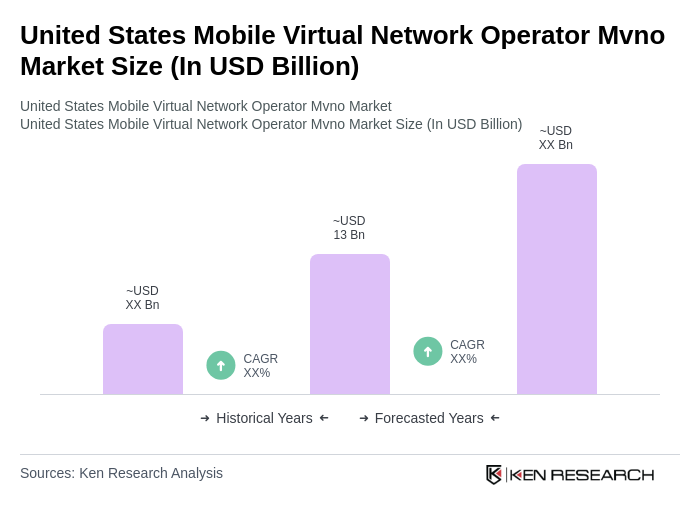
- The United States Mobile Virtual Network Operator MVNO market is valued at USD 13 billion, based on a five-year historical analysis. This growth is primarily driven by increasing demand for affordable mobile services, bundling by cable operators, and expansion of 5G-enabled data usage among consumers, alongside intensified MNO–MVNO partnerships that broaden plan variety and price points.
- Key demand centers align with large metropolitan regions where cable MVNOs and digital-first brands scale through converged bundles (mobile + broadband) and retail distribution; nationwide cable footprints concentrated in states such as California and Texas, and major urban markets like New York, Los Angeles, and Chicago, underpin subscriber acquisition due to dense populations and high mobile data adoption.
- In 2023, the Federal Communications Commission (FCC) strengthened consumer protection rules for mobile services by adopting measures on broadband “nutrition labels” and transparency in fees and speeds, which apply to providers offering mobile broadband services, including MVNOs—aimed at clear, comparable pricing and plan disclosure to improve informed choice and competition.
United States Mobile Virtual Network Operator Mvno Market Segmentation
By Type:The MVNO market can be segmented into various types, including Discount MVNOs, Telecom MVNOs, Retail MVNOs, Migrant/Ethnic MVNOs, Business MVNOs, Roaming MVNOs, and M2M/IoT MVNOs. Each of these subsegments caters to different consumer needs and preferences, with Discount MVNOs leading the market due to their cost-effective offerings.

By End-User:The end-user segmentation includes Consumers, Small and Medium Businesses (SMBs), Large Enterprises, and the Public Sector & Education. The Consumer segment dominates the market, driven by the increasing reliance on mobile connectivity for personal and professional communication, and by cable MVNO bundles that target households with converged services.

United States Mobile Virtual Network Operator Mvno Market Competitive Landscape
The United States Mobile Virtual Network Operator MVNO market is characterized by a dynamic mix of regional and international players. Leading participants such as TracFone Wireless (a Verizon company), Comcast Corporation (Xfinity Mobile), Charter Communications (Spectrum Mobile), Cox Communications (Cox Mobile), Dish Wireless (Boost Mobile, Boost Infinite), Google Fi Wireless, Cricket Wireless (an AT&T company), Metro by T-Mobile, Straight Talk Wireless, Mint Mobile (a T-Mobile company), Consumer Cellular, Visible (a Verizon company), US Mobile, H2O Wireless, Ting Mobile contribute to innovation, geographic expansion, and service delivery in this space.
United States Mobile Virtual Network Operator Mvno Market Industry Analysis
Growth Drivers
- Increasing Demand for Flexible Mobile Plans:The U.S. mobile market is witnessing a significant shift towards flexible mobile plans, with over 60 million subscribers opting for MVNO services in future. This trend is driven by consumer preferences for customizable plans that cater to individual usage patterns. According to the Pew Research Center, 75% of consumers prioritize flexibility in their mobile plans, indicating a robust demand for MVNO offerings that align with these preferences, particularly among younger demographics.
- Rise of Digital-Only MVNOs:The emergence of digital-only MVNOs has transformed the competitive landscape, with companies like Mint Mobile and Visible gaining traction. In future, digital-only MVNOs accounted for approximately 30% of the MVNO market share, reflecting a growing consumer inclination towards online services. The convenience of app-based management and lower operational costs allows these MVNOs to offer competitive pricing, appealing to tech-savvy consumers who prefer seamless digital experiences.
- Expansion of 5G Networks:The rollout of 5G networks across the United States is a critical growth driver for MVNOs. As of future, over 85% of the U.S. population has access to 5G services, enabling MVNOs to offer enhanced data speeds and improved service quality. This technological advancement is expected to attract new customers, with a projected increase in mobile data consumption by 35% in future, further solidifying the role of MVNOs in the evolving telecommunications landscape.
Market Challenges
- Intense Competition from Major Carriers:MVNOs face significant challenges from major carriers like Verizon and AT&T, which dominate the market with extensive resources and brand recognition. In future, these carriers held over 75% of the U.S. mobile market share, making it difficult for MVNOs to compete on pricing and service offerings. The aggressive marketing strategies and bundled services from these carriers further complicate MVNOs' efforts to attract and retain customers in a saturated market.
- Regulatory Compliance Costs:MVNOs must navigate a complex regulatory environment, which can impose substantial compliance costs. In future, the average compliance expenditure for MVNOs was estimated at $1.8 million annually, encompassing licensing, reporting, and consumer protection regulations. These costs can strain the financial resources of smaller MVNOs, limiting their ability to invest in marketing and service enhancements, ultimately affecting their competitiveness in the market.
United States Mobile Virtual Network Operator Mvno Market Future Outlook
The future of the U.S. MVNO market appears promising, driven by technological advancements and evolving consumer preferences. As 5G adoption accelerates, MVNOs are likely to leverage enhanced data capabilities to attract new customers. Additionally, the increasing demand for personalized mobile services will encourage MVNOs to innovate their offerings. With a focus on customer experience and digital engagement, MVNOs are well-positioned to capture a larger share of the market, particularly among younger, tech-savvy consumers seeking flexibility and value.
Market Opportunities
- Niche Market Segmentation:MVNOs have the opportunity to target niche markets, such as seniors or specific ethnic communities, which are often underserved by major carriers. By tailoring services to meet the unique needs of these segments, MVNOs can enhance customer loyalty and drive growth, potentially increasing their subscriber base by 20% in these targeted demographics.
- Partnerships with IoT Providers:Collaborating with Internet of Things (IoT) providers presents a significant opportunity for MVNOs. As IoT devices proliferate, MVNOs can offer specialized plans catering to connected devices, tapping into a market projected to reach 35 billion connected devices by future. This strategic alignment can enhance revenue streams and position MVNOs as key players in the IoT ecosystem.
Scope of the Report
| Segment | Sub-Segments |
|---|---|
| By Type | Discount MVNOs Telecom MVNOs Retail MVNOs Migrant/Ethnic MVNOs Business MVNOs Roaming MVNOs M2M/IoT MVNOs |
| By End-User | Consumer Small and Medium Businesses (SMBs) Large Enterprises Public Sector & Education |
| By Distribution Channel | Online/Digital-Only Retail & Big-Box Partners Cable & Broadband Bundles Direct/Inside Sales |
| By Pricing Model | Pay-As-You-Go (Prepaid) Monthly Subscriptions Family/Shared Plans Unlimited Data Plans |
| By Service Type | Voice Data Messaging eSIM & BYOD Support |
| By Customer Segment | Youth/Value Seekers Seniors Business & Prosumer Immigrant/International Callers |
| By Operational Model | Reseller MVNO Service Provider MVNO Full MVNO |
Key Target Audience
Investors and Venture Capitalist Firms
Government and Regulatory Bodies (e.g., Federal Communications Commission, National Telecommunications and Information Administration)
Mobile Network Operators
Telecommunications Equipment Manufacturers
Wholesale Network Providers
Industry Associations (e.g., Competitive Carriers Association)
Financial Institutions
Telecom Infrastructure Providers
Players Mentioned in the Report:
TracFone Wireless (a Verizon company)
Comcast Corporation (Xfinity Mobile)
Charter Communications (Spectrum Mobile)
Cox Communications (Cox Mobile)
Dish Wireless (Boost Mobile, Boost Infinite)
Google Fi Wireless
Cricket Wireless (an AT&T company)
Metro by T-Mobile
Straight Talk Wireless
Mint Mobile (a T-Mobile company)
Consumer Cellular
Visible (a Verizon company)
US Mobile
H2O Wireless
Ting Mobile
Table of Contents
Market Assessment Phase
1. Executive Summary and Approach
2. United States Mobile Virtual Network Operator Mvno Market Overview
2.1 Key Insights and Strategic Recommendations
2.2 United States Mobile Virtual Network Operator Mvno Market Overview
2.3 Definition and Scope
2.4 Evolution of Market Ecosystem
2.5 Timeline of Key Regulatory Milestones
2.6 Value Chain & Stakeholder Mapping
2.7 Business Cycle Analysis
2.8 Policy & Incentive Landscape
3. United States Mobile Virtual Network Operator Mvno Market Analysis
3.1 Growth Drivers
3.1.1 Increasing Demand for Flexible Mobile Plans
3.1.2 Rise of Digital-Only MVNOs
3.1.3 Expansion of 5G Networks
3.1.4 Cost-Effectiveness of MVNO Services
3.2 Market Challenges
3.2.1 Intense Competition from Major Carriers
3.2.2 Regulatory Compliance Costs
3.2.3 Customer Retention Issues
3.2.4 Limited Brand Recognition
3.3 Market Opportunities
3.3.1 Niche Market Segmentation
3.3.2 Partnerships with IoT Providers
3.3.3 Expansion into Underserved Regions
3.3.4 Innovative Pricing Models
3.4 Market Trends
3.4.1 Growth of Mobile Data Consumption
3.4.2 Shift Towards Subscription-Based Services
3.4.3 Increasing Focus on Customer Experience
3.4.4 Adoption of AI in Customer Service
3.5 Government Regulation
3.5.1 FCC Regulations on MVNO Operations
3.5.2 Consumer Protection Laws
3.5.3 Data Privacy Regulations
3.5.4 Spectrum Allocation Policies
4. SWOT Analysis
5. Stakeholder Analysis
6. Porter's Five Forces Analysis
7. United States Mobile Virtual Network Operator Mvno Market Market Size, 2019-2024
7.1 By Value
7.2 By Volume
7.3 By Average Selling Price
8. United States Mobile Virtual Network Operator Mvno Market Segmentation
8.1 By Type
8.1.1 Discount MVNOs
8.1.2 Telecom MVNOs
8.1.3 Retail MVNOs
8.1.4 Migrant/Ethnic MVNOs
8.1.5 Business MVNOs
8.1.6 Roaming MVNOs
8.1.7 M2M/IoT MVNOs
8.2 By End-User
8.2.1 Consumer
8.2.2 Small and Medium Businesses (SMBs)
8.2.3 Large Enterprises
8.2.4 Public Sector & Education
8.3 By Distribution Channel
8.3.1 Online/Digital-Only
8.3.2 Retail & Big-Box Partners
8.3.3 Cable & Broadband Bundles
8.3.4 Direct/Inside Sales
8.4 By Pricing Model
8.4.1 Pay-As-You-Go (Prepaid)
8.4.2 Monthly Subscriptions
8.4.3 Family/Shared Plans
8.4.4 Unlimited Data Plans
8.5 By Service Type
8.5.1 Voice
8.5.2 Data
8.5.3 Messaging
8.5.4 eSIM & BYOD Support
8.6 By Customer Segment
8.6.1 Youth/Value Seekers
8.6.2 Seniors
8.6.3 Business & Prosumer
8.6.4 Immigrant/International Callers
8.7 By Operational Model
8.7.1 Reseller MVNO
8.7.2 Service Provider MVNO
8.7.3 Full MVNO
9. United States Mobile Virtual Network Operator Mvno Market Competitive Analysis
9.1 Market Share of Key Players
9.2 Cross Comparison of Key Players
9.2.1 Company Name
9.2.2 Operational Model (Reseller, Service Provider, Full MVNO)
9.2.3 Host Network(s) (AT&T, T-Mobile, Verizon)
9.2.4 Subscriber Base (latest disclosed, millions)
9.2.5 Customer Acquisition Cost (CAC)
9.2.6 Monthly Churn Rate
9.2.7 Average Revenue Per User (ARPU)
9.2.8 Plan Mix (% Unlimited vs. Metered)
9.2.9 5G/eSIM Availability
9.2.10 Distribution Mix (Online, Retail, Cable Bundle %)
9.2.11 Net Adds/Porting Ratio (In vs. Out)
9.2.12 Customer Lifetime Value (CLV)
9.2.13 NPS/CSAT and Call Resolution Metrics
9.2.14 Pricing Positioning (Low-cost, Value, Premium)
9.2.15 EBITDA Margin/Operating Margin (MVNO segment)
9.3 SWOT Analysis of Top Players
9.4 Pricing Analysis
9.5 Detailed Profile of Major Companies
9.5.1 TracFone Wireless (a Verizon company)
9.5.2 Comcast Corporation (Xfinity Mobile)
9.5.3 Charter Communications (Spectrum Mobile)
9.5.4 Cox Communications (Cox Mobile)
9.5.5 Dish Wireless (Boost Mobile, Boost Infinite)
9.5.6 Google Fi Wireless
9.5.7 Cricket Wireless (an AT&T company)
9.5.8 Metro by T-Mobile
9.5.9 Straight Talk Wireless
9.5.10 Mint Mobile (a T-Mobile company)
9.5.11 Consumer Cellular
9.5.12 Visible (a Verizon company)
9.5.13 US Mobile
9.5.14 H2O Wireless
9.5.15 Ting Mobile
10. United States Mobile Virtual Network Operator Mvno Market End-User Analysis
10.1 Procurement Behavior of Key Ministries
10.1.1 Budget Allocation Trends
10.1.2 Decision-Making Processes
10.1.3 Preferred Service Providers
10.2 Corporate Spend on Infrastructure & Energy
10.2.1 Investment in Mobile Infrastructure
10.2.2 Spending on Data Services
10.2.3 Budget for Communication Tools
10.3 Pain Point Analysis by End-User Category
10.3.1 Connectivity Issues
10.3.2 Cost Management Challenges
10.3.3 Service Quality Concerns
10.4 User Readiness for Adoption
10.4.1 Awareness of MVNO Options
10.4.2 Willingness to Switch Providers
10.4.3 Technology Adoption Rates
10.5 Post-Deployment ROI and Use Case Expansion
10.5.1 Measurement of Service Effectiveness
10.5.2 Expansion into New Use Cases
10.5.3 Long-Term Value Assessment
11. United States Mobile Virtual Network Operator Mvno Market Future Size, 2025-2030
11.1 By Value
11.2 By Volume
11.3 By Average Selling Price
Go-To-Market Strategy Phase
1. Whitespace Analysis + Business Model Canvas
1.1 Market Gaps Identification
1.2 Business Model Framework
2. Marketing and Positioning Recommendations
2.1 Branding Strategies
2.2 Product USPs
3. Distribution Plan
3.1 Urban Retail Strategies
3.2 Rural NGO Tie-Ups
4. Channel & Pricing Gaps
4.1 Underserved Routes
4.2 Pricing Bands Analysis
5. Unmet Demand & Latent Needs
5.1 Category Gaps
5.2 Consumer Segments
6. Customer Relationship
6.1 Loyalty Programs
6.2 After-Sales Service
7. Value Proposition
7.1 Sustainability Initiatives
7.2 Integrated Supply Chains
8. Key Activities
8.1 Regulatory Compliance
8.2 Branding Efforts
8.3 Distribution Setup
9. Entry Strategy Evaluation
9.1 Domestic Market Entry Strategy
9.1.1 Product Mix Considerations
9.1.2 Pricing Band Strategy
9.1.3 Packaging Options
9.2 Export Entry Strategy
9.2.1 Target Countries
9.2.2 Compliance Roadmap
10. Entry Mode Assessment
10.1 Joint Ventures
10.2 Greenfield Investments
10.3 Mergers & Acquisitions
10.4 Distributor Model
11. Capital and Timeline Estimation
11.1 Capital Requirements
11.2 Timelines for Implementation
12. Control vs Risk Trade-Off
12.1 Ownership Considerations
12.2 Partnerships Evaluation
13. Profitability Outlook
13.1 Breakeven Analysis
13.2 Long-Term Sustainability
14. Potential Partner List
14.1 Distributors
14.2 Joint Ventures
14.3 Acquisition Targets
15. Execution Roadmap
15.1 Phased Plan for Market Entry
15.1.1 Market Setup
15.1.2 Market Entry
15.1.3 Growth Acceleration
15.1.4 Scale & Stabilize
15.2 Key Activities and Milestones
15.2.1 Activity Timeline
15.2.2 Milestone Tracking
Research Methodology
Phase 1: Approach1
Desk Research
- Analysis of industry reports from telecommunications associations and market research firms
- Review of regulatory frameworks and policies affecting MVNO operations in the U.S.
- Examination of financial reports and press releases from leading MVNOs and mobile network operators
Primary Research
- Interviews with executives from MVNOs to understand market dynamics and challenges
- Surveys targeting consumers to gauge preferences and usage patterns of MVNO services
- Focus groups with industry experts to discuss trends and future outlooks for the MVNO market
Validation & Triangulation
- Cross-validation of findings through multiple data sources, including consumer surveys and industry reports
- Triangulation of qualitative insights from interviews with quantitative data from market analysis
- Sanity checks conducted through expert panel reviews to ensure data accuracy and relevance
Phase 2: Market Size Estimation1
Top-down Assessment
- Estimation of total addressable market (TAM) based on overall mobile service revenues in the U.S.
- Segmentation of the market by customer demographics, service types, and geographic regions
- Incorporation of growth rates from historical data and projected trends in mobile usage
Bottom-up Modeling
- Collection of subscriber data from various MVNOs to establish baseline metrics
- Analysis of average revenue per user (ARPU) across different MVNO segments
- Calculation of market size based on subscriber counts and ARPU estimates
Forecasting & Scenario Analysis
- Development of forecasting models using historical growth rates and market drivers
- Scenario analysis based on potential regulatory changes and technological advancements
- Creation of multiple projections (baseline, optimistic, and pessimistic) through 2030
Phase 3: CATI Sample Composition1
| Scope Item/Segment | Sample Size | Target Respondent Profiles |
|---|---|---|
| Consumer MVNO Usage | 150 | Current MVNO Subscribers, Potential MVNO Users |
| Business MVNO Solutions | 100 | IT Managers, Procurement Officers in SMEs |
| Market Trends and Innovations | 80 | Telecom Analysts, Industry Consultants |
| Regulatory Impact Assessment | 60 | Policy Makers, Regulatory Affairs Specialists |
| Customer Satisfaction and Retention | 120 | Customer Service Managers, Marketing Directors |
Frequently Asked Questions
What is the current value of the United States MVNO market?
The United States Mobile Virtual Network Operator (MVNO) market is valued at approximately USD 13 billion, reflecting a significant growth driven by consumer demand for affordable mobile services and the expansion of 5G data usage.
What factors are driving the growth of the MVNO market in the U.S.?
Who are the major players in the U.S. MVNO market?
What types of MVNOs exist in the U.S. market?
Other Regional/Country Reports
Indonesia Mobile Virtual Network Operator Mvno Market
Malaysia Mobile Virtual Network Operator Mvno Market
APAC Mobile Virtual Network Operator Mvno Market
Why Buy From Us?

What makes us stand out is that our consultants follow Robust, Refine and Result (RRR) methodology. Robust for clear definitions, approaches and sanity checking, Refine for differentiating respondents' facts and opinions, and Result for presenting data with story.

We have set a benchmark in the industry by offering our clients with syndicated and customized market research reports featuring coverage of entire market as well as meticulous research and analyst insights.

While we don't replace traditional research, we flip the method upside down. Our dual approach of Top Bottom & Bottom Top ensures quality deliverable by not just verifying company fundamentals but also looking at the sector and macroeconomic factors.

With one step in the future, our research team constantly tries to show you the bigger picture. We help with some of the tough questions you may encounter along the way: How is the industry positioned? Best marketing channel? KPI's of competitors? By aligning every element, we help maximize success.

Our report gives you instant access to the answers and sources that other companies might choose to hide. We elaborate each steps of research methodology we have used and showcase you the sample size to earn your trust.

If you need any support, we are here! We pride ourselves on universe strength, data quality, and quick, friendly, and professional service.