About the Report
Base Year 2024United States Party Supply Rental Market Overview
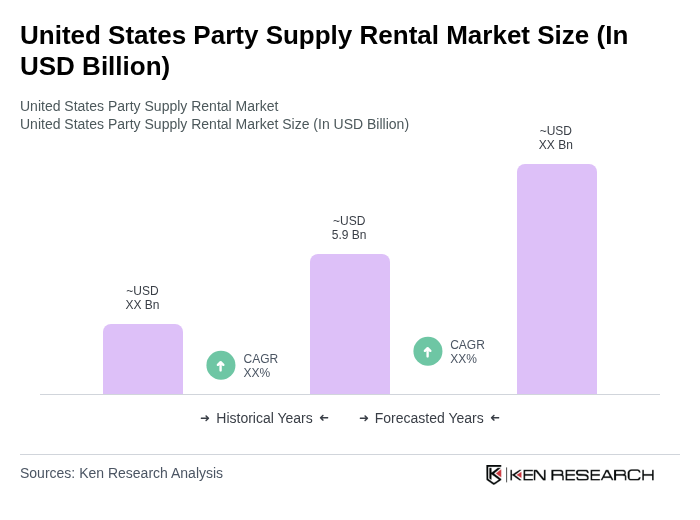
- The United States Party Supply Rental Market is valued at USD 5.9 billion, based on a five-year historical analysis. This growth is primarily driven by the increasing trend of event hosting, including weddings, corporate events, and private parties, alongside a growing preference for rental services over ownership due to cost-effectiveness and convenience. Additional growth drivers include the expansion of digital booking platforms, heightened demand for customized event experiences, and a growing emphasis on sustainability and eco-friendly rental options .
- Key cities dominating the market include New York, Los Angeles, and Chicago. These metropolitan areas are characterized by a high density of events and celebrations, supported by robust infrastructure and a diverse population that drives demand for party supplies and rental services. The presence of major corporate hubs and a vibrant social scene further amplifies the frequency and scale of events in these cities .
- The United States party supply rental industry is governed by safety standards outlined in the "Consumer Product Safety Improvement Act (CPSIA), 2008" issued by the U.S. Consumer Product Safety Commission. This regulation mandates that all rental equipment, especially items intended for children or public use, must comply with specific safety certifications regarding lead content, phthalates, and mechanical safety. Rental businesses are required to maintain compliance documentation and ensure equipment is regularly inspected and certified for consumer safety .
United States Party Supply Rental Market Segmentation
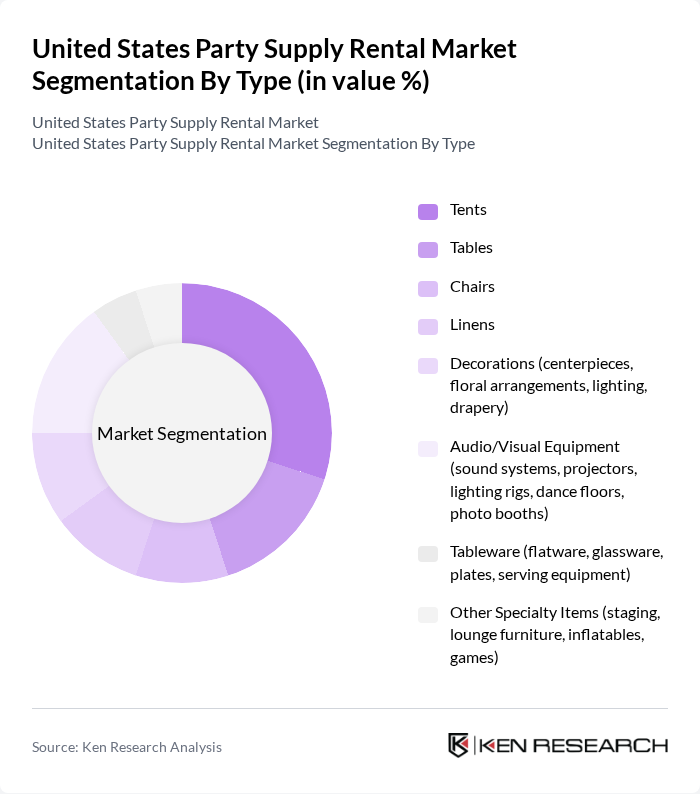
By Type:The market is segmented into various types of rental supplies, including tents, tables, chairs, linens, decorations, audio/visual equipment, tableware, and other specialty items. Among these, tents and audio/visual equipment remain particularly dominant due to their essential role in outdoor events and corporate functions. The demand for high-quality audio/visual setups has surged as events increasingly incorporate technology for enhanced experiences and immersive environments. Sustainability trends are also influencing product choices, with eco-friendly linens and reusable decorations gaining traction .
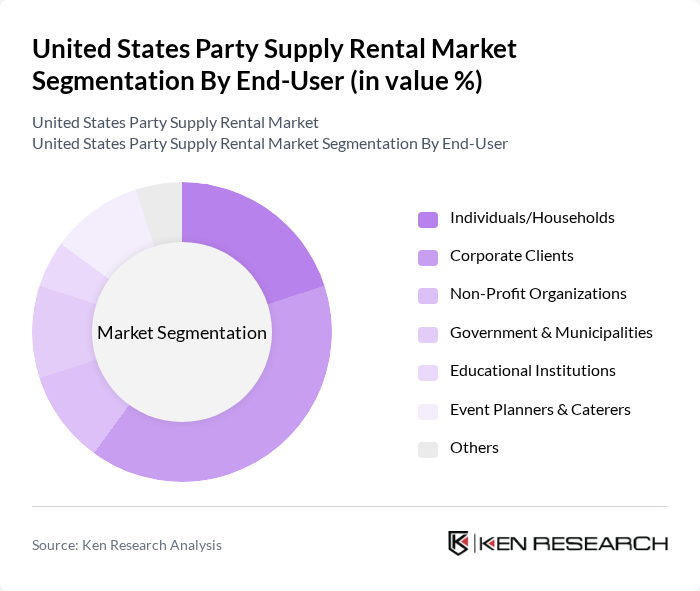
By End-User:The end-user segmentation includes individuals/households, corporate clients, non-profit organizations, government & municipalities, educational institutions, event planners & caterers, and others. Corporate clients are the leading segment, driven by the increasing number of corporate events and the need for professional setups. The trend of hosting elaborate corporate functions has led to a significant rise in demand for rental services tailored to business needs. Event planners and caterers are also a rapidly growing segment, as demand for personalized, high-impact experiences continues to rise .
United States Party Supply Rental Market Competitive Landscape
The United States Party Supply Rental Market is characterized by a dynamic mix of regional and international players. Leading participants such as CORT Party Rental, Classic Party Rentals, Bright Event Rentals, All Occasions Party Rentals, A Classic Party Rental, Big D Party Rentals, Avalon Tent & Party, Baker Party Rentals, Party Reflections, Inc., Pleasanton Rentals, Taylor Rental, Ventura Rental Center, Premiere Events, Event Rentals Unlimited, Reventals Event Rentals contribute to innovation, geographic expansion, and service delivery in this space .
United States Party Supply Rental Market Industry Analysis
Growth Drivers
- Increasing Demand for Event Personalization:The trend towards personalized events is driving the party supply rental market, with 70% of event planners reporting a rise in customized requests. This shift is supported by a survey indicating that 60% of consumers are willing to spend an additional $500 on personalized event experiences. As disposable income rises, particularly among millennials, the demand for unique and tailored events is expected to continue growing, further fueling the rental market.
- Rise in Disposable Income and Spending on Events:The U.S. disposable personal income is projected to reach $19 trillion in future, reflecting a 3.5% increase from previous estimates. This growth in disposable income correlates with increased spending on events, with average consumer spending on celebrations rising to $1,200 per event. As consumers allocate more funds towards memorable experiences, the party supply rental market is poised to benefit significantly from this trend.
- Growth of the Event Planning Industry:The event planning industry is expected to generate $5 billion in revenue in future, marking a 5% increase from the previous year. This growth is driven by a surge in corporate events, weddings, and social gatherings, leading to higher demand for rental supplies. As event planners increasingly seek comprehensive rental solutions, the party supply rental market stands to gain from this expanding industry landscape, enhancing its overall market presence.
Market Challenges
- Seasonal Fluctuations in Demand:The party supply rental market experiences significant seasonal demand fluctuations, with peak seasons typically occurring during summer and holiday periods. For instance, 40% of annual revenue is generated in just three months, leading to challenges in inventory management and cash flow. This seasonality can strain resources and complicate operational planning, making it difficult for companies to maintain consistent profitability throughout the year.
- High Competition Among Rental Companies:The party supply rental market is characterized by intense competition, with over 5,000 rental companies operating in the U.S. This saturation leads to price wars and reduced profit margins, as companies strive to differentiate themselves. In future, the average profit margin for rental businesses is projected to be around 10%, which is significantly lower than other sectors, making it crucial for companies to innovate and enhance service offerings to remain competitive.
United States Party Supply Rental Market Future Outlook
The future of the party supply rental market in the United States appears promising, driven by evolving consumer preferences and technological advancements. As event personalization continues to gain traction, companies that adapt their offerings to meet these demands will likely thrive. Additionally, the integration of technology in rental processes, such as online booking and inventory management, will streamline operations and enhance customer experiences, positioning businesses for sustained growth in the coming years.
Market Opportunities
- Increasing Trend of Eco-Friendly Events:The growing emphasis on sustainability presents a significant opportunity for rental companies to offer eco-friendly products. In future, 45% of event planners are expected to prioritize sustainable options, creating demand for biodegradable and reusable supplies. Companies that align with this trend can attract environmentally conscious consumers and differentiate themselves in a competitive market.
- Expansion into Corporate Event Rentals:The corporate event sector is projected to grow by 6% in future, with businesses increasingly investing in professional gatherings. This trend opens avenues for rental companies to expand their services tailored to corporate clients, including high-quality equipment and specialized packages. By targeting this lucrative segment, companies can enhance their revenue streams and establish long-term partnerships with corporate clients.
Scope of the Report
| Segment | Sub-Segments |
|---|---|
| By Type | Tents Tables Chairs Linens Decorations (centerpieces, floral arrangements, lighting, drapery) Audio/Visual Equipment (sound systems, projectors, lighting rigs, dance floors, photo booths) Tableware (flatware, glassware, plates, serving equipment) Other Specialty Items (staging, lounge furniture, inflatables, games) |
| By End-User | Individuals/Households Corporate Clients Non-Profit Organizations Government & Municipalities Educational Institutions Event Planners & Caterers Others |
| By Event Type | Weddings (traditional, destination) Corporate Events (conferences, product launches, seminars) Private Parties (birthday, anniversary, graduation) Festivals (cultural, food, music) Nonprofit & Fundraising Events Others |
| By Rental Duration | One-day Rentals Weekly Rentals Monthly Rentals Long-term/Seasonal Rentals Recurring Events Others |
| By Geographic Distribution | Northeast Midwest South West Major Metropolitan Areas Others |
| By Customer Segment | B2C (Business to Consumer) B2B (Business to Business) Government Contracts Event Planners & Agencies Caterers & Hospitality Providers Others |
| By Service Type | Delivery and Setup On-site Support/Staffing Cleaning and Maintenance Pickup & Breakdown Services Online Booking & Virtual Previews Others |
Key Target Audience
Investors and Venture Capitalist Firms
Government and Regulatory Bodies (e.g., Small Business Administration, Federal Trade Commission)
Event Planners and Coordinators
Corporate Event Organizers
Non-Profit Organizations and Charities
Hospitality and Venue Management Companies
Trade Show and Exhibition Organizers
Insurance Companies and Risk Management Firms
Players Mentioned in the Report:
CORT Party Rental
Classic Party Rentals
Bright Event Rentals
All Occasions Party Rentals
A Classic Party Rental
Big D Party Rentals
Avalon Tent & Party
Baker Party Rentals
Party Reflections, Inc.
Pleasanton Rentals
Taylor Rental
Ventura Rental Center
Premiere Events
Event Rentals Unlimited
Reventals Event Rentals
Table of Contents
Market Assessment Phase
1. Executive Summary and Approach
2. United States Party Supply Rental Market Overview
2.1 Key Insights and Strategic Recommendations
2.2 United States Party Supply Rental Market Overview
2.3 Definition and Scope
2.4 Evolution of Market Ecosystem
2.5 Timeline of Key Regulatory Milestones
2.6 Value Chain & Stakeholder Mapping
2.7 Business Cycle Analysis
2.8 Policy & Incentive Landscape
3. United States Party Supply Rental Market Analysis
3.1 Growth Drivers
3.1.1 Increasing demand for event personalization
3.1.2 Rise in disposable income and spending on events
3.1.3 Growth of the event planning industry
3.1.4 Expansion of online rental platforms
3.2 Market Challenges
3.2.1 Seasonal fluctuations in demand
3.2.2 High competition among rental companies
3.2.3 Logistics and transportation issues
3.2.4 Regulatory compliance and safety standards
3.3 Market Opportunities
3.3.1 Increasing trend of eco-friendly events
3.3.2 Expansion into corporate event rentals
3.3.3 Technological advancements in rental management
3.3.4 Partnerships with event planners and venues
3.4 Market Trends
3.4.1 Growth of DIY event solutions
3.4.2 Customization of rental packages
3.4.3 Integration of technology in rental processes
3.4.4 Increased focus on customer experience
3.5 Government Regulation
3.5.1 Safety regulations for rental equipment
3.5.2 Tax regulations affecting rental businesses
3.5.3 Environmental regulations for event waste
3.5.4 Licensing requirements for rental companies
4. SWOT Analysis
5. Stakeholder Analysis
6. Porter's Five Forces Analysis
7. United States Party Supply Rental Market Market Size, 2019-2024
7.1 By Value
7.2 By Volume
7.3 By Average Selling Price
8. United States Party Supply Rental Market Segmentation
8.1 By Type
8.1.1 Tents
8.1.2 Tables
8.1.3 Chairs
8.1.4 Linens
8.1.5 Decorations (centerpieces, floral arrangements, lighting, drapery)
8.1.6 Audio/Visual Equipment (sound systems, projectors, lighting rigs, dance floors, photo booths)
8.1.7 Tableware (flatware, glassware, plates, serving equipment)
8.1.8 Other Specialty Items (staging, lounge furniture, inflatables, games)
8.2 By End-User
8.2.1 Individuals/Households
8.2.2 Corporate Clients
8.2.3 Non-Profit Organizations
8.2.4 Government & Municipalities
8.2.5 Educational Institutions
8.2.6 Event Planners & Caterers
8.2.7 Others
8.3 By Event Type
8.3.1 Weddings (traditional, destination)
8.3.2 Corporate Events (conferences, product launches, seminars)
8.3.3 Private Parties (birthday, anniversary, graduation)
8.3.4 Festivals (cultural, food, music)
8.3.5 Nonprofit & Fundraising Events
8.3.6 Others
8.4 By Rental Duration
8.4.1 One-day Rentals
8.4.2 Weekly Rentals
8.4.3 Monthly Rentals
8.4.4 Long-term/Seasonal Rentals
8.4.5 Recurring Events
8.4.6 Others
8.5 By Geographic Distribution
8.5.1 Northeast
8.5.2 Midwest
8.5.3 South
8.5.4 West
8.5.5 Major Metropolitan Areas
8.5.6 Others
8.6 By Customer Segment
8.6.1 B2C (Business to Consumer)
8.6.2 B2B (Business to Business)
8.6.3 Government Contracts
8.6.4 Event Planners & Agencies
8.6.5 Caterers & Hospitality Providers
8.6.6 Others
8.7 By Service Type
8.7.1 Delivery and Setup
8.7.2 On-site Support/Staffing
8.7.3 Cleaning and Maintenance
8.7.4 Pickup & Breakdown Services
8.7.5 Online Booking & Virtual Previews
8.7.6 Others
9. United States Party Supply Rental Market Competitive Analysis
9.1 Market Share of Key Players
9.2 Cross Comparison of Key Players
9.2.1 Company Name
9.2.2 Group Size (Large, Medium, or Small as per industry convention)
9.2.3 Annual Revenue
9.2.4 Revenue Growth Rate (YoY %)
9.2.5 Number of Locations/Branches
9.2.6 Market Penetration Rate (by region or event type)
9.2.7 Customer Retention Rate
9.2.8 Average Order Value
9.2.9 Inventory Turnover Rate
9.2.10 Utilization Rate of Rental Assets
9.2.11 Customer Satisfaction Score (NPS or equivalent)
9.2.12 Digital Booking Ratio (online vs. offline)
9.2.13 Brand Recognition Index
9.2.14 Sustainability Initiatives (eco-friendly offerings % of total)
9.3 SWOT Analysis of Top Players
9.4 Pricing Analysis
9.5 Detailed Profile of Major Companies
9.5.1 CORT Party Rental
9.5.2 Classic Party Rentals
9.5.3 Bright Event Rentals
9.5.4 All Occasions Party Rentals
9.5.5 A Classic Party Rental
9.5.6 Big D Party Rentals
9.5.7 Avalon Tent & Party
9.5.8 Baker Party Rentals
9.5.9 Party Reflections, Inc.
9.5.10 Pleasanton Rentals
9.5.11 Taylor Rental
9.5.12 Ventura Rental Center
9.5.13 Premiere Events
9.5.14 Event Rentals Unlimited
9.5.15 Reventals Event Rentals
10. United States Party Supply Rental Market End-User Analysis
10.1 Procurement Behavior of Key Ministries
10.1.1 Event Planning Procedures
10.1.2 Budget Allocation for Events
10.1.3 Supplier Selection Criteria
10.1.4 Contract Management Practices
10.2 Corporate Spend on Infrastructure & Energy
10.2.1 Budget Trends for Corporate Events
10.2.2 Investment in Sustainable Practices
10.2.3 Spending on Event Technology
10.2.4 Cost Management Strategies
10.3 Pain Point Analysis by End-User Category
10.3.1 Challenges in Event Logistics
10.3.2 Issues with Equipment Quality
10.3.3 Difficulty in Supplier Communication
10.3.4 Budget Constraints
10.4 User Readiness for Adoption
10.4.1 Awareness of Rental Options
10.4.2 Willingness to Use Online Platforms
10.4.3 Familiarity with Rental Processes
10.4.4 Perceived Value of Rentals
10.5 Post-Deployment ROI and Use Case Expansion
10.5.1 Measurement of Event Success
10.5.2 Feedback Mechanisms
10.5.3 Opportunities for Repeat Business
10.5.4 Expansion into New Event Types
11. United States Party Supply Rental Market Future Size, 2025-2030
11.1 By Value
11.2 By Volume
11.3 By Average Selling Price
Go-To-Market Strategy Phase
1. Whitespace Analysis + Business Model Canvas
1.1 Market Gaps Identification
1.2 Business Model Framework
2. Marketing and Positioning Recommendations
2.1 Branding Strategies
2.2 Product USPs
3. Distribution Plan
3.1 Urban Retail vs Rural NGO Tie-ups
4. Channel & Pricing Gaps
4.1 Underserved Routes
4.2 Pricing Bands
5. Unmet Demand & Latent Needs
5.1 Category Gaps
5.2 Consumer Segments
6. Customer Relationship
6.1 Loyalty Programs
6.2 After-sales Service
7. Value Proposition
7.1 Sustainability
7.2 Integrated Supply Chains
8. Key Activities
8.1 Regulatory Compliance
8.2 Branding
8.3 Distribution Setup
9. Entry Strategy Evaluation
9.1 Domestic Market Entry Strategy
9.1.1 Product Mix
9.1.2 Pricing Band
9.1.3 Packaging
9.2 Export Entry Strategy
9.2.1 Target Countries
9.2.2 Compliance Roadmap
10. Entry Mode Assessment
10.1 JV
10.2 Greenfield
10.3 M&A
10.4 Distributor Model
11. Capital and Timeline Estimation
11.1 Capital Requirements
11.2 Timelines
12. Control vs Risk Trade-Off
12.1 Ownership vs Partnerships
13. Profitability Outlook
13.1 Breakeven Analysis
13.2 Long-term Sustainability
14. Potential Partner List
14.1 Distributors
14.2 JVs
14.3 Acquisition Targets
15. Execution Roadmap
15.1 Phased Plan for Market Entry
15.1.1 Market Setup
15.1.2 Market Entry
15.1.3 Growth Acceleration
15.1.4 Scale & Stabilize
15.2 Key Activities and Milestones
15.2.1 Milestone Planning
15.2.2 Activity Tracking
Research Methodology
Phase 1: Approach1
Desk Research
- Analysis of industry reports from trade associations and market research firms
- Review of government publications and economic data related to the party supply rental sector
- Examination of online platforms and rental service websites for pricing and service offerings
Primary Research
- Interviews with owners and managers of party supply rental businesses
- Surveys targeting event planners and corporate clients who utilize rental services
- Field visits to rental locations to observe operations and customer interactions
Validation & Triangulation
- Cross-validation of findings through multiple data sources, including sales data and customer feedback
- Triangulation of insights from primary interviews with secondary data trends
- Sanity checks conducted through expert panel discussions with industry veterans
Phase 2: Market Size Estimation1
Top-down Assessment
- Estimation of market size based on overall event industry growth and rental service penetration
- Segmentation of the market by type of events (weddings, corporate events, parties) and geographic regions
- Incorporation of trends in consumer spending on events and experiences
Bottom-up Modeling
- Collection of data on rental rates and service volumes from leading rental companies
- Estimation of average transaction values and frequency of rentals per event type
- Calculation of total market size by aggregating firm-level data across the industry
Forecasting & Scenario Analysis
- Development of forecasts based on historical growth rates and emerging market trends
- Scenario analysis considering economic conditions, consumer behavior shifts, and technological advancements
- Projections for market growth through 2030 under various economic scenarios
Phase 3: CATI Sample Composition1
| Scope Item/Segment | Sample Size | Target Respondent Profiles |
|---|---|---|
| Wedding Event Rentals | 100 | Wedding Planners, Venue Coordinators |
| Corporate Event Rentals | 80 | Corporate Event Managers, HR Representatives |
| Private Party Rentals | 60 | Homeowners, Party Organizers |
| Festival and Fair Rentals | 50 | Event Organizers, Municipal Event Coordinators |
| Equipment and Furniture Rentals | 70 | Rental Business Owners, Operations Managers |
Frequently Asked Questions
What is the current value of the United States Party Supply Rental Market?
The United States Party Supply Rental Market is valued at approximately USD 5.9 billion, reflecting a significant growth trend driven by increased event hosting and a preference for rental services over ownership due to cost-effectiveness and convenience.
What factors are driving growth in the party supply rental market?
Which cities are the largest markets for party supply rentals in the U.S.?
What types of supplies are commonly rented in the party supply rental market?
Other Regional/Country Reports
Indonesia Party Supply Rental Market
Malaysia Party Supply Rental Market
KSA Party Supply Rental Market
APAC Party Supply Rental Market
SEA Party Supply Rental Market
Other Adjacent Reports
South Africa Event Planning Services Market
Indonesia Wedding Supplies Market
Thailand Corporate Event Management Market
Singapore Tent and Canopy Rental Market
Belgium Furniture Rental Market
Belgium Audio Visual Equipment Rental Market
KSA Catering Equipment Rental Market
Brazil Party Decoration Supplies Market
Brazil Inflatable and Bounce House Rental Market
Vietnam Event Lighting and Sound Market
Why Buy From Us?

What makes us stand out is that our consultants follow Robust, Refine and Result (RRR) methodology. Robust for clear definitions, approaches and sanity checking, Refine for differentiating respondents' facts and opinions, and Result for presenting data with story.

We have set a benchmark in the industry by offering our clients with syndicated and customized market research reports featuring coverage of entire market as well as meticulous research and analyst insights.

While we don't replace traditional research, we flip the method upside down. Our dual approach of Top Bottom & Bottom Top ensures quality deliverable by not just verifying company fundamentals but also looking at the sector and macroeconomic factors.

With one step in the future, our research team constantly tries to show you the bigger picture. We help with some of the tough questions you may encounter along the way: How is the industry positioned? Best marketing channel? KPI's of competitors? By aligning every element, we help maximize success.

Our report gives you instant access to the answers and sources that other companies might choose to hide. We elaborate each steps of research methodology we have used and showcase you the sample size to earn your trust.

If you need any support, we are here! We pride ourselves on universe strength, data quality, and quick, friendly, and professional service.