About the Report
Base Year 2024US Party Supply Rental Market Overview
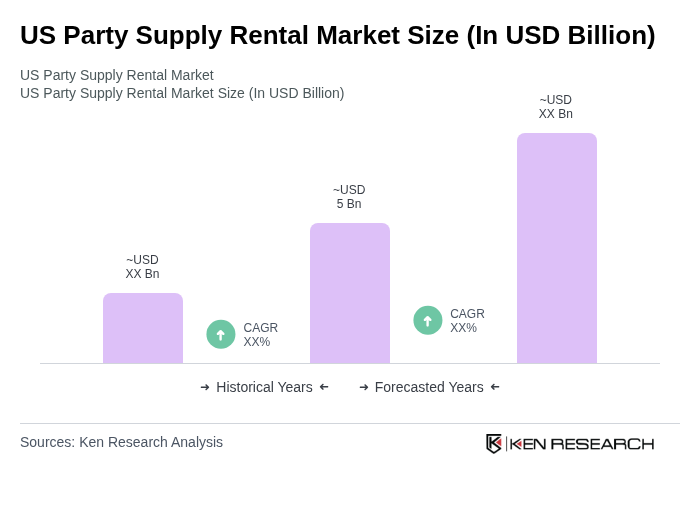
- The US Party Supply Rental Market is valued at USD 5 billion, based on a five-year historical analysis. This growth is primarily driven by the increasing demand for event planning services, a rise in disposable income, and a growing trend towards renting rather than purchasing party supplies. The market has seen a significant uptick in consumer spending on events, leading to a robust rental market.
- Key players in this market are concentrated in major metropolitan areas such as New York, Los Angeles, and Chicago. These cities dominate due to their large populations, high frequency of events, and a vibrant culture of celebrations and gatherings. The presence of numerous event planners and corporate clients in these regions further fuels the demand for party supply rentals.
- In recent years, there has been growing regulatory and customer pressure for eco-friendly practices within the party supply rental industry, encouraging companies to adopt greener practices and reduce their environmental footprint.
US Party Supply Rental Market Segmentation
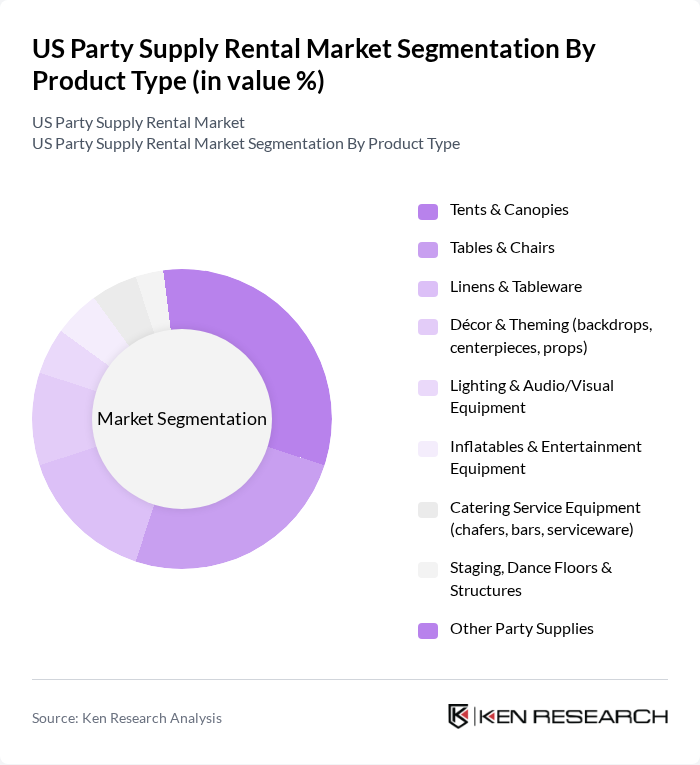
By Product Type:The product type segmentation includes various categories such as Tents & Canopies, Tables & Chairs, Linens & Tableware, Décor & Theming, Lighting & Audio/Visual Equipment, Inflatables & Entertainment Equipment, Catering Service Equipment, Staging, Dance Floors & Structures, and Other Party Supplies. Among these, Tents & Canopies and Tables & Chairs are the leading subsegments due to their essential role in outdoor and indoor events, respectively. The demand for these items is driven by the increasing number of weddings, corporate events, and social gatherings.
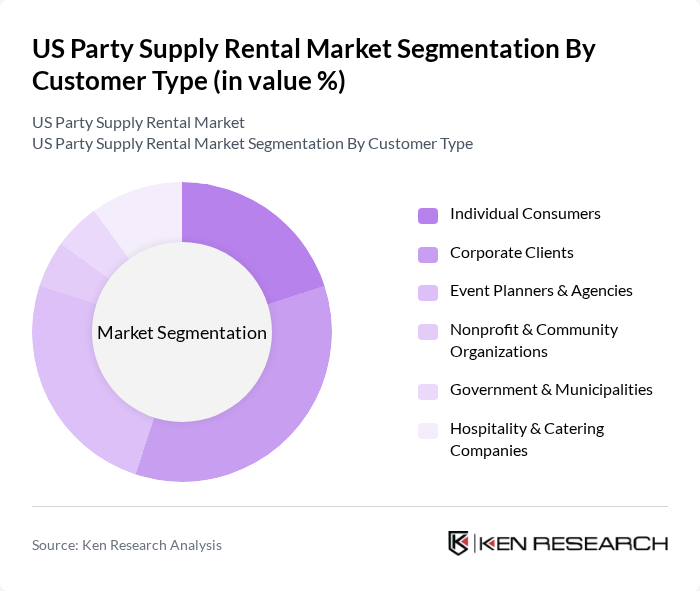
By Customer Type:The customer type segmentation includes Individual Consumers, Corporate Clients, Event Planners & Agencies, Nonprofit & Community Organizations, Government & Municipalities, and Hospitality & Catering Companies. Corporate Clients and Event Planners & Agencies are the dominant segments, driven by the increasing number of corporate events and the professionalization of event planning services. These segments are characterized by higher spending and a preference for comprehensive rental solutions.
US Party Supply Rental Market Competitive Landscape
The US Party Supply Rental Market is characterized by a dynamic mix of regional and international players. Leading participants such as Party City Holdings Inc., CORT Party Rental, Bright Event Rentals LLC, All Occasions Party Rental, American Party Rental, A Classic Party Rental, Party Reflections Inc., Big D Party Rentals, Baker Party Rentals, Avalon Tent & Party, Premiere Events, Ventura Rental Center, Taylor Rental, Pleasanton Rentals, Reventals Event Rentals contribute to innovation, geographic expansion, and service delivery in this space.
US Party Supply Rental Market Industry Analysis
Growth Drivers
- Increasing Demand for Event Personalization:The US party supply rental market is experiencing a surge in demand for personalized events, with 70% of consumers preferring customized experiences. This trend is supported by a report from the Event Marketing Institute, which indicates that 60% of event planners are focusing on unique themes and tailored services. As disposable income rises, individuals are willing to invest more in creating memorable, personalized events, driving growth in the rental sector.
- Rise in Disposable Income:The US disposable personal income is projected to reach $20.1 trillion in future, reflecting a 4.5% increase from the previous period. This rise enables consumers to allocate more funds towards event planning and party supplies. According to the Bureau of Economic Analysis, increased disposable income correlates with higher spending on leisure activities, including parties and events, thus boosting the demand for rental services in the party supply market.
- Growth of the Event Planning Industry:The event planning industry is expected to generate $1.6 billion in revenue in future, marking a 5% growth from the previous period. This growth is driven by an increase in corporate events, weddings, and social gatherings. The International Live Events Association reports that 80% of event planners are expanding their services, which directly benefits the party supply rental market as more events require diverse rental options to meet client needs.
Market Challenges
- Seasonal Fluctuations in Demand:The party supply rental market faces significant seasonal demand fluctuations, with peak seasons around summer and holidays. According to IBISWorld, this results in a 45% increase in demand during peak months, while off-peak months see a decline of up to 25%. Such variability complicates inventory management and can lead to revenue instability for rental companies, impacting their overall profitability.
- High Competition Among Rental Companies:The US party supply rental market is highly competitive, with over 5,500 rental companies vying for market share. This saturation leads to price wars, reducing profit margins. A 2024 industry analysis by MarketResearch.com indicates that 60% of companies are struggling to differentiate their offerings, which can hinder growth and innovation in the sector, making it challenging for new entrants to establish themselves.
US Party Supply Rental Market Future Outlook
The US party supply rental market is poised for continued growth, driven by evolving consumer preferences and technological advancements. As event personalization becomes increasingly important, companies that leverage data analytics to tailor their offerings will gain a competitive edge. Additionally, the integration of eco-friendly practices and sustainable products will resonate with environmentally conscious consumers, further enhancing market appeal. The rise of virtual events may also create new avenues for rental services, expanding the market's reach and potential customer base.
Market Opportunities
- Expansion into Corporate Events:The corporate event sector is projected to grow by 6% in future, presenting a significant opportunity for party supply rental companies. By targeting corporate clients, businesses can diversify their offerings and increase revenue streams, as corporate events often require extensive rental services for meetings, conferences, and team-building activities.
- Development of Eco-Friendly Rental Options:With 75% of consumers expressing a preference for sustainable products, the development of eco-friendly rental options can attract environmentally conscious customers. Companies that invest in biodegradable materials and sustainable practices can differentiate themselves in the market, tapping into a growing segment that prioritizes sustainability in their event planning.
Scope of the Report
| Segment | Sub-Segments |
|---|---|
| By Product Type | Tents & Canopies Tables & Chairs Linens & Tableware Décor & Theming (backdrops, centerpieces, props) Lighting & Audio/Visual Equipment Inflatables & Entertainment Equipment Catering Service Equipment (chafers, bars, serviceware) Staging, Dance Floors & Structures Other Party Supplies |
| By Customer Type | Individual Consumers Corporate Clients Event Planners & Agencies Nonprofit & Community Organizations Government & Municipalities Hospitality & Catering Companies |
| By Event Type | Weddings & Social Events Corporate Events & Conferences Private Parties (birthdays, graduations, baby & bridal showers) Festivals, Fairs & Community Events Trade Shows & Exhibitions School & University Events Other Special Events |
| By Rental Duration | Single?Day Rentals Multi?Day / Weekend Rentals Long?Term / Seasonal Rentals Recurring / Contract?Based Rentals |
| By Service Offering | Dry Hire (rental only) Delivery, Setup & Teardown Full?Service Event Production Design & Customization Services On?site Support & Coordination |
| By Booking Channel | Offline / Traditional (showrooms, phone, walk?ins) Company?Owned Online Platforms Third?Party Marketplaces & Aggregators Event Planner / Venue Referral Networks |
| By Geographic Focus | Local / Single?Metro Operators Regional / Multi?State Operators National Players |
Key Target Audience
Investors and Venture Capitalist Firms
Government and Regulatory Bodies (e.g., Small Business Administration, Federal Trade Commission)
Event Planners and Coordinators
Corporate Event Organizers
Wedding Planners and Bridal Consultants
Non-Profit Organizations and Charitable Event Coordinators
Hospitality and Venue Management Companies
Insurance Providers and Risk Management Firms
Players Mentioned in the Report:
Party City Holdings Inc.
CORT Party Rental
Bright Event Rentals LLC
All Occasions Party Rental
American Party Rental
A Classic Party Rental
Party Reflections Inc.
Big D Party Rentals
Baker Party Rentals
Avalon Tent & Party
Premiere Events
Ventura Rental Center
Taylor Rental
Pleasanton Rentals
Reventals Event Rentals
Table of Contents
Market Assessment Phase
1. Executive Summary and Approach
2. US Party Supply Rental Market Overview
2.1 Key Insights and Strategic Recommendations
2.2 US Party Supply Rental Market Overview
2.3 Definition and Scope
2.4 Evolution of Market Ecosystem
2.5 Timeline of Key Regulatory Milestones
2.6 Value Chain & Stakeholder Mapping
2.7 Business Cycle Analysis
2.8 Policy & Incentive Landscape
3. US Party Supply Rental Market Analysis
3.1 Growth Drivers
3.1.1 Increasing demand for event personalization
3.1.2 Rise in disposable income
3.1.3 Growth of the event planning industry
3.1.4 Expansion of online rental platforms
3.2 Market Challenges
3.2.1 Seasonal fluctuations in demand
3.2.2 High competition among rental companies
3.2.3 Logistics and transportation issues
3.2.4 Inventory management complexities
3.3 Market Opportunities
3.3.1 Expansion into corporate events
3.3.2 Development of eco-friendly rental options
3.3.3 Partnerships with event planners
3.3.4 Utilization of technology for customer engagement
3.4 Market Trends
3.4.1 Increasing use of social media for marketing
3.4.2 Customization of rental packages
3.4.3 Growth in DIY event planning
3.4.4 Focus on sustainability in product offerings
3.5 Government Regulation
3.5.1 Safety regulations for rental equipment
3.5.2 Tax incentives for small businesses
3.5.3 Environmental regulations on materials
3.5.4 Licensing requirements for rental businesses
4. SWOT Analysis
5. Stakeholder Analysis
6. Porter's Five Forces Analysis
7. US Party Supply Rental Market Market Size, 2019-2024
7.1 By Value
7.2 By Volume
7.3 By Average Selling Price
8. US Party Supply Rental Market Segmentation
8.1 By Product Type
8.1.1 Tents & Canopies
8.1.2 Tables & Chairs
8.1.3 Linens & Tableware
8.1.4 Décor & Theming (backdrops, centerpieces, props)
8.1.5 Lighting & Audio/Visual Equipment
8.1.6 Inflatables & Entertainment Equipment
8.1.7 Catering Service Equipment (chafers, bars, serviceware)
8.1.8 Staging, Dance Floors & Structures
8.1.9 Other Party Supplies
8.2 By Customer Type
8.2.1 Individual Consumers
8.2.2 Corporate Clients
8.2.3 Event Planners & Agencies
8.2.4 Nonprofit & Community Organizations
8.2.5 Government & Municipalities
8.2.6 Hospitality & Catering Companies
8.3 By Event Type
8.3.1 Weddings & Social Events
8.3.2 Corporate Events & Conferences
8.3.3 Private Parties (birthdays, graduations, baby & bridal showers)
8.3.4 Festivals, Fairs & Community Events
8.3.5 Trade Shows & Exhibitions
8.3.6 School & University Events
8.3.7 Other Special Events
8.4 By Rental Duration
8.4.1 Single?Day Rentals
8.4.2 Multi?Day / Weekend Rentals
8.4.3 Long?Term / Seasonal Rentals
8.4.4 Recurring / Contract?Based Rentals
8.5 By Service Offering
8.5.1 Dry Hire (rental only)
8.5.2 Delivery, Setup & Teardown
8.5.3 Full?Service Event Production
8.5.4 Design & Customization Services
8.5.5 On?site Support & Coordination
8.6 By Booking Channel
8.6.1 Offline / Traditional (showrooms, phone, walk?ins)
8.6.2 Company?Owned Online Platforms
8.6.3 Third?Party Marketplaces & Aggregators
8.6.4 Event Planner / Venue Referral Networks
8.7 By Geographic Focus
8.7.1 Local / Single?Metro Operators
8.7.2 Regional / Multi?State Operators
8.7.3 National Players
9. US Party Supply Rental Market Competitive Analysis
9.1 Market Share of Key Players
9.2 Cross Comparison of Key Players
9.2.1 Company Name
9.2.2 Group Size (Large, Medium, or Small as per industry convention)
9.2.3 Estimated US Party Rental Revenue
9.2.4 Historical Revenue CAGR (3–5 Years)
9.2.5 EBITDA Margin
9.2.6 Average Order Value per Event
9.2.7 Utilization Rate of Rental Inventory
9.2.8 Inventory Turnover (Events per Asset per Year)
9.2.9 On?Time Delivery & Setup Rate
9.2.10 Customer Retention / Repeat Booking Rate
9.2.11 Digital Booking Share (online vs offline)
9.2.12 Geographic Coverage (number of locations / states served)
9.2.13 Product & Service Breadth Index
9.2.14 Net Promoter Score / Customer Satisfaction Index
9.3 SWOT Analysis of Top Players
9.4 Pricing Analysis
9.5 Detailed Profile of Major Companies
9.5.1 Party City Holdings Inc.
9.5.2 CORT Party Rental
9.5.3 Bright Event Rentals LLC
9.5.4 All Occasions Party Rental
9.5.5 American Party Rental
9.5.6 A Classic Party Rental
9.5.7 Party Reflections Inc.
9.5.8 Big D Party Rentals
9.5.9 Baker Party Rentals
9.5.10 Avalon Tent & Party
9.5.11 Premiere Events
9.5.12 Ventura Rental Center
9.5.13 Taylor Rental
9.5.14 Pleasanton Rentals
9.5.15 Reventals Event Rentals
10. US Party Supply Rental Market End-User Analysis
10.1 Procurement Behavior of Key Ministries
10.1.1 Budget Allocation for Events
10.1.2 Decision-Making Process
10.1.3 Preferred Suppliers
10.1.4 Contracting Procedures
10.2 Corporate Spend on Infrastructure & Energy
10.2.1 Event Budgeting Trends
10.2.2 Investment in Event Technology
10.2.3 Spending on Sustainability Initiatives
10.3 Pain Point Analysis by End-User Category
10.3.1 Cost Management
10.3.2 Quality of Equipment
10.3.3 Timeliness of Delivery
10.3.4 Customer Service Issues
10.4 User Readiness for Adoption
10.4.1 Awareness of Rental Options
10.4.2 Willingness to Rent vs. Buy
10.4.3 Feedback on Rental Experiences
10.5 Post-Deployment ROI and Use Case Expansion
10.5.1 Measurement of Event Success
10.5.2 Repeat Business Potential
10.5.3 Expansion into New Event Types
11. US Party Supply Rental Market Future Size, 2025-2030
11.1 By Value
11.2 By Volume
11.3 By Average Selling Price
Go-To-Market Strategy Phase
1. Whitespace Analysis + Business Model Canvas
1.1 Market Gaps Identification
1.2 Business Model Components
2. Marketing and Positioning Recommendations
2.1 Branding Strategies
2.2 Product USPs
3. Distribution Plan
3.1 Urban Retail vs Rural NGO Tie-ups
4. Channel & Pricing Gaps
4.1 Underserved Routes
4.2 Pricing Bands
5. Unmet Demand & Latent Needs
5.1 Category Gaps
5.2 Consumer Segments
6. Customer Relationship
6.1 Loyalty Programs
6.2 After-sales Service
7. Value Proposition
7.1 Sustainability
7.2 Integrated Supply Chains
8. Key Activities
8.1 Regulatory Compliance
8.2 Branding
8.3 Distribution Setup
9. Entry Strategy Evaluation
9.1 Domestic Market Entry Strategy
9.1.1 Product Mix
9.1.2 Pricing Band
9.1.3 Packaging
9.2 Export Entry Strategy
9.2.1 Target Countries
9.2.2 Compliance Roadmap
10. Entry Mode Assessment
10.1 JV
10.2 Greenfield
10.3 M&A
10.4 Distributor Model
11. Capital and Timeline Estimation
11.1 Capital Requirements
11.2 Timelines
12. Control vs Risk Trade-Off
12.1 Ownership vs Partnerships
13. Profitability Outlook
13.1 Breakeven Analysis
13.2 Long-term Sustainability
14. Potential Partner List
14.1 Distributors
14.2 JVs
14.3 Acquisition Targets
15. Execution Roadmap
15.1 Phased Plan for Market Entry
15.1.1 Market Setup
15.1.2 Market Entry
15.1.3 Growth Acceleration
15.1.4 Scale & Stabilize
15.2 Key Activities and Milestones
15.2.1 Activity Timeline
15.2.2 Milestone Tracking
Research Methodology
Phase 1: Approach1
Desk Research
- Analysis of industry reports from trade associations and market research firms
- Review of government publications and economic data related to the event rental sector
- Examination of online platforms and social media trends in party supply rentals
Primary Research
- Interviews with owners and managers of party supply rental businesses
- Surveys targeting event planners and coordinators to understand demand trends
- Field visits to rental locations to observe inventory and customer interactions
Validation & Triangulation
- Cross-validation of findings with multiple data sources, including sales data and consumer feedback
- Triangulation of insights from primary interviews with secondary research findings
- Sanity checks through expert panel discussions with industry veterans
Phase 2: Market Size Estimation1
Top-down Assessment
- Estimation of market size based on overall event industry growth and spending
- Segmentation of the market by type of events (weddings, corporate events, parties)
- Incorporation of seasonal trends and regional variations in rental demand
Bottom-up Modeling
- Collection of data on rental rates and average transaction sizes from key players
- Estimation of total rental volume based on historical data and growth projections
- Analysis of customer demographics and preferences to refine market estimates
Forecasting & Scenario Analysis
- Development of forecasts using historical growth rates and market drivers
- Scenario analysis based on economic conditions, consumer behavior, and event trends
- Creation of baseline, optimistic, and pessimistic projections through 2030
Phase 3: CATI Sample Composition1
| Scope Item/Segment | Sample Size | Target Respondent Profiles |
|---|---|---|
| Wedding Event Rentals | 120 | Wedding Planners, Venue Managers |
| Corporate Event Rentals | 110 | Corporate Event Coordinators, HR Managers |
| Private Party Rentals | 90 | Homeowners, Party Planners |
| Festival and Fair Rentals | 75 | Event Organizers, City Officials |
| Non-Profit Event Rentals | 65 | Non-Profit Coordinators, Fundraising Managers |
Frequently Asked Questions
What is the current value of the US Party Supply Rental Market?
The US Party Supply Rental Market is valued at approximately USD 5 billion, reflecting a significant growth driven by increased consumer spending on events and a shift towards renting rather than purchasing party supplies.
What factors are driving growth in the US Party Supply Rental Market?
Which cities dominate the US Party Supply Rental Market?
What are the main product types in the party supply rental market?
Other Regional/Country Reports
Indonesia Party Supply Rental Market
Malaysia Party Supply Rental Market
KSA Party Supply Rental Market
APAC Party Supply Rental Market
SEA Party Supply Rental Market
Other Adjacent Reports
Belgium Event Planning Market
Middle East Catering Services Market Report Size Share Growth Drivers Trends Opportunities & Forecast 2025–2030USA Wedding Services Market Report Size Share Growth Drivers Trends Opportunities & Forecast 2025–2030Mexico Corporate Event Management Market
Mexico Audio Visual Equipment Rental Market
Oman Tent and Canopy Manufacturing Market
Kuwait Party Decoration Retail Market
South Korea Inflatable Entertainment Market
UAE Hospitality Equipment Rental Market
Germany Eco-Friendly Supplies Market
Why Buy From Us?

What makes us stand out is that our consultants follow Robust, Refine and Result (RRR) methodology. Robust for clear definitions, approaches and sanity checking, Refine for differentiating respondents' facts and opinions, and Result for presenting data with story.

We have set a benchmark in the industry by offering our clients with syndicated and customized market research reports featuring coverage of entire market as well as meticulous research and analyst insights.

While we don't replace traditional research, we flip the method upside down. Our dual approach of Top Bottom & Bottom Top ensures quality deliverable by not just verifying company fundamentals but also looking at the sector and macroeconomic factors.

With one step in the future, our research team constantly tries to show you the bigger picture. We help with some of the tough questions you may encounter along the way: How is the industry positioned? Best marketing channel? KPI's of competitors? By aligning every element, we help maximize success.

Our report gives you instant access to the answers and sources that other companies might choose to hide. We elaborate each steps of research methodology we have used and showcase you the sample size to earn your trust.

If you need any support, we are here! We pride ourselves on universe strength, data quality, and quick, friendly, and professional service.