Ken Research Logo

US Amphibious Excavator Market

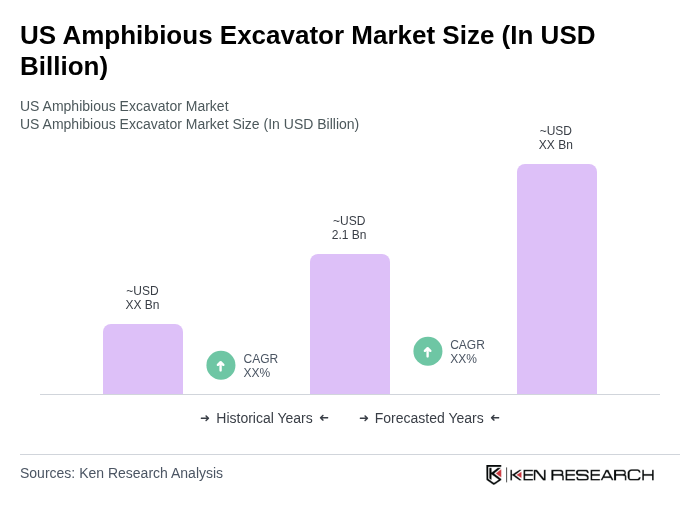
The US Amphibious Excavator Market, worth USD 2.1 Bn, grows due to demand in dredging, coastal resilience, and environmental projects across key states.

Region:North America

Author(s):Dev

Product Code:KRAD5143

Pages:93

Published On:December 2025
About the Report

Base Year 2024

US Amphibious Excavator Market Overview

  • The US Amphibious Excavator Market is valued at USD 2.1 billion, based on a five-year historical analysis and recent industry estimates for the United States share of the global amphibious excavators market. This growth is primarily driven by increasing demand for specialized excavation equipment in wetland restoration, flood control, coastal resilience, and water-adjacent infrastructure projects, supported by rising investments in dredging, shoreline protection, and land reclamation. The market has seen a surge in investments from both public and private sectors, with strong emphasis on environmental sustainability, efficient land and water management, and the use of multipurpose heavy equipment that can operate in both terrestrial and aquatic environments.
  • Key demand hubs in this market include states such as Florida, Louisiana, California, and other Gulf Coast and Atlantic coastal states, which account for a significant share of wetland and coastal areas in the US and are active in marsh restoration, levee and canal maintenance, and hurricane/flood mitigation works. The presence of major construction, dredging, and marine engineering contractors in these regions, combined with extensive port, inland waterway, and coastal infrastructure, further enhances their market position, as they require advanced amphibious equipment for dredging, bank reinforcement, habitat restoration, and navigation channel maintenance.
  • In 2023, the US regulatory environment for heavy off-road equipment used in sensitive and wetland areas continued to tighten, with amphibious excavators required to comply with federal emissions and environmental protection standards when operating in such locations. The key binding framework is the United States Environmental Protection Agency’s “Control of Emissions of Air Pollution from Nonroad Diesel Engines” (40 CFR Part 89 and subsequent updates under Tier 4 standards), issued by the US Environmental Protection Agency, which sets limits on nitrogen oxides (NOx), particulate matter (PM), hydrocarbons, and carbon monoxide for nonroad diesel engines commonly used in amphibious excavators, and requires the use of certified engines, aftertreatment systems, and compliant fuels in order to operate legally. In parallel, projects in wetlands and other sensitive aquatic environments must meet operational guidelines under federal wetland permitting and dredge-and-fill regulations, such as Section 404 of the Clean Water Act administered by the US Army Corps of Engineers and the EPA, which impose conditions on methods, equipment use, and mitigation to protect water quality and aquatic habitats during excavation activities.
US Amphibious Excavator Market Size

US Amphibious Excavator Market Segmentation

By Type:The market is segmented into various types of amphibious excavators, including small, medium, and large excavators, as well as pontoon conversion kits and add-on pontoons. This structure aligns with global industry practice, where machines are differentiated primarily by operating weight and undercarriage configuration. Each type serves different operational needs, with small excavators (generally below 10 tons) being favored for tight spaces, shallow canals, and urban or confined wetland works, while medium and large models are preferred for heavy-duty dredging, river training, port maintenance, and major land reclamation or flood control projects where higher reach and bucket capacity are required.
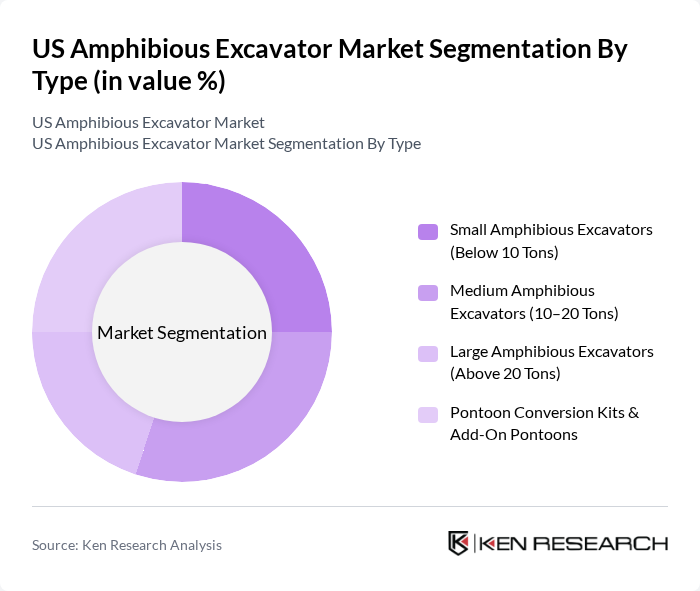
US Amphibious Excavator Market segmentation by Type.

By End-User:The end-user segmentation includes construction and infrastructure contractors, dredging and marine engineering companies, environmental and wetland restoration services, government agencies, and public works departments, as well as oil and gas utilities. This breakdown reflects how amphibious excavators are deployed across channel deepening, shoreline reinforcement, bridge and road approaches, pipeline and cable corridors, habitat restoration, and municipal stormwater or drainage management. Each end-user has distinct requirements that drive the demand for amphibious excavators, with contractors and dredging firms emphasizing productivity and versatility, environmental service providers prioritizing low-impact access to sensitive sites, and public agencies focusing on long-term asset maintenance and resilience against flooding and erosion.
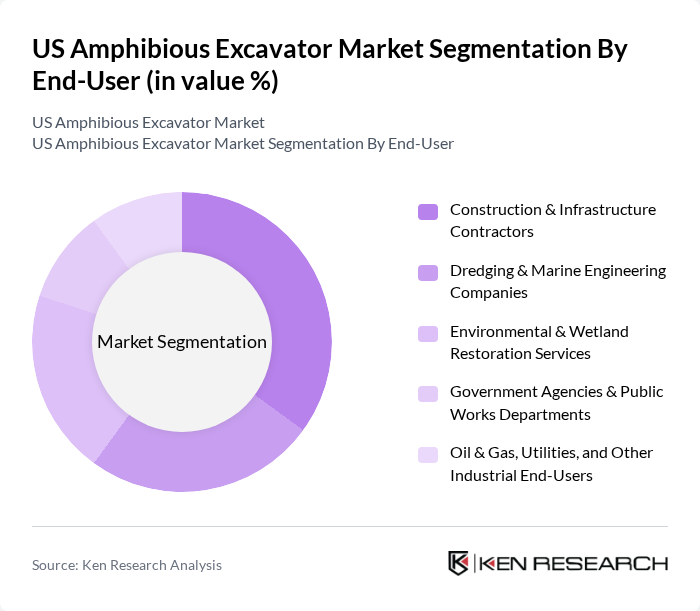
US Amphibious Excavator Market segmentation by End-User.

US Amphibious Excavator Market Competitive Landscape

The US Amphibious Excavator Market is characterized by a dynamic mix of regional and international players. Leading participants such as Wilco Manufacturing, LLC (USA), Wetland Equipment Company, Inc. (USA), Wilson Marsh Equipment, Inc. (USA), EIK Engineering Sdn Bhd (Amphibious Excavator Attachments – US Presence), REMU Oy (Amphibious Excavators – US Distribution), Bell Dredging Pumps (Bell Amphibious Excavators – US Projects), Aquatic Plant Management, Inc. (US Amphibious Equipment Operator & Fleet Owner), Marsh Buggies, Inc. (USA), Normrock Industries Inc. (North America – US Supply), Caterpillar Inc. (Amphibious Excavator Conversions via US Partners), Volvo Construction Equipment (US Amphibious Excavator Deployments), Hyundai Construction Equipment Americas, Inc., SANY America Inc., Doosan Bobcat North America, XCMG North America Corporation contribute to innovation, geographic expansion, and service delivery in this space.

Wilco Manufacturing, LLC

1969

Louisiana, USA

Wetland Equipment Company, Inc.

2000

Florida, USA

Wilson Marsh Equipment, Inc.

1988

California, USA

EIK Engineering Sdn Bhd

2005

Malaysia (US Presence)

REMU Oy

1997

Finland (US Distribution)

Company

Establishment Year

Headquarters

US Amphibious Excavator Revenue

Amphibious Segment Revenue Growth Rate (CAGR)

Installed Base / Fleet Size in the US

US Market Share in Amphibious Excavators (By Units)

Average Selling Price (ASP) by Key Size Class

Product Portfolio Breadth (Type & Application Coverage)

US Amphibious Excavator Market Industry Analysis

Growth Drivers

  • Increasing Demand for Efficient Dredging Solutions:The US dredging market is projected to reach $3.5 billion by 2024, driven by the need for efficient sediment removal in waterways. This demand is fueled by the increasing frequency of flooding events, which necessitate regular dredging to maintain navigability. Additionally, the US Army Corps of Engineers reported a 15% increase in dredging projects over the past two years, highlighting the growing reliance on amphibious excavators for effective and timely dredging operations.
  • Expansion of Infrastructure Projects:The US government allocated $1.2 trillion for infrastructure development under the Infrastructure Investment and Jobs Act, which includes significant funding for waterway and coastal restoration projects. This investment is expected to create a surge in demand for amphibious excavators, as they are essential for constructing and maintaining infrastructure in wetland areas. Furthermore, the American Society of Civil Engineers estimates that 30% of this funding will directly support projects requiring specialized excavation equipment, further driving market growth.
  • Rising Environmental Regulations:The US Environmental Protection Agency (EPA) has implemented stricter regulations on waterway maintenance and habitat restoration, mandating the use of advanced excavation technologies. In future, compliance costs for environmental regulations are expected to exceed $2.2 billion, pushing contractors to adopt more efficient and eco-friendly excavation solutions. As a result, the demand for amphibious excavators, which meet these regulatory standards, is anticipated to increase significantly, fostering market growth.

Market Challenges

  • High Initial Investment Costs:The average cost of an amphibious excavator ranges from $300,000 to $1 million, presenting a significant barrier for small to medium-sized contractors. This high upfront investment can deter potential buyers, especially in a competitive market where profit margins are tight. Additionally, the need for ongoing maintenance and operational costs can further strain budgets, limiting the adoption of these specialized machines in the industry.
  • Limited Availability of Skilled Operators:The US construction industry faces a shortage of skilled labor, with an estimated 400,000 positions unfilled in future. This shortage extends to operators of specialized equipment like amphibious excavators, which require specific training and expertise. The lack of qualified personnel can lead to project delays and increased operational costs, posing a significant challenge for companies looking to leverage these advanced excavation technologies effectively.

US Amphibious Excavator Market Future Outlook

The US amphibious excavator market is poised for significant growth, driven by increasing investments in infrastructure and environmental restoration projects. As regulations become more stringent, the demand for advanced, eco-friendly excavation solutions will rise. Additionally, technological advancements, such as automation and IoT integration, will enhance operational efficiency. Companies that adapt to these trends and invest in workforce training will likely gain a competitive edge, positioning themselves favorably in a rapidly evolving market landscape.

Market Opportunities

  • Growth in Wetland Restoration Projects:The US government has committed over $1 billion to wetland restoration initiatives in future, creating a substantial opportunity for amphibious excavator manufacturers. These projects require specialized equipment capable of operating in sensitive environments, thus driving demand for advanced excavation solutions that can meet ecological standards while ensuring project efficiency.
  • Increasing Adoption of Eco-Friendly Equipment:With a growing emphasis on sustainability, the market for eco-friendly excavation equipment is expanding. In future, it is estimated that 25% of new construction projects will prioritize green technologies, including low-emission amphibious excavators. This shift presents a lucrative opportunity for manufacturers to innovate and capture market share by offering environmentally responsible solutions that comply with emerging regulations.

Scope of the Report

SegmentSub-Segments
By Type

Small Amphibious Excavators (Below 10 Tons)

Medium Amphibious Excavators (10–20 Tons)

Large Amphibious Excavators (Above 20 Tons)

Pontoon Conversion Kits & Add-On Pontoons

By End-User

Construction & Infrastructure Contractors

Dredging & Marine Engineering Companies

Environmental & Wetland Restoration Services

Government Agencies & Public Works Departments

Oil & Gas, Utilities, and Other Industrial End-Users

By Application

Dredging & Waterway Maintenance

Flood Control & Disaster Management

Wetland Restoration & Habitat Management

Pipeline & Cable Installation in Marshlands

Land Reclamation & Shoreline Protection

By Payload/Operating Weight Class

Below 10 Tons

–20 Tons

–30 Tons

Above 30 Tons

By Region

Northeast

Midwest

South

West

By Technology / Powertrain

Conventional Diesel-Hydraulic

Advanced Telematics-Enabled Systems

Hybrid / Electric-Assisted Amphibious Excavators

Retrofit & Specialized Attachments

By Ownership / Financing Model

Direct Purchase (Capex)

Operating Lease / Rental

Dealer & OEM Financing Programs

Government-Backed and Public-Project Financing

Key Target Audience

Investors and Venture Capitalist Firms

Government and Regulatory Bodies (e.g., U.S. Army Corps of Engineers, Environmental Protection Agency)

Manufacturers and Producers

Construction and Infrastructure Companies

Marine and Aquatic Engineering Firms

Environmental Consulting Firms

Industry Associations (e.g., Association of Equipment Manufacturers)

Financial Institutions

Players Mentioned in the Report:

Wilco Manufacturing, LLC (USA)

Wetland Equipment Company, Inc. (USA)

Wilson Marsh Equipment, Inc. (USA)

EIK Engineering Sdn Bhd (Amphibious Excavator Attachments US Presence)

REMU Oy (Amphibious Excavators US Distribution)

Bell Dredging Pumps (Bell Amphibious Excavators US Projects)

Aquatic Plant Management, Inc. (US Amphibious Equipment Operator & Fleet Owner)

Marsh Buggies, Inc. (USA)

Normrock Industries Inc. (North America US Supply)

Caterpillar Inc. (Amphibious Excavator Conversions via US Partners)

Volvo Construction Equipment (US Amphibious Excavator Deployments)

Hyundai Construction Equipment Americas, Inc.

SANY America Inc.

Doosan Bobcat North America

XCMG North America Corporation

Table of Contents

Market Assessment Phase

1. Executive Summary and Approach


2. US Amphibious Excavator Market Overview

2.1 Key Insights and Strategic Recommendations

2.2 US Amphibious Excavator Market Overview

2.3 Definition and Scope

2.4 Evolution of Market Ecosystem

2.5 Timeline of Key Regulatory Milestones

2.6 Value Chain & Stakeholder Mapping

2.7 Business Cycle Analysis

2.8 Policy & Incentive Landscape


3. US Amphibious Excavator Market Analysis

3.1 Growth Drivers

3.1.1 Increasing demand for efficient dredging solutions
3.1.2 Expansion of infrastructure projects
3.1.3 Rising environmental regulations
3.1.4 Technological advancements in excavation equipment

3.2 Market Challenges

3.2.1 High initial investment costs
3.2.2 Limited availability of skilled operators
3.2.3 Regulatory compliance complexities
3.2.4 Competition from traditional excavation methods

3.3 Market Opportunities

3.3.1 Growth in wetland restoration projects
3.3.2 Increasing adoption of eco-friendly equipment
3.3.3 Expansion into emerging markets
3.3.4 Partnerships with government agencies

3.4 Market Trends

3.4.1 Shift towards automation in excavation
3.4.2 Integration of IoT in machinery
3.4.3 Focus on sustainability and reduced emissions
3.4.4 Customization of equipment for specific applications

3.5 Government Regulation

3.5.1 Environmental protection regulations
3.5.2 Safety standards for construction equipment
3.5.3 Licensing requirements for operators
3.5.4 Incentives for using eco-friendly machinery

4. SWOT Analysis


5. Stakeholder Analysis


6. Porter's Five Forces Analysis


7. US Amphibious Excavator Market Market Size, 2019-2024

7.1 By Value

7.2 By Volume

7.3 By Average Selling Price


8. US Amphibious Excavator Market Segmentation

8.1 By Type

8.1.1 Small Amphibious Excavators (Below 10 Tons)
8.1.2 Medium Amphibious Excavators (10–20 Tons)
8.1.3 Large Amphibious Excavators (Above 20 Tons)
8.1.4 Pontoon Conversion Kits & Add-On Pontoons

8.2 By End-User

8.2.1 Construction & Infrastructure Contractors
8.2.2 Dredging & Marine Engineering Companies
8.2.3 Environmental & Wetland Restoration Services
8.2.4 Government Agencies & Public Works Departments
8.2.5 Oil & Gas, Utilities, and Other Industrial End-Users

8.3 By Application

8.3.1 Dredging & Waterway Maintenance
8.3.2 Flood Control & Disaster Management
8.3.3 Wetland Restoration & Habitat Management
8.3.4 Pipeline & Cable Installation in Marshlands
8.3.5 Land Reclamation & Shoreline Protection

8.4 By Payload/Operating Weight Class

8.4.1 Below 10 Tons
8.4.2 10–20 Tons
8.4.3 20–30 Tons
8.4.4 Above 30 Tons

8.5 By Region

8.5.1 Northeast
8.5.2 Midwest
8.5.3 South
8.5.4 West

8.6 By Technology / Powertrain

8.6.1 Conventional Diesel-Hydraulic
8.6.2 Advanced Telematics-Enabled Systems
8.6.3 Hybrid / Electric-Assisted Amphibious Excavators
8.6.4 Retrofit & Specialized Attachments

8.7 By Ownership / Financing Model

8.7.1 Direct Purchase (Capex)
8.7.2 Operating Lease / Rental
8.7.3 Dealer & OEM Financing Programs
8.7.4 Government-Backed and Public-Project Financing

9. US Amphibious Excavator Market Competitive Analysis

9.1 Market Share of Key Players

9.2 Cross Comparison of Key Players

9.2.1 Company Name
9.2.2 US Amphibious Excavator Revenue
9.2.3 Amphibious Segment Revenue Growth Rate (CAGR)
9.2.4 Installed Base / Fleet Size in the US
9.2.5 US Market Share in Amphibious Excavators (By Units)
9.2.6 Average Selling Price (ASP) by Key Size Class
9.2.7 Product Portfolio Breadth (Type & Application Coverage)
9.2.8 Distribution & Dealer Network Coverage (Number of States Served)
9.2.9 Share of Sales via Rental & Leasing Channels
9.2.10 Backlog / Order Book for US Projects
9.2.11 After-Sales Service Footprint (Service Centers / Response Time)
9.2.12 R&D Intensity (R&D Spend as % of Amphibious Revenue)
9.2.13 Key US Reference Projects in Dredging & Wetland Restoration

9.3 SWOT Analysis of Top Players

9.4 Pricing Analysis

9.5 Detailed Profile of Major Companies

9.5.1 Wilco Manufacturing, LLC (USA)
9.5.2 Wetland Equipment Company, Inc. (USA)
9.5.3 Wilson Marsh Equipment, Inc. (USA)
9.5.4 EIK Engineering Sdn Bhd (Amphibious Excavator Attachments – US Presence)
9.5.5 REMU Oy (Amphibious Excavators – US Distribution)
9.5.6 Bell Dredging Pumps (Bell Amphibious Excavators – US Projects)
9.5.7 Aquatic Plant Management, Inc. (US Amphibious Equipment Operator & Fleet Owner)
9.5.8 Marsh Buggies, Inc. (USA)
9.5.9 Normrock Industries Inc. (North America – US Supply)
9.5.10 Caterpillar Inc. (Amphibious Excavator Conversions via US Partners)
9.5.11 Volvo Construction Equipment (US Amphibious Excavator Deployments)
9.5.12 Hyundai Construction Equipment Americas, Inc.
9.5.13 SANY America Inc.
9.5.14 Doosan Bobcat North America
9.5.15 XCMG North America Corporation

10. US Amphibious Excavator Market End-User Analysis

10.1 Procurement Behavior of Key Ministries

10.1.1 Federal Government Procurement Trends
10.1.2 State Government Procurement Strategies
10.1.3 Local Government Budget Allocations
10.1.4 Environmental Agency Procurement Practices

10.2 Corporate Spend on Infrastructure & Energy

10.2.1 Major Corporate Investments
10.2.2 Trends in Infrastructure Spending
10.2.3 Energy Sector Expenditure Patterns
10.2.4 Corporate Sustainability Initiatives

10.3 Pain Point Analysis by End-User Category

10.3.1 Construction Sector Challenges
10.3.2 Environmental Services Pain Points
10.3.3 Government Project Issues
10.3.4 Industrial Sector Concerns

10.4 User Readiness for Adoption

10.4.1 Awareness of Amphibious Excavators
10.4.2 Training and Skill Development Needs
10.4.3 Financial Readiness for Investment
10.4.4 Technological Adaptability

10.5 Post-Deployment ROI and Use Case Expansion

10.5.1 ROI Measurement Techniques
10.5.2 Case Studies of Successful Deployments
10.5.3 Expansion into New Use Cases
10.5.4 Long-term Benefits Analysis

11. US Amphibious Excavator Market Future Size, 2025-2030

11.1 By Value

11.2 By Volume

11.3 By Average Selling Price


Go-To-Market Strategy Phase

1. Whitespace Analysis + Business Model Canvas

1.1 Market Gaps Identification

1.2 Business Model Framework


2. Marketing and Positioning Recommendations

2.1 Branding Strategies

2.2 Product USPs


3. Distribution Plan

3.1 Urban Retail Strategies

3.2 Rural NGO Tie-ups


4. Channel & Pricing Gaps

4.1 Underserved Routes

4.2 Pricing Bands Analysis


5. Unmet Demand & Latent Needs

5.1 Category Gaps

5.2 Consumer Segments


6. Customer Relationship

6.1 Loyalty Programs

6.2 After-sales Service


7. Value Proposition

7.1 Sustainability Initiatives

7.2 Integrated Supply Chains


8. Key Activities

8.1 Regulatory Compliance

8.2 Branding Efforts

8.3 Distribution Setup


9. Entry Strategy Evaluation

9.1 Domestic Market Entry Strategy

9.1.1 Product Mix Considerations
9.1.2 Pricing Band Strategy
9.1.3 Packaging Options

9.2 Export Entry Strategy

9.2.1 Target Countries Identification
9.2.2 Compliance Roadmap Development

10. Entry Mode Assessment

10.1 Joint Ventures

10.2 Greenfield Investments

10.3 Mergers & Acquisitions

10.4 Distributor Model Evaluation


11. Capital and Timeline Estimation

11.1 Capital Requirements Analysis

11.2 Timelines for Market Entry


12. Control vs Risk Trade-Off

12.1 Ownership Considerations

12.2 Partnerships Evaluation


13. Profitability Outlook

13.1 Breakeven Analysis

13.2 Long-term Sustainability Strategies


14. Potential Partner List

14.1 Distributors Identification

14.2 Joint Ventures Opportunities

14.3 Acquisition Targets


15. Execution Roadmap

15.1 Phased Plan for Market Entry

15.1.1 Market Setup
15.1.2 Market Entry
15.1.3 Growth Acceleration
15.1.4 Scale & Stabilize

15.2 Key Activities and Milestones

15.2.1 Milestone Planning
15.2.2 Activity Tracking

Research Methodology

ApproachModellingSample

Phase 1: Approach1

Desk Research

  • Industry reports from government agencies and trade associations related to amphibious equipment
  • Market analysis publications focusing on construction and excavation sectors
  • Academic journals and white papers discussing technological advancements in amphibious excavators

Primary Research

  • Interviews with industry experts, including engineers and product managers from leading manufacturers
  • Surveys targeting end-users such as construction firms and environmental agencies
  • Field visits to construction sites utilizing amphibious excavators for firsthand observations

Validation & Triangulation

  • Cross-validation of data through multiple sources, including sales figures and market trends
  • Triangulation of insights from primary interviews with secondary data findings
  • Sanity checks conducted through expert panels comprising industry veterans

Phase 2: Market Size Estimation1

Top-down Assessment

  • Analysis of national infrastructure spending and its correlation with amphibious excavator demand
  • Segmentation of the market by application areas such as dredging, construction, and environmental restoration
  • Incorporation of regional growth trends and government initiatives promoting waterway projects

Bottom-up Modeling

  • Estimation of unit sales based on historical data from major amphibious excavator manufacturers
  • Operational cost analysis derived from pricing models of existing equipment in the market
  • Volume projections based on anticipated project pipelines in relevant sectors

Forecasting & Scenario Analysis

  • Multi-variable regression analysis incorporating economic indicators and construction activity forecasts
  • Scenario modeling based on potential regulatory changes affecting environmental projects
  • Development of baseline, optimistic, and pessimistic market growth scenarios through 2030

Phase 3: CATI Sample Composition1

Scope Item/SegmentSample SizeTarget Respondent Profiles
Construction Sector Utilization100Project Managers, Site Supervisors
Environmental Restoration Projects80Environmental Engineers, Project Coordinators
Dredging Operations70Operations Managers, Marine Contractors
Government Infrastructure Initiatives60Policy Makers, Urban Planners
Rental Services for Excavators90Rental Fleet Managers, Business Development Executives

Frequently Asked Questions

What is the current value of the US Amphibious Excavator Market?

The US Amphibious Excavator Market is valued at approximately USD 2.1 billion, reflecting a significant growth driven by increased demand for specialized excavation equipment in various environmental and infrastructure projects.

What factors are driving the growth of the US Amphibious Excavator Market?

Which regions in the US are the primary demand hubs for amphibious excavators?

What types of amphibious excavators are available in the market?

Other Regional/Country Reports

Indonesia Amphibious Excavator Market

Malaysia Amphibious Excavator Market

KSA Amphibious Excavator Market

APAC Amphibious Excavator Market

SEA Amphibious Excavator Market

Vietnam Amphibious Excavator Market

Other Adjacent Reports

Global dredging equipment market report size, share, growth drivers, trends, opportunities & forecast 2025–2030

South Africa Wetland Restoration Market

Japan Flood Control Systems Market

Brazil Coastal Protection Market

Japan Marine Construction Equipment Market

Germany Heavy Construction Machinery Market

Oman Environmental Remediation Market

Japan Waterway Maintenance Market

Philippines Land Reclamation Equipment Market

Vietnam Infrastructure Development Market

Why Buy From Us?

Refine Robust Result (RRR) Framework

What makes us stand out is that our consultants follow Robust, Refine and Result (RRR) methodology. Robust for clear definitions, approaches and sanity checking, Refine for differentiating respondents' facts and opinions, and Result for presenting data with story.

Our Reach Is Unmatched

We have set a benchmark in the industry by offering our clients with syndicated and customized market research reports featuring coverage of entire market as well as meticulous research and analyst insights.

Shifting the Research Paradigm

While we don't replace traditional research, we flip the method upside down. Our dual approach of Top Bottom & Bottom Top ensures quality deliverable by not just verifying company fundamentals but also looking at the sector and macroeconomic factors.

More Insights-Better Decisions

With one step in the future, our research team constantly tries to show you the bigger picture. We help with some of the tough questions you may encounter along the way: How is the industry positioned? Best marketing channel? KPI's of competitors? By aligning every element, we help maximize success.

Transparency and Trust

Our report gives you instant access to the answers and sources that other companies might choose to hide. We elaborate each steps of research methodology we have used and showcase you the sample size to earn your trust.

Round the Clock Support

If you need any support, we are here! We pride ourselves on universe strength, data quality, and quick, friendly, and professional service.

Why Clients Choose Us?

400000+
Reports in repository
150+
Consulting projects a year
100+
Analysts
8000+
Client Queries in 2022








