About the Report
Base Year 2024US Commercial Vacuum Cleaner Market Overview
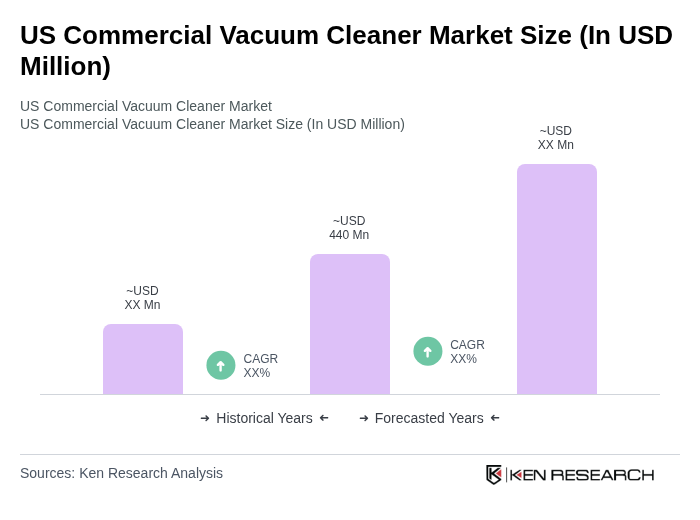
- The US Commercial Vacuum Cleaner Market is valued at USD 440 million, based on a five-year historical analysis. This growth is primarily driven by increasing demand for efficient cleaning solutions in commercial spaces, coupled with advancements in technology that enhance performance and user experience. The rise in health and hygiene awareness, especially post-pandemic, has further propelled the market as businesses seek to maintain cleanliness and safety standards. The adoption of robotic and cordless vacuum cleaners, which offer automation and convenience, is accelerating market expansion as businesses aim to reduce labor costs and improve cleaning efficacy in large commercial environments. Expanding e-commerce channels and rising disposable incomes among commercial enterprises are also facilitating access to a wide range of vacuum cleaner models .
- Key players in this market are concentrated in major urban centers such as New York, Los Angeles, and Chicago. These cities dominate due to their high density of commercial establishments, including offices, retail outlets, and hospitality venues, which require regular cleaning services. The presence of a diverse range of businesses in these metropolitan areas also fosters competition and innovation among vacuum cleaner manufacturers. Over two million workers in cleaning and maintenance roles depend on vacuum cleaners for daily operations in these urban centers .
- In 2023, the US government implemented regulations mandating the use of energy-efficient appliances in commercial settings. This regulation aims to reduce energy consumption and promote sustainability within the cleaning industry. As a result, commercial vacuum cleaners must now meet specific energy efficiency standards, encouraging manufacturers to innovate and develop eco-friendly products that comply with these new guidelines. The regulatory framework is governed by the “Energy Conservation Program for Appliance Standards,” issued by the US Department of Energy under Title 10, Code of Federal Regulations, Part 430 (2023), which sets minimum energy efficiency requirements and testing protocols for commercial appliances, including vacuum cleaners .
US Commercial Vacuum Cleaner Market Segmentation
By Type:The market is segmented into various types of vacuum cleaners, including upright, canister, robotic, backpack, wet/dry, central vacuum systems, drum vacuum cleaners, and others. Each type serves different cleaning needs and preferences, with specific features catering to various commercial environments. Upright vacuum cleaners are widely used for large carpeted areas in offices and retail spaces due to their powerful suction and ease of maneuverability. Canister models are preferred for versatility and cleaning under furniture, while robotic vacuum cleaners are increasingly adopted for automated, scheduled cleaning in commercial settings. Backpack vacuum cleaners offer ergonomic advantages for cleaning staff in large facilities, and wet/dry models are essential for environments requiring both liquid and solid debris removal. Central vacuum systems and drum vacuum cleaners are utilized in industrial and large-scale commercial environments for heavy-duty cleaning tasks .
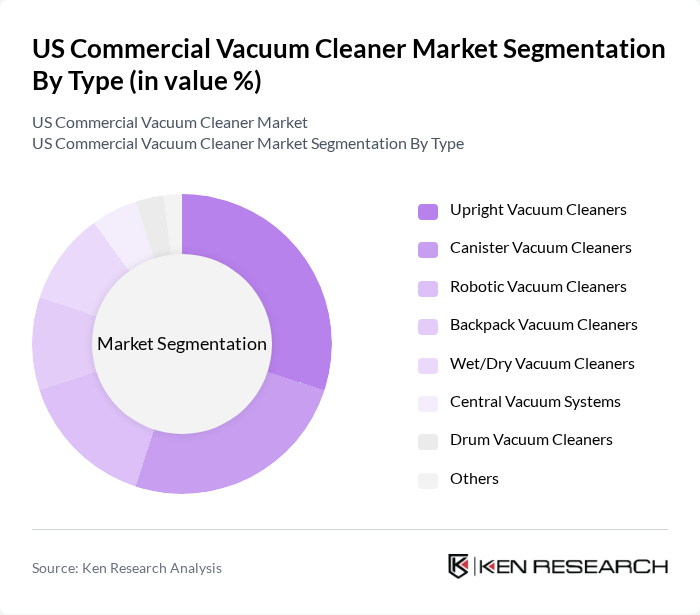
The upright vacuum cleaners segment is currently dominating the market due to their versatility and effectiveness in various commercial settings. They are preferred for their powerful suction capabilities and ease of use, making them suitable for large areas such as offices and retail spaces. Additionally, the growing trend of maintaining cleanliness in public spaces has led to increased adoption of upright models, which are often favored for their ability to handle different floor types efficiently. The robust design and reliability of these vacuum cleaners further contribute to their popularity among commercial users. Robotic vacuum cleaners are experiencing rapid growth, driven by advancements in automation and the need for labor-saving solutions in commercial environments .
By End-User:The market is segmented based on end-users, including commercial offices, retail stores, educational institutions, healthcare facilities, the hospitality sector, industrial facilities, cleaning service providers, and others. Each end-user category has unique cleaning requirements that influence the choice of vacuum cleaners. Commercial offices require regular cleaning to maintain a professional environment and support employee health and productivity. Retail stores prioritize vacuum cleaners that can efficiently clean high-traffic areas and various flooring types. Educational institutions and healthcare facilities demand vacuum cleaners with advanced filtration systems to ensure hygiene and safety. The hospitality sector focuses on quiet, efficient models suitable for guest areas, while industrial facilities require heavy-duty vacuum cleaners for large spaces and challenging debris. Cleaning service providers seek versatile, durable equipment to serve multiple clients across different environments .
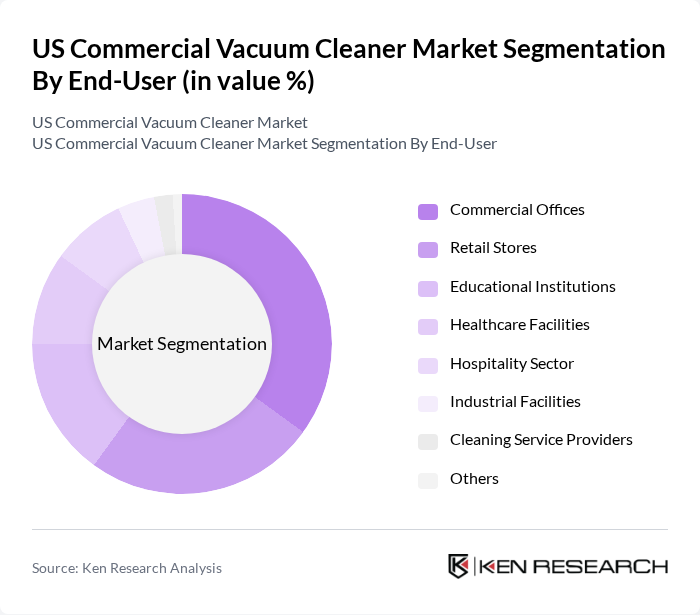
Commercial offices represent the largest end-user segment in the market, driven by the need for regular cleaning to maintain a professional environment. The increasing focus on employee health and productivity has led businesses to invest in high-quality vacuum cleaners that ensure cleanliness and hygiene. Additionally, the rise of flexible workspaces and co-working environments has further fueled demand, as these spaces require efficient cleaning solutions to accommodate varying occupancy levels. The emphasis on maintaining a clean and safe workplace continues to position commercial offices as the leading end-user segment. Healthcare and hospitality sectors are also significant contributors, with stringent hygiene requirements and high standards for cleanliness .
US Commercial Vacuum Cleaner Market Competitive Landscape
The US Commercial Vacuum Cleaner Market is characterized by a dynamic mix of regional and international players. Leading participants such as Hoover, BISSELL, SharkNinja, Dyson, Eureka, Oreck, Nilfisk, Tennant Company, Advance (Nilfisk Advance Inc.), Sanitaire, Kärcher, Electrolux, iRobot, ProTeam, Numatic International contribute to innovation, geographic expansion, and service delivery in this space.
US Commercial Vacuum Cleaner Market Industry Analysis
Growth Drivers
- Increasing Demand for Cleanliness in Commercial Spaces:The US commercial cleaning industry is projected to reach $60 billion in future, driven by heightened expectations for cleanliness in workplaces. This demand is particularly strong in sectors like healthcare and food service, where cleanliness is paramount. The rise in office occupancy rates, which reached 50% in future, further fuels the need for efficient cleaning solutions, including advanced vacuum cleaners that meet rigorous hygiene standards.
- Technological Advancements in Vacuum Cleaner Design:The US vacuum cleaner market is witnessing significant innovation, with over $1.5 billion invested in R&D in future alone. Features such as HEPA filtration and noise reduction technology are becoming standard, enhancing user experience and efficiency. Additionally, the introduction of robotic vacuum cleaners, which accounted for approximately 10% of total sales in future, reflects a shift towards automation, appealing to businesses seeking to optimize cleaning processes and reduce labor costs.
- Rising Awareness of Health and Hygiene Standards:The COVID-19 pandemic has heightened awareness of health and hygiene, leading to increased spending on cleaning equipment. In future, commercial entities reported a 20% increase in cleaning budgets, with a significant portion allocated to vacuum cleaners. This trend is expected to continue as businesses prioritize maintaining high hygiene standards, particularly in high-traffic areas, thereby driving demand for advanced vacuum cleaning solutions.
Market Challenges
- High Competition Among Established Brands:The US commercial vacuum cleaner market is characterized by intense competition, with major players like Dyson, Hoover, and Bissell dominating. In future, these brands collectively held approximately 50% market share, making it challenging for new entrants to gain traction. This competitive landscape pressures companies to continuously innovate and reduce prices, impacting profit margins and overall market growth.
- Fluctuating Raw Material Prices:The volatility of raw material prices, particularly for plastics and metals, poses a significant challenge for manufacturers. In future, the price of polypropylene increased by approximately 15%, affecting production costs for vacuum cleaners. This fluctuation can lead to unpredictable pricing strategies and may force companies to absorb costs, ultimately impacting their profitability and ability to invest in new technologies.
US Commercial Vacuum Cleaner Market Future Outlook
The US commercial vacuum cleaner market is poised for growth, driven by ongoing technological advancements and a persistent focus on cleanliness in various sectors. As businesses increasingly adopt automation and smart technologies, the demand for innovative vacuum solutions will rise. Additionally, the shift towards eco-friendly products will likely influence purchasing decisions, encouraging manufacturers to develop sustainable options that align with consumer preferences and regulatory standards, ensuring a competitive edge in the evolving market landscape.
Market Opportunities
- Expansion into Eco-Friendly Vacuum Cleaner Segments:With a growing emphasis on sustainability, the eco-friendly vacuum cleaner segment is gaining traction. In future, sales of green cleaning products increased by approximately 15%, indicating a strong market opportunity for manufacturers to develop environmentally friendly vacuum cleaners that appeal to eco-conscious businesses, potentially capturing a significant share of the market.
- Development of Smart Vacuum Cleaner Technologies:The integration of IoT in vacuum cleaners presents a lucrative opportunity. In future, smart vacuum cleaners accounted for approximately 10% of total US vacuum cleaner sales, reflecting consumer interest in automation. As businesses seek efficiency, manufacturers can capitalize on this trend by developing smart features that enhance cleaning processes, improve user experience, and provide data analytics for better operational management.
Scope of the Report
| Segment | Sub-Segments |
|---|---|
| By Type | Upright Vacuum Cleaners Canister Vacuum Cleaners Robotic Vacuum Cleaners Backpack Vacuum Cleaners Wet/Dry Vacuum Cleaners Central Vacuum Systems Drum Vacuum Cleaners Others |
| By End-User | Commercial Offices Retail Stores Educational Institutions Healthcare Facilities Hospitality Sector Industrial Facilities Cleaning Service Providers Others |
| By Application | Floor Cleaning Carpet Cleaning Upholstery Cleaning Hard Surface Cleaning Outdoor Cleaning Others |
| By Power Source | Corded (AC Power) Vacuum Cleaners Cordless (Battery-Powered) Vacuum Cleaners Hybrid Vacuum Cleaners Others |
| By Features | HEPA Filtration Noise Reduction Technology Smart Connectivity Self-Cleaning Mechanisms Advanced Navigation (Robotics) Others |
| By Distribution Channel | Online Retail Offline Retail Direct Sales Others |
| By Price Range | Budget Vacuum Cleaners Mid-Range Vacuum Cleaners Premium Vacuum Cleaners Others |
Key Target Audience
Investors and Venture Capitalist Firms
Government and Regulatory Bodies (e.g., Environmental Protection Agency, Occupational Safety and Health Administration)
Manufacturers and Producers
Distributors and Retailers
Facility Management Companies
Cleaning Service Providers
Industry Associations (e.g., International Sanitary Supply Association)
Financial Institutions
Players Mentioned in the Report:
Hoover
BISSELL
SharkNinja
Dyson
Eureka
Oreck
Nilfisk
Tennant Company
Advance (Nilfisk Advance Inc.)
Sanitaire
Karcher
Electrolux
iRobot
ProTeam
Numatic International
Table of Contents
Market Assessment Phase
1. Executive Summary and Approach
2. US Commercial Vacuum Cleaner Market Overview
2.1 Key Insights and Strategic Recommendations
2.2 US Commercial Vacuum Cleaner Market Overview
2.3 Definition and Scope
2.4 Evolution of Market Ecosystem
2.5 Timeline of Key Regulatory Milestones
2.6 Value Chain & Stakeholder Mapping
2.7 Business Cycle Analysis
2.8 Policy & Incentive Landscape
3. US Commercial Vacuum Cleaner Market Analysis
3.1 Growth Drivers
3.1.1 Increasing demand for cleanliness in commercial spaces
3.1.2 Technological advancements in vacuum cleaner design
3.1.3 Rising awareness of health and hygiene standards
3.1.4 Growth in the hospitality and service industries
3.2 Market Challenges
3.2.1 High competition among established brands
3.2.2 Fluctuating raw material prices
3.2.3 Regulatory compliance costs
3.2.4 Limited consumer awareness of advanced features
3.3 Market Opportunities
3.3.1 Expansion into eco-friendly vacuum cleaner segments
3.3.2 Increasing adoption of automation in cleaning processes
3.3.3 Growth in e-commerce for vacuum cleaner sales
3.3.4 Development of smart vacuum cleaner technologies
3.4 Market Trends
3.4.1 Shift towards cordless and lightweight vacuum cleaners
3.4.2 Integration of IoT in vacuum cleaner functionalities
3.4.3 Rising demand for multi-functional cleaning devices
3.4.4 Increased focus on energy-efficient models
3.5 Government Regulation
3.5.1 Energy efficiency standards for commercial appliances
3.5.2 Safety regulations for electrical equipment
3.5.3 Environmental regulations on waste disposal
3.5.4 Compliance with indoor air quality standards
4. SWOT Analysis
5. Stakeholder Analysis
6. Porter's Five Forces Analysis
7. US Commercial Vacuum Cleaner Market Market Size, 2019-2024
7.1 By Value
7.2 By Volume
7.3 By Average Selling Price
8. US Commercial Vacuum Cleaner Market Segmentation
8.1 By Type
8.1.1 Upright Vacuum Cleaners
8.1.2 Canister Vacuum Cleaners
8.1.3 Robotic Vacuum Cleaners
8.1.4 Backpack Vacuum Cleaners
8.1.5 Wet/Dry Vacuum Cleaners
8.1.6 Central Vacuum Systems
8.1.7 Drum Vacuum Cleaners
8.1.8 Others
8.2 By End-User
8.2.1 Commercial Offices
8.2.2 Retail Stores
8.2.3 Educational Institutions
8.2.4 Healthcare Facilities
8.2.5 Hospitality Sector
8.2.6 Industrial Facilities
8.2.7 Cleaning Service Providers
8.2.8 Others
8.3 By Application
8.3.1 Floor Cleaning
8.3.2 Carpet Cleaning
8.3.3 Upholstery Cleaning
8.3.4 Hard Surface Cleaning
8.3.5 Outdoor Cleaning
8.3.6 Others
8.4 By Power Source
8.4.1 Corded (AC Power) Vacuum Cleaners
8.4.2 Cordless (Battery-Powered) Vacuum Cleaners
8.4.3 Hybrid Vacuum Cleaners
8.4.4 Others
8.5 By Features
8.5.1 HEPA Filtration
8.5.2 Noise Reduction Technology
8.5.3 Smart Connectivity
8.5.4 Self-Cleaning Mechanisms
8.5.5 Advanced Navigation (Robotics)
8.5.6 Others
8.6 By Distribution Channel
8.6.1 Online Retail
8.6.2 Offline Retail
8.6.3 Direct Sales
8.6.4 Others
8.7 By Price Range
8.7.1 Budget Vacuum Cleaners
8.7.2 Mid-Range Vacuum Cleaners
8.7.3 Premium Vacuum Cleaners
8.7.4 Others
9. US Commercial Vacuum Cleaner Market Competitive Analysis
9.1 Market Share of Key Players
9.2 Cross Comparison of Key Players
9.2.1 Company Name
9.2.2 Group Size (Large, Medium, or Small as per industry convention)
9.2.3 Revenue Growth Rate (YoY %)
9.2.4 Market Penetration Rate (% of US Commercial Segment)
9.2.5 Customer Retention Rate (%)
9.2.6 Pricing Strategy (Average Selling Price, Discounting Practices)
9.2.7 Product Innovation Rate (New Product Launches per Year)
9.2.8 Distribution Efficiency (Channel Coverage, Lead Time)
9.2.9 Brand Recognition Score (Market Surveys, Brand Index)
9.2.10 Customer Satisfaction Index (Net Promoter Score, After-Sales Service Ratings)
9.2.11 Warranty & Service Coverage (Average Warranty Period, Service Network Size)
9.2.12 Sustainability Initiatives (Eco-Friendly Product Share, Green Certifications)
9.3 SWOT Analysis of Top Players
9.4 Pricing Analysis
9.5 Detailed Profile of Major Companies
9.5.1 Hoover
9.5.2 BISSELL
9.5.3 SharkNinja
9.5.4 Dyson
9.5.5 Eureka
9.5.6 Oreck
9.5.7 Nilfisk
9.5.8 Tennant Company
9.5.9 Advance (Nilfisk Advance Inc.)
9.5.10 Sanitaire
9.5.11 Kärcher
9.5.12 Electrolux
9.5.13 iRobot
9.5.14 ProTeam
9.5.15 Numatic International
10. US Commercial Vacuum Cleaner Market End-User Analysis
10.1 Procurement Behavior of Key Ministries
10.1.1 Budget Allocation Trends
10.1.2 Preferred Procurement Methods
10.1.3 Evaluation Criteria for Suppliers
10.1.4 Contract Duration Preferences
10.2 Corporate Spend on Infrastructure & Energy
10.2.1 Investment Trends in Cleaning Equipment
10.2.2 Budgeting for Maintenance and Upgrades
10.2.3 Impact of Economic Conditions on Spending
10.2.4 Corporate Sustainability Initiatives
10.3 Pain Point Analysis by End-User Category
10.3.1 Common Cleaning Challenges
10.3.2 Equipment Downtime Issues
10.3.3 Training and Skill Gaps
10.3.4 Cost Management Concerns
10.4 User Readiness for Adoption
10.4.1 Awareness of New Technologies
10.4.2 Willingness to Invest in Upgrades
10.4.3 Training Needs for Staff
10.4.4 Feedback Mechanisms for Improvement
10.5 Post-Deployment ROI and Use Case Expansion
10.5.1 Measurement of Cleaning Efficiency
10.5.2 Cost Savings Analysis
10.5.3 User Satisfaction Metrics
10.5.4 Opportunities for Additional Services
11. US Commercial Vacuum Cleaner Market Future Size, 2025-2030
11.1 By Value
11.2 By Volume
11.3 By Average Selling Price
Go-To-Market Strategy Phase
1. Whitespace Analysis + Business Model Canvas
1.1 Market Gaps Identification
1.2 Value Proposition Development
1.3 Revenue Streams Analysis
1.4 Cost Structure Evaluation
1.5 Key Partnerships Exploration
1.6 Customer Segments Definition
1.7 Channels Strategy
2. Marketing and Positioning Recommendations
2.1 Branding Strategies
2.2 Product USPs
2.3 Target Audience Identification
2.4 Communication Strategy
2.5 Digital Marketing Tactics
2.6 Trade Show Participation
2.7 Customer Engagement Initiatives
3. Distribution Plan
3.1 Urban Retail Strategy
3.2 Rural NGO Tie-Ups
3.3 E-commerce Strategy
3.4 Direct Sales Approach
3.5 Distribution Partnerships
3.6 Logistics and Supply Chain Management
3.7 Inventory Management Solutions
4. Channel & Pricing Gaps
4.1 Underserved Routes
4.2 Pricing Bands Analysis
4.3 Competitor Pricing Comparison
4.4 Customer Price Sensitivity
4.5 Discount Strategies
4.6 Bundling Opportunities
4.7 Promotional Pricing Tactics
5. Unmet Demand & Latent Needs
5.1 Category Gaps Identification
5.2 Consumer Segments Analysis
5.3 Emerging Trends Exploration
5.4 Feedback Collection Mechanisms
5.5 Product Development Opportunities
5.6 Market Entry Barriers
5.7 Customer Pain Points Addressing
6. Customer Relationship
6.1 Loyalty Programs Design
6.2 After-sales Service Strategies
6.3 Customer Feedback Loops
6.4 Community Engagement Initiatives
6.5 Customer Education Programs
6.6 Relationship Management Tools
6.7 Retention Strategies
7. Value Proposition
7.1 Sustainability Initiatives
7.2 Integrated Supply Chains
7.3 Unique Selling Points Development
7.4 Customer-Centric Innovations
7.5 Competitive Advantage Analysis
7.6 Value Communication Strategies
7.7 Long-term Value Creation
8. Key Activities
8.1 Regulatory Compliance
8.2 Branding Initiatives
8.3 Distribution Setup
8.4 Marketing Campaigns
8.5 Training and Development Programs
8.6 Performance Monitoring
8.7 Stakeholder Engagement
9. Entry Strategy Evaluation
9.1 Domestic Market Entry Strategy
9.1.1 Product Mix Considerations
9.1.2 Pricing Band Strategy
9.1.3 Packaging Innovations
9.2 Export Entry Strategy
9.2.1 Target Countries Identification
9.2.2 Compliance Roadmap Development
10. Entry Mode Assessment
10.1 Joint Ventures
10.2 Greenfield Investments
10.3 Mergers & Acquisitions
10.4 Distributor Model Evaluation
11. Capital and Timeline Estimation
11.1 Capital Requirements Analysis
11.2 Timelines for Market Entry
12. Control vs Risk Trade-Off
12.1 Ownership vs Partnerships
13. Profitability Outlook
13.1 Breakeven Analysis
13.2 Long-term Sustainability Strategies
14. Potential Partner List
14.1 Distributors Identification
14.2 Joint Ventures Opportunities
14.3 Acquisition Targets
15. Execution Roadmap
15.1 Phased Plan for Market Entry
15.1.1 Market Setup
15.1.2 Market Entry
15.1.3 Growth Acceleration
15.1.4 Scale & Stabilize
15.2 Key Activities and Milestones
15.2.1 Milestone Planning
15.2.2 Activity Tracking
Research Methodology
Phase 1: Approach1
Desk Research
- Analysis of industry reports from market research firms focusing on the US commercial vacuum cleaner market
- Review of government publications and trade association data related to cleaning equipment standards and regulations
- Examination of sales data and market trends from leading distributors and retailers in the commercial cleaning sector
Primary Research
- Interviews with facility managers and procurement officers in various sectors such as hospitality, healthcare, and education
- Surveys conducted with cleaning service providers to understand their purchasing behavior and preferences
- Field interviews with product managers from leading vacuum cleaner manufacturers to gather insights on product innovations and market needs
Validation & Triangulation
- Cross-validation of findings through comparison with historical sales data and market growth rates
- Triangulation of insights from primary interviews with secondary data sources to ensure consistency
- Sanity checks through expert panel reviews involving industry veterans and market analysts
Phase 2: Market Size Estimation1
Top-down Assessment
- Estimation of total market size based on overall cleaning equipment expenditure in the US
- Segmentation of the market by end-user industries such as commercial, industrial, and institutional sectors
- Incorporation of growth trends influenced by the increasing focus on hygiene and cleanliness in public spaces
Bottom-up Modeling
- Collection of sales volume data from major commercial vacuum cleaner manufacturers and distributors
- Estimation of average selling prices across different product categories and features
- Calculation of market size based on unit sales multiplied by average prices for each segment
Forecasting & Scenario Analysis
- Utilization of time-series analysis to project future market growth based on historical data
- Scenario modeling considering factors such as economic conditions, technological advancements, and regulatory changes
- Development of multiple forecasts (baseline, optimistic, and pessimistic) to account for market uncertainties
Phase 3: CATI Sample Composition1
| Scope Item/Segment | Sample Size | Target Respondent Profiles |
|---|---|---|
| Hospitality Sector Cleaning Equipment | 45 | Facility Managers, Housekeeping Supervisors |
| Healthcare Facility Maintenance | 38 | Procurement Officers, Environmental Services Directors |
| Educational Institution Cleaning Needs | 42 | Operations Managers, Campus Facility Directors |
| Commercial Cleaning Service Providers | 50 | Business Owners, Service Managers |
| Retail Sector Cleaning Equipment Usage | 40 | Store Managers, Maintenance Supervisors |
Frequently Asked Questions
What is the current value of the US Commercial Vacuum Cleaner Market?
The US Commercial Vacuum Cleaner Market is valued at approximately USD 440 million, reflecting a significant growth driven by the increasing demand for efficient cleaning solutions and advancements in technology, particularly in the wake of heightened health and hygiene awareness post-pandemic.
What types of vacuum cleaners are popular in the commercial market?
How has the COVID-19 pandemic affected the commercial vacuum cleaner market?
What are the key growth drivers for the US Commercial Vacuum Cleaner Market?
Other Regional/Country Reports
Other Adjacent Reports
Mexico Commercial Cleaning Services Market
South Africa Industrial Cleaning Equipment Market
US Robotic Vacuum Cleaner MarketMexico Floor Care Products Market
Global janitorial supplies market report size, share, growth drivers, trends, opportunities & forecast 2025–2030Qatar Commercial Carpet Cleaner Market
Brazil Wet Dry Vacuum Market
Middle East Air Purifier Market Report Size Share Growth Drivers Trends Opportunities & Forecast 2025–2030Mexico Disinfectant Products Market
Mexico Sustainable Cleaning Solutions Market
Why Buy From Us?

What makes us stand out is that our consultants follow Robust, Refine and Result (RRR) methodology. Robust for clear definitions, approaches and sanity checking, Refine for differentiating respondents' facts and opinions, and Result for presenting data with story.

We have set a benchmark in the industry by offering our clients with syndicated and customized market research reports featuring coverage of entire market as well as meticulous research and analyst insights.

While we don't replace traditional research, we flip the method upside down. Our dual approach of Top Bottom & Bottom Top ensures quality deliverable by not just verifying company fundamentals but also looking at the sector and macroeconomic factors.

With one step in the future, our research team constantly tries to show you the bigger picture. We help with some of the tough questions you may encounter along the way: How is the industry positioned? Best marketing channel? KPI's of competitors? By aligning every element, we help maximize success.

Our report gives you instant access to the answers and sources that other companies might choose to hide. We elaborate each steps of research methodology we have used and showcase you the sample size to earn your trust.

If you need any support, we are here! We pride ourselves on universe strength, data quality, and quick, friendly, and professional service.