About the Report
Base Year 2024US Continuous Positive Airway Pressure (CPAP) Devices Market Overview
- The US Continuous Positive Airway Pressure (CPAP) Devices Market is valued at USD 4.2 billion, based on a five-year historical analysis. This growth is primarily driven by the increasing prevalence of obstructive sleep apnea associated with rising obesity and an aging population, greater awareness and diagnosis of sleep disorders, and ongoing technological advancements such as quieter motors, improved humidification, and cloud?connected devices that enhance comfort, adherence, and clinical monitoring.
- Demand is particularly strong in large metropolitan areas with high population density, higher healthcare expenditure, and extensive networks of accredited sleep centers and tertiary hospitals, where diagnosis rates and specialist access for sleep apnea are higher than in rural regions. These urban markets support robust uptake of CPAP devices through established referral pathways, reimbursement coverage, and availability of homecare providers and durable medical equipment suppliers focused on sleep therapy.
- US market access and safety for CPAP devices are governed by the Food and Drug Administration (FDA) under the Federal Food, Drug, and Cosmetic Act and its implementing regulations, including 21 CFR Part 868 (Anesthesiology Devices), which require premarket notification or approval, compliance with quality system regulations in 21 CFR Part 820, and adherence to performance and labeling standards.
 Devices Market.png "US Continuous Positive Airway Pressure (CPAP) Devices Market Size")
US Continuous Positive Airway Pressure (CPAP) Devices Market Segmentation
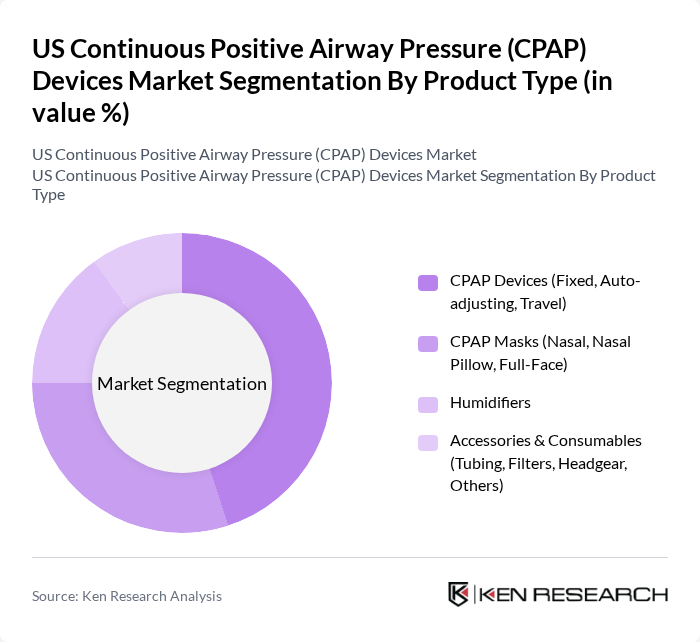
By Product Type:The product type segmentation includes various categories such as CPAP Devices, CPAP Masks, Humidifiers, and Accessories & Consumables. Among these, CPAP Devices, which include fixed, auto-adjusting, and travel variants, dominate the market due to their essential role in treating obstructive sleep apnea, with PAP devices (CPAP, BiPAP, and Auto CPAP) recognized as the gold?standard therapy. The increasing adoption of auto-adjusting and cloud?connected devices, which provide personalized therapy and enable remote monitoring, is particularly notable as they cater to diverse patient needs and support payer requirements for adherence tracking.
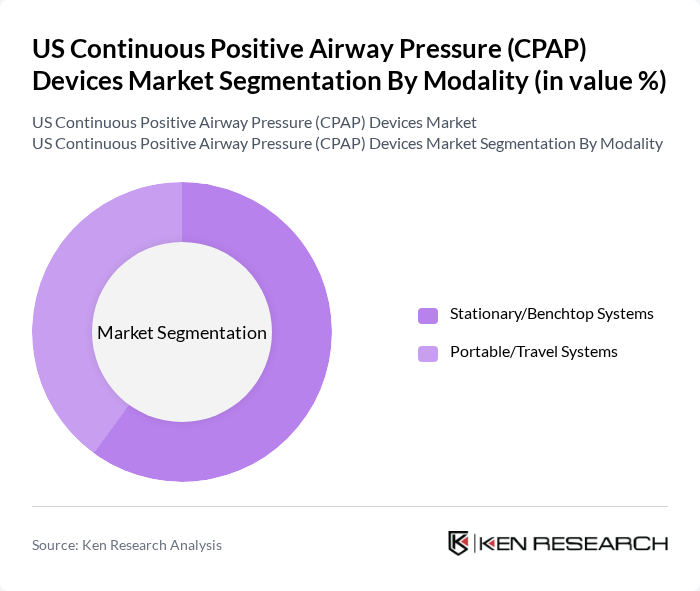
By Modality:The modality segmentation includes Stationary/Benchtop Systems and Portable/Travel Systems. Stationary systems dominate the market due to their widespread use in home care and institutional settings, where they provide consistent and effective therapy and are often integrated with remote monitoring platforms for long?term management of obstructive sleep apnea. The growing trend towards portable systems is also notable, supported by increasing travel, patient preference for mobility, and design improvements that reduce size and noise while maintaining therapeutic performance.
US Continuous Positive Airway Pressure (CPAP) Devices Market Competitive Landscape
The US Continuous Positive Airway Pressure (CPAP) Devices Market is characterized by a dynamic mix of regional and international players. Leading participants such as ResMed Inc., Koninklijke Philips N.V. (Philips Respironics), Fisher & Paykel Healthcare Corporation Limited, Drive DeVilbiss Healthcare (Drive Medical), 3B Medical, Inc., Somnetics International, Inc., Apex Medical Corp., BMC Medical Co., Ltd. (BMC Medical), Inspire Medical Systems, Inc., Itamar Medical Ltd. (a Zoll Medical company), React Health (formerly 3B Medical/AGS Health, including Z2 CPAP line), Vyaire Medical, Inc., Natus Medical Incorporated, Sleepnet Corporation, Owens & Minor, Inc. (Apria Healthcare) contribute to innovation, geographic expansion, and service delivery in this space.
US Continuous Positive Airway Pressure (CPAP) Devices Market Industry Analysis
Growth Drivers
- Increasing Prevalence of Sleep Apnea:The prevalence of sleep apnea in the United States is estimated to affect approximatelyat least 20 millionindividuals, with around 80% of moderate to severe cases undiagnosed. This growing patient population drives demand for CPAP devices, as healthcare providers increasingly recognize the importance of diagnosing and treating sleep disorders. The American Academy of Sleep Medicine reports that untreated sleep apnea can lead to serious health complications, further emphasizing the need for effective treatment solutions.
- Rising Awareness About Sleep Disorders:Public awareness campaigns and educational initiatives have significantly increased knowledge about sleep disorders, particularly sleep apnea. In future, it is projected that over60%of adults will be aware of sleep apnea and its associated risks, leading to more individuals seeking diagnosis and treatment. This heightened awareness is supported by organizations like the National Sleep Foundation, which actively promotes the importance of sleep health, thereby boosting the demand for CPAP devices.
- Technological Advancements in CPAP Devices:The CPAP device market is witnessing rapid technological advancements, with innovations such as automatic pressure adjustments and integrated humidifiers. In future, it is expected that over40%of CPAP devices will incorporate smart technology, enhancing user experience and compliance. These advancements not only improve treatment efficacy but also attract new users, as modern devices become more user-friendly and effective in managing sleep apnea symptoms.
Market Challenges
- High Cost of CPAP Devices:The average cost of CPAP devices ranges fromaround USD 500 to about USD 3,000, which can be a significant barrier for many patients. In future, it is estimated that nearly30%of patients will face financial constraints that prevent them from purchasing these devices. This high cost can lead to lower adoption rates, particularly among uninsured or underinsured populations, limiting access to necessary treatment for sleep apnea.
- Compliance Issues Among Patients:Compliance with CPAP therapy remains a significant challenge, with studies indicating that approximately30% to 60%of patients do not adhere to prescribed treatment regimens. In future, it is projected that non-compliance will affect nearly10 millionpatients, leading to suboptimal health outcomes. Factors such as discomfort, lack of education, and inadequate follow-up care contribute to this issue, necessitating improved patient support and education initiatives.
US Continuous Positive Airway Pressure (CPAP) Devices Market Future Outlook
The future of the CPAP devices market in the United States appears promising, driven by ongoing technological innovations and a growing emphasis on patient-centric care. As telehealth services expand, more patients will have access to remote consultations and follow-up care, enhancing treatment adherence. Additionally, the integration of artificial intelligence in CPAP technology is expected to improve device customization and user experience, ultimately leading to better health outcomes for patients suffering from sleep apnea.
Market Opportunities
- Expansion of Telehealth Services:The rise of telehealth services presents a significant opportunity for CPAP device manufacturers. In future, it is anticipated that telehealth consultations will increase by30%, allowing for better patient monitoring and support. This shift can lead to improved adherence to CPAP therapy, ultimately enhancing patient outcomes and driving device sales.
- Development of Portable CPAP Devices:The demand for portable CPAP devices is on the rise, particularly among travelers and those seeking convenience. In future, it is projected that portable CPAP devices will account for25%of the market, driven by advancements in battery technology and compact design. This trend offers manufacturers a lucrative opportunity to cater to a growing segment of health-conscious consumers.
Scope of the Report
| Segment | Sub-Segments |
|---|---|
| By Product Type | CPAP Devices (Fixed, Auto-adjusting, Travel) CPAP Masks (Nasal, Nasal Pillow, Full-Face) Humidifiers Accessories & Consumables (Tubing, Filters, Headgear, Others) |
| By Modality | Stationary/Benchtop Systems Portable/Travel Systems |
| By Indication | Obstructive Sleep Apnea (OSA) Central Sleep Apnea Complex/Mixed Sleep Apnea Other Respiratory Disorders (e.g., COPD, Post?surgical, Hypoxemia) |
| By End-User | Home Care Settings Hospitals Sleep Clinics & Sleep Labs Ambulatory Surgical Centers & Others |
| By Distribution Channel | Durable Medical Equipment (DME) Providers Hospital & Clinic-based Procurement Online Channels (Manufacturer & E?commerce Platforms) Retail Pharmacies & Others |
| By Region | Northeast Midwest South West |
| By Patient Type | Adults Pediatric Geriatric |
Key Target Audience
Investors and Venture Capitalist Firms
Government and Regulatory Bodies (e.g., Food and Drug Administration, Centers for Medicare & Medicaid Services)
Manufacturers and Producers
Distributors and Retailers
Health Insurance Providers
Healthcare Providers and Hospitals
Industry Associations (e.g., American Academy of Sleep Medicine)
Financial Institutions
Players Mentioned in the Report:
ResMed Inc.
Koninklijke Philips N.V. (Philips Respironics)
Fisher & Paykel Healthcare Corporation Limited
Drive DeVilbiss Healthcare (Drive Medical)
3B Medical, Inc.
Somnetics International, Inc.
Apex Medical Corp.
BMC Medical Co., Ltd. (BMC Medical)
Inspire Medical Systems, Inc.
Itamar Medical Ltd. (a Zoll Medical company)
React Health (formerly 3B Medical/AGS Health, including Z2 CPAP line)
Vyaire Medical, Inc.
Natus Medical Incorporated
Sleepnet Corporation
Owens & Minor, Inc. (Apria Healthcare)
Table of Contents
Market Assessment Phase
1. Executive Summary and Approach
2. US Continuous Positive Airway Pressure (CPAP) Devices Market Overview
2.1 Key Insights and Strategic Recommendations
2.2 US Continuous Positive Airway Pressure (CPAP) Devices Market Overview
2.3 Definition and Scope
2.4 Evolution of Market Ecosystem
2.5 Timeline of Key Regulatory Milestones
2.6 Value Chain & Stakeholder Mapping
2.7 Business Cycle Analysis
2.8 Policy & Incentive Landscape
3. US Continuous Positive Airway Pressure (CPAP) Devices Market Analysis
3.1 Growth Drivers
3.1.1 Increasing prevalence of sleep apnea
3.1.2 Rising awareness about sleep disorders
3.1.3 Technological advancements in CPAP devices
3.1.4 Growing geriatric population
3.2 Market Challenges
3.2.1 High cost of CPAP devices
3.2.2 Compliance issues among patients
3.2.3 Limited insurance coverage
3.2.4 Competition from alternative therapies
3.3 Market Opportunities
3.3.1 Expansion of telehealth services
3.3.2 Development of portable CPAP devices
3.3.3 Increasing investment in R&D
3.3.4 Partnerships with healthcare providers
3.4 Market Trends
3.4.1 Shift towards home healthcare solutions
3.4.2 Integration of AI in CPAP technology
3.4.3 Customization of CPAP devices
3.4.4 Focus on patient-centric care
3.5 Government Regulation
3.5.1 FDA regulations on medical devices
3.5.2 Reimbursement policies for CPAP therapy
3.5.3 Guidelines for device safety and efficacy
3.5.4 Compliance with health data privacy laws
4. SWOT Analysis
5. Stakeholder Analysis
6. Porter's Five Forces Analysis
7. US Continuous Positive Airway Pressure (CPAP) Devices Market Market Size, 2019-2024
7.1 By Value
7.2 By Volume
7.3 By Average Selling Price
8. US Continuous Positive Airway Pressure (CPAP) Devices Market Segmentation
8.1 By Product Type
8.1.1 CPAP Devices (Fixed, Auto-adjusting, Travel)
8.1.2 CPAP Masks (Nasal, Nasal Pillow, Full-Face)
8.1.3 Humidifiers
8.1.4 Accessories & Consumables (Tubing, Filters, Headgear, Others)
8.2 By Modality
8.2.1 Stationary/Benchtop Systems
8.2.2 Portable/Travel Systems
8.3 By Indication
8.3.1 Obstructive Sleep Apnea (OSA)
8.3.2 Central Sleep Apnea
8.3.3 Complex/Mixed Sleep Apnea
8.3.4 Other Respiratory Disorders (e.g., COPD, Post?surgical, Hypoxemia)
8.4 By End-User
8.4.1 Home Care Settings
8.4.2 Hospitals
8.4.3 Sleep Clinics & Sleep Labs
8.4.4 Ambulatory Surgical Centers & Others
8.5 By Distribution Channel
8.5.1 Durable Medical Equipment (DME) Providers
8.5.2 Hospital & Clinic-based Procurement
8.5.3 Online Channels (Manufacturer & E?commerce Platforms)
8.5.4 Retail Pharmacies & Others
8.6 By Region
8.6.1 Northeast
8.6.2 Midwest
8.6.3 South
8.6.4 West
8.7 By Patient Type
8.7.1 Adults
8.7.2 Pediatric
8.7.3 Geriatric
9. US Continuous Positive Airway Pressure (CPAP) Devices Market Competitive Analysis
9.1 Market Share of Key Players
9.2 Cross Comparison of Key Players
9.2.1 Company Name
9.2.2 U.S. CPAP Devices Revenue (USD Million)
9.2.3 U.S. CPAP Devices Revenue Growth Rate (%)
9.2.4 U.S. Market Share (%)
9.2.5 Product Portfolio Breadth (Devices, Masks, Accessories)
9.2.6 R&D Intensity (% of Revenue Spent on R&D)
9.2.7 Connected / Cloud?enabled Device Penetration (%)
9.2.8 Average Selling Price (ASP) Positioning
9.2.9 Distribution Coverage in the U.S. (DMEs, Hospitals, Online)
9.2.10 Regulatory & Recall Track Record in the U.S.
9.2.11 Patient Adherence / Therapy Compliance Support Programs
9.3 SWOT Analysis of Top Players
9.4 Pricing Analysis
9.5 Detailed Profile of Major Companies
9.5.1 ResMed Inc.
9.5.2 Koninklijke Philips N.V. (Philips Respironics)
9.5.3 Fisher & Paykel Healthcare Corporation Limited
9.5.4 Drive DeVilbiss Healthcare (Drive Medical)
9.5.5 3B Medical, Inc.
9.5.6 Somnetics International, Inc.
9.5.7 Apex Medical Corp.
9.5.8 BMC Medical Co., Ltd. (BMC Medical)
9.5.9 Inspire Medical Systems, Inc.
9.5.10 Itamar Medical Ltd. (a Zoll Medical company)
9.5.11 React Health (formerly 3B Medical/AGS Health, including Z2 CPAP line)
9.5.12 Vyaire Medical, Inc.
9.5.13 Natus Medical Incorporated
9.5.14 Sleepnet Corporation
9.5.15 Owens & Minor, Inc. (Apria Healthcare)
10. US Continuous Positive Airway Pressure (CPAP) Devices Market End-User Analysis
10.1 Procurement Behavior of Key Ministries
10.1.1 Budget Allocation for Sleep Disorders
10.1.2 Procurement Processes
10.1.3 Supplier Selection Criteria
10.1.4 Contract Management Practices
10.2 Corporate Spend on Infrastructure & Energy
10.2.1 Investment in Healthcare Infrastructure
10.2.2 Spending on Medical Equipment
10.2.3 Budget for Employee Health Programs
10.2.4 Others
10.3 Pain Point Analysis by End-User Category
10.3.1 Challenges in Device Compliance
10.3.2 Accessibility Issues
10.3.3 Cost Barriers
10.3.4 Others
10.4 User Readiness for Adoption
10.4.1 Awareness Levels
10.4.2 Training Needs
10.4.3 Support Systems
10.4.4 Others
10.5 Post-Deployment ROI and Use Case Expansion
10.5.1 Measurement of Health Outcomes
10.5.2 Cost Savings Analysis
10.5.3 User Feedback Mechanisms
10.5.4 Others
11. US Continuous Positive Airway Pressure (CPAP) Devices Market Future Size, 2025-2030
11.1 By Value
11.2 By Volume
11.3 By Average Selling Price
Go-To-Market Strategy Phase
1. Whitespace Analysis + Business Model Canvas
1.1 Market Gaps Identification
1.2 Business Model Framework
2. Marketing and Positioning Recommendations
2.1 Branding Strategies
2.2 Product USPs
3. Distribution Plan
3.1 Urban Retail vs Rural NGO Tie-ups
4. Channel & Pricing Gaps
4.1 Underserved Routes
4.2 Pricing Bands
5. Unmet Demand & Latent Needs
5.1 Category Gaps
5.2 Consumer Segments
6. Customer Relationship
6.1 Loyalty Programs
6.2 After-sales Service
7. Value Proposition
7.1 Sustainability
7.2 Integrated Supply Chains
8. Key Activities
8.1 Regulatory Compliance
8.2 Branding
8.3 Distribution Setup
9. Entry Strategy Evaluation
9.1 Domestic Market Entry Strategy
9.1.1 Product Mix
9.1.2 Pricing Band
9.1.3 Packaging
9.2 Export Entry Strategy
9.2.1 Target Countries
9.2.2 Compliance Roadmap
10. Entry Mode Assessment
10.1 JV
10.2 Greenfield
10.3 M&A
10.4 Distributor Model
11. Capital and Timeline Estimation
11.1 Capital Requirements
11.2 Timelines
12. Control vs Risk Trade-Off
12.1 Ownership vs Partnerships
13. Profitability Outlook
13.1 Breakeven Analysis
13.2 Long-term Sustainability
14. Potential Partner List
14.1 Distributors
14.2 JVs
14.3 Acquisition Targets
15. Execution Roadmap
15.1 Phased Plan for Market Entry
15.1.1 Market Setup
15.1.2 Market Entry
15.1.3 Growth Acceleration
15.1.4 Scale & Stabilize
15.2 Key Activities and Milestones
15.2.1 Milestone Planning
15.2.2 Activity Tracking
Research Methodology
Phase 1: Approach1
Desk Research
- Analysis of market reports from healthcare organizations and industry associations
- Review of published articles and white papers on CPAP device technology and trends
- Examination of regulatory guidelines and reimbursement policies from CMS and FDA
Primary Research
- Interviews with pulmonologists and sleep specialists to understand clinical preferences
- Surveys with CPAP device manufacturers regarding production and sales data
- Focus groups with patients using CPAP devices to gather user experience insights
Validation & Triangulation
- Cross-validation of findings through multiple expert interviews and secondary data sources
- Triangulation of market size estimates from different research methodologies
- Sanity checks through feedback from a panel of healthcare professionals
Phase 2: Market Size Estimation1
Top-down Assessment
- Estimation of total addressable market based on national health expenditure data
- Segmentation of market by device type, including fixed and auto-adjusting CPAPs
- Incorporation of demographic trends and prevalence rates of sleep apnea
Bottom-up Modeling
- Collection of sales data from leading CPAP manufacturers and distributors
- Estimation of average selling prices based on product specifications and features
- Volume estimates derived from patient population statistics and device usage rates
Forecasting & Scenario Analysis
- Multi-variable forecasting using historical sales data and market growth drivers
- Scenario analysis based on potential changes in healthcare policies and insurance coverage
- Development of baseline, optimistic, and pessimistic market growth scenarios through 2030
Phase 3: CATI Sample Composition1
| Scope Item/Segment | Sample Size | Target Respondent Profiles |
|---|---|---|
| Healthcare Providers | 120 | Pulmonologists, Sleep Medicine Specialists |
| CPAP Device Manufacturers | 90 | Product Managers, Sales Directors |
| Patients Using CPAP Devices | 140 | Current Users, Recent Users |
| Insurance Providers | 80 | Claims Analysts, Policy Underwriters |
| Healthcare Policy Experts | 50 | Health Economists, Regulatory Affairs Specialists |
Frequently Asked Questions
What is the current value of the US Continuous Positive Airway Pressure (CPAP) Devices Market?
The US Continuous Positive Airway Pressure (CPAP) Devices Market is valued at approximately USD 4.2 billion, driven by the rising prevalence of obstructive sleep apnea, increased awareness of sleep disorders, and technological advancements in CPAP devices.
What factors are driving the growth of the CPAP devices market in the US?
How does the prevalence of sleep apnea affect the demand for CPAP devices?
What are the main types of CPAP devices available in the market?
Other Regional/Country Reports
Indonesia Continuous Positive Airway Pressure (CPAP) Devices Market
Malaysia Continuous Positive Airway Pressure (CPAP) Devices Market
KSA Continuous Positive Airway Pressure (CPAP) Devices Market
APAC Continuous Positive Airway Pressure (CPAP) Devices Market
SEA Continuous Positive Airway Pressure (CPAP) Devices Market
Vietnam Continuous Positive Airway Pressure (CPAP) Devices Market
Other Adjacent Reports
Belgium Sleep Apnea Diagnostics Market
Singapore Respiratory Therapy Equipment Market
South Africa Home Healthcare Devices Market
Qatar Medical Wearables Market
Belgium Oxygen Therapy Equipment Market
Brazil Sleep Monitoring Systems Market
Kuwait Bi-Level Positive Airway Pressure Devices Market
South Korea Sleep Disorder Pharmaceuticals Market
United States Durable Medical Equipment Market Outlook to 2030: Size, Share, Growth and TrendsKsa Telehealth Services Market Report Size, Share, Growth Drivers, Trends, Opportunities & Forecast 2025–2030Why Buy From Us?

What makes us stand out is that our consultants follow Robust, Refine and Result (RRR) methodology. Robust for clear definitions, approaches and sanity checking, Refine for differentiating respondents' facts and opinions, and Result for presenting data with story.

We have set a benchmark in the industry by offering our clients with syndicated and customized market research reports featuring coverage of entire market as well as meticulous research and analyst insights.

While we don't replace traditional research, we flip the method upside down. Our dual approach of Top Bottom & Bottom Top ensures quality deliverable by not just verifying company fundamentals but also looking at the sector and macroeconomic factors.

With one step in the future, our research team constantly tries to show you the bigger picture. We help with some of the tough questions you may encounter along the way: How is the industry positioned? Best marketing channel? KPI's of competitors? By aligning every element, we help maximize success.

Our report gives you instant access to the answers and sources that other companies might choose to hide. We elaborate each steps of research methodology we have used and showcase you the sample size to earn your trust.

If you need any support, we are here! We pride ourselves on universe strength, data quality, and quick, friendly, and professional service.