About the Report
Base Year 2024US CubeSat Market Overview
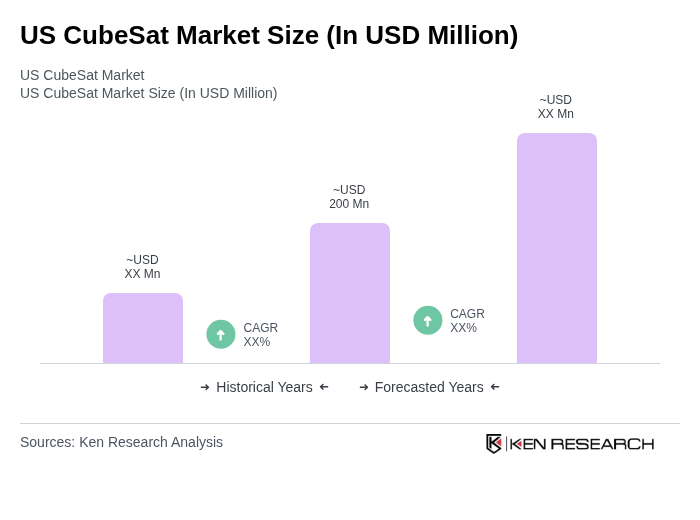
- The US CubeSat market is valued at USD 200 million, based on a five-year historical analysis. Growth is primarily driven by advancements in miniaturization technology, rising demand for low-cost satellite solutions, and increased interest in Earth observation, remote sensing, and communication applications. Recent trends highlight expanding commercial deployments, integration of artificial intelligence for data processing, and enhanced launch service accessibility, which further accelerate market adoption across government, commercial, and educational sectors.
- The United States maintains dominance in the CubeSat market, with key players concentrated in California, Texas, and Florida. This leadership is attributed to the presence of major aerospace companies, research institutions, and agencies such as NASA, which drive innovation and development in satellite technology. Robust infrastructure, significant investments in space exploration, and a strong ecosystem of launch providers and integrators further reinforce the US's leading position in the global CubeSat sector.
- The regulatory framework for CubeSat launches in the United States is governed by the Space Policy Directive-3, issued by the Executive Office of the President in 2018. This directive establishes standards for space traffic management and streamlines licensing processes for satellite operators, including CubeSat missions. It mandates coordination with the Federal Communications Commission (FCC) and the Federal Aviation Administration (FAA) for spectrum allocation and launch licensing, supporting innovation and public-private collaboration in the space sector.
US CubeSat Market Segmentation
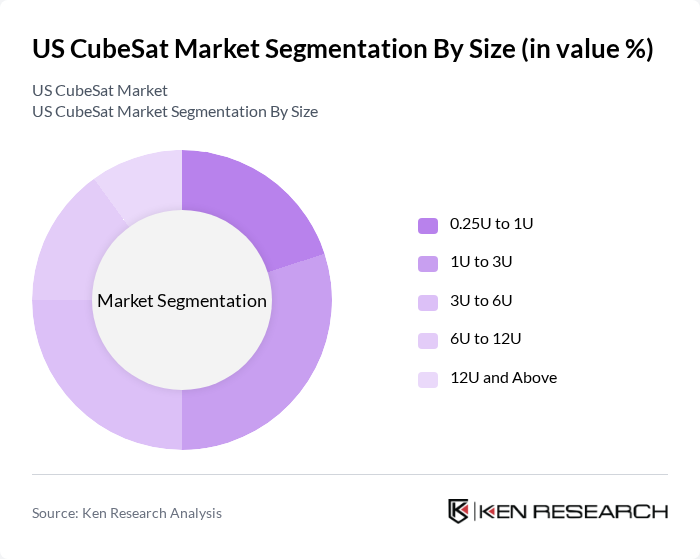
By Size:The CubeSat market is segmented by size, including 0.25U to 1U, 1U to 3U, 3U to 6U, 6U to 12U, and 12U and above. The 1U to 3U segment accounts for the largest share, driven by its versatility for Earth observation, technology demonstration, and communication missions. Larger CubeSat sizes (3U and above) are increasingly adopted for advanced payloads, scientific research, and commercial imaging, while smaller units remain popular for educational and technology validation purposes.
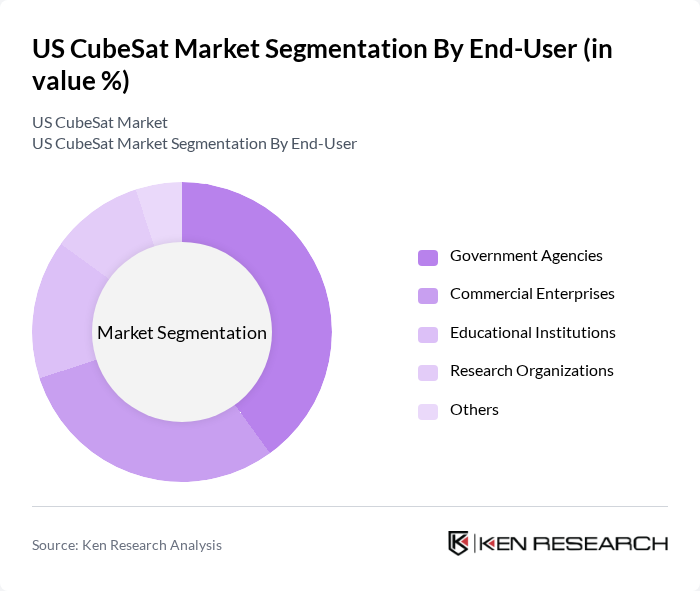
By End-User:The CubeSat market is segmented by end-user, including government agencies, commercial enterprises, educational institutions, research organizations, and others. Government agencies lead in adoption due to national security, Earth observation, and scientific missions. Commercial enterprises are rapidly increasing their share, leveraging CubeSats for remote sensing, IoT connectivity, and data services. Educational institutions and research organizations utilize CubeSats for technology demonstration, STEM education, and experimental payloads.
US CubeSat Market Competitive Landscape
The US CubeSat market is characterized by a dynamic mix of regional and international players. Leading participants such as Planet Labs PBC, Spire Global, Inc., Blue Canyon Technologies, LLC, Tyvak Nano-Satellite Systems, Inc. (Terran Orbital), NASA Ames Research Center, Northrop Grumman Innovation Systems, Rocket Lab USA, Inc., AAC Clyde Space, Pumpkin, Inc., NASA Jet Propulsion Laboratory, CU Aerospace LLC, Orbital Micro Systems, EnduroSat, SpaceX, L3Harris Technologies, Inc. contribute to innovation, geographic expansion, and service delivery in this space.
US CubeSat Market Industry Analysis
Growth Drivers
- Increasing Demand for Low-Cost Satellite Solutions:The US CubeSat market is experiencing a surge in demand for low-cost satellite solutions, driven by the need for affordable access to space. In future, the average cost of launching a CubeSat is projected to be around $1 million, significantly lower than traditional satellites, which can exceed $100 million. This affordability is attracting startups and educational institutions, leading to an estimated 30% increase in CubeSat launches compared to previous years, according to the Space Data Association.
- Advancements in Miniaturization Technology:Technological advancements in miniaturization are propelling the CubeSat market forward. Innovations in microelectronics and materials science have enabled the development of smaller, lighter components, allowing CubeSats to carry more sophisticated payloads. For instance, the integration of advanced sensors and communication systems has improved CubeSat capabilities, with payload capacities increasing by 40% since 2020. This trend is supported by a future report from the National Aeronautics and Space Administration (NASA) highlighting the potential for enhanced mission profiles.
- Rising Interest in Space Exploration and Research:The growing interest in space exploration and research is a significant driver for the CubeSat market. In future, NASA's budget for small satellite missions is expected to reach $500 million, reflecting a commitment to innovative research initiatives. Additionally, universities and research institutions are increasingly utilizing CubeSats for scientific experiments, with over 100 educational institutions actively engaged in CubeSat projects. This trend is fostering a collaborative environment that enhances research capabilities and expands the market.
Market Challenges
- Regulatory Hurdles and Compliance Issues:The CubeSat market faces significant regulatory hurdles that can impede growth. In future, the Federal Communications Commission (FCC) is expected to process over 200 satellite applications, leading to potential delays in licensing. Compliance with International Traffic in Arms Regulations (ITAR) further complicates the landscape, as companies must navigate stringent export controls. These regulatory challenges can result in increased costs and extended timelines for CubeSat missions, hindering market expansion.
- Limited Access to Launch Opportunities:Access to launch opportunities remains a critical challenge for the CubeSat market. In future, the number of dedicated small satellite launches is projected to be around 50, which may not meet the growing demand from CubeSat developers. Additionally, competition for slots on larger rockets can lead to increased costs and scheduling conflicts. This limited access can restrict the ability of new entrants to participate in the market, stifling innovation and growth.
US CubeSat Market Future Outlook
The future of the US CubeSat market appears promising, driven by ongoing technological advancements and increasing collaboration between public and private sectors. As more educational institutions and startups enter the market, the diversity of applications is expected to expand significantly. Furthermore, government initiatives aimed at fostering innovation in space technology will likely enhance funding opportunities. The focus on sustainability and space debris management will also shape future developments, ensuring that CubeSats play a vital role in the evolving landscape of space exploration.
Market Opportunities
- Growth in Educational and Research Institutions:The increasing involvement of educational institutions in CubeSat projects presents a significant market opportunity. With over 150 universities engaged in CubeSat development, the potential for innovative research and collaboration is substantial. This trend is expected to drive demand for CubeSat solutions, fostering a new generation of engineers and scientists in the space sector.
- Partnerships with Commercial Space Companies:Collaborations between CubeSat developers and commercial space companies are creating new avenues for growth. In future, partnerships are anticipated to increase by 25%, enabling shared resources and expertise. These alliances can enhance the development of advanced CubeSat technologies and expand market reach, ultimately benefiting both parties and driving innovation in the industry.
Scope of the Report
| Segment | Sub-Segments |
|---|---|
| By Size | U to 1U U to 3U U to 6U U to 12U U and Above |
| By End-User | Government Agencies Commercial Enterprises Educational Institutions Research Organizations Others |
| By Application | Earth Observation & Traffic Monitoring Communication Science, Technology & Education Space Observation Technology Demonstration Others |
| By Component | Payloads Power Systems Communication Systems Structure & Bus Propulsion Systems Others |
| By Launch Method | Dedicated Launch Vehicles Ride-Share Missions Secondary Payloads Others |
| By Orbit Type | Low Earth Orbit (LEO) Medium Earth Orbit (MEO) Geostationary Orbit (GEO) Others |
| By Funding Source | Government Grants Private Investments Crowdfunding Others |
Key Target Audience
Investors and Venture Capitalist Firms
Government and Regulatory Bodies (e.g., NASA, FCC, NOAA)
Manufacturers and Producers
Satellite Operators
Defense and Military Organizations
Aerospace and Defense Contractors
Telecommunications Companies
Space Research Organizations
Players Mentioned in the Report:
Planet Labs PBC
Spire Global, Inc.
Blue Canyon Technologies, LLC
Tyvak Nano-Satellite Systems, Inc. (Terran Orbital)
NASA Ames Research Center
Northrop Grumman Innovation Systems
Rocket Lab USA, Inc.
AAC Clyde Space
Pumpkin, Inc.
NASA Jet Propulsion Laboratory
CU Aerospace LLC
Orbital Micro Systems
EnduroSat
SpaceX
L3Harris Technologies, Inc.
Table of Contents
Market Assessment Phase
1. Executive Summary and Approach
2. US CubeSat Market Overview
2.1 Key Insights and Strategic Recommendations
2.2 US CubeSat Market Overview
2.3 Definition and Scope
2.4 Evolution of Market Ecosystem
2.5 Timeline of Key Regulatory Milestones
2.6 Value Chain & Stakeholder Mapping
2.7 Business Cycle Analysis
2.8 Policy & Incentive Landscape
3. US CubeSat Market Analysis
3.1 Growth Drivers
3.1.1 Increasing demand for low-cost satellite solutions
3.1.2 Advancements in miniaturization technology
3.1.3 Rising interest in space exploration and research
3.1.4 Expanding commercial applications in Earth observation
3.2 Market Challenges
3.2.1 Regulatory hurdles and compliance issues
3.2.2 Limited access to launch opportunities
3.2.3 Competition from larger satellite systems
3.2.4 Technical limitations in payload capabilities
3.3 Market Opportunities
3.3.1 Growth in educational and research institutions
3.3.2 Partnerships with commercial space companies
3.3.3 Development of new applications in telecommunications
3.3.4 Government funding for small satellite missions
3.4 Market Trends
3.4.1 Increasing collaboration between private and public sectors
3.4.2 Emergence of CubeSat constellations for data collection
3.4.3 Focus on sustainability and space debris management
3.4.4 Advancements in propulsion and power systems
3.5 Government Regulation
3.5.1 FCC licensing requirements for satellite operations
3.5.2 ITAR compliance for satellite components
3.5.3 National security regulations impacting satellite launches
3.5.4 Environmental assessments for launch sites
4. SWOT Analysis
5. Stakeholder Analysis
6. Porter's Five Forces Analysis
7. US CubeSat Market Market Size, 2019-2024
7.1 By Value
7.2 By Volume
7.3 By Average Selling Price
8. US CubeSat Market Segmentation
8.1 By Size
8.1.1 0.25U to 1U
8.1.2 1U to 3U
8.1.3 3U to 6U
8.1.4 6U to 12U
8.1.5 12U and Above
8.2 By End-User
8.2.1 Government Agencies
8.2.2 Commercial Enterprises
8.2.3 Educational Institutions
8.2.4 Research Organizations
8.2.5 Others
8.3 By Application
8.3.1 Earth Observation & Traffic Monitoring
8.3.2 Communication
8.3.3 Science, Technology & Education
8.3.4 Space Observation
8.3.5 Technology Demonstration
8.3.6 Others
8.4 By Component
8.4.1 Payloads
8.4.2 Power Systems
8.4.3 Communication Systems
8.4.4 Structure & Bus
8.4.5 Propulsion Systems
8.4.6 Others
8.5 By Launch Method
8.5.1 Dedicated Launch Vehicles
8.5.2 Ride-Share Missions
8.5.3 Secondary Payloads
8.5.4 Others
8.6 By Orbit Type
8.6.1 Low Earth Orbit (LEO)
8.6.2 Medium Earth Orbit (MEO)
8.6.3 Geostationary Orbit (GEO)
8.6.4 Others
8.7 By Funding Source
8.7.1 Government Grants
8.7.2 Private Investments
8.7.3 Crowdfunding
8.7.4 Others
9. US CubeSat Market Competitive Analysis
9.1 Market Share of Key Players
9.2 Cross Comparison of Key Players
9.2.1 Company Name
9.2.2 Group Size (Large, Medium, or Small as per industry convention)
9.2.3 Revenue Growth Rate (YoY %)
9.2.4 Number of CubeSats Launched (Cumulative/Annual)
9.2.5 Market Penetration Rate (US CubeSat Market Share %)
9.2.6 Average Contract Value (USD)
9.2.7 R&D Intensity (% of Revenue)
9.2.8 Innovation Index (Patents Filed, New Product Launches)
9.2.9 Launch Success Rate (%)
9.2.10 Key Partnerships (Number/Type)
9.2.11 Customer Segmentation (Govt, Commercial, Academic)
9.2.12 Operational Efficiency (Lead Time, Cost per Launch)
9.2.13 Customer Satisfaction Score (NPS or Equivalent)
9.3 SWOT Analysis of Top Players
9.4 Pricing Analysis
9.5 Detailed Profile of Major Companies
9.5.1 Planet Labs PBC
9.5.2 Spire Global, Inc.
9.5.3 Blue Canyon Technologies, LLC
9.5.4 Tyvak Nano-Satellite Systems, Inc. (Terran Orbital)
9.5.5 NASA Ames Research Center
9.5.6 Northrop Grumman Innovation Systems
9.5.7 Rocket Lab USA, Inc.
9.5.8 AAC Clyde Space
9.5.9 Pumpkin, Inc.
9.5.10 NASA Jet Propulsion Laboratory
9.5.11 CU Aerospace LLC
9.5.12 Orbital Micro Systems
9.5.13 EnduroSat
9.5.14 SpaceX
9.5.15 L3Harris Technologies, Inc.
10. US CubeSat Market End-User Analysis
10.1 Procurement Behavior of Key Ministries
10.1.1 Federal Agencies
10.1.2 State Governments
10.1.3 Research Institutions
10.1.4 Others
10.2 Corporate Spend on Infrastructure & Energy
10.2.1 Investment in Satellite Technology
10.2.2 Budget Allocation for R&D
10.2.3 Expenditure on Launch Services
10.2.4 Others
10.3 Pain Point Analysis by End-User Category
10.3.1 Budget Constraints
10.3.2 Technical Limitations
10.3.3 Regulatory Compliance Issues
10.3.4 Others
10.4 User Readiness for Adoption
10.4.1 Awareness of CubeSat Benefits
10.4.2 Training and Support Needs
10.4.3 Integration with Existing Systems
10.4.4 Others
10.5 Post-Deployment ROI and Use Case Expansion
10.5.1 Performance Metrics
10.5.2 User Feedback and Adaptation
10.5.3 Scalability of Applications
10.5.4 Others
11. US CubeSat Market Future Size, 2025-2030
11.1 By Value
11.2 By Volume
11.3 By Average Selling Price
Go-To-Market Strategy Phase
1. Whitespace Analysis + Business Model Canvas
1.1 Market Gaps Identification
1.2 Business Model Development
2. Marketing and Positioning Recommendations
2.1 Branding Strategies
2.2 Product USPs
3. Distribution Plan
3.1 Urban Retail vs Rural NGO Tie-ups
4. Channel & Pricing Gaps
4.1 Underserved Routes
4.2 Pricing Bands
5. Unmet Demand & Latent Needs
5.1 Category Gaps
5.2 Consumer Segments
6. Customer Relationship
6.1 Loyalty Programs
6.2 After-sales Service
7. Value Proposition
7.1 Sustainability
7.2 Integrated Supply Chains
8. Key Activities
8.1 Regulatory Compliance
8.2 Branding
8.3 Distribution Setup
9. Entry Strategy Evaluation
9.1 Domestic Market Entry Strategy
9.1.1 Product Mix
9.1.2 Pricing Band
9.1.3 Packaging
9.2 Export Entry Strategy
9.2.1 Target Countries
9.2.2 Compliance Roadmap
10. Entry Mode Assessment
10.1 JV
10.2 Greenfield
10.3 M&A
10.4 Distributor Model
11. Capital and Timeline Estimation
11.1 Capital Requirements
11.2 Timelines
12. Control vs Risk Trade-Off
12.1 Ownership vs Partnerships
13. Profitability Outlook
13.1 Breakeven Analysis
13.2 Long-term Sustainability
14. Potential Partner List
14.1 Distributors
14.2 JVs
14.3 Acquisition Targets
15. Execution Roadmap
15.1 Phased Plan for Market Entry
15.1.1 Market Setup
15.1.2 Market Entry
15.1.3 Growth Acceleration
15.1.4 Scale & Stabilize
15.2 Key Activities and Milestones
15.2.1 Activity Planning
15.2.2 Milestone Tracking
Research Methodology
Phase 1: Approach1
Desk Research
- Analysis of industry reports from space agencies and satellite organizations
- Review of academic publications and white papers on CubeSat technology
- Examination of market trends and forecasts from aerospace industry analysts
Primary Research
- Interviews with executives from CubeSat manufacturing companies
- Surveys targeting satellite operators and end-users in various sectors
- Field interviews with researchers and engineers involved in CubeSat projects
Validation & Triangulation
- Cross-validation of findings through multiple data sources including government reports
- Triangulation of market data with insights from industry conferences and workshops
- Sanity checks through expert panel reviews comprising industry veterans
Phase 2: Market Size Estimation1
Top-down Assessment
- Estimation of total addressable market based on national space budgets
- Segmentation by application areas such as Earth observation, communication, and research
- Incorporation of government initiatives promoting CubeSat development
Bottom-up Modeling
- Volume estimates based on production rates of leading CubeSat manufacturers
- Cost analysis derived from component pricing and assembly expenses
- Revenue projections based on service contracts and satellite launches
Forecasting & Scenario Analysis
- Multi-factor regression analysis incorporating technological advancements and funding trends
- Scenario modeling based on regulatory changes and international collaboration
- Baseline, optimistic, and pessimistic forecasts through 2035
Phase 3: CATI Sample Composition1
| Scope Item/Segment | Sample Size | Target Respondent Profiles |
|---|---|---|
| Commercial CubeSat Applications | 100 | Business Development Managers, Product Managers |
| Government and Defense CubeSat Programs | 80 | Program Directors, Procurement Officers |
| Academic Research Initiatives | 50 | Research Scientists, University Professors |
| CubeSat Launch Services | 40 | Launch Coordinators, Operations Managers |
| CubeSat Component Suppliers | 60 | Supply Chain Managers, Product Engineers |
Frequently Asked Questions
What is the current value of the US CubeSat market?
The US CubeSat market is valued at approximately USD 200 million, driven by advancements in miniaturization technology, demand for low-cost satellite solutions, and increased interest in applications such as Earth observation and communication.
What factors are driving the growth of the US CubeSat market?
Which states are leading in the US CubeSat market?
What regulatory framework governs CubeSat launches in the US?
Other Regional/Country Reports
Indonesia CubeSat Market
Malaysia CubeSat Market
KSA CubeSat Market
APAC CubeSat Market
Other Adjacent Reports
Oman Nanosatellite Market
UAE Satellite Launch Services Market
Qatar Earth Observation Satellite Market
Thailand Space Communication Equipment Market
GCC Remote Sensing Technology Market Report Size Share Growth Drivers Trends Opportunities & Forecast 2025–2030Global Aerospace Manufacturing Market Outlook to 2030Malaysia Satellite Payload Market
Philippines Space Data Analytics Market
Singapore Orbital Debris Management Market
Why Buy From Us?

What makes us stand out is that our consultants follow Robust, Refine and Result (RRR) methodology. Robust for clear definitions, approaches and sanity checking, Refine for differentiating respondents' facts and opinions, and Result for presenting data with story.

We have set a benchmark in the industry by offering our clients with syndicated and customized market research reports featuring coverage of entire market as well as meticulous research and analyst insights.

While we don't replace traditional research, we flip the method upside down. Our dual approach of Top Bottom & Bottom Top ensures quality deliverable by not just verifying company fundamentals but also looking at the sector and macroeconomic factors.

With one step in the future, our research team constantly tries to show you the bigger picture. We help with some of the tough questions you may encounter along the way: How is the industry positioned? Best marketing channel? KPI's of competitors? By aligning every element, we help maximize success.

Our report gives you instant access to the answers and sources that other companies might choose to hide. We elaborate each steps of research methodology we have used and showcase you the sample size to earn your trust.

If you need any support, we are here! We pride ourselves on universe strength, data quality, and quick, friendly, and professional service.