Us Desiccated Coconut Market Report Size, Share, Growth Drivers, Trends, Opportunities & Forecast 2025–2030

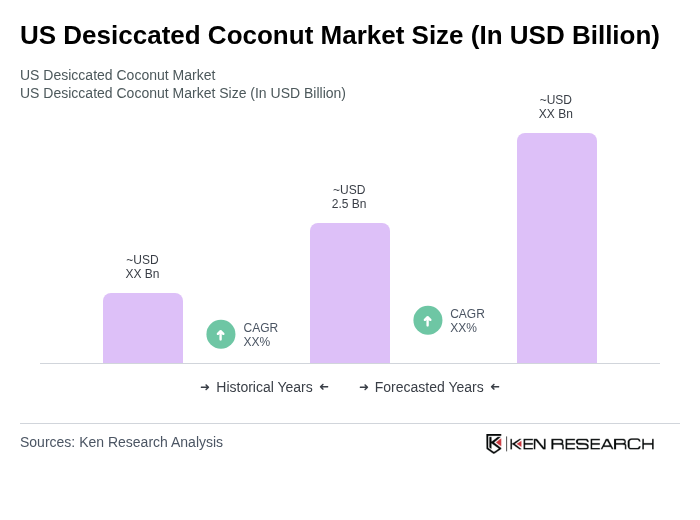
The US Desiccated Coconut Market, valued at USD 2.5 billion, grows due to rising health awareness, vegan diets, and demand for natural ingredients in bakery and confectionery.

Region:North America

Author(s):Shubham

Product Code:KRAD3518

Pages:97

Published On:November 2025
About the Report

Base Year 2024

US Desiccated Coconut Market Overview

  • The US Desiccated Coconut Market is valued at USD 2.5 billion, based on a five-year historical analysis. This growth is primarily driven by the increasing demand for coconut-based products in the food and beverage sector, as well as the rising popularity of health-conscious diets that incorporate natural ingredients. The market is also supported by the expanding vegan and vegetarian population, which favors plant-based alternatives. Recent trends highlight a surge in demand for clean-label, minimally processed, and organic coconut products, aligning with consumer preferences for transparency and sustainability .
  • Key players in this market include California, Florida, and Hawaii, which are pivotal due to their established supply chains and proximity to major distribution networks. While these states do not dominate coconut cultivation (as most desiccated coconut is imported), they serve as critical hubs for import processing, warehousing, and distribution, leveraging strong logistics infrastructure and established food industry networks .
  • In 2023, the US government reinforced regulations to ensure the quality and safety of coconut products. The Food and Drug Administration (FDA) enforces the Food Safety Modernization Act (FSMA), which requires all desiccated coconut products—domestic and imported—to comply with preventive controls, hazard analysis, labeling requirements, and safety testing. The FSMA (21 U.S.C. § 2201 et seq., issued by the US Congress and enforced by the FDA, 2011) mandates that food facilities implement risk-based preventive controls to protect consumers and ensure transparency in the market .
US Desiccated Coconut Market Size

US Desiccated Coconut Market Segmentation

By Form:The market is segmented into various forms of desiccated coconut, including shredded, flaked, powdered, granular, and chips. Among these, shredded coconut is the most popular due to its versatility in culinary applications, particularly in baking and confectionery. The demand for shredded coconut is driven by its ease of use and the growing trend of home baking, which has surged in recent years. Flaked and powdered forms are also gaining traction, especially in health food products and smoothies. This segmentation aligns with industry reporting, where shreds, flakes, powder, and chips are the primary forms available in the US market .
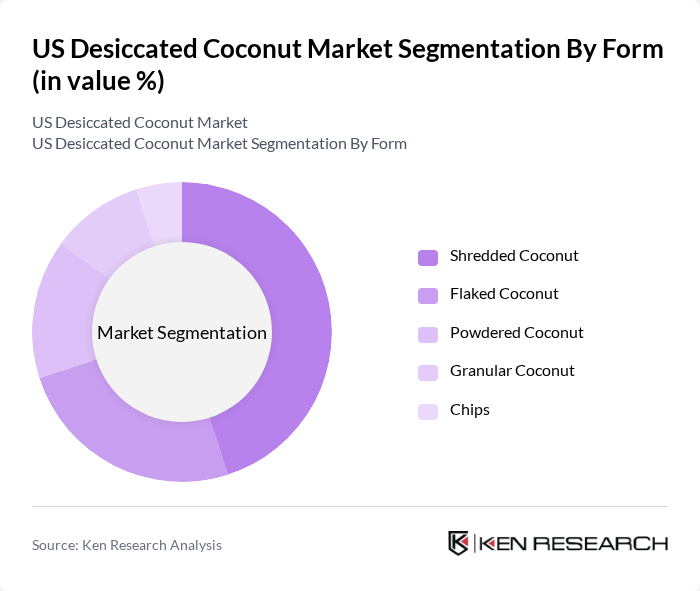
US Desiccated Coconut Market segmentation by Form.

By Application:The desiccated coconut market is utilized across various applications, including bakery and confectionery, dairy products, health foods and supplements, culinary uses, and others. The bakery and confectionery segment leads the market, driven by the increasing consumer preference for coconut-based desserts and snacks. Health foods and supplements are also witnessing significant growth as consumers seek nutritious and natural ingredients to enhance their diets. The segmentation reflects the dominance of bakery and confectionery, followed by dairy and health food applications, consistent with market research findings .
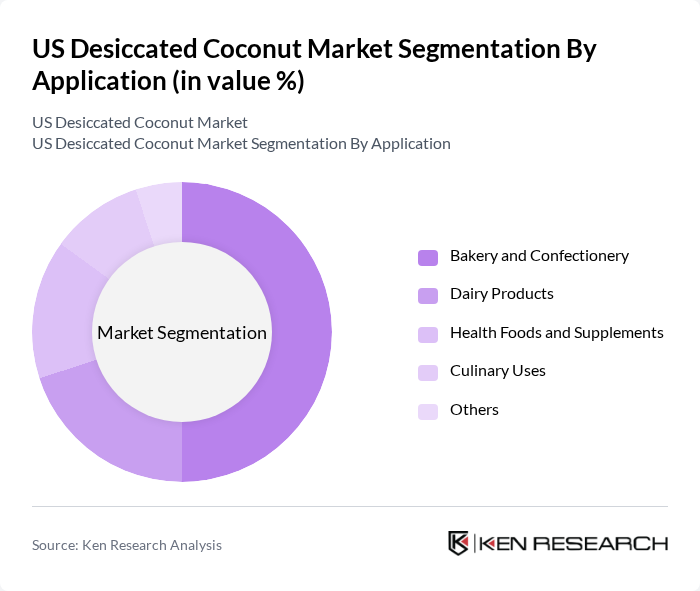
US Desiccated Coconut Market segmentation by Application.

US Desiccated Coconut Market Competitive Landscape

The US Desiccated Coconut Market is characterized by a dynamic mix of regional and international players. Leading participants such as Nutiva, Bob's Red Mill Natural Foods, Edward & Sons Trading Co., Inc., Let's Do Organic, Nature's Way Products, LLC, Sunfood Superfoods, Kevala, Organic Traditions, The Coconut Company, Aloha Shoyu Company, Inc., Thai Agri Foods Public Company Limited, Coconut Merchant contribute to innovation, geographic expansion, and service delivery in this space.

Nutiva

1999

Richmond, California

Bob's Red Mill Natural Foods

1978

Milwaukie, Oregon

Edward & Sons Trading Co., Inc.

1982

Carpinteria, California

Let's Do Organic

1995

Carpinteria, California

Nature's Way Products, LLC

1969

Green Bay, Wisconsin

Company

Establishment Year

Headquarters

Company Size (Large, Medium, or Small)

Annual Revenue (USD Millions)

Year-over-Year Revenue Growth Rate (%)

Market Share (%)

Product Portfolio Breadth (Number of SKUs)

Geographic Presence (Number of States)

US Desiccated Coconut Market Industry Analysis

Growth Drivers

  • Increasing Health Consciousness:The US population is increasingly prioritizing health, with 70% of consumers actively seeking healthier food options. This trend is supported by the rise in organic food sales, which reached $70 billion in future, reflecting a 12% increase from the previous year. As desiccated coconut is rich in fiber and healthy fats, its appeal as a nutritious ingredient is growing, driving demand in health-focused food products and snacks.
  • Rising Demand for Natural Ingredients:The natural food market in the US is projected to reach $300 billion by future, with consumers increasingly favoring products free from artificial additives. Desiccated coconut, being a natural ingredient, aligns perfectly with this trend. The clean label movement is gaining traction, with 60% of consumers willing to pay more for products with simple, recognizable ingredients, further boosting the demand for desiccated coconut in various food applications.
  • Growth in Vegan and Plant-Based Diets:The plant-based food market in the US is expected to surpass $74 billion by future, driven by a 27% increase in veganism over the past five years. Desiccated coconut serves as a versatile ingredient in vegan recipes, providing texture and flavor. This growth in plant-based diets is encouraging food manufacturers to incorporate desiccated coconut into their products, enhancing its market presence and appeal among health-conscious consumers.

Market Challenges

  • Price Volatility of Raw Materials:The price of coconuts has fluctuated significantly, with a 15% increase noted in future due to adverse weather conditions affecting supply. This volatility poses a challenge for manufacturers relying on consistent pricing for desiccated coconut. As raw material costs rise, producers may face pressure to increase product prices, potentially impacting consumer demand and market stability in the short term.
  • Competition from Alternative Ingredients:The market for alternative ingredients, such as almond flour and oat flour, is expanding rapidly, with a projected growth rate of 20% annually. These alternatives often compete on price and functionality, posing a challenge for desiccated coconut. As consumers explore diverse ingredient options, manufacturers must innovate to differentiate their products and maintain market share amidst increasing competition.

US Desiccated Coconut Market Future Outlook

The US desiccated coconut market is poised for significant growth, driven by evolving consumer preferences towards health and wellness. Innovations in product formulations and packaging are expected to enhance market appeal, while the rise of e-commerce platforms will facilitate broader distribution. Additionally, as sustainability becomes a priority, companies focusing on ethical sourcing and environmentally friendly practices will likely gain a competitive edge, positioning themselves favorably in the market landscape.

Market Opportunities

  • Expansion into New Food Applications:There is a growing opportunity for desiccated coconut in non-traditional food applications, such as protein bars and smoothies. The health food sector is expanding, with the protein bar market alone projected to reach $6 billion by future. This trend presents a significant opportunity for manufacturers to innovate and create new products that incorporate desiccated coconut, appealing to health-conscious consumers.
  • Increasing Export Potential:The US desiccated coconut market has substantial export potential, particularly to regions with rising health trends, such as Europe and Asia. In future, US exports of coconut products increased by 10%, indicating a growing international demand. By tapping into these markets, producers can enhance their revenue streams and establish a global presence, further driving growth in the desiccated coconut sector.

Scope of the Report

SegmentSub-Segments
By Form

Shredded Coconut

Flaked Coconut

Powdered Coconut

Granular Coconut

Chips

By Application

Bakery and Confectionery

Dairy Products

Health Foods and Supplements

Culinary Uses

Others

By Distribution Channel

Direct (B2B)

Supermarkets and Hypermarkets

Online Retail

Specialty Stores

Convenience Stores

By Nature

Conventional Desiccated Coconut

Organic Desiccated Coconut

By End-User

Food and Beverage Industry

Food Services Industry

Households

By Packaging Type

Bulk Packaging

Retail Packaging

Eco-friendly Packaging

By Region

Northeast

Midwest

South

West

Key Target Audience

Investors and Venture Capitalist Firms

Government and Regulatory Bodies (e.g., U.S. Department of Agriculture, Food and Drug Administration)

Manufacturers and Producers

Distributors and Retailers

Food and Beverage Companies

Health and Wellness Brands

Importers and Exporters

Food Safety and Quality Assurance Organizations

Players Mentioned in the Report:

Nutiva

Bob's Red Mill Natural Foods

Edward & Sons Trading Co., Inc.

Let's Do Organic

Nature's Way Products, LLC

Sunfood Superfoods

Kevala

Organic Traditions

The Coconut Company

Aloha Shoyu Company, Inc.

Thai Agri Foods Public Company Limited

Coconut Merchant

Table of Contents

Market Assessment Phase

1. Executive Summary and Approach


2. US Desiccated Coconut Market Overview

2.1 Key Insights and Strategic Recommendations

2.2 US Desiccated Coconut Market Overview

2.3 Definition and Scope

2.4 Evolution of Market Ecosystem

2.5 Timeline of Key Regulatory Milestones

2.6 Value Chain & Stakeholder Mapping

2.7 Business Cycle Analysis

2.8 Policy & Incentive Landscape


3. US Desiccated Coconut Market Analysis

3.1 Growth Drivers

3.1.1 Increasing Health Consciousness
3.1.2 Rising Demand for Natural Ingredients
3.1.3 Growth in Vegan and Plant-Based Diets
3.1.4 Expansion of Food Processing Industry

3.2 Market Challenges

3.2.1 Price Volatility of Raw Materials
3.2.2 Competition from Alternative Ingredients
3.2.3 Supply Chain Disruptions
3.2.4 Regulatory Compliance Issues

3.3 Market Opportunities

3.3.1 Expansion into New Food Applications
3.3.2 Increasing Export Potential
3.3.3 Development of Value-Added Products
3.3.4 Collaborations with Health Food Brands

3.4 Market Trends

3.4.1 Growing Popularity of Organic Products
3.4.2 Innovations in Packaging Solutions
3.4.3 Rise of E-commerce Platforms
3.4.4 Focus on Sustainable Sourcing

3.5 Government Regulation

3.5.1 Food Safety Standards
3.5.2 Labeling Requirements
3.5.3 Import Tariffs and Trade Policies
3.5.4 Environmental Regulations

4. SWOT Analysis


5. Stakeholder Analysis


6. Porter's Five Forces Analysis


7. US Desiccated Coconut Market Market Size, 2019-2024

7.1 By Value

7.2 By Volume

7.3 By Average Selling Price


8. US Desiccated Coconut Market Segmentation

8.1 By Form

8.1.1 Shredded Coconut
8.1.2 Flaked Coconut
8.1.3 Powdered Coconut
8.1.4 Granular Coconut
8.1.5 Chips

8.2 By Application

8.2.1 Bakery and Confectionery
8.2.2 Dairy Products
8.2.3 Health Foods and Supplements
8.2.4 Culinary Uses
8.2.5 Others

8.3 By Distribution Channel

8.3.1 Direct (B2B)
8.3.2 Supermarkets and Hypermarkets
8.3.3 Online Retail
8.3.4 Specialty Stores
8.3.5 Convenience Stores

8.4 By Nature

8.4.1 Conventional Desiccated Coconut
8.4.2 Organic Desiccated Coconut

8.5 By End-User

8.5.1 Food and Beverage Industry
8.5.2 Food Services Industry
8.5.3 Households

8.6 By Packaging Type

8.6.1 Bulk Packaging
8.6.2 Retail Packaging
8.6.3 Eco-friendly Packaging

8.7 By Region

8.7.1 Northeast
8.7.2 Midwest
8.7.3 South
8.7.4 West

9. US Desiccated Coconut Market Competitive Analysis

9.1 Market Share of Key Players

9.2 Cross Comparison of Key Players

9.2.1 Company Name
9.2.2 Company Size (Large, Medium, or Small)
9.2.3 Annual Revenue (USD Millions)
9.2.4 Year-over-Year Revenue Growth Rate (%)
9.2.5 Market Share (%)
9.2.6 Product Portfolio Breadth (Number of SKUs)
9.2.7 Geographic Presence (Number of States)
9.2.8 Distribution Channel Coverage (Direct, Retail, Online)
9.2.9 Organic Product Offering (%)
9.2.10 Brand Recognition Score (1-10)

9.3 SWOT Analysis of Top Players

9.4 Pricing Analysis

9.5 Detailed Profile of Major Companies

9.5.1 Nutiva
9.5.2 Bob's Red Mill Natural Foods
9.5.3 Edward & Sons Trading Co., Inc.
9.5.4 Let's Do Organic
9.5.5 Nature's Way Products, LLC
9.5.6 Sunfood Superfoods
9.5.7 Kevala
9.5.8 Organic Traditions
9.5.9 The Coconut Company
9.5.10 Aloha Shoyu Company, Inc.
9.5.11 Thai Agri Foods Public Company Limited
9.5.12 Coconut Merchant

10. US Desiccated Coconut Market End-User Analysis

10.1 Food and Beverage Industry Procurement

10.1.1 Supplier Selection Criteria
10.1.2 Quality and Certification Requirements
10.1.3 Volume and Pricing Negotiations
10.1.4 Supply Chain Reliability Expectations

10.2 Food Services Industry Procurement

10.2.1 Purchasing Patterns
10.2.2 Budget Allocations
10.2.3 Supplier Relationships
10.2.4 Sustainability Preferences

10.3 Household Consumer Behavior

10.3.1 Purchase Frequency and Quantity
10.3.2 Price Sensitivity Analysis
10.3.3 Brand Loyalty Patterns
10.3.4 Organic vs. Conventional Preferences

10.4 Pain Point Analysis by End-User Category

10.4.1 Quality Consistency Issues
10.4.2 Supply Chain Reliability Concerns
10.4.3 Price Volatility Impact
10.4.4 Regulatory Compliance Challenges

10.5 Market Adoption and Growth Potential

10.5.1 Awareness and Education Levels
10.5.2 Product Trial and Conversion Rates
10.5.3 Repeat Purchase Rates
10.5.4 Future Demand Expansion Opportunities

11. US Desiccated Coconut Market Future Size, 2025-2030

11.1 By Value

11.2 By Volume

11.3 By Average Selling Price


Go-To-Market Strategy Phase

1. Whitespace Analysis + Business Model Canvas

1.1 Market Gaps Identification

1.2 Value Proposition Development

1.3 Revenue Streams Analysis

1.4 Cost Structure Evaluation

1.5 Key Partnerships Exploration

1.6 Customer Segmentation

1.7 Competitive Advantage Assessment


2. Marketing and Positioning Recommendations

2.1 Branding Strategies

2.2 Product USPs

2.3 Target Market Identification

2.4 Communication Strategy

2.5 Digital Marketing Tactics

2.6 Customer Engagement Approaches

2.7 Performance Measurement


3. Distribution Plan

3.1 Urban Retail Strategies

3.2 E-commerce Integration

3.3 Direct-to-Consumer Channels

3.4 Logistics Optimization

3.5 Channel Partner Development

3.6 Inventory Management

3.7 Distribution Cost Analysis


4. Channel & Pricing Gaps

4.1 Underserved Distribution Channels

4.2 Pricing Bands Analysis

4.3 Competitor Pricing Strategies

4.4 Customer Price Sensitivity

4.5 Value-Based Pricing Models

4.6 Discounting Strategies

4.7 Price Monitoring Mechanisms


5. Unmet Demand & Latent Needs

5.1 Category Gaps

5.2 Consumer Segments Analysis

5.3 Product Development Opportunities

5.4 Market Entry Barriers

5.5 Customer Feedback Integration

5.6 Trend Analysis

5.7 Future Demand Projections


6. Customer Relationship

6.1 Loyalty Programs

6.2 After-sales Service

6.3 Customer Feedback Mechanisms

6.4 Relationship Management Strategies

6.5 Community Engagement Initiatives

6.6 Customer Education Programs

6.7 Performance Metrics


7. Value Proposition

7.1 Sustainability Initiatives

7.2 Integrated Supply Chains

7.3 Quality Assurance Practices

7.4 Customer-Centric Innovations

7.5 Competitive Differentiation

7.6 Brand Loyalty Development

7.7 Market Positioning Strategies


8. Key Activities

8.1 Regulatory Compliance

8.2 Branding Initiatives

8.3 Distribution Setup

8.4 Marketing Campaigns

8.5 Training and Development

8.6 Performance Monitoring

8.7 Stakeholder Engagement


9. Entry Strategy Evaluation

9.1 Domestic Market Entry Strategy

9.1.1 Product Mix
9.1.2 Pricing Band
9.1.3 Packaging Considerations

9.2 Export Entry Strategy

9.2.1 Target Countries
9.2.2 Compliance Roadmap

10. Entry Mode Assessment

10.1 Joint Ventures</h4


Research Methodology

ApproachModellingSample

Phase 1: Approach1

Desk Research

  • Analysis of industry reports from the Coconut Development Board and USDA
  • Review of market trends and statistics from trade associations and agricultural journals
  • Examination of import/export data and pricing trends from government trade databases

Primary Research

  • Interviews with key stakeholders in the coconut supply chain, including farmers and processors
  • Surveys targeting distributors and retailers to understand market dynamics and consumer preferences
  • Field visits to processing facilities to gather insights on production practices and capacity

Validation & Triangulation

  • Cross-validation of findings through multiple data sources, including trade publications and expert opinions
  • Triangulation of market data with historical trends and future projections
  • Sanity checks conducted through expert panel reviews and feedback sessions

Phase 2: Market Size Estimation1

Top-down Assessment

  • Estimation of total market size based on national coconut production statistics and consumption rates
  • Segmentation of the market by product type, including shredded, flaked, and powdered coconut
  • Incorporation of growth rates from related sectors, such as health foods and vegan products

Bottom-up Modeling

  • Collection of sales data from leading desiccated coconut manufacturers and distributors
  • Estimation of production costs and pricing strategies based on raw material sourcing
  • Volume analysis based on consumer demand trends and retail sales data

Forecasting & Scenario Analysis

  • Multi-variable forecasting using factors such as health trends, dietary shifts, and economic indicators
  • Scenario analysis based on potential regulatory changes and market entry of new players
  • Development of baseline, optimistic, and pessimistic market growth scenarios through 2030

Phase 3: CATI Sample Composition1

Scope Item/SegmentSample SizeTarget Respondent Profiles
Retail Market Insights150Store Managers, Category Buyers
Food Manufacturing Sector100Product Development Managers, Quality Assurance Leads
Health Food Retailers80Health Food Store Owners, Nutritionists
Export Market Analysis70Export Managers, Trade Compliance Officers
Consumer Preferences Survey120Health-Conscious Consumers, Vegan Diet Adopters

Frequently Asked Questions

What is the current value of the US Desiccated Coconut Market?

The US Desiccated Coconut Market is valued at approximately USD 2.5 billion, reflecting a significant growth trend driven by increasing demand for coconut-based products in the food and beverage sector and the rise of health-conscious diets.

What factors are driving the growth of the US Desiccated Coconut Market?

Which states are key players in the US Desiccated Coconut Market?

What are the main forms of desiccated coconut available in the market?

Other Regional/Country Reports

Indonesia Desiccated Coconut Market

Malaysia Desiccated Coconut Market

KSA Desiccated Coconut Market

APAC Desiccated Coconut Market

SEA Desiccated Coconut Market

Vietnam Desiccated Coconut Market

Why Buy From Us?

Refine Robust Result (RRR) Framework

What makes us stand out is that our consultants follow Robust, Refine and Result (RRR) methodology. Robust for clear definitions, approaches and sanity checking, Refine for differentiating respondents' facts and opinions, and Result for presenting data with story.

Our Reach Is Unmatched

We have set a benchmark in the industry by offering our clients with syndicated and customized market research reports featuring coverage of entire market as well as meticulous research and analyst insights.

Shifting the Research Paradigm

While we don't replace traditional research, we flip the method upside down. Our dual approach of Top Bottom & Bottom Top ensures quality deliverable by not just verifying company fundamentals but also looking at the sector and macroeconomic factors.

More Insights-Better Decisions

With one step in the future, our research team constantly tries to show you the bigger picture. We help with some of the tough questions you may encounter along the way: How is the industry positioned? Best marketing channel? KPI's of competitors? By aligning every element, we help maximize success.

Transparency and Trust

Our report gives you instant access to the answers and sources that other companies might choose to hide. We elaborate each steps of research methodology we have used and showcase you the sample size to earn your trust.

Round the Clock Support

If you need any support, we are here! We pride ourselves on universe strength, data quality, and quick, friendly, and professional service.

Why Clients Choose Us?

400000+
Reports in repository
150+
Consulting projects a year
100+
Analysts
8000+
Client Queries in 2022








