About the Report
Base Year 2024US Direct to Consumer Genetic Testing Market Overview
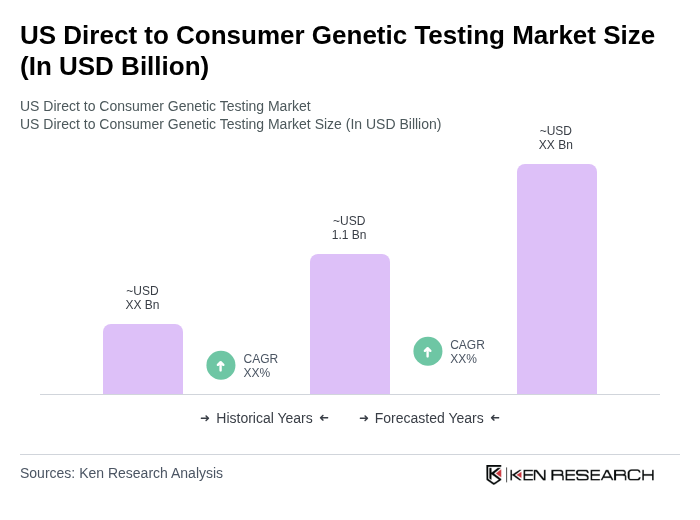
- The US Direct to Consumer Genetic Testing Market is valued at USD 1.1 billion, based on a five-year historical analysis. This growth is primarily driven by increasing consumer interest in personal health, ancestry, and genetic predispositions to diseases. The rise of e-commerce, greater adoption of preventive healthcare, and advancements in genomic technologies such as next-generation sequencing have also contributed significantly to market expansion. Heightened awareness of personalized medicine and the proliferation of affordable testing kits are further accelerating market growth.
- Key players in this market are concentrated in major cities such as San Francisco, New York, and Boston, which dominate due to their robust tech ecosystems, access to venture capital, and a high concentration of healthcare and biotech companies. These regions foster innovation and attract consumers interested in genetic testing services.
- The “Genetic Information Nondiscrimination Act (GINA), 2008” issued by the US Congress, and the “FDA Direct-to-Consumer Tests Guidance, 2018” by the US Food and Drug Administration, require all direct-to-consumer genetic testing companies to provide clear information about the limitations and potential risks of their tests. These regulations enhance consumer protection by mandating transparency and ensuring that individuals make informed decisions regarding their genetic health. Companies must comply with labeling, risk communication, and data privacy standards.
US Direct to Consumer Genetic Testing Market Segmentation
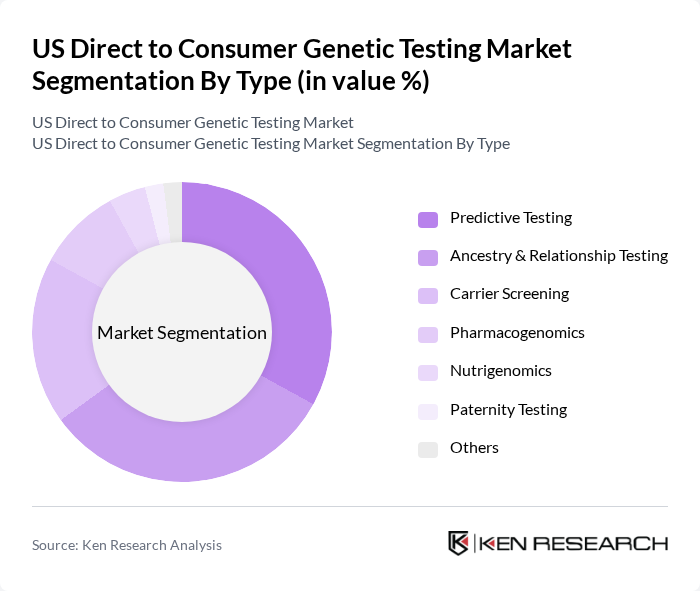
By Type:The market is segmented into various types of genetic testing services. Among these, Ancestry & Relationship Testing has emerged as the leading sub-segment, driven by a growing consumer interest in genealogy and personal heritage. Predictive Testing and Carrier Screening also hold significant market shares, as consumers increasingly seek insights into their health risks and genetic conditions. The demand for these services is fueled by rising awareness of genetic disorders, the importance of early detection, and the growing integration of AI-driven genomic analysis for health risk assessment.
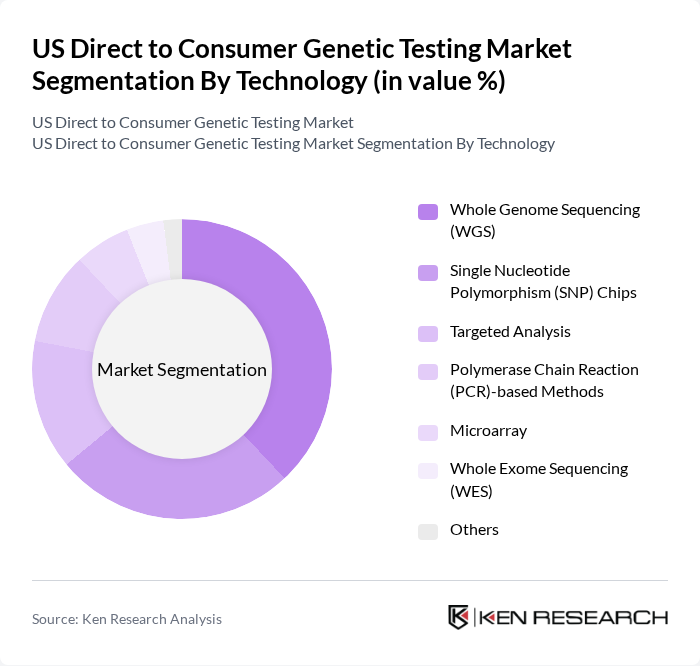
By Technology:The technology segment includes various methods used in genetic testing. Whole Genome Sequencing (WGS) is a leading technology, favored for its comprehensive analysis of an individual's entire genetic makeup. Single Nucleotide Polymorphism (SNP) Chips and Polymerase Chain Reaction (PCR)-based Methods are also widely used due to their cost-effectiveness and efficiency in specific applications. The increasing affordability of sequencing technologies and the integration of digital health platforms have further propelled the adoption of WGS in the consumer market.
US Direct to Consumer Genetic Testing Market Competitive Landscape
The US Direct to Consumer Genetic Testing Market is characterized by a dynamic mix of regional and international players. Leading participants such as 23andMe, AncestryDNA, MyHeritage, FamilyTreeDNA, Invitae, Color Genomics, Nebula Genomics, Veritas Genetics, Dante Labs, Gene by Gene, Genos, Sequencing.com, Genomic Health, Pathway Genomics, Helix, Fulgent Genetics, Sema4, EasyDNA, Living DNA, AlphaBiolabs contribute to innovation, geographic expansion, and service delivery in this space.
US Direct to Consumer Genetic Testing Market Industry Analysis
Growth Drivers
- Increasing Consumer Awareness of Genetic Health:The US population's awareness of genetic health has surged, with 70% of adults now recognizing the importance of genetic testing for health management. This awareness is driven by educational campaigns and media coverage, leading to a projected increase in genetic testing uptake. The National Institutes of Health reported that 40 million Americans engaged in genetic testing, highlighting a growing trend towards proactive health measures and personalized healthcare solutions.
- Advancements in DNA Sequencing Technology:The cost of DNA sequencing has plummeted from approximately $100,000 to around $500, making genetic testing more accessible. Innovations in sequencing technologies, such as next-generation sequencing (NGS), have improved accuracy and reduced turnaround times. According to the National Human Genome Research Institute, these advancements are expected to drive a 30% increase in genetic testing services in future, as consumers seek affordable and reliable options for health insights.
- Rising Demand for Personalized Medicine:The personalized medicine market is projected to reach $2.7 trillion, reflecting a significant shift towards tailored healthcare solutions. Genetic testing plays a crucial role in this trend, enabling healthcare providers to offer customized treatment plans based on individual genetic profiles. The American Society of Clinical Oncology reported that 80% of oncologists now utilize genetic testing to inform treatment decisions, underscoring the growing integration of genetics in clinical practice and consumer health management.
Market Challenges
- Privacy Concerns Regarding Genetic Data:Privacy issues surrounding genetic data remain a significant challenge, with 50% of consumers expressing concerns about data security. The potential for misuse of genetic information raises ethical questions, leading to hesitancy in testing uptake. A survey by the Pew Research Center indicated that 70% of respondents were worried about how their genetic data might be used by third parties, highlighting the need for robust data protection measures in the industry.
- Regulatory Hurdles and Compliance Issues:The regulatory landscape for genetic testing is complex, with the FDA overseeing testing kits and requiring compliance with stringent guidelines. In recent times, the FDA issued 20 warning letters to companies for non-compliance, illustrating the challenges faced by the industry. Additionally, the evolving nature of regulations can create uncertainty for companies, potentially stifling innovation and delaying the introduction of new testing services to the market.
US Direct to Consumer Genetic Testing Market Future Outlook
The future of the US direct-to-consumer genetic testing market appears promising, driven by technological advancements and increasing consumer engagement. As awareness of genetic health continues to rise, more individuals are likely to seek genetic insights for personalized healthcare. Furthermore, the integration of genetic testing with telehealth services is expected to enhance accessibility, allowing consumers to receive tailored health recommendations. This trend, coupled with ongoing innovations in testing methodologies, positions the market for significant growth in future.
Market Opportunities
- Expansion into Underserved Demographics:There is a significant opportunity to target underserved populations, particularly in rural areas where access to genetic testing is limited. By developing affordable and accessible testing solutions, companies can tap into a market segment that is currently underrepresented, potentially increasing overall market penetration and consumer engagement.
- Development of New Testing Services and Products:The demand for innovative genetic testing services, such as pharmacogenomics and carrier screening, presents a lucrative opportunity. Companies that invest in research and development to create new, specialized tests can differentiate themselves in a competitive market, catering to the evolving needs of consumers seeking personalized health insights.
Scope of the Report
| Segment | Sub-Segments |
|---|---|
| By Type | Predictive Testing Ancestry & Relationship Testing Carrier Screening Pharmacogenomics Nutrigenomics Paternity Testing Others |
| By Technology | Whole Genome Sequencing (WGS) Single Nucleotide Polymorphism (SNP) Chips Targeted Analysis Polymerase Chain Reaction (PCR)-based Methods Microarray Whole Exome Sequencing (WES) Others |
| By Distribution Channel | Online Platform Over-the-Counter (OTC) Direct Sales Others |
| By End-User | Individual Consumers Healthcare Providers Research Institutions Others |
| By Demographics | Age Groups Gender Ethnic Background Others |
| By Geographic Region | Northeast Midwest South West Others |
| By Testing Method | Saliva Testing Blood Testing Others |
| By Data Utilization | Personal Health Management Research and Development Others |
Key Target Audience
Investors and Venture Capitalist Firms
Government and Regulatory Bodies (e.g., Food and Drug Administration, Centers for Disease Control and Prevention)
Manufacturers and Producers
Distributors and Retailers
Health Insurance Companies
Pharmaceutical Companies
Healthcare Providers and Practitioners
Industry Associations and Advocacy Groups
Players Mentioned in the Report:
23andMe
AncestryDNA
MyHeritage
FamilyTreeDNA
Invitae
Color Genomics
Nebula Genomics
Veritas Genetics
Dante Labs
Gene by Gene
Genos
Sequencing.com
Genomic Health
Pathway Genomics
Helix
Fulgent Genetics
Sema4
EasyDNA
Living DNA
AlphaBiolabs
Table of Contents
Market Assessment Phase
1. Executive Summary and Approach
2. US Direct to Consumer Genetic Testing Market Overview
2.1 Key Insights and Strategic Recommendations
2.2 US Direct to Consumer Genetic Testing Market Overview
2.3 Definition and Scope
2.4 Evolution of Market Ecosystem
2.5 Timeline of Key Regulatory Milestones
2.6 Value Chain & Stakeholder Mapping
2.7 Business Cycle Analysis
2.8 Policy & Incentive Landscape
3. US Direct to Consumer Genetic Testing Market Analysis
3.1 Growth Drivers
3.1.1 Increasing consumer awareness of genetic health
3.1.2 Advancements in DNA sequencing technology
3.1.3 Rising demand for personalized medicine
3.1.4 Growth in e-commerce and online health services
3.2 Market Challenges
3.2.1 Privacy concerns regarding genetic data
3.2.2 Regulatory hurdles and compliance issues
3.2.3 Limited insurance coverage for genetic tests
3.2.4 Misinterpretation of genetic test results by consumers
3.3 Market Opportunities
3.3.1 Expansion into underserved demographics
3.3.2 Development of new testing services and products
3.3.3 Partnerships with healthcare providers
3.3.4 Integration of genetic testing with wellness programs
3.4 Market Trends
3.4.1 Increasing use of AI in genetic analysis
3.4.2 Growth of direct-to-consumer marketing strategies
3.4.3 Rise in consumer demand for ancestry testing
3.4.4 Focus on ethical considerations in genetic testing
3.5 Government Regulation
3.5.1 FDA guidelines on genetic testing kits
3.5.2 HIPAA regulations on genetic data privacy
3.5.3 State-level regulations on genetic testing
3.5.4 Genetic Information Nondiscrimination Act (GINA)
4. SWOT Analysis
5. Stakeholder Analysis
6. Porter's Five Forces Analysis
7. US Direct to Consumer Genetic Testing Market Market Size, 2019-2024
7.1 By Value
7.2 By Volume
7.3 By Average Selling Price
8. US Direct to Consumer Genetic Testing Market Segmentation
8.1 By Type
8.1.1 Predictive Testing
8.1.2 Ancestry & Relationship Testing
8.1.3 Carrier Screening
8.1.4 Pharmacogenomics
8.1.5 Nutrigenomics
8.1.6 Paternity Testing
8.1.7 Others
8.2 By Technology
8.2.1 Whole Genome Sequencing (WGS)
8.2.2 Single Nucleotide Polymorphism (SNP) Chips
8.2.3 Targeted Analysis
8.2.4 Polymerase Chain Reaction (PCR)-based Methods
8.2.5 Microarray
8.2.6 Whole Exome Sequencing (WES)
8.2.7 Others
8.3 By Distribution Channel
8.3.1 Online Platform
8.3.2 Over-the-Counter (OTC)
8.3.3 Direct Sales
8.3.4 Others
8.4 By End-User
8.4.1 Individual Consumers
8.4.2 Healthcare Providers
8.4.3 Research Institutions
8.4.4 Others
8.5 By Demographics
8.5.1 Age Groups
8.5.2 Gender
8.5.3 Ethnic Background
8.5.4 Others
8.6 By Geographic Region
8.6.1 Northeast
8.6.2 Midwest
8.6.3 South
8.6.4 West
8.6.5 Others
8.7 By Testing Method
8.7.1 Saliva Testing
8.7.2 Blood Testing
8.7.3 Others
8.8 By Data Utilization
8.8.1 Personal Health Management
8.8.2 Research and Development
8.8.3 Others
9. US Direct to Consumer Genetic Testing Market Competitive Analysis
9.1 Market Share of Key Players
9.2 KPIs for Cross Comparison of Key Players
9.2.1 Company Name
9.2.2 Market Share (%)
9.2.3 Revenue (USD Millions)
9.2.4 Customer Acquisition Cost (CAC)
9.2.5 Customer Retention Rate (%)
9.2.6 Revenue Growth Rate (%)
9.2.7 Market Penetration Rate (%)
9.2.8 Pricing Strategy (Average Test Price, Subscription Model, etc.)
9.2.9 Average Order Value (AOV)
9.2.10 Customer Lifetime Value (CLV)
9.2.11 Brand Awareness Index
9.2.12 Regulatory Compliance Status
9.2.13 Product Portfolio Breadth
9.2.14 Distribution Channel Mix (%)
9.3 SWOT Analysis of Top Players
9.4 Pricing Analysis
9.5 List of Major Companies
9.5.1 23andMe
9.5.2 AncestryDNA
9.5.3 MyHeritage
9.5.4 FamilyTreeDNA
9.5.5 Invitae
9.5.6 Color Genomics
9.5.7 Nebula Genomics
9.5.8 Veritas Genetics
9.5.9 Dante Labs
9.5.10 Gene by Gene
9.5.11 Genos
9.5.12 Sequencing.com
9.5.13 Genomic Health
9.5.14 Pathway Genomics
9.5.15 Helix
9.5.16 Fulgent Genetics
9.5.17 Sema4
9.5.18 EasyDNA
9.5.19 Living DNA
9.5.20 AlphaBiolabs
10. US Direct to Consumer Genetic Testing Market End-User Analysis
10.1 Procurement Behavior of Key Ministries
10.1.1 Government Health Programs
10.1.2 Public Health Initiatives
10.1.3 Research Grants
10.1.4 Others
10.2 Corporate Spend on Infrastructure & Energy
10.2.1 Investment in Genetic Research
10.2.2 Funding for Health Technology
10.2.3 Others
10.3 Pain Point Analysis by End-User Category
10.3.1 Lack of Awareness
10.3.2 High Costs of Testing
10.3.3 Data Privacy Concerns
10.3.4 Others
10.4 User Readiness for Adoption
10.4.1 Consumer Education Levels
10.4.2 Access to Technology
10.4.3 Others
10.5 Post-Deployment ROI and Use Case Expansion
10.5.1 Long-term Health Monitoring
10.5.2 Integration with Healthcare Systems
10.5.3 Others
11. US Direct to Consumer Genetic Testing Market Future Size, 2025-2030
11.1 By Value
11.2 By Volume
11.3 By Average Selling Price
Go-To-Market Strategy Phase
1. Whitespace Analysis + Business Model Canvas
1.1 Market Gaps Identification
1.2 Business Model Development
2. Marketing and Positioning Recommendations
2.1 Branding Strategies
2.2 Product USPs
3. Distribution Plan
3.1 Urban Retail vs Rural NGO Tie-ups
4. Channel & Pricing Gaps
4.1 Underserved Routes
4.2 Pricing Bands
5. Unmet Demand & Latent Needs
5.1 Category Gaps
5.2 Consumer Segments
6. Customer Relationship
6.1 Loyalty Programs
6.2 After-sales Service
7. Value Proposition
7.1 Sustainability
7.2 Integrated Supply Chains
8. Key Activities
8.1 Regulatory Compliance
8.2 Branding
8.3 Distribution Setup
9. Entry Strategy Evaluation
9.1 Domestic Market Entry Strategy
9.1.1 Product Mix
9.1.2 Pricing Band
9.1.3 Packaging
9.2 Export Entry Strategy
9.2.1 Target Countries
9.2.2 Compliance Roadmap
10. Entry Mode Assessment
10.1 JV
10.2 Greenfield
10.3 M&A
10.4 Distributor Model
11. Capital and Timeline Estimation
11.1 Capital Requirements
11.2 Timelines
12. Control vs Risk Trade-Off
12.1 Ownership vs Partnerships
13. Profitability Outlook
13.1 Breakeven Analysis
13.2 Long-term Sustainability
14. Potential Partner List
14.1 Distributors
14.2 JVs
14.3 Acquisition Targets
15. Execution Roadmap
15.1 Phased Plan for Market Entry
15.1.1 Market Setup
15.1.2 Market Entry
15.1.3 Growth Acceleration
15.1.4 Scale & Stabilize
15.2 Key Activities and Milestones
15.2.1 Milestone Planning
15.2.2 Activity Tracking
Research Methodology
Phase 1: Approach1
Desk Research
- Analysis of market reports from industry associations and genetic testing organizations
- Review of academic publications and white papers on consumer genetics and health trends
- Examination of regulatory frameworks and guidelines from the FDA and other relevant bodies
Primary Research
- Interviews with key opinion leaders in the genetic testing field, including geneticists and healthcare professionals
- Surveys targeting consumers who have used direct-to-consumer genetic testing services
- Focus groups with potential users to understand perceptions and concerns regarding genetic testing
Validation & Triangulation
- Cross-validation of findings through multiple data sources, including market size estimates and consumer behavior studies
- Triangulation of qualitative insights from interviews with quantitative data from surveys
- Sanity checks through expert panel reviews to ensure the reliability of the data collected
Phase 2: Market Size Estimation1
Top-down Assessment
- Estimation of market size based on overall healthcare spending and the proportion allocated to genetic testing
- Analysis of demographic trends and their impact on the adoption of genetic testing services
- Incorporation of growth rates from related sectors, such as personalized medicine and wellness
Bottom-up Modeling
- Collection of data on the number of tests sold by leading direct-to-consumer genetic testing companies
- Estimation of average pricing for various genetic testing services offered
- Calculation of market size based on volume of tests and average revenue per test
Forecasting & Scenario Analysis
- Multi-factor regression analysis incorporating factors such as technological advancements and consumer awareness
- Scenario modeling based on potential regulatory changes and shifts in consumer attitudes towards genetic testing
- Development of baseline, optimistic, and pessimistic forecasts through 2030
Phase 3: CATI Sample Composition1
| Scope Item/Segment | Sample Size | Target Respondent Profiles |
|---|---|---|
| Consumer Awareness and Attitudes | 100 | General Public, Health-Conscious Consumers |
| Healthcare Provider Insights | 60 | Physicians, Genetic Counselors |
| Market Trends and Adoption Rates | 50 | Market Analysts, Industry Experts |
| Regulatory Impact Assessment | 40 | Regulatory Affairs Specialists, Compliance Officers |
| Consumer Experience and Satisfaction | 70 | Previous Users of Genetic Testing Services |
Frequently Asked Questions
What is the current value of the US Direct to Consumer Genetic Testing Market?
The US Direct to Consumer Genetic Testing Market is valued at approximately USD 1.1 billion, reflecting significant growth driven by consumer interest in personal health, ancestry, and advancements in genomic technologies.
What factors are driving the growth of the genetic testing market in the US?
What types of genetic testing services are most popular among consumers?
How has technology impacted the genetic testing market?
Other Regional/Country Reports
Indonesia Direct to Consumer Genetic Testing Market
Malaysia Direct to Consumer Genetic Testing Market
KSA Direct to Consumer Genetic Testing Market
APAC Direct to Consumer Genetic Testing Market
SEA Direct to Consumer Genetic Testing Market
Vietnam Direct to Consumer Genetic Testing Market
Other Adjacent Reports
Bahrain Genealogy Services Market
Qatar Genetic Counseling Market
KSA Genomic Sequencing Technology Market
GCC Health Data Analytics Market Size, Share, Growth Drivers, Trends, Opportunities & Forecast 2025–2030Global Telemedicine Market Report Size, Share, Growth Drivers, Trends, Opportunities & Forecast 2025–2030Vietnam Consumer Health Products Market
KSA Biotechnology Tools Market
Why Buy From Us?

What makes us stand out is that our consultants follow Robust, Refine and Result (RRR) methodology. Robust for clear definitions, approaches and sanity checking, Refine for differentiating respondents' facts and opinions, and Result for presenting data with story.

We have set a benchmark in the industry by offering our clients with syndicated and customized market research reports featuring coverage of entire market as well as meticulous research and analyst insights.

While we don't replace traditional research, we flip the method upside down. Our dual approach of Top Bottom & Bottom Top ensures quality deliverable by not just verifying company fundamentals but also looking at the sector and macroeconomic factors.

With one step in the future, our research team constantly tries to show you the bigger picture. We help with some of the tough questions you may encounter along the way: How is the industry positioned? Best marketing channel? KPI's of competitors? By aligning every element, we help maximize success.

Our report gives you instant access to the answers and sources that other companies might choose to hide. We elaborate each steps of research methodology we have used and showcase you the sample size to earn your trust.

If you need any support, we are here! We pride ourselves on universe strength, data quality, and quick, friendly, and professional service.