About the Report
Base Year 2024US Earthmoving Equipment Market Overview
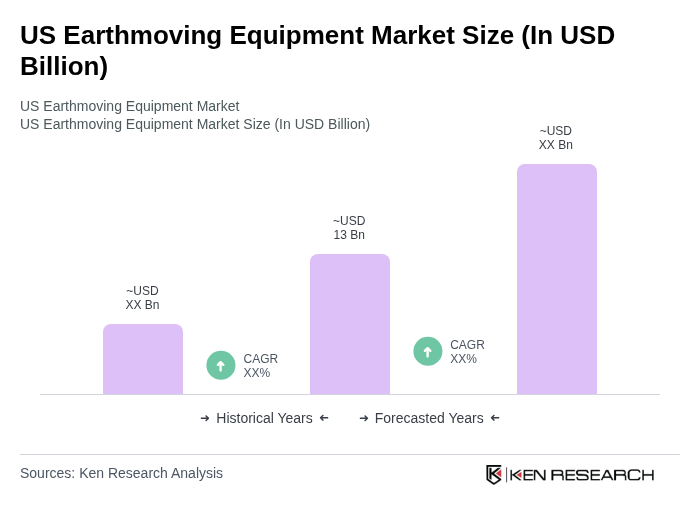
- The US Earthmoving Equipment Market is valued at USD 13 billion, based on a five-year historical analysis, as part of the broader US heavy construction equipment and construction equipment markets where earthmoving machines represent the largest share by value. This growth is primarily driven by increasing infrastructure investments, urbanization, and a surge in construction activities across residential, commercial, and industrial sectors. The demand for earthmoving equipment has been bolstered by the need for efficient machinery in construction, mining, energy, and large-scale agricultural and land-development applications, along with rising equipment rental penetration and a shift toward more fuel?efficient and semi?autonomous machines.
- Key demand centers in this market include major metropolitan areas such as New York, Los Angeles, and Houston, which drive substantial volumes due to high levels of commercial, residential, and infrastructure construction. Additionally, states like Texas and California are significant contributors, supported by large-scale energy, industrial, transportation, and renewable projects that require advanced earthmoving equipment for site preparation, grading, and materials handling.
- The Infrastructure Investment and Jobs Act, formally enacted as the Infrastructure Investment and Jobs Act (IIJA) of 2021 by the US Congress and signed by the President, authorizes around USD 1.2 trillion in funding for transportation, broadband, power, water, and environmental projects, including roughly USD 550 billion in new federal infrastructure spending. This federal legislation is driving multi?year pipelines of highway, bridge, transit, airport, port, grid, and utility upgrades, thereby supporting higher procurement and utilization of earthmoving equipment across the United States as these projects move from planning to execution.
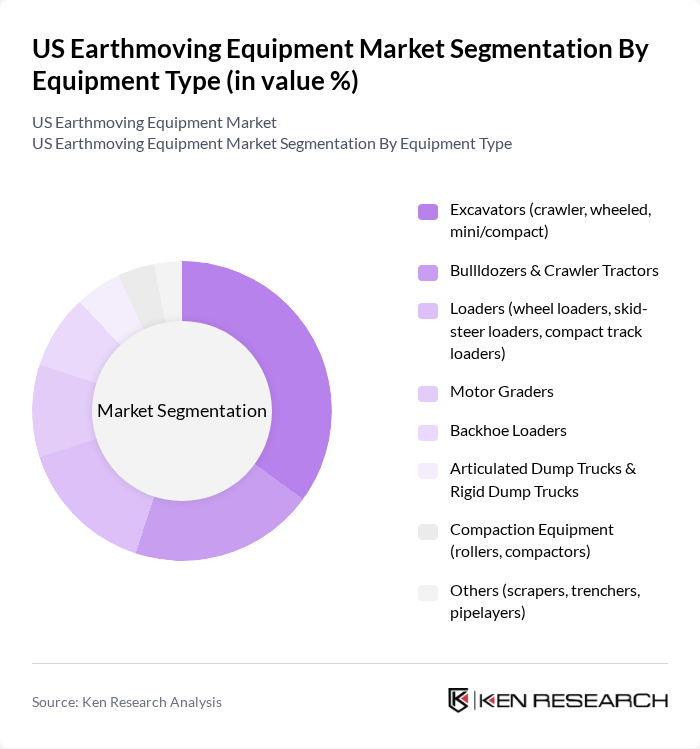
US Earthmoving Equipment Market Segmentation
By Equipment Type:The equipment type segmentation includes various categories such as excavators, bulldozers, loaders, motor graders, backhoe loaders, articulated dump trucks, compaction equipment, and others. Each of these subsegments plays a crucial role in the earthmoving equipment market, with excavators being particularly dominant due to their versatility in digging, lifting, trenching, and material?handling applications across construction, mining, utilities, and industrial projects.
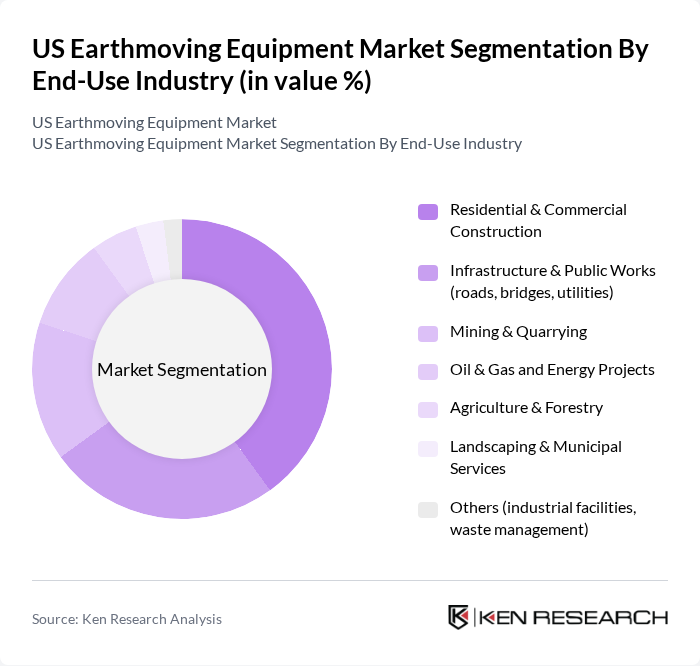
By End-Use Industry:The end-use industry segmentation encompasses residential and commercial construction, infrastructure and public works, mining and quarrying, oil and gas, agriculture and forestry, landscaping, and municipal services. The residential and commercial construction sector is the leading segment, driven by ongoing urban development, warehouse and manufacturing plant construction, and housing demand, while infrastructure and public works are increasingly supported by federal and state funding programs that prioritize roads, bridges, transit, utilities, and renewable energy projects.
US Earthmoving Equipment Market Competitive Landscape
The US Earthmoving Equipment Market is characterized by a dynamic mix of regional and international players. Leading participants such as Caterpillar Inc., Deere & Company (John Deere Construction & Forestry), Komatsu America Corp., Volvo Construction Equipment North America, Inc., Hitachi Construction Machinery Americas Inc., CNH Industrial – CASE Construction Equipment, CNH Industrial – New Holland Construction, Doosan Infracore North America (DEVELON), JCB Inc., Liebherr USA, Co., SANY America, Inc., Bobcat Company, Wacker Neuson America Corporation, Takeuchi US, and Kubota Tractor Corporation contribute to innovation, geographic expansion, and service delivery in this space.
US Earthmoving Equipment Market Industry Analysis
Growth Drivers
- Increased Infrastructure Development:The US government allocatedabout USD 1.2 trillionfor infrastructure improvements under the Infrastructure Investment and Jobs Act, which is expected to significantly boost the demand for earthmoving equipment. This investment aims to repair roads, bridges, and public transit systems, creating a robust environment for construction activities. As a result, the earthmoving equipment market is projected to benefit from increased project initiations, leading to higher equipment sales and rentals across the nation.
- Rising Demand for Construction Activities:The US construction industry is projected to reachabout USD 2.1 trillion in future, driven by residential and commercial projects. This surge in construction activities is primarily fueled by a growing population and urbanization trends, necessitating the use of earthmoving equipment for site preparation and excavation. Consequently, the demand for excavators, bulldozers, and other machinery is expected to rise, further propelling market growth in the coming years.
- Technological Advancements in Equipment:The integration of advanced technologies such as telematics and automation in earthmoving equipment is enhancing operational efficiency. For instance, the adoption of GPS and IoT technologies is expected to improve equipment tracking and maintenance, reducing downtime.In future, the market for smart construction equipment is anticipated to grow by 15%, driven by these innovations, which will attract more investments and increase the overall market size.
Market Challenges
- High Initial Capital Investment:The average cost of earthmoving equipment can range fromabout USD 50,000 to over USD 500,000, depending on the type and specifications. This high initial investment poses a significant barrier for small and medium-sized construction firms, limiting their ability to acquire new machinery. As a result, many companies may opt for rental solutions, which can impact long-term sales growth in the earthmoving equipment market.
- Fluctuating Raw Material Prices:The earthmoving equipment industry is heavily reliant on raw materials such as steel and aluminum, whose prices can be volatile. For instance,global steel prices experienced sharp increases of around thirty percent in a recent period of supply disruptions and strong demand recovery. Such fluctuations can lead to increased production costs, affecting profit margins for manufacturers. This uncertainty may hinder investment in new equipment and slow down market growth as companies grapple with rising expenses.
US Earthmoving Equipment Market Future Outlook
The US earthmoving equipment market is poised for significant transformation, driven by technological advancements and increasing infrastructure investments. As the demand for sustainable construction practices grows, companies are likely to adopt electric and hybrid machinery, aligning with environmental regulations. Furthermore, the integration of automation and IoT technologies will enhance operational efficiency, making equipment more attractive to contractors. Overall, these trends indicate a dynamic market landscape that will evolve to meet the changing needs of the construction industry.
Market Opportunities
- Expansion into Emerging Markets:The US earthmoving equipment manufacturers have a significant opportunity to expand into emerging markets, particularly in Asia and Africa, where infrastructure development is rapidly increasing.With a projected growth rate of 7% in these regions, companies can tap into new customer bases and diversify their revenue streams, enhancing overall market presence.
- Adoption of Electric and Hybrid Equipment:The shift towards electric and hybrid earthmoving equipment presents a lucrative opportunity for manufacturers. The US has set an economy?wide goal to reduce greenhouse gas emissions byabout 50 percent to 52 percent below previous baseline levels in future, which is expected to support higher demand for low?emission and electric machinery. This transition not only aligns with regulatory requirements but also appeals to environmentally conscious consumers, driving sales and innovation in the sector.
Scope of the Report
| Segment | Sub-Segments |
|---|---|
| By Equipment Type | Excavators (crawler, wheeled, mini/compact) Bulldozers & Crawler Tractors Loaders (wheel loaders, skid-steer loaders, compact track loaders) Motor Graders Backhoe Loaders Articulated Dump Trucks & Rigid Dump Trucks Compaction Equipment (rollers, compactors) Others (scrapers, trenchers, pipelayers) |
| By End-Use Industry | Residential & Commercial Construction Infrastructure & Public Works (roads, bridges, utilities) Mining & Quarrying Oil & Gas and Energy Projects Agriculture & Forestry Landscaping & Municipal Services Others (industrial facilities, waste management) |
| By Application | Excavation & Site Preparation Earthmoving & Grading Material Loading & Hauling Demolition & Recycling Road & Highway Construction Snow Removal & Maintenance Others |
| By Propulsion / Fuel Type | Diesel CNG/LNG/RNG and Other Alternative Fuels Hybrid (diesel-electric) Battery Electric |
| By Operating Weight / Size Class | Compact Equipment (< 6 tons) Medium Equipment (6–30 tons) Heavy Equipment (> 30 tons) |
| By Ownership Model / Distribution Channel | Direct OEM Sales Authorized Dealers / Distributors Rental & Leasing Companies Online & Digital Channels Others |
| By Region | Northeast Midwest South West |
Key Target Audience
Investors and Venture Capitalist Firms
Government and Regulatory Bodies (e.g., U.S. Department of Transportation, Occupational Safety and Health Administration)
Manufacturers and Producers
Distributors and Retailers
Construction and Infrastructure Companies
Heavy Equipment Rental Companies
Industry Associations (e.g., Association of Equipment Manufacturers)
Financial Institutions
Players Mentioned in the Report:
Caterpillar Inc.
Deere & Company (John Deere Construction & Forestry)
Komatsu America Corp.
Volvo Construction Equipment North America, Inc.
Hitachi Construction Machinery Americas Inc.
CNH Industrial CASE Construction Equipment
CNH Industrial New Holland Construction
Doosan Infracore North America (DEVELON)
JCB Inc.
Liebherr USA, Co.
SANY America, Inc.
Bobcat Company
Wacker Neuson America Corporation
Takeuchi US
Kubota Tractor Corporation
Table of Contents
Market Assessment Phase
1. Executive Summary and Approach
2. US Earthmoving Equipment Market Overview
2.1 Key Insights and Strategic Recommendations
2.2 US Earthmoving Equipment Market Overview
2.3 Definition and Scope
2.4 Evolution of Market Ecosystem
2.5 Timeline of Key Regulatory Milestones
2.6 Value Chain & Stakeholder Mapping
2.7 Business Cycle Analysis
2.8 Policy & Incentive Landscape
3. US Earthmoving Equipment Market Analysis
3.1 Growth Drivers
3.1.1 Increased Infrastructure Development
3.1.2 Rising Demand for Construction Activities
3.1.3 Technological Advancements in Equipment
3.1.4 Government Investments in Public Works
3.2 Market Challenges
3.2.1 High Initial Capital Investment
3.2.2 Fluctuating Raw Material Prices
3.2.3 Regulatory Compliance Costs
3.2.4 Skilled Labor Shortages
3.3 Market Opportunities
3.3.1 Expansion into Emerging Markets
3.3.2 Adoption of Electric and Hybrid Equipment
3.3.3 Increased Focus on Sustainability
3.3.4 Integration of IoT in Equipment
3.4 Market Trends
3.4.1 Shift Towards Automation
3.4.2 Growing Rental Market for Equipment
3.4.3 Enhanced Safety Regulations
3.4.4 Digitalization of Operations
3.5 Government Regulation
3.5.1 Emission Standards for Equipment
3.5.2 Safety Regulations in Construction
3.5.3 Tax Incentives for Green Equipment
3.5.4 Licensing Requirements for Operators
4. SWOT Analysis
5. Stakeholder Analysis
6. Porter's Five Forces Analysis
7. US Earthmoving Equipment Market Market Size, 2019-2024
7.1 By Value
7.2 By Volume
7.3 By Average Selling Price
8. US Earthmoving Equipment Market Segmentation
8.1 By Equipment Type
8.1.1 Excavators (crawler, wheeled, mini/compact)
8.1.2 Bulldozers & Crawler Tractors
8.1.3 Loaders (wheel loaders, skid-steer loaders, compact track loaders)
8.1.4 Motor Graders
8.1.5 Backhoe Loaders
8.1.6 Articulated Dump Trucks & Rigid Dump Trucks
8.1.7 Compaction Equipment (rollers, compactors)
8.1.8 Others (scrapers, trenchers, pipelayers)
8.2 By End-Use Industry
8.2.1 Residential & Commercial Construction
8.2.2 Infrastructure & Public Works (roads, bridges, utilities)
8.2.3 Mining & Quarrying
8.2.4 Oil & Gas and Energy Projects
8.2.5 Agriculture & Forestry
8.2.6 Landscaping & Municipal Services
8.2.7 Others (industrial facilities, waste management)
8.3 By Application
8.3.1 Excavation & Site Preparation
8.3.2 Earthmoving & Grading
8.3.3 Material Loading & Hauling
8.3.4 Demolition & Recycling
8.3.5 Road & Highway Construction
8.3.6 Snow Removal & Maintenance
8.3.7 Others
8.4 By Propulsion / Fuel Type
8.4.1 Diesel
8.4.2 CNG/LNG/RNG and Other Alternative Fuels
8.4.3 Hybrid (diesel-electric)
8.4.4 Battery Electric
8.5 By Operating Weight / Size Class
8.5.1 Compact Equipment (< 6 tons)
8.5.2 Medium Equipment (6–30 tons)
8.5.3 Heavy Equipment (> 30 tons)
8.6 By Ownership Model / Distribution Channel
8.6.1 Direct OEM Sales
8.6.2 Authorized Dealers / Distributors
8.6.3 Rental & Leasing Companies
8.6.4 Online & Digital Channels
8.6.5 Others
8.7 By Region
8.7.1 Northeast
8.7.2 Midwest
8.7.3 South
8.7.4 West
9. US Earthmoving Equipment Market Competitive Analysis
9.1 Market Share of Key Players
9.2 Cross Comparison of Key Players
9.2.1 Company Name
9.2.2 Group Size (global major, regional major, niche/other)
9.2.3 US Earthmoving Equipment Revenue (latest year)
9.2.4 3–5 Year Revenue CAGR (Earthmoving Segment)
9.2.5 US Market Share in Earthmoving Equipment (by value)
9.2.6 Product Portfolio Breadth (equipment types & weight classes covered)
9.2.7 Share of Sales via Rental & Leasing Channel
9.2.8 Installed Machine Park / Active Fleet in the US
9.2.9 Average Selling Price Positioning (premium / mid / value)
9.2.10 R&D Intensity (% of revenue)
9.2.11 Telematics & Connectivity Adoption (share of connected units)
9.2.12 Aftermarket & Service Revenue Share
9.2.13 Operating Margin (construction/earthmoving segment)
9.3 SWOT Analysis of Top Players
9.4 Pricing Analysis
9.5 Detailed Profile of Major Companies
9.5.1 Caterpillar Inc.
9.5.2 Deere & Company (John Deere Construction & Forestry)
9.5.3 Komatsu America Corp.
9.5.4 Volvo Construction Equipment North America, Inc.
9.5.5 Hitachi Construction Machinery Americas Inc.
9.5.6 CNH Industrial – CASE Construction Equipment
9.5.7 CNH Industrial – New Holland Construction
9.5.8 Doosan Infracore North America (DEVELON)
9.5.9 JCB Inc.
9.5.10 Liebherr USA, Co.
9.5.11 SANY America, Inc.
9.5.12 Bobcat Company
9.5.13 Wacker Neuson America Corporation
9.5.14 Takeuchi US
9.5.15 Kubota Tractor Corporation
10. US Earthmoving Equipment Market End-User Analysis
10.1 Procurement Behavior of Key Ministries
10.1.1 Federal Procurement Trends
10.1.2 State-Level Procurement Strategies
10.1.3 Local Government Procurement Practices
10.1.4 Budget Allocations for Infrastructure
10.2 Corporate Spend on Infrastructure & Energy
10.2.1 Investment Trends in Construction
10.2.2 Corporate Infrastructure Budgets
10.2.3 Energy Sector Spending
10.2.4 Public-Private Partnerships
10.3 Pain Point Analysis by End-User Category
10.3.1 Construction Sector Challenges
10.3.2 Mining Sector Issues
10.3.3 Agricultural Equipment Needs
10.3.4 Government Infrastructure Pain Points
10.4 User Readiness for Adoption
10.4.1 Adoption of New Technologies
10.4.2 Training and Skill Development
10.4.3 Financial Readiness
10.4.4 Regulatory Compliance Awareness
10.5 Post-Deployment ROI and Use Case Expansion
10.5.1 Measuring Equipment Efficiency
10.5.2 Long-term Cost Savings
10.5.3 Expansion into New Applications
10.5.4 User Feedback and Improvement
11. US Earthmoving Equipment Market Future Size, 2025-2030
11.1 By Value
11.2 By Volume
11.3 By Average Selling Price
Go-To-Market Strategy Phase
1. Whitespace Analysis + Business Model Canvas
1.1 Market Gaps Identification
1.2 Business Model Development
2. Marketing and Positioning Recommendations
2.1 Branding Strategies
2.2 Product USPs
3. Distribution Plan
3.1 Urban Retail vs Rural NGO Tie-ups
4. Channel & Pricing Gaps
4.1 Underserved Routes
4.2 Pricing Bands
5. Unmet Demand & Latent Needs
5.1 Category Gaps
5.2 Consumer Segments
6. Customer Relationship
6.1 Loyalty Programs
6.2 After-sales Service
7. Value Proposition
7.1 Sustainability
7.2 Integrated Supply Chains
8. Key Activities
8.1 Regulatory Compliance
8.2 Branding
8.3 Distribution Setup
9. Entry Strategy Evaluation
9.1 Domestic Market Entry Strategy
9.1.1 Product Mix
9.1.2 Pricing Band
9.1.3 Packaging
9.2 Export Entry Strategy
9.2.1 Target Countries
9.2.2 Compliance Roadmap
10. Entry Mode Assessment
10.1 JV
10.2 Greenfield
10.3 M&A
10.4 Distributor Model
11. Capital and Timeline Estimation
11.1 Capital Requirements
11.2 Timelines
12. Control vs Risk Trade-Off
12.1 Ownership vs Partnerships
13. Profitability Outlook
13.1 Breakeven Analysis
13.2 Long-term Sustainability
14. Potential Partner List
14.1 Distributors
14.2 JVs
14.3 Acquisition Targets
15. Execution Roadmap
15.1 Phased Plan for Market Entry
15.1.1 Market Setup
15.1.2 Market Entry
15.1.3 Growth Acceleration
15.1.4 Scale & Stabilize
15.2 Key Activities and Milestones
15.2.1 Activity Planning
15.2.2 Milestone Tracking
Research Methodology
Phase 1: Approach1
Desk Research
- Industry reports from the Association of Equipment Manufacturers (AEM)
- Government publications on infrastructure spending and economic forecasts
- Market analysis from trade journals and publications focused on construction and earthmoving equipment
Primary Research
- Interviews with fleet managers and procurement officers in construction firms
- Surveys with equipment rental companies to gauge market demand
- Field interviews with operators and technicians to understand equipment usage trends
Validation & Triangulation
- Cross-validation of data from multiple industry sources and reports
- Triangulation of insights from primary interviews with secondary data findings
- Sanity checks through expert panel reviews comprising industry veterans
Phase 2: Market Size Estimation1
Top-down Assessment
- Analysis of total construction spending and its correlation with earthmoving equipment sales
- Segmentation of the market by equipment type, including excavators, loaders, and bulldozers
- Incorporation of trends in infrastructure development and urbanization
Bottom-up Modeling
- Volume estimates based on sales data from leading manufacturers and distributors
- Operational cost analysis derived from equipment pricing and maintenance expenses
- Estimation of market share based on fleet composition in various sectors
Forecasting & Scenario Analysis
- Multi-variable regression analysis incorporating economic indicators and construction activity
- Scenario modeling based on potential changes in government infrastructure policies
- Baseline, optimistic, and pessimistic forecasts through 2030 based on market dynamics
Phase 3: CATI Sample Composition1
| Scope Item/Segment | Sample Size | Target Respondent Profiles |
|---|---|---|
| Construction Equipment Rental | 120 | Rental Managers, Business Development Executives |
| Heavy Machinery Sales | 100 | Sales Managers, Product Line Directors |
| Infrastructure Development Projects | 80 | Project Managers, Civil Engineers |
| Mining Equipment Usage | 70 | Operations Managers, Site Supervisors |
| Government Infrastructure Initiatives | 60 | Policy Makers, Economic Development Officers |
Frequently Asked Questions
What is the current value of the US Earthmoving Equipment Market?
The US Earthmoving Equipment Market is valued at approximately USD 13 billion, making it the largest segment within the broader US heavy construction equipment market. This valuation reflects a five-year historical analysis and is driven by increased infrastructure investments and construction activities.
What factors are driving growth in the US Earthmoving Equipment Market?
Which regions in the US are major demand centers for earthmoving equipment?
What types of equipment are included in the US Earthmoving Equipment Market?
Other Regional/Country Reports
Indonesia Earthmoving Equipment Market
Malaysia Earthmoving Equipment Market
APAC Earthmoving Equipment Market
SEA Earthmoving Equipment Market
Other Adjacent Reports
Belgium Forestry Equipment Market
Asia Pacific Material Handling Equipment Market Outlook to 2030: Size, Share, Growth and TrendsUAE Road Construction Machinery MarketBelgium Infrastructure Development Equipment Market
Singapore Oil and Gas Extraction Equipment Market
Oman Landscaping Machinery Market
Germany Municipal Services Equipment Market
Why Buy From Us?

What makes us stand out is that our consultants follow Robust, Refine and Result (RRR) methodology. Robust for clear definitions, approaches and sanity checking, Refine for differentiating respondents' facts and opinions, and Result for presenting data with story.

We have set a benchmark in the industry by offering our clients with syndicated and customized market research reports featuring coverage of entire market as well as meticulous research and analyst insights.

While we don't replace traditional research, we flip the method upside down. Our dual approach of Top Bottom & Bottom Top ensures quality deliverable by not just verifying company fundamentals but also looking at the sector and macroeconomic factors.

With one step in the future, our research team constantly tries to show you the bigger picture. We help with some of the tough questions you may encounter along the way: How is the industry positioned? Best marketing channel? KPI's of competitors? By aligning every element, we help maximize success.

Our report gives you instant access to the answers and sources that other companies might choose to hide. We elaborate each steps of research methodology we have used and showcase you the sample size to earn your trust.

If you need any support, we are here! We pride ourselves on universe strength, data quality, and quick, friendly, and professional service.