About the Report
Base Year 2024US Freighter Aircraft Market Overview
- The US Freighter Aircraft Market is valued at USD 5 billion, based on a five-year historical analysis. This growth is primarily driven by the increasing demand for e-commerce logistics, which has accelerated the need for efficient air cargo solutions. Additionally, the rise in global trade and the expansion of supply chains have further fueled the market's growth, as businesses seek faster delivery options to meet consumer expectations.
- Key players in this market include major integrators and cargo airlines. The US dominates the market due to its extensive logistics infrastructure, advanced technology, and a high concentration of leading freight carriers. China follows closely, driven by its manufacturing capabilities and growing e-commerce sector, while Germany serves as a critical hub for European logistics.
- In 2023, the US government implemented regulations to enhance air cargo security, mandating that all freighter aircraft undergo rigorous screening processes. This regulation aims to ensure the safety of air cargo operations and protect against potential threats, thereby increasing operational costs but also enhancing the overall reliability of air freight services.

US Freighter Aircraft Market Segmentation
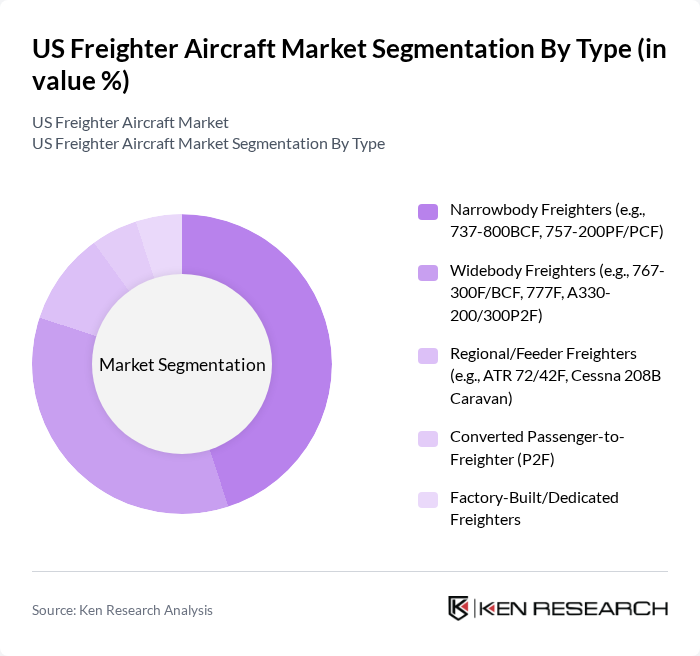
By Type:The market is segmented into various types of freighter aircraft, including narrowbody freighters, widebody freighters, regional/feeders, converted passenger-to-freighter (P2F), and factory-built/dedicated freighters. Among these, narrowbody freighters are gaining traction due to their operational efficiency and lower costs, making them a preferred choice for regional and short-haul operations. Widebody freighters, on the other hand, dominate long-haul routes, catering to the growing demand for international cargo transport.
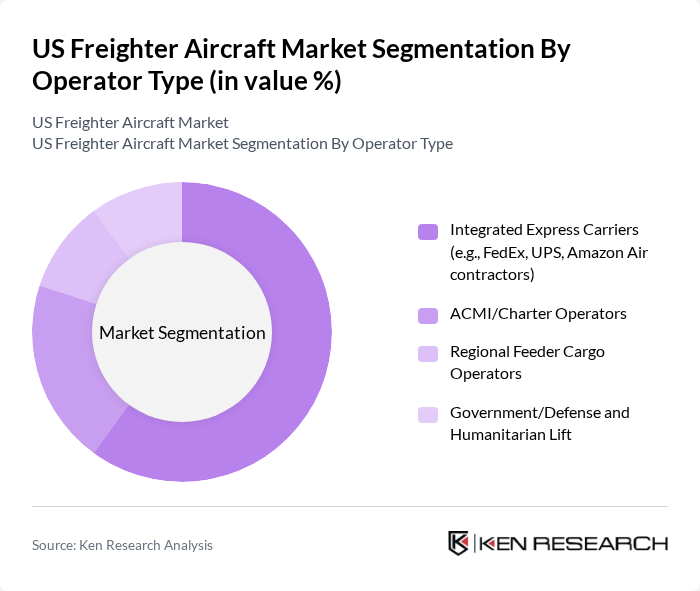
By Operator Type:The operator type segmentation includes integrated express carriers, ACMI/charter operators, regional feeder cargo operators, and government/defense and humanitarian lift. Integrated express carriers dominate the market due to their extensive networks and ability to provide fast delivery services. The rise of e-commerce has further solidified their position, as they are equipped to handle high volumes of packages efficiently.
US Freighter Aircraft Market Competitive Landscape
The US Freighter Aircraft Market is characterized by a dynamic mix of regional and international players. Leading participants such as FedEx Express (FedEx Corporation), UPS Airlines (United Parcel Service, Inc.), Amazon Air (Prime Air), Atlas Air Worldwide Holdings, Inc., Air Transport Services Group, Inc. (ATSG), Kalitta Air, LLC, Western Global Airlines, LLC, Ameriflight, LLC, Empire Airlines, Inc., Sun Country Airlines (cargo operations for Amazon), DHL Express (DHL Aviation / Southern Air legacy operations), The Boeing Company (freighter OEM & BCF programs), Airbus S.A.S. (A330P2F/A321P2F programs), Israel Aerospace Industries (IAI Bedek Aviation Group), Aeronautical Engineers, Inc. (AEI) contribute to innovation, geographic expansion, and service delivery in this space.
US Freighter Aircraft Market Industry Analysis
Growth Drivers
- Increasing E-commerce Demand:The US e-commerce market is projected to reach $1.3 trillion in future, driving the need for efficient air cargo solutions. With online retail sales expected to grow by 15% annually, logistics companies are investing in freighter aircraft to meet delivery expectations. This surge in demand for rapid shipping services is compelling operators to expand their fleets, thereby enhancing the freighter aircraft market's growth potential significantly.
- Expansion of Global Trade:The US's total exports are anticipated to reach $2 trillion in future, reflecting a 5% increase from previous years. This growth in international trade necessitates robust air cargo capabilities to transport goods swiftly across borders. As businesses seek to capitalize on global markets, the demand for freighter aircraft will rise, supporting the logistics infrastructure essential for efficient trade operations.
- Technological Advancements in Aircraft Design:Innovations in aircraft technology are leading to the development of more efficient freighter models. For instance, the introduction of composite materials and advanced aerodynamics is expected to reduce operational costs by up to 20% in future. These advancements not only enhance fuel efficiency but also improve payload capacity, making modern freighter aircraft more attractive to operators looking to optimize their logistics operations.
Market Challenges
- High Initial Investment Costs:The average cost of a new freighter aircraft can exceed $100 million, posing a significant barrier for many operators. This high capital requirement limits entry into the market, particularly for smaller logistics companies. As a result, the financial burden associated with acquiring and maintaining a fleet can hinder overall market growth, especially in a competitive environment where cost efficiency is crucial.
- Regulatory Compliance Complexity:The US aviation industry is subject to stringent regulations, with the FAA overseeing safety and operational standards. Compliance with these regulations often requires substantial investment in training and technology, which can be a challenge for operators. In future, the cost of compliance is projected to rise by 10%, further complicating operational budgets and potentially stalling fleet expansion efforts in the freighter aircraft market.
US Freighter Aircraft Market Future Outlook
The US freighter aircraft market is poised for significant transformation as e-commerce continues to reshape logistics. With advancements in technology and a growing emphasis on sustainability, operators are likely to adopt more efficient aircraft designs and sustainable fuels. Additionally, the increasing demand for last-mile delivery services will drive innovation in fleet management and operational efficiency. As the market adapts to these trends, stakeholders can expect enhanced collaboration and investment opportunities that will redefine the competitive landscape.
Market Opportunities
- Growth in Last-Mile Delivery Services:The last-mile delivery segment is projected to grow to $100 billion in future, creating a substantial opportunity for freighter aircraft operators. This growth is driven by consumer demand for faster delivery times, prompting logistics companies to invest in dedicated freighter services to enhance their operational capabilities and meet customer expectations effectively.
- Development of Sustainable Aviation Fuels:The market for sustainable aviation fuels (SAFs) is expected to reach $15 billion in future, driven by regulatory pressures and environmental concerns. As airlines and logistics companies increasingly adopt SAFs, the freighter aircraft market will benefit from reduced emissions and improved public perception, positioning operators favorably in a competitive landscape focused on sustainability.
Scope of the Report
| Segment | Sub-Segments |
|---|---|
| By Type | Narrowbody Freighters (e.g., 737-800BCF, 757-200PF/PCF) Widebody Freighters (e.g., 767-300F/BCF, 777F, A330-200/300P2F) Regional/Feeder Freighters (e.g., ATR 72/42F, Cessna 208B Caravan) Converted Passenger-to-Freighter (P2F) Factory-Built/Dedicated Freighters |
| By Operator Type | Integrated Express Carriers (e.g., FedEx, UPS, Amazon Air contractors) ACMI/Charter Operators Regional Feeder Cargo Operators Government/Defense and Humanitarian Lift |
| By Payload Class | Light: Up to 5 tons Medium: >5 to 20 tons Heavy: >20 to 60 tons Super Heavy: Above 60 tons |
| By Range Capability | Short-Haul: Up to 1,500 nm Medium-Haul: 1,501–3,500 nm Long-Haul: Above 3,500 nm |
| By Acquisition Channel | Direct OEM Purchase Passenger-to-Freighter Conversions (via STC providers) Operating Lease/ACMI |
| By Maintenance Scope | Airframe & Heavy Checks (C/D checks) Engine & APU MRO Components & Modifications (e.g., cargo door, floor strengthening) |
| By Financing Structure | Operating Lease Finance Lease Direct Purchase (Cash/Loan) Sale-Leaseback |
Key Target Audience
Investors and Venture Capitalist Firms
Government and Regulatory Bodies (e.g., Federal Aviation Administration, Department of Transportation)
Freight and Logistics Companies
Aerospace Manufacturers
Air Cargo Service Providers
Airline Operators
Maintenance, Repair, and Overhaul (MRO) Service Providers
Insurance Companies Specializing in Aviation
Players Mentioned in the Report:
FedEx Express (FedEx Corporation)
UPS Airlines (United Parcel Service, Inc.)
Amazon Air (Prime Air)
Atlas Air Worldwide Holdings, Inc.
Air Transport Services Group, Inc. (ATSG)
Kalitta Air, LLC
Western Global Airlines, LLC
Ameriflight, LLC
Empire Airlines, Inc.
Sun Country Airlines (cargo operations for Amazon)
DHL Express (DHL Aviation / Southern Air legacy operations)
The Boeing Company (freighter OEM & BCF programs)
Airbus S.A.S. (A330P2F/A321P2F programs)
Israel Aerospace Industries (IAI Bedek Aviation Group)
Aeronautical Engineers, Inc. (AEI)
Table of Contents
Market Assessment Phase
1. Executive Summary and Approach
2. US Freighter Aircraft Market Overview
2.1 Key Insights and Strategic Recommendations
2.2 US Freighter Aircraft Market Overview
2.3 Definition and Scope
2.4 Evolution of Market Ecosystem
2.5 Timeline of Key Regulatory Milestones
2.6 Value Chain & Stakeholder Mapping
2.7 Business Cycle Analysis
2.8 Policy & Incentive Landscape
3. US Freighter Aircraft Market Analysis
3.1 Growth Drivers
3.1.1 Increasing E-commerce Demand
3.1.2 Expansion of Global Trade
3.1.3 Technological Advancements in Aircraft Design
3.1.4 Rising Fuel Efficiency Standards
3.2 Market Challenges
3.2.1 High Initial Investment Costs
3.2.2 Regulatory Compliance Complexity
3.2.3 Limited Availability of Skilled Workforce
3.2.4 Fluctuating Fuel Prices
3.3 Market Opportunities
3.3.1 Growth in Last-Mile Delivery Services
3.3.2 Increasing Demand for Air Cargo Services
3.3.3 Development of Sustainable Aviation Fuels
3.3.4 Expansion into Emerging Markets
3.4 Market Trends
3.4.1 Shift Towards Automation in Operations
3.4.2 Increasing Focus on Sustainability
3.4.3 Adoption of Advanced Analytics for Fleet Management
3.4.4 Growth of Charter Services
3.5 Government Regulation
3.5.1 FAA Regulations on Aircraft Safety
3.5.2 Environmental Regulations on Emissions
3.5.3 Import Tariffs on Aircraft Components
3.5.4 Subsidies for Sustainable Aviation Initiatives
4. SWOT Analysis
5. Stakeholder Analysis
6. Porter's Five Forces Analysis
7. US Freighter Aircraft Market Market Size, 2019-2024
7.1 By Value
7.2 By Volume
7.3 By Average Selling Price
8. US Freighter Aircraft Market Segmentation
8.1 By Type
8.1.1 Narrowbody Freighters (e.g., 737-800BCF, 757-200PF/PCF)
8.1.2 Widebody Freighters (e.g., 767-300F/BCF, 777F, A330-200/300P2F)
8.1.3 Regional/Feeder Freighters (e.g., ATR 72/42F, Cessna 208B Caravan)
8.1.4 Converted Passenger-to-Freighter (P2F)
8.1.5 Factory-Built/Dedicated Freighters
8.2 By Operator Type
8.2.1 Integrated Express Carriers (e.g., FedEx, UPS, Amazon Air contractors)
8.2.2 ACMI/Charter Operators
8.2.3 Regional Feeder Cargo Operators
8.2.4 Government/Defense and Humanitarian Lift
8.3 By Payload Class
8.3.1 Light: Up to 5 tons
8.3.2 Medium: >5 to 20 tons
8.3.3 Heavy: >20 to 60 tons
8.3.4 Super Heavy: Above 60 tons
8.4 By Range Capability
8.4.1 Short-Haul: Up to 1,500 nm
8.4.2 Medium-Haul: 1,501–3,500 nm
8.4.3 Long-Haul: Above 3,500 nm
8.5 By Acquisition Channel
8.5.1 Direct OEM Purchase
8.5.2 Passenger-to-Freighter Conversions (via STC providers)
8.5.3 Operating Lease/ACMI
8.6 By Maintenance Scope
8.6.1 Airframe & Heavy Checks (C/D checks)
8.6.2 Engine & APU MRO
8.6.3 Components & Modifications (e.g., cargo door, floor strengthening)
8.7 By Financing Structure
8.7.1 Operating Lease
8.7.2 Finance Lease
8.7.3 Direct Purchase (Cash/Loan)
8.7.4 Sale-Leaseback
9. US Freighter Aircraft Market Competitive Analysis
9.1 Market Share of Key Players
9.2 Cross Comparison of Key Players
9.2.1 Company Name
9.2.2 Fleet Size (aircraft count)
9.2.3 Freighter Mix (% narrowbody / widebody / regional)
9.2.4 Average Fleet Age (years)
9.2.5 Annual Block Hours per Aircraft (utilization)
9.2.6 Load Factor / LF (by RTK or FTK)
9.2.7 On?Time Performance (OTP, %)
9.2.8 Yield (¢ per freight tonne?kilometer)
9.2.9 Unit Cost – CASK/CAC (cost per ATK or FTK)
9.2.10 Network Reach (US hubs, intl. gateways)
9.2.11 Conversion Pipeline (P2F slots on order)
9.2.12 Capital Intensity (capex per aircraft or per ATK)
9.2.13 Lease vs Owned Ratio (%)
9.2.14 Revenue Mix (% express, ACMI/CMI, charter, postal/defense)
9.2.15 Safety & Compliance (IOSA/FAA metrics, incidents per 100k cycles)
9.3 SWOT Analysis of Top Players
9.4 Pricing Analysis
9.5 Detailed Profile of Major Companies
9.5.1 FedEx Express (FedEx Corporation)
9.5.2 UPS Airlines (United Parcel Service, Inc.)
9.5.3 Amazon Air (Prime Air)
9.5.4 Atlas Air Worldwide Holdings, Inc.
9.5.5 Air Transport Services Group, Inc. (ATSG)
9.5.6 Kalitta Air, LLC
9.5.7 Western Global Airlines, LLC
9.5.8 Ameriflight, LLC
9.5.9 Empire Airlines, Inc.
9.5.10 Sun Country Airlines (cargo operations for Amazon)
9.5.11 DHL Express (DHL Aviation / Southern Air legacy operations)
9.5.12 The Boeing Company (freighter OEM & BCF programs)
9.5.13 Airbus S.A.S. (A330P2F/A321P2F programs)
9.5.14 Israel Aerospace Industries (IAI Bedek Aviation Group)
9.5.15 Aeronautical Engineers, Inc. (AEI)
10. US Freighter Aircraft Market End-User Analysis
10.1 Procurement Behavior of Key Ministries
10.1.1 Federal Aviation Administration (FAA)
10.1.2 Department of Defense (DoD)
10.1.3 Department of Transportation (DoT)
10.2 Corporate Spend on Infrastructure & Energy
10.2.1 Investment in Air Cargo Infrastructure
10.2.2 Budget Allocation for Fleet Expansion
10.3 Pain Point Analysis by End-User Category
10.3.1 Cost Management Challenges
10.3.2 Regulatory Compliance Issues
10.3.3 Service Reliability Concerns
10.4 User Readiness for Adoption
10.4.1 Technology Adoption Rates
10.4.2 Training and Skill Development Needs
10.5 Post-Deployment ROI and Use Case Expansion
10.5.1 Performance Metrics Tracking
10.5.2 Expansion into New Markets
11. US Freighter Aircraft Market Future Size, 2025-2030
11.1 By Value
11.2 By Volume
11.3 By Average Selling Price
Go-To-Market Strategy Phase
1. Whitespace Analysis + Business Model Canvas
1.1 Market Gaps Identification
1.2 Value Proposition Development
1.3 Revenue Streams Analysis
1.4 Cost Structure Evaluation
1.5 Key Partnerships Exploration
1.6 Customer Segmentation
1.7 Channels of Distribution
2. Marketing and Positioning Recommendations
2.1 Branding Strategies
2.2 Product USPs
3. Distribution Plan
3.1 Urban Retail vs Rural NGO Tie-ups
4. Channel & Pricing Gaps
4.1 Underserved Routes
4.2 Pricing Bands
5. Unmet Demand & Latent Needs
5.1 Category Gaps
5.2 Consumer Segments
6. Customer Relationship
6.1 Loyalty Programs
6.2 After-sales Service
7. Value Proposition
7.1 Sustainability
7.2 Integrated Supply Chains
8. Key Activities
8.1 Regulatory Compliance
8.2 Branding
8.3 Distribution Setup
9. Entry Strategy Evaluation
9.1 Domestic Market Entry Strategy
9.1.1 Product Mix
9.1.2 Pricing Band
9.1.3 Packaging
9.2 Export Entry Strategy
9.2.1 Target Countries
9.2.2 Compliance Roadmap
10. Entry Mode Assessment
10.1 JV
10.2 Greenfield
10.3 M&A
10.4 Distributor Model
11. Capital and Timeline Estimation
11.1 Capital Requirements
11.2 Timelines
12. Control vs Risk Trade-Off
12.1 Ownership vs Partnerships
13. Profitability Outlook
13.1 Breakeven Analysis
13.2 Long-term Sustainability
14. Potential Partner List
14.1 Distributors
14.2 JVs
14.3 Acquisition Targets
15. Execution Roadmap
15.1 Phased Plan for Market Entry
15.1.1 Market Setup
15.1.2 Market Entry
15.1.3 Growth Acceleration
15.1.4 Scale & Stabilize
15.2 Key Activities and Milestones
15.2.1 Activity Planning
15.2.2 Milestone Tracking
Research Methodology
Phase 1: Approach1
Desk Research
- Analysis of industry reports from aviation authorities and trade associations
- Review of historical data on freighter aircraft registrations and deliveries
- Examination of regulatory frameworks and safety standards impacting freighter operations
Primary Research
- Interviews with fleet managers at major cargo airlines
- Surveys with aircraft manufacturers and suppliers
- Field interviews with logistics and freight forwarding experts
Validation & Triangulation
- Cross-validation of data from multiple industry sources and reports
- Triangulation of insights from primary interviews with secondary data findings
- Sanity checks through expert panel discussions and feedback sessions
Phase 2: Market Size Estimation1
Top-down Assessment
- Estimation of total air cargo market size and growth trends
- Segmentation by aircraft type, including dedicated freighters and converted passenger aircraft
- Incorporation of economic indicators affecting air freight demand
Bottom-up Modeling
- Analysis of fleet composition and operational capacity of leading cargo airlines
- Cost structure analysis based on maintenance, fuel, and operational expenses
- Volume of cargo transported per aircraft type and associated revenue generation
Forecasting & Scenario Analysis
- Multi-variable forecasting using economic growth, trade volumes, and e-commerce trends
- Scenario modeling based on potential regulatory changes and environmental policies
- Development of baseline, optimistic, and pessimistic market projections through 2030
Phase 3: CATI Sample Composition1
| Scope Item/Segment | Sample Size | Target Respondent Profiles |
|---|---|---|
| Cargo Airlines Operations | 120 | Fleet Managers, Operations Directors |
| Aircraft Manufacturing Insights | 90 | Product Development Managers, Sales Executives |
| Logistics and Freight Forwarding | 80 | Logistics Coordinators, Supply Chain Analysts |
| Regulatory Compliance and Safety | 70 | Compliance Officers, Safety Managers |
| Market Trends and Forecasting | 60 | Market Analysts, Economic Advisors |
Frequently Asked Questions
What is the current value of the US Freighter Aircraft Market?
The US Freighter Aircraft Market is valued at approximately USD 5 billion, driven by increasing demand for e-commerce logistics and global trade expansion. This market is expected to grow as businesses seek efficient air cargo solutions to meet consumer expectations.
What factors are driving growth in the US Freighter Aircraft Market?
Who are the major players in the US Freighter Aircraft Market?
What types of freighter aircraft are available in the market?
Other Regional/Country Reports
Indonesia Freighter Aircraft Market
Malaysia Freighter Aircraft Market
Why Buy From Us?

What makes us stand out is that our consultants follow Robust, Refine and Result (RRR) methodology. Robust for clear definitions, approaches and sanity checking, Refine for differentiating respondents' facts and opinions, and Result for presenting data with story.

We have set a benchmark in the industry by offering our clients with syndicated and customized market research reports featuring coverage of entire market as well as meticulous research and analyst insights.

While we don't replace traditional research, we flip the method upside down. Our dual approach of Top Bottom & Bottom Top ensures quality deliverable by not just verifying company fundamentals but also looking at the sector and macroeconomic factors.

With one step in the future, our research team constantly tries to show you the bigger picture. We help with some of the tough questions you may encounter along the way: How is the industry positioned? Best marketing channel? KPI's of competitors? By aligning every element, we help maximize success.

Our report gives you instant access to the answers and sources that other companies might choose to hide. We elaborate each steps of research methodology we have used and showcase you the sample size to earn your trust.

If you need any support, we are here! We pride ourselves on universe strength, data quality, and quick, friendly, and professional service.