About the Report
Base Year 2024US Golf Simulator Market Overview
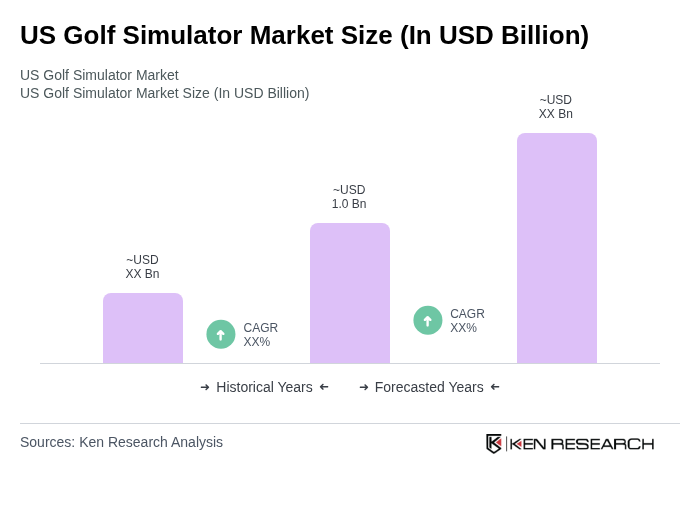
- The US Golf Simulator Market is valued at USD 1.0 billion, based on a five-year historical analysis. This growth is primarily driven by the increasing popularity of golf among younger demographics, rapid advancements in simulation technology, and the rising trend of indoor sports facilities. The market has seen robust demand for high-quality simulators that offer realistic gameplay, advanced analytics, and immersive training experiences. Key growth drivers include the expansion of urban golf bars, private clubs, and the integration of fitness and entertainment features in simulator systems.
- Key players in this market include major cities such as Los Angeles, New York, and Chicago, which dominate due to their large populations, high disposable incomes, and a strong culture of sports and recreation. These urban centers feature a significant number of golf courses, training facilities, and entertainment venues that increasingly incorporate simulators to attract both serious golfers and casual users.
- In 2023, the US government implemented the “Physical Education Modernization Act, 2023” issued by the Department of Education, which introduced funding and compliance requirements for the integration of advanced sports technology—including golf simulators—into school physical education programs. The Act mandates minimum equipment standards, regular usage reporting, and eligibility thresholds for grant allocation, aiming to enhance youth participation in sports and support the adoption of simulators and training equipment in educational institutions.
US Golf Simulator Market Segmentation
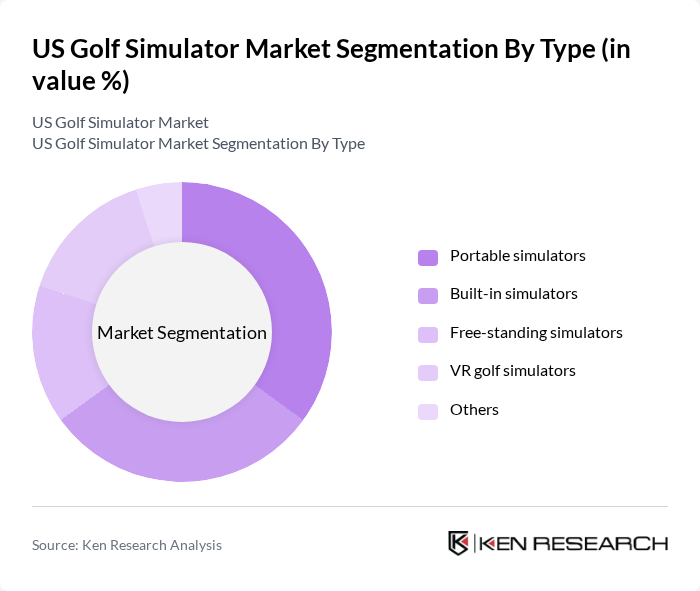
By Type:The market is segmented into portable simulators, built-in simulators, free-standing simulators, VR golf simulators, and others. Portable simulators are gaining traction due to their convenience, affordability, and suitability for home environments, making them popular among residential users. Built-in simulators remain significant for commercial establishments, golf clubs, and luxury residences, where permanent installations are preferred. The demand for VR golf simulators is rising as technology advances, offering highly immersive and interactive experiences for both training and entertainment purposes.
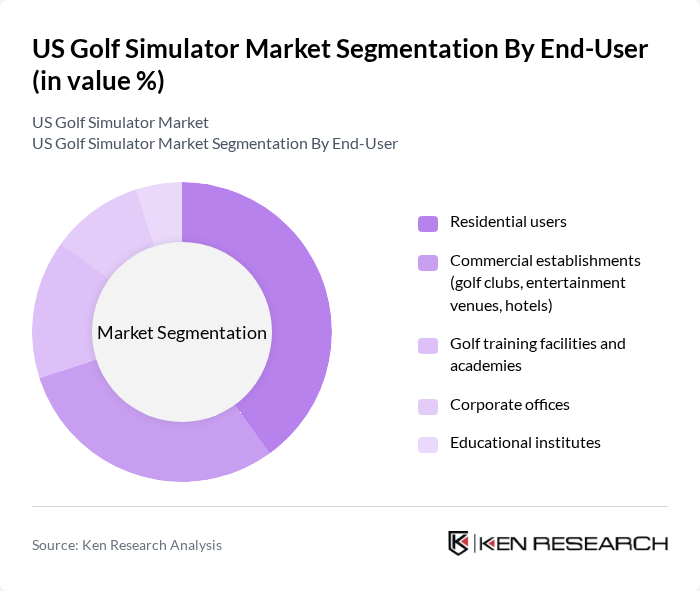
By End-User:The end-user segmentation includes residential users, commercial establishments (golf clubs, entertainment venues, hotels), golf training facilities and academies, corporate offices, educational institutes, and others. Residential users are increasingly adopting simulators for home use, driven by the desire for convenience and year-round practice. Commercial establishments are significant users, leveraging simulators to enhance customer experiences, attract visitors, and provide entertainment in urban settings. Golf training facilities and academies utilize simulators for skill development and analytics, while educational institutes incorporate them into physical education programs.
US Golf Simulator Market Competitive Landscape
The US Golf Simulator Market is characterized by a dynamic mix of regional and international players. Leading participants such as Full Swing Golf, SkyTrak, TrackMan, OptiShot Golf, Foresight Sports, aboutGOLF, Golfzon, HD Golf, P3-Indoor Golf, Uneekor, FlightScope (Mevo+), Rapsodo, Bushnell Golf, Garmin, Callaway Golf, Five Iron Golf, X-Golf America, Topgolf Swing Suite, Golf VX contribute to innovation, geographic expansion, and service delivery in this space.
US Golf Simulator Market Industry Analysis
Growth Drivers
- Increasing Popularity of Indoor Golf:The indoor golf segment has seen a significant rise, with over 10 million Americans participating in indoor golf activities in future. This trend is supported by the growing number of indoor golf facilities, which increased by 15% from 2021 to future. The convenience of year-round play, regardless of weather conditions, has made indoor golf appealing, particularly in urban areas where space is limited. This shift is expected to continue driving demand for golf simulators.
- Technological Advancements in Simulation:The golf simulator industry has benefited from rapid technological advancements, with the introduction of high-definition graphics and real-time data analytics. In future, the average cost of advanced simulators dropped by 20%, making them more accessible to consumers. Additionally, features such as swing analysis and virtual coaching have enhanced user experience, attracting both amateur and professional golfers. This technological evolution is a key driver of market growth, appealing to tech-savvy consumers.
- Rising Disposable Income Among Consumers:The US saw a 5% increase in disposable income in future, reaching an average of $54,000 per household. This rise in disposable income has led to increased spending on leisure activities, including golf. As more consumers prioritize experiences over material goods, the demand for golf simulators, which offer a unique entertainment experience, is expected to grow. This trend is particularly evident among millennials and Gen Z, who are increasingly investing in home entertainment systems.
Market Challenges
- High Initial Investment Costs:The average cost of a high-quality golf simulator ranges from $5,000 to $50,000, which can be a significant barrier for many potential buyers. This high initial investment limits market penetration, particularly among casual golfers and families. Additionally, the ongoing costs associated with maintenance and software updates can deter consumers from making a purchase. As a result, the market faces challenges in reaching a broader audience.
- Limited Awareness Among Potential Users:Despite the growing popularity of golf simulators, many potential users remain unaware of their benefits. A survey conducted in future indicated that 60% of non-golfers had never heard of golf simulators. This lack of awareness hinders market growth, as potential customers may not understand how simulators can enhance their golfing experience. Effective marketing strategies are essential to educate consumers and increase adoption rates in this segment.
US Golf Simulator Market Future Outlook
The US golf simulator market is poised for continued growth, driven by technological innovations and changing consumer preferences. As more individuals seek engaging home entertainment options, the demand for golf simulators is expected to rise. Additionally, the integration of virtual reality technologies and mobile applications will enhance user experiences, making simulators more appealing. Partnerships with golf training academies will further promote awareness and adoption, positioning the market for robust expansion in future.
Market Opportunities
- Expansion into Commercial Spaces:There is a growing opportunity for golf simulators in commercial venues such as bars and entertainment centers. In future, over 1,200 new commercial golf facilities opened, indicating a trend towards integrating golf simulators into social spaces. This expansion can significantly increase market reach and revenue potential, attracting a diverse clientele seeking unique entertainment experiences.
- Integration with Virtual Reality Technologies:The incorporation of virtual reality (VR) into golf simulators presents a significant market opportunity. As VR technology becomes more affordable and accessible, it is projected that the number of VR-enabled golf simulators will increase by 30% in future. This integration can enhance user engagement and provide immersive experiences, appealing to tech-savvy consumers and driving sales in the market.
Scope of the Report
| Segment | Sub-Segments |
|---|---|
| By Type | Portable simulators Built-in simulators Free-standing simulators VR golf simulators Others |
| By End-User | Residential users Commercial establishments (golf clubs, entertainment venues, hotels) Golf training facilities and academies Corporate offices Educational institutes Others |
| By Application | Training and practice Entertainment and leisure Competitive gaming/e-sports Event hosting Others |
| By Distribution Channel | Direct sales Online retail Specialty stores Wholesale distributors Others |
| By Technology | Infrared sensor technology Camera-based systems Radar-based systems Hybrid systems Cloud-based simulation software Others |
| By User Demographics | Age groups Skill levels Geographic locations Gender Others |
| By Price Range | Premium segment Mid-range segment Budget segment Others |
Key Target Audience
Investors and Venture Capitalist Firms
Government and Regulatory Bodies (e.g., U.S. Consumer Product Safety Commission, Federal Trade Commission)
Manufacturers and Producers
Distributors and Retailers
Technology Providers
Industry Associations (e.g., National Golf Foundation)
Financial Institutions
Real Estate Developers and Property Management Firms
Players Mentioned in the Report:
Full Swing Golf
SkyTrak
TrackMan
OptiShot Golf
Foresight Sports
aboutGOLF
Golfzon
HD Golf
P3-Indoor Golf
Uneekor
FlightScope (Mevo+)
Rapsodo
Bushnell Golf
Garmin
Callaway Golf
Five Iron Golf
X-Golf America
Topgolf Swing Suite
Golf VX
Table of Contents
Market Assessment Phase
1. Executive Summary and Approach
2. US Golf Simulator Market Overview
2.1 Key Insights and Strategic Recommendations
2.2 US Golf Simulator Market Overview
2.3 Definition and Scope
2.4 Evolution of Market Ecosystem
2.5 Timeline of Key Regulatory Milestones
2.6 Value Chain & Stakeholder Mapping
2.7 Business Cycle Analysis
2.8 Policy & Incentive Landscape
3. US Golf Simulator Market Analysis
3.1 Growth Drivers
3.1.1 Increasing popularity of indoor golf
3.1.2 Technological advancements in simulation
3.1.3 Rising disposable income among consumers
3.1.4 Growth of golf-related entertainment venues
3.2 Market Challenges
3.2.1 High initial investment costs
3.2.2 Limited awareness among potential users
3.2.3 Competition from traditional golf courses
3.2.4 Maintenance and technical support issues
3.3 Market Opportunities
3.3.1 Expansion into commercial spaces
3.3.2 Integration with virtual reality technologies
3.3.3 Development of mobile applications
3.3.4 Partnerships with golf training academies
3.4 Market Trends
3.4.1 Increasing demand for home entertainment systems
3.4.2 Growth in e-sports and competitive gaming
3.4.3 Customization and personalization of simulators
3.4.4 Sustainability initiatives in product development
3.5 Government Regulation
3.5.1 Safety standards for electronic equipment
3.5.2 Tax incentives for sports-related businesses
3.5.3 Regulations on data privacy and user information
3.5.4 Compliance with consumer protection laws
4. SWOT Analysis
5. Stakeholder Analysis
6. Porter's Five Forces Analysis
7. US Golf Simulator Market Market Size, 2019-2024
7.1 By Value
7.2 By Volume
7.3 By Average Selling Price
8. US Golf Simulator Market Segmentation
8.1 By Type
8.1.1 Portable simulators
8.1.2 Built-in simulators
8.1.3 Free-standing simulators
8.1.4 VR golf simulators
8.1.5 Others
8.2 By End-User
8.2.1 Residential users
8.2.2 Commercial establishments (golf clubs, entertainment venues, hotels)
8.2.3 Golf training facilities and academies
8.2.4 Corporate offices
8.2.5 Educational institutes
8.2.6 Others
8.3 By Application
8.3.1 Training and practice
8.3.2 Entertainment and leisure
8.3.3 Competitive gaming/e-sports
8.3.4 Event hosting
8.3.5 Others
8.4 By Distribution Channel
8.4.1 Direct sales
8.4.2 Online retail
8.4.3 Specialty stores
8.4.4 Wholesale distributors
8.4.5 Others
8.5 By Technology
8.5.1 Infrared sensor technology
8.5.2 Camera-based systems
8.5.3 Radar-based systems
8.5.4 Hybrid systems
8.5.5 Cloud-based simulation software
8.5.6 Others
8.6 By User Demographics
8.6.1 Age groups
8.6.2 Skill levels
8.6.3 Geographic locations
8.6.4 Gender
8.6.5 Others
8.7 By Price Range
8.7.1 Premium segment
8.7.2 Mid-range segment
8.7.3 Budget segment
8.7.4 Others
9. US Golf Simulator Market Competitive Analysis
9.1 Market Share of Key Players
9.2 Cross Comparison of Key Players
9.2.1 Company Name
9.2.2 Company Size (Large, Medium, Small as per industry convention)
9.2.3 Annual Revenue (USD)
9.2.4 Revenue Growth Rate (%)
9.2.5 US Market Share (%)
9.2.6 Number of US Installations
9.2.7 Average Selling Price (ASP)
9.2.8 Product Portfolio Breadth
9.2.9 Technology Differentiation (e.g., VR, AI, sensor type)
9.2.10 Customer Segments Served (Residential, Commercial, Training, etc.)
9.2.11 Customer Satisfaction/Net Promoter Score (NPS)
9.2.12 Brand Awareness Index
9.2.13 Distribution Channel Mix (%)
9.2.14 After-Sales Service Coverage
9.2.15 Warranty/Support Terms
9.3 SWOT Analysis of Top Players
9.4 Pricing Analysis
9.5 Detailed Profile of Major Companies
9.5.1 Full Swing Golf
9.5.2 SkyTrak
9.5.3 TrackMan
9.5.4 OptiShot Golf
9.5.5 Foresight Sports
9.5.6 aboutGOLF
9.5.7 Golfzon
9.5.8 HD Golf
9.5.9 P3-Indoor Golf
9.5.10 Uneekor
9.5.11 FlightScope (Mevo+)
9.5.12 Rapsodo
9.5.13 Bushnell Golf
9.5.14 Garmin
9.5.15 Callaway Golf
9.5.16 Five Iron Golf
9.5.17 X-Golf America
9.5.18 Topgolf Swing Suite
9.5.19 Golf VX
10. US Golf Simulator Market End-User Analysis
10.1 Procurement Behavior of Key Ministries
10.1.1 Budget allocation for sports technology
10.1.2 Evaluation criteria for procurement
10.1.3 Decision-making processes
10.1.4 Supplier selection criteria
10.2 Corporate Spend on Infrastructure & Energy
10.2.1 Investment in sports facilities
10.2.2 Budget for technology upgrades
10.2.3 Spending on employee engagement activities
10.2.4 Allocation for training programs
10.3 Pain Point Analysis by End-User Category
10.3.1 Cost of ownership
10.3.2 Technical support challenges
10.3.3 Space requirements
10.3.4 User experience issues
10.4 User Readiness for Adoption
10.4.1 Awareness of technology benefits
10.4.2 Willingness to invest
10.4.3 Training needs
10.4.4 Feedback from early adopters
10.5 Post-Deployment ROI and Use Case Expansion
10.5.1 Measurement of performance improvements
10.5.2 User satisfaction surveys
10.5.3 Expansion into new use cases
10.5.4 Long-term value assessment
11. US Golf Simulator Market Future Size, 2025-2030
11.1 By Value
11.2 By Volume
11.3 By Average Selling Price
Go-To-Market Strategy Phase
1. Whitespace Analysis + Business Model Canvas
1.1 Market gaps identification
1.2 Value proposition development
1.3 Revenue model exploration
1.4 Customer segmentation analysis
1.5 Competitive landscape overview
2. Marketing and Positioning Recommendations
2.1 Branding strategies
2.2 Product USPs
2.3 Target audience identification
2.4 Marketing channels selection
2.5 Messaging and communication plan
3. Distribution Plan
3.1 Urban retail vs rural NGO tie-ups
3.2 Online vs offline distribution strategies
3.3 Partnership opportunities
3.4 Logistics and supply chain considerations
3.5 Distribution channel effectiveness
4. Channel & Pricing Gaps
4.1 Underserved routes
4.2 Pricing bands
4.3 Competitor pricing analysis
4.4 Value-based pricing strategies
4.5 Customer feedback on pricing
5. Unmet Demand & Latent Needs
5.1 Category gaps
5.2 Consumer segments
5.3 Emerging trends analysis
5.4 Future demand forecasting
5.5 Product development opportunities
6. Customer Relationship
6.1 Loyalty programs
6.2 After-sales service
6.3 Customer engagement strategies
6.4 Feedback mechanisms
6.5 Community building initiatives
7. Value Proposition
7.1 Sustainability
7.2 Integrated supply chains
7.3 Unique selling points
7.4 Customer-centric approach
7.5 Competitive advantages
8. Key Activities
8.1 Regulatory compliance
8.2 Branding
8.3 Distribution setup
8.4 Marketing execution
8.5 Performance monitoring
9. Entry Strategy Evaluation
9.1 Domestic Market Entry Strategy
9.1.1 Product mix
9.1.2 Pricing band
9.1.3 Packaging
9.2 Export Entry Strategy
9.2.1 Target countries
9.2.2 Compliance roadmap
10. Entry Mode Assessment
10.1 JV
10.2 Greenfield
10.3 M&A
10.4 Distributor Model
11. Capital and Timeline Estimation
11.1 Capital requirements
11.2 Timelines
12. Control vs Risk Trade-Off
12.1 Ownership vs Partnerships
13. Profitability Outlook
13.1 Breakeven analysis
13.2 Long-term sustainability
14. Potential Partner List
14.1 Distributors
14.2 JVs
14.3 Acquisition targets
15. Execution Roadmap
15.1 Phased Plan for Market Entry
15.1.1 Market Setup
15.1.2 Market Entry
15.1.3 Growth Acceleration
15.1.4 Scale & Stabilize
15.2 Key Activities and Milestones
15.2.1 Activity timelines
15.2.2 Milestone tracking
Research Methodology
Phase 1: Approach1
Desk Research
- Industry reports from golf associations and market research firms
- Analysis of sales data from golf simulator manufacturers and retailers
- Review of consumer behavior studies related to golf and sports technology
Primary Research
- Interviews with product managers at leading golf simulator companies
- Surveys targeting golf enthusiasts and club owners
- Field interviews with golf instructors and coaches using simulators
Validation & Triangulation
- Cross-validation of findings with industry expert opinions
- Triangulation of data from sales, consumer feedback, and market trends
- Sanity checks through focus group discussions with target demographics
Phase 2: Market Size Estimation1
Top-down Assessment
- Estimation of total addressable market based on golf participation rates
- Analysis of growth trends in home entertainment and sports technology sectors
- Incorporation of demographic shifts and urbanization impacts on golf simulator adoption
Bottom-up Modeling
- Volume estimates based on sales data from major golf simulator brands
- Cost analysis of golf simulators, including installation and maintenance
- Market segmentation by user type: individual, commercial, and educational institutions
Forecasting & Scenario Analysis
- Multi-factor regression analysis incorporating economic indicators and consumer spending
- Scenario modeling based on technological advancements and market entry of new players
- Baseline, optimistic, and pessimistic forecasts through 2030
Phase 3: CATI Sample Composition1
| Scope Item/Segment | Sample Size | Target Respondent Profiles |
|---|---|---|
| Home Golf Simulator Users | 120 | Golf Enthusiasts, Homeowners |
| Commercial Golf Facilities | 85 | Facility Managers, Golf Club Owners |
| Golf Instructional Programs | 65 | Golf Instructors, Academy Directors |
| Retailers of Golf Equipment | 55 | Store Managers, Sales Representatives |
| Sports Technology Experts | 50 | Product Developers, Market Analysts |
Frequently Asked Questions
What is the current value of the US Golf Simulator Market?
The US Golf Simulator Market is valued at approximately USD 1.0 billion, reflecting significant growth driven by the increasing popularity of golf among younger demographics and advancements in simulation technology.
What factors are driving the growth of the US Golf Simulator Market?
Which cities are the largest markets for golf simulators in the US?
How has the Physical Education Modernization Act, 2023 impacted golf simulators?
Other Regional/Country Reports
Indonesia Golf Simulator Market
Malaysia Golf Simulator Market
KSA Golf Simulator Market
APAC Golf Simulator Market
SEA Golf Simulator Market
Vietnam Golf Simulator Market
Other Adjacent Reports
Thailand Indoor Sports Equipment Market
Qatar golf training aids market report size, share, growth drivers, trends, opportunities & forecast 2025–2030Bahrain Home Entertainment Systems Market
Bahrain Sports Analytics Software Market
Thailand Fitness Technology Market
Singapore Augmented Reality Applications Market
Indonesia E-Sports Market Outlook 2030MEA Simulation Software Market Outlook to 2030: Size, Share, Growth and TrendsEgypt Recreational Gaming Market
Why Buy From Us?

What makes us stand out is that our consultants follow Robust, Refine and Result (RRR) methodology. Robust for clear definitions, approaches and sanity checking, Refine for differentiating respondents' facts and opinions, and Result for presenting data with story.

We have set a benchmark in the industry by offering our clients with syndicated and customized market research reports featuring coverage of entire market as well as meticulous research and analyst insights.

While we don't replace traditional research, we flip the method upside down. Our dual approach of Top Bottom & Bottom Top ensures quality deliverable by not just verifying company fundamentals but also looking at the sector and macroeconomic factors.

With one step in the future, our research team constantly tries to show you the bigger picture. We help with some of the tough questions you may encounter along the way: How is the industry positioned? Best marketing channel? KPI's of competitors? By aligning every element, we help maximize success.

Our report gives you instant access to the answers and sources that other companies might choose to hide. We elaborate each steps of research methodology we have used and showcase you the sample size to earn your trust.

If you need any support, we are here! We pride ourselves on universe strength, data quality, and quick, friendly, and professional service.