About the Report
Base Year 2024US Traditional Ceramics Market Overview
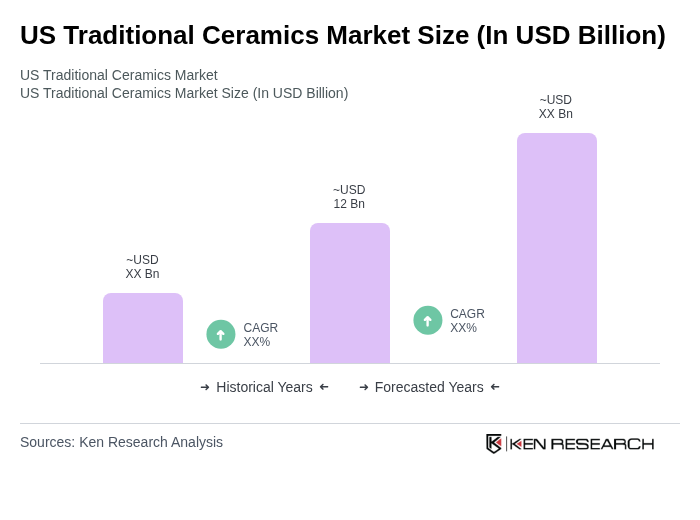
- The US Traditional Ceramics Market is valued at USD 12 billion, based on a five-year historical analysis. This growth is primarily driven by increasing consumer demand for artisanal and handcrafted products, alongside a resurgence in home decor and renovation projects. The market has seen a steady rise in interest for sustainable and eco-friendly materials, which has further propelled the sector's expansion.
- Key players in this market include California, New York, and North Carolina, which dominate due to their rich cultural heritage in ceramics and a strong presence of skilled artisans. These regions benefit from a combination of historical significance, local craftsmanship, and a vibrant art community that fosters innovation and creativity in traditional ceramics.
- In 2023, the US government implemented regulations aimed at promoting sustainable practices in the ceramics industry. This includes guidelines for reducing emissions during production and encouraging the use of recycled materials. The initiative is part of a broader effort to enhance environmental sustainability and reduce the carbon footprint of manufacturing processes.
US Traditional Ceramics Market Segmentation
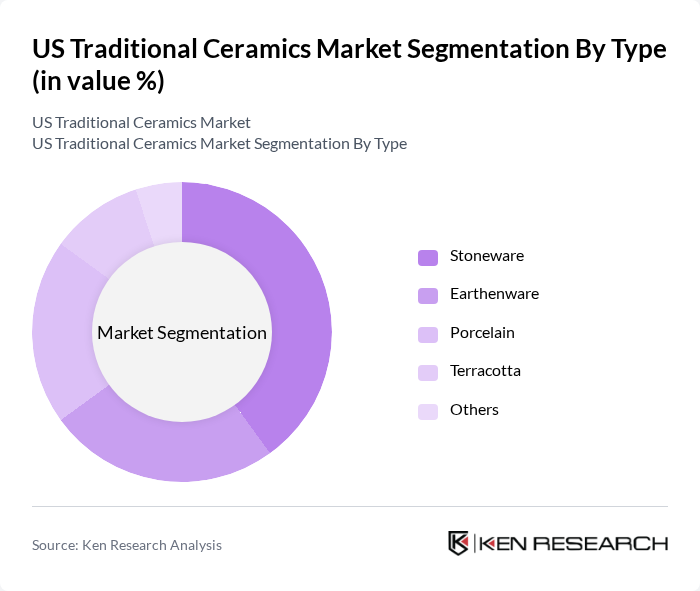
By Type:The market is segmented into various types, including Stoneware, Earthenware, Porcelain, Terracotta, and Others. Among these, Stoneware is currently the leading subsegment due to its durability and versatility, making it a preferred choice for both functional and decorative items. Consumers are increasingly drawn to Stoneware for its ability to withstand high temperatures and its aesthetic appeal, which aligns with contemporary design trends. Earthenware and Porcelain also hold significant market shares, catering to different consumer preferences and price points.
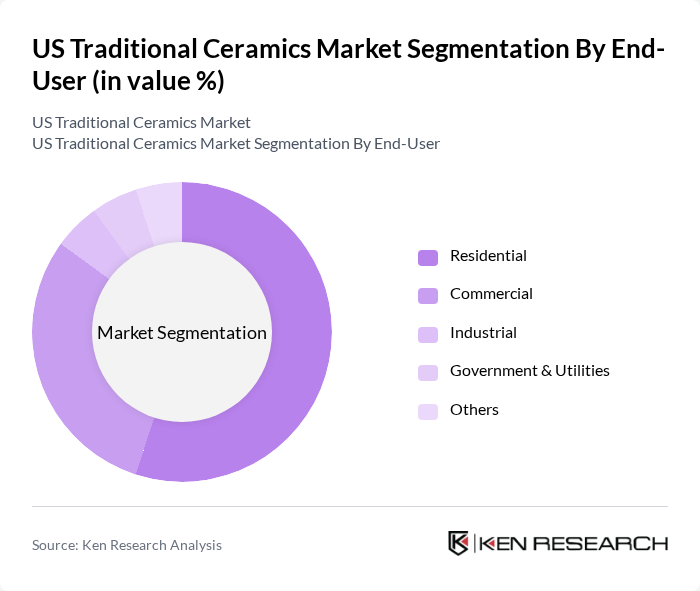
By End-User:The end-user segmentation includes Residential, Commercial, Industrial, Government & Utilities, and Others. The Residential segment is the most significant contributor to the market, driven by the growing trend of home decoration and renovation. Consumers are increasingly investing in high-quality ceramics for their homes, which has led to a surge in demand for decorative items and tableware. The Commercial segment also shows robust growth, particularly in restaurants and hotels that seek unique and aesthetically pleasing tableware.
US Traditional Ceramics Market Competitive Landscape
The US Traditional Ceramics Market is characterized by a dynamic mix of regional and international players. Leading participants such as Wedgwood, Royal Doulton, Lenox Corporation, Fiesta Tableware Company, Noritake Co., Limited, Villeroy & Boch, Rachael Ray Home, Mikasa, Corelle Brands LLC, Pfaltzgraff, Spode, Dansk, Portmeirion Group, Emile Henry, and Boleslawiec Pottery contribute to innovation, geographic expansion, and service delivery in this space.
US Traditional Ceramics Market Industry Analysis
Growth Drivers
- Increasing Demand for Handmade Ceramics:The US handmade ceramics market has seen a significant rise, with sales reaching approximately $1.3 billion in future. This growth is driven by consumers' preference for unique, artisanal products, reflecting a broader trend towards personalization in home decor. The National Endowment for the Arts reported a 20% increase in participation in craft-related activities, indicating a strong cultural shift towards valuing handmade goods, which is expected to continue into future.
- Rising Interest in Sustainable and Eco-Friendly Products:The demand for sustainable ceramics is surging, with a reported 35% increase in sales of eco-friendly products in future. This trend aligns with the growing consumer awareness of environmental issues, as evidenced by a 2023 survey from the Pew Research Center, which found that 72% of Americans prioritize sustainability in their purchasing decisions. As more consumers seek environmentally responsible options, the traditional ceramics market is poised to benefit significantly.
- Growth of the Home Decor and Interior Design Sector:The US home decor market was valued at $220 billion in future, with ceramics playing a crucial role in this growth. The American Society of Interior Designers reported a 15% increase in demand for ceramic products in residential projects, driven by trends favoring unique and handcrafted items. This growth is expected to continue as homeowners increasingly invest in personalized and aesthetically pleasing home environments throughout future.
Market Challenges
- High Production Costs:The production costs for traditional ceramics have risen significantly, with average costs increasing by 30% in the past two years due to higher raw material prices and labor costs. According to the Bureau of Labor Statistics, the cost of clay and other materials has surged, impacting profit margins for small artisans and manufacturers. This challenge may hinder the ability of producers to compete with lower-priced mass-produced alternatives in the market.
- Competition from Mass-Produced Alternatives:The traditional ceramics market faces intense competition from mass-produced ceramics, which are often sold at lower prices. In future, mass-produced ceramics accounted for approximately 70% of the total ceramics market share. This dominance poses a significant challenge for traditional artisans, who struggle to compete on price while maintaining quality. The increasing availability of affordable alternatives may limit market growth for traditional ceramics in the coming years.
US Traditional Ceramics Market Future Outlook
The future of the US traditional ceramics market appears promising, driven by a continued emphasis on sustainability and the growing popularity of artisan products. As consumer preferences shift towards unique, handcrafted items, the market is likely to see increased demand for eco-friendly ceramics. Additionally, the integration of technology in production processes may enhance efficiency and innovation, allowing artisans to meet evolving consumer expectations while maintaining quality and craftsmanship.
Market Opportunities
- Growth in Customization and Personalization Trends:The trend towards customization presents a significant opportunity for traditional ceramics. With consumers increasingly seeking personalized products, artisans can leverage this demand by offering bespoke designs. This approach not only enhances customer satisfaction but also allows for premium pricing, potentially increasing revenue streams for small businesses in the ceramics sector.
- Collaborations with Artists and Designers:Collaborations between traditional ceramicists and contemporary artists or designers can create unique product lines that attract new customer segments. Such partnerships can enhance brand visibility and appeal, tapping into the growing market for exclusive, limited-edition items. This strategy can significantly boost sales and foster innovation within the traditional ceramics industry.
Scope of the Report
| Segment | Sub-Segments |
|---|---|
| By Type | Stoneware Earthenware Porcelain Terracotta Others |
| By End-User | Residential Commercial Industrial Government & Utilities Others |
| By Application | Tableware Decorative Items Tiles and Flooring Sanitary Ware Others |
| By Distribution Channel | Online Retail Specialty Stores Home Improvement Stores Art Galleries Others |
| By Price Range | Budget Mid-Range Premium Luxury Others |
| By Material Used | Clay Glazes Additives Others |
| By Design Style | Traditional Contemporary Rustic Minimalist Others |
Key Target Audience
Investors and Venture Capitalist Firms
Government and Regulatory Bodies (e.g., U.S. Environmental Protection Agency, U.S. Department of Commerce)
Manufacturers and Producers
Distributors and Retailers
Artisans and Craftspersons
Interior Designers and Architects
Industry Associations (e.g., American Ceramic Society)
Financial Institutions
Players Mentioned in the Report:
Wedgwood
Royal Doulton
Lenox Corporation
Fiesta Tableware Company
Noritake Co., Limited
Villeroy & Boch
Rachael Ray Home
Mikasa
Corelle Brands LLC
Pfaltzgraff
Spode
Dansk
Portmeirion Group
Emile Henry
Boleslawiec Pottery
Table of Contents
Market Assessment Phase
1. Executive Summary and Approach
2. US Traditional Ceramics Market Overview
2.1 Key Insights and Strategic Recommendations
2.2 US Traditional Ceramics Market Overview
2.3 Definition and Scope
2.4 Evolution of Market Ecosystem
2.5 Timeline of Key Regulatory Milestones
2.6 Value Chain & Stakeholder Mapping
2.7 Business Cycle Analysis
2.8 Policy & Incentive Landscape
3. US Traditional Ceramics Market Analysis
3.1 Growth Drivers
3.1.1 Increasing Demand for Handmade Ceramics
3.1.2 Rising Interest in Sustainable and Eco-Friendly Products
3.1.3 Growth of the Home Decor and Interior Design Sector
3.1.4 Expansion of E-commerce Platforms for Ceramics
3.2 Market Challenges
3.2.1 High Production Costs
3.2.2 Competition from Mass-Produced Alternatives
3.2.3 Supply Chain Disruptions
3.2.4 Limited Awareness of Traditional Ceramics
3.3 Market Opportunities
3.3.1 Growth in Customization and Personalization Trends
3.3.2 Collaborations with Artists and Designers
3.3.3 Expansion into International Markets
3.3.4 Development of Innovative Glazing Techniques
3.4 Market Trends
3.4.1 Increasing Popularity of Artisan Markets
3.4.2 Shift Towards Minimalist and Functional Designs
3.4.3 Integration of Technology in Ceramics Production
3.4.4 Focus on Health and Safety Standards in Materials
3.5 Government Regulation
3.5.1 Compliance with Environmental Standards
3.5.2 Regulations on Material Sourcing
3.5.3 Safety Regulations for Food-Grade Ceramics
3.5.4 Support for Local Artisans and Craftsmen
4. SWOT Analysis
5. Stakeholder Analysis
6. Porter's Five Forces Analysis
7. US Traditional Ceramics Market Market Size, 2019-2024
7.1 By Value
7.2 By Volume
7.3 By Average Selling Price
8. US Traditional Ceramics Market Segmentation
8.1 By Type
8.1.1 Stoneware
8.1.2 Earthenware
8.1.3 Porcelain
8.1.4 Terracotta
8.1.5 Others
8.2 By End-User
8.2.1 Residential
8.2.2 Commercial
8.2.3 Industrial
8.2.4 Government & Utilities
8.2.5 Others
8.3 By Application
8.3.1 Tableware
8.3.2 Decorative Items
8.3.3 Tiles and Flooring
8.3.4 Sanitary Ware
8.3.5 Others
8.4 By Distribution Channel
8.4.1 Online Retail
8.4.2 Specialty Stores
8.4.3 Home Improvement Stores
8.4.4 Art Galleries
8.4.5 Others
8.5 By Price Range
8.5.1 Budget
8.5.2 Mid-Range
8.5.3 Premium
8.5.4 Luxury
8.5.5 Others
8.6 By Material Used
8.6.1 Clay
8.6.2 Glazes
8.6.3 Additives
8.6.4 Others
8.7 By Design Style
8.7.1 Traditional
8.7.2 Contemporary
8.7.3 Rustic
8.7.4 Minimalist
8.7.5 Others
9. US Traditional Ceramics Market Competitive Analysis
9.1 Market Share of Key Players
9.2 Cross Comparison of Key Players
9.2.1 Company Name
9.2.2 Group Size (Large, Medium, or Small as per industry convention)
9.2.3 Revenue Growth Rate
9.2.4 Market Penetration Rate
9.2.5 Customer Retention Rate
9.2.6 Pricing Strategy
9.2.7 Product Quality Index
9.2.8 Brand Recognition Score
9.2.9 Distribution Efficiency
9.2.10 Innovation Rate
9.3 SWOT Analysis of Top Players
9.4 Pricing Analysis
9.5 Detailed Profile of Major Companies
9.5.1 Wedgwood
9.5.2 Royal Doulton
9.5.3 Lenox Corporation
9.5.4 Fiesta Tableware Company
9.5.5 Noritake Co., Limited
9.5.6 Villeroy & Boch
9.5.7 Rachael Ray Home
9.5.8 Mikasa
9.5.9 Corelle Brands LLC
9.5.10 Pfaltzgraff
9.5.11 Spode
9.5.12 Dansk
9.5.13 Portmeirion Group
9.5.14 Emile Henry
9.5.15 Boleslawiec Pottery
10. US Traditional Ceramics Market End-User Analysis
10.1 Procurement Behavior of Key Ministries
10.1.1 Government Contracts for Ceramics
10.1.2 Budget Allocations for Art and Culture
10.1.3 Preferences for Local Artisans
10.1.4 Sustainability Considerations
10.2 Corporate Spend on Infrastructure & Energy
10.2.1 Investment in Local Craftsmanship
10.2.2 Funding for Community Art Projects
10.2.3 Expenditure on Ceramics for Public Spaces
10.2.4 Support for Educational Programs
10.3 Pain Point Analysis by End-User Category
10.3.1 Quality Concerns
10.3.2 Availability of Unique Designs
10.3.3 Pricing Sensitivity
10.3.4 Delivery Timeliness
10.4 User Readiness for Adoption
10.4.1 Awareness of Traditional Ceramics
10.4.2 Willingness to Pay for Quality
10.4.3 Interest in Customization
10.4.4 Engagement with Local Artisans
10.5 Post-Deployment ROI and Use Case Expansion
10.5.1 Customer Satisfaction Metrics
10.5.2 Repeat Purchase Rates
10.5.3 Brand Loyalty Indicators
10.5.4 Expansion into New Product Lines
11. US Traditional Ceramics Market Future Size, 2025-2030
11.1 By Value
11.2 By Volume
11.3 By Average Selling Price
Go-To-Market Strategy Phase
1. Whitespace Analysis + Business Model Canvas
1.1 Market Gaps Identification
1.2 Value Proposition Development
1.3 Revenue Streams Analysis
1.4 Cost Structure Evaluation
1.5 Key Partnerships Exploration
1.6 Customer Segments Definition
1.7 Channels of Distribution
2. Marketing and Positioning Recommendations
2.1 Branding Strategies
2.2 Product USPs
2.3 Target Audience Identification
2.4 Marketing Channels Selection
2.5 Promotional Strategies
2.6 Customer Engagement Tactics
2.7 Performance Metrics
3. Distribution Plan
3.1 Urban Retail Strategies
3.2 Rural NGO Tie-ups
3.3 Online Distribution Channels
3.4 Partnerships with Local Artisans
3.5 Logistics and Supply Chain Management
3.6 Inventory Management Solutions
3.7 Customer Service Framework
4. Channel & Pricing Gaps
4.1 Underserved Routes
4.2 Pricing Bands Analysis
4.3 Competitor Pricing Strategies
4.4 Customer Price Sensitivity
4.5 Value-Based Pricing Models
4.6 Discounting Strategies
4.7 Price Optimization Techniques
5. Unmet Demand & Latent Needs
5.1 Category Gaps Identification
5.2 Consumer Segments Analysis
5.3 Emerging Trends Exploration
5.4 Feedback Mechanisms
5.5 Product Development Opportunities
5.6 Market Entry Strategies
5.7 Customer Needs Assessment
6. Customer Relationship
6.1 Loyalty Programs
6.2 After-sales Service
6.3 Customer Feedback Loops
6.4 Community Engagement Initiatives
6.5 Personalization Strategies
6.6 Customer Education Programs
6.7 Relationship Management Tools
7. Value Proposition
7.1 Sustainability Initiatives
7.2 Integrated Supply Chains
7.3 Unique Selling Points
7.4 Customer-Centric Innovations
7.5 Brand Storytelling
7.6 Competitive Differentiation
7.7 Value Delivery Mechanisms
8. Key Activities
8.1 Regulatory Compliance
8.2 Branding Initiatives
8.3 Distribution Setup
8.4 Quality Assurance Processes
8.5 Training and Development Programs
8.6 Market Research Activities
8.7 Performance Monitoring Systems
9. Entry Strategy Evaluation
9.1 Domestic Market Entry Strategy
9.1.1 Product Mix Considerations
9.1.2 Pricing Band Analysis
9.1.3 Packaging Innovations
9.2 Export Entry Strategy
9.2.1 Target Countries Identification
9.2.2 Compliance Roadmap Development
10. Entry Mode Assessment
10.1 Joint Ventures
10.2 Greenfield Investments
10.3 Mergers & Acquisitions
10.4 Distributor Model Evaluation
10.5 Risk Assessment
10.6 Strategic Fit Analysis
10.7 Long-term Viability Considerations
11. Capital and Timeline Estimation
11.1 Capital Requirements
11.2 Timelines for Implementation
11.3 Funding Sources Exploration
11.4 Financial Projections
11.5 Budget Allocation Strategies
11.6 Cost-Benefit Analysis
11.7 Risk Mitigation Plans
12. Control vs Risk Trade-Off
12.1 Ownership vs Partnerships
12.2 Control Mechanisms
12.3 Risk Management Strategies
12.4 Decision-Making Frameworks
12.5 Performance Evaluation Metrics
12.6 Exit Strategies
12.7 Long-term Strategic Goals
13. Profitability Outlook
13.1 Breakeven Analysis
13.2 Long-term Sustainability
13.3 Profit Margin Projections
13.4 Revenue Growth Forecasts
13.5 Cost Management Strategies
13.6 Financial Health Indicators
13.7 Investment Return Analysis
14. Potential Partner List
14.1 Distributors
14.2 Joint Ventures
14.3 Acquisition Targets
14.4 Strategic Alliances
14.5 Local Artisans
14.6 Industry Associations
14.7 Research Institutions
15. Execution Roadmap
15.1 Phased Plan for Market Entry
15.1.1 Market Setup
15.1.2 Market Entry
15.1.3 Growth Acceleration
15.1.4 Scale & Stabilize
15.2 Key Activities and Milestones
15.2.1 Timeline for Key Activities
15.2.2 Milestone Tracking
15.2.3 Performance Review Schedule
Research Methodology
Phase 1: Approach1
Desk Research
- Analysis of industry reports from the American Ceramics Society and relevant trade associations
- Review of market trends and forecasts from academic journals and publications focused on ceramics
- Examination of government publications and statistics related to manufacturing and exports of traditional ceramics
Primary Research
- Interviews with artisans and manufacturers in the traditional ceramics sector
- Surveys targeting retailers and distributors of traditional ceramics products
- Field visits to pottery workshops and exhibitions to gather qualitative insights
Validation & Triangulation
- Cross-validation of findings through multiple data sources, including trade publications and expert opinions
- Triangulation of market data with consumer behavior studies and sales figures
- Sanity checks conducted through expert panel discussions with industry veterans
Phase 2: Market Size Estimation1
Top-down Assessment
- Estimation of market size based on national ceramics production statistics and export data
- Segmentation of the market by product type, including earthenware, stoneware, and porcelain
- Incorporation of demographic trends influencing consumer preferences for traditional ceramics
Bottom-up Modeling
- Collection of sales data from key players in the traditional ceramics market
- Estimation of average selling prices and production volumes across different product categories
- Analysis of distribution channels and their impact on overall market size
Forecasting & Scenario Analysis
- Development of forecasts based on historical growth rates and emerging market trends
- Scenario analysis considering factors such as economic conditions and cultural shifts towards handmade products
- Creation of baseline, optimistic, and pessimistic projections through 2030
Phase 3: CATI Sample Composition1
| Scope Item/Segment | Sample Size | Target Respondent Profiles |
|---|---|---|
| Artisan Pottery Producers | 100 | Artisans, Workshop Owners |
| Retailers of Traditional Ceramics | 80 | Store Managers, Buyers |
| Distributors in the Ceramics Supply Chain | 60 | Distribution Managers, Logistics Coordinators |
| Consumers of Traditional Ceramics | 150 | Home Decor Enthusiasts, Collectors |
| Industry Experts and Analysts | 50 | Market Analysts, Academic Researchers |
Frequently Asked Questions
What is the current value of the US Traditional Ceramics Market?
The US Traditional Ceramics Market is valued at approximately USD 12 billion, reflecting a steady growth driven by consumer demand for artisanal products and home decor renovations, alongside a focus on sustainable materials.
Which regions are the key players in the US Traditional Ceramics Market?
What types of ceramics are included in the US Traditional Ceramics Market?
What are the main end-user segments in the US Traditional Ceramics Market?
Other Regional/Country Reports
Indonesia Traditional Ceramics Market
Malaysia Traditional Ceramics Market
KSA Traditional Ceramics Market
APAC Traditional Ceramics Market
SEA Traditional Ceramics Market
Other Adjacent Reports
Brazil Artisanal Crafts Market
Qatar Sustainable Materials Market
Global interior design market report size, share, growth drivers, trends, opportunities & forecast 2025–2030Philippines Kitchenware Market Size, Share & Forecast, By Product Type, Price Tier & Distribution Channel, 2025-2032UAE Fine China Market
India Handicrafts Market Size, Share & Forecast, By Product Type, Price Tier & Distribution Channel, 2026–2032South Korea Giftware Market
Belgium Hospitality Supplies Market
Why Buy From Us?

What makes us stand out is that our consultants follow Robust, Refine and Result (RRR) methodology. Robust for clear definitions, approaches and sanity checking, Refine for differentiating respondents' facts and opinions, and Result for presenting data with story.

We have set a benchmark in the industry by offering our clients with syndicated and customized market research reports featuring coverage of entire market as well as meticulous research and analyst insights.

While we don't replace traditional research, we flip the method upside down. Our dual approach of Top Bottom & Bottom Top ensures quality deliverable by not just verifying company fundamentals but also looking at the sector and macroeconomic factors.

With one step in the future, our research team constantly tries to show you the bigger picture. We help with some of the tough questions you may encounter along the way: How is the industry positioned? Best marketing channel? KPI's of competitors? By aligning every element, we help maximize success.

Our report gives you instant access to the answers and sources that other companies might choose to hide. We elaborate each steps of research methodology we have used and showcase you the sample size to earn your trust.

If you need any support, we are here! We pride ourselves on universe strength, data quality, and quick, friendly, and professional service.