About the Report
Base Year 2024Listen to the audio summary
US Wholesale Distribution (WD) Automotive Aftermarket Overview
- The US Wholesale Distribution (WD) Automotive Aftermarket market is valued at USD 288 billion, based on a five-year historical analysis. This growth is primarily driven by the increasing vehicle population, rising consumer preference for vehicle maintenance, and the growing trend of DIY repairs among consumers. The aftermarket sector has seen a surge in demand for replacement parts and accessories, reflecting the aging vehicle fleet in the country. E-commerce expansion, vehicle technology advancements, and the proliferation of electric and hybrid vehicles are further accelerating market growth.
- Key players in this market include California, Texas, and Florida, which dominate due to their large populations and high vehicle ownership rates. These states have a robust infrastructure for automotive services and a significant number of repair shops and dealerships, contributing to the overall growth of the aftermarket industry.
- In 2023, the US government implemented regulations aimed at enhancing vehicle safety and emissions standards. The new guidelines require aftermarket parts to meet specific safety and environmental criteria, ensuring that consumers have access to high-quality components that comply with federal regulations. For example, the “Federal Motor Vehicle Safety Standards (FMVSS)” issued by the National Highway Traffic Safety Administration (NHTSA), as amended in 2023, mandates compliance for critical replacement parts such as lighting, brakes, and emission control systems. These standards require manufacturers and distributors to certify that aftermarket components meet or exceed prescribed safety and environmental thresholds, with periodic compliance audits and penalties for violations.
 Automotive Aftermarket Industry Market.png "US Wholesale Distribution (WD) Automotive Aftermarket Industry Market Size")
US Wholesale Distribution (WD) Automotive Aftermarket Segmentation
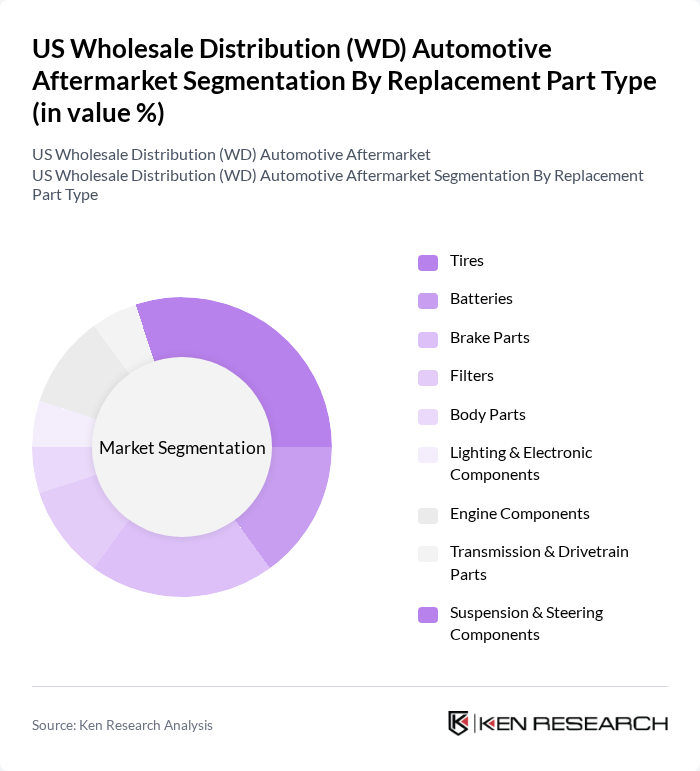
By Replacement Part Type:The replacement part type segmentation includes various components essential for vehicle maintenance and repair. The subsegments are Tires, Batteries, Brake Parts, Filters, Body Parts, Lighting & Electronic Components, Engine Components, Transmission & Drivetrain Parts, and Suspension & Steering Components. Among these, Tires and Brake Parts are particularly dominant due to their critical role in vehicle safety and performance. The increasing focus on vehicle safety, the aging vehicle fleet, and the growing trend of regular vehicle maintenance have led to a higher demand for these components. The rise of advanced driver-assistance systems (ADAS) and electrification is also boosting demand for specialized replacement parts.
By Product Category:The product category segmentation encompasses Automotive Parts, Automotive Accessories, Tools and Equipment, Fluids and Lubricants, and Chemicals and Additives. Automotive Parts dominate this segment due to the essential nature of these components in vehicle operation and safety. The increasing trend of vehicle customization and enhancement, as well as the adoption of digital sales channels, has also led to a rise in demand for Automotive Accessories, making it a significant contributor to market growth.

US Wholesale Distribution (WD) Automotive Aftermarket Competitive Landscape
The US Wholesale Distribution (WD) Automotive Aftermarket market is characterized by a dynamic mix of regional and international players. Leading participants such as Genuine Parts Company (NAPA Auto Parts), AutoZone, Inc., O'Reilly Automotive, Inc., Advance Auto Parts, Inc. contribute to innovation, geographic expansion, and service delivery in this space.
US Wholesale Distribution (WD) Automotive Aftermarket Industry Analysis
Growth Drivers
- Increasing Vehicle Ownership:The US vehicle ownership rate reached approximately 1.9 vehicles per household in future, with over 285 million registered vehicles. This growth in ownership drives demand for aftermarket parts and services, as vehicle maintenance becomes essential. The increasing number of vehicles on the road, particularly in urban areas, is expected to contribute to a projected increase in aftermarket spending, which was estimated at $325 billion in future, further supporting the wholesale distribution sector.
- Rise in Vehicle Age:The average age of vehicles on US roads has risen to 12.5 years as of future, leading to increased demand for replacement parts and repair services. Older vehicles typically require more maintenance, which boosts the aftermarket sector. With over 40% of vehicles being over 12 years old, the need for parts and services is expected to grow, driving sales in the wholesale distribution market, which saw a revenue increase of $5 billion in future.
- Growth in E-commerce for Auto Parts:E-commerce sales in the automotive aftermarket reached $22 billion in future, reflecting a significant shift towards online purchasing. This trend is driven by consumer preferences for convenience and competitive pricing. The rise of digital platforms has enabled wholesalers to reach a broader audience, with online sales projected to account for over 20% of total aftermarket sales in future, enhancing distribution efficiency and market penetration.
Market Challenges
- Intense Competition:The US automotive aftermarket is characterized by fierce competition, with over 30,000 companies vying for market share. This saturation leads to price wars and reduced profit margins, making it challenging for wholesalers to maintain profitability. In future, the average profit margin for aftermarket distributors was reported at just 5%, highlighting the need for differentiation and innovation to survive in this competitive landscape.
- Supply Chain Disruptions:The automotive aftermarket has faced significant supply chain disruptions, particularly due to global events such as the COVID-19 pandemic. In future, 60% of distributors reported delays in receiving parts, impacting their ability to meet customer demand. These disruptions have led to increased operational costs and inventory management challenges, forcing wholesalers to adapt their strategies to mitigate risks and ensure timely delivery of products.
US Wholesale Distribution (WD) Automotive Aftermarket Future Outlook
The future of the US wholesale distribution automotive aftermarket appears promising, driven by technological advancements and evolving consumer preferences. As digitalization continues to reshape the industry, wholesalers are expected to invest in advanced analytics and customer relationship management systems to enhance service delivery. Additionally, the growing trend towards eco-friendly products will likely influence product offerings, aligning with consumer demand for sustainability and innovation in automotive parts and services.
Market Opportunities
- Expansion of Online Sales Channels:The shift towards e-commerce presents a significant opportunity for wholesalers to expand their online presence. By investing in user-friendly platforms and digital marketing strategies, companies can tap into the growing consumer base that prefers online shopping, potentially increasing sales by an estimated $10 billion by future.
- Increasing Demand for Eco-friendly Products:As consumers become more environmentally conscious, there is a rising demand for eco-friendly automotive parts. Wholesalers can capitalize on this trend by offering sustainable products, which could lead to a market growth of approximately $5 billion by future, aligning with regulatory pressures and consumer preferences for greener alternatives.
Scope of the Report
| Segment | Sub-Segments |
|---|---|
| By Replacement Part Type | Tires Batteries Brake Parts Filters Body Parts Lighting & Electronic Components Engine Components Transmission & Drivetrain Parts Suspension & Steering Components |
| By Product Category | Automotive Parts Automotive Accessories Tools and Equipment Fluids and Lubricants Chemicals and Additives |
| By Vehicle Type | Light Vehicles Medium-Duty Trucks Heavy-Duty Vehicles Electric and Hybrid Vehicles |
| By End-User | Independent Repair Shops Dealerships Fleet Operators Retail Consumers (DIY) Auto Parts Retailers |
| By Distribution Channel | Online/E-commerce Platforms Brick-and-Mortar Stores Wholesale Distributors Direct-to-Consumer Sales Mobile Solutions and Apps |
| By Price Range | Budget/Economy Mid-Range Premium/OEM Quality |
| By Brand Type | OEM (Original Equipment Manufacturer) Aftermarket Branded Private Label Generic/Unbranded |
Key Target Audience
Investors and Venture Capitalist Firms
Government and Regulatory Bodies (e.g., Federal Trade Commission, Environmental Protection Agency)
Automotive Parts Manufacturers
Wholesale Distributors
Automotive Service Providers
Logistics and Supply Chain Companies
Automotive Industry Associations
Financial Institutions and Banks
Players Mentioned in the Report:
Genuine Parts Company (NAPA Auto Parts)
AutoZone, Inc.
O'Reilly Automotive, Inc.
Advance Auto Parts, Inc.
Table of Contents
Market Assessment Phase
1. Executive Summary and Approach
2. US Wholesale Distribution (WD) Automotive Aftermarket Overview
2.1 Key Insights and Strategic Recommendations
2.2 US Wholesale Distribution (WD) Automotive Aftermarket Overview
2.3 Definition and Scope
2.4 Evolution of Market Ecosystem
2.5 Timeline of Key Regulatory Milestones
2.6 Value Chain & Stakeholder Mapping
2.7 Business Cycle Analysis
2.8 Policy & Incentive Landscape
3. US Wholesale Distribution (WD) Automotive Aftermarket Analysis
3.1 Growth Drivers
3.1.1 Increasing Vehicle Ownership
3.1.2 Rise in Vehicle Age
3.1.3 Growth in E-commerce for Auto Parts
3.1.4 Technological Advancements in Automotive Repair
3.2 Market Challenges
3.2.1 Intense Competition
3.2.2 Supply Chain Disruptions
3.2.3 Regulatory Compliance Costs
3.2.4 Fluctuating Raw Material Prices
3.3 Market Opportunities
3.3.1 Expansion of Online Sales Channels
3.3.2 Increasing Demand for Eco-friendly Products
3.3.3 Growth in Automotive Repair Services
3.3.4 Strategic Partnerships with E-commerce Platforms
3.4 Market Trends
3.4.1 Shift Towards Digitalization
3.4.2 Increasing Focus on Customer Experience
3.4.3 Adoption of Advanced Analytics
3.4.4 Growth of Subscription-based Services
3.5 Government Regulation
3.5.1 Emission Standards Compliance
3.5.2 Safety Regulations for Automotive Parts
3.5.3 Import Tariffs on Auto Parts
3.5.4 Consumer Protection Laws
4. SWOT Analysis
5. Stakeholder Analysis
6. Porter's Five Forces Analysis
7. US Wholesale Distribution (WD) Automotive Aftermarket Market Size, 2019-2024
7.1 By Value
7.2 By Volume
7.3 By Average Selling Price
8. US Wholesale Distribution (WD) Automotive Aftermarket Segmentation
8.1 By Replacement Part Type
8.1.1 Tires
8.1.2 Batteries
8.1.3 Brake Parts
8.1.4 Filters
8.1.5 Body Parts
8.1.6 Lighting & Electronic Components
8.1.7 Engine Components
8.1.8 Transmission & Drivetrain Parts
8.1.9 Suspension & Steering Components
8.2 By Product Category
8.2.1 Automotive Parts
8.2.2 Automotive Accessories
8.2.3 Tools and Equipment
8.2.4 Fluids and Lubricants
8.2.5 Chemicals and Additives
8.3 By Vehicle Type
8.3.1 Light Vehicles
8.3.2 Medium-Duty Trucks
8.3.3 Heavy-Duty Vehicles
8.3.4 Electric and Hybrid Vehicles
8.4 By End-User
8.4.1 Independent Repair Shops
8.4.2 Dealerships
8.4.3 Fleet Operators
8.4.4 Retail Consumers (DIY)
8.4.5 Auto Parts Retailers
8.5 By Distribution Channel
8.5.1 Online/E-commerce Platforms
8.5.2 Brick-and-Mortar Stores
8.5.3 Wholesale Distributors
8.5.4 Direct-to-Consumer Sales
8.5.5 Mobile Solutions and Apps
8.6 By Price Range
8.6.1 Budget/Economy
8.6.2 Mid-Range
8.6.3 Premium/OEM Quality
8.7 By Brand Type
8.7.1 OEM (Original Equipment Manufacturer)
8.7.2 Aftermarket Branded
8.7.3 Private Label
8.7.4 Generic/Unbranded
9. US Wholesale Distribution (WD) Automotive Aftermarket Competitive Analysis
9.1 Market Share of Key Players(Micro, Small, Medium, Large Enterprises)
9.2 Cross Comparison of Key Players
9.2.1 Company Name
9.2.2 Group Size (Large, Medium, or Small as per industry convention)
9.2.3 Annual Revenue (USD Millions)
9.2.4 Revenue Growth Rate (YoY %)
9.2.5 Market Share (%)
9.2.6 Number of Distribution Centers/Warehouses
9.2.7 Geographic Coverage (States/Regions Served)
9.2.8 SKU Count (Number of Product Lines)
9.2.9 Inventory Turnover Ratio
9.2.10 E-commerce Sales as % of Total Revenue
9.2.11 Operating Margin (%)
9.2.12 Return on Assets (ROA %)
9.2.13 Same-Store Sales Growth (%)
9.2.14 Private Label Penetration (%)
9.2.15 Average Order Fulfillment Time (Days)
9.3 SWOT Analysis of Top Players
9.4 Pricing Analysis(By Class and Payload)
9.5 Detailed Profile of Major Companies
9.5.1 Genuine Parts Company (NAPA Auto Parts)
9.5.2 AutoZone, Inc.
9.5.3 O'Reilly Automotive, Inc.
9.5.4 Advance Auto Parts, Inc.
9.5.5
Research Methodology
Phase 1: Approach1
Desk Research
- Industry reports from automotive aftermarket associations and trade publications
- Market data from government agencies such as the U.S. Department of Commerce
- Analysis of historical sales trends and forecasts from reputable market research firms
Primary Research
- Interviews with key stakeholders including distributors, retailers, and manufacturers in the automotive aftermarket
- Surveys targeting automotive service providers and repair shops to gather insights on purchasing behavior
- Focus groups with end consumers to understand preferences and trends in aftermarket products
Validation & Triangulation
- Cross-validation of findings through multiple data sources including sales data and expert opinions
- Triangulation of market insights from primary interviews and secondary data analysis
- Sanity checks through expert panel reviews to ensure data accuracy and relevance
Phase 2: Market Size Estimation1
Top-down Assessment
- Estimation of total market size based on national automotive sales and aftermarket service revenue
- Segmentation of the market by product categories such as parts, accessories, and tools
- Incorporation of growth rates from historical data and projected trends in vehicle ownership
Bottom-up Modeling
- Collection of sales data from leading distributors and retailers in the automotive aftermarket
- Estimation of average transaction values and frequency of purchases across different segments
- Volume x price analysis to derive revenue estimates for each product category
Forecasting & Scenario Analysis
- Multi-variable forecasting models incorporating economic indicators and consumer spending trends
- Scenario analysis based on potential regulatory changes and technological advancements in the automotive sector
- Development of baseline, optimistic, and pessimistic forecasts through 2030
Phase 3: CATI Sample Composition1
| Scope Item/Segment | Sample Size | Target Respondent Profiles |
|---|---|---|
| Automotive Parts Distributors | 80 | Distribution Managers, Sales Directors |
| Retail Automotive Aftermarket | 60 | Store Managers, Purchasing Agents |
| Automotive Repair Shops | 50 | Shop Owners, Service Managers |
| OEM Parts Suppliers | 40 | Procurement Managers, Product Development Leads |
| Consumer Insights on Aftermarket Products | 50 | Car Owners, Automotive Enthusiasts |
Frequently Asked Questions
What is the current value of the US Wholesale Distribution Automotive Aftermarket?
The US Wholesale Distribution Automotive Aftermarket is valued at approximately USD 288 billion, driven by factors such as increasing vehicle population, consumer preference for maintenance, and the trend of DIY repairs among consumers.
What are the key growth drivers for the US Automotive Aftermarket?
Which states dominate the US Wholesale Distribution Automotive Aftermarket?
What types of replacement parts are most in demand in the aftermarket?
Other Regional/Country Reports
Indonesia Wholesale Distribution WD Automotive Aftermarket Industry
Malaysia Wholesale Distribution WD Automotive Aftermarket Industry
KSA Wholesale Distribution WD Automotive Aftermarket Industry
APAC Wholesale Distribution WD Automotive Aftermarket Industry
SEA Wholesale Distribution WD Automotive Aftermarket Industry
Vietnam Wholesale Distribution WD Automotive Aftermarket Industry
Other Adjacent Reports
Thailand Automotive Parts Manufacturing Market
KSA Automotive Repair and Maintenance Market Size, Share & Forecast, By Service Type, Vehicle Type & Customer Type, 2026-2031South Africa Electric Vehicle Components Market
South Korea Automotive E-commerce Market
Egypt Tire Manufacturing Market
India Automotive Battery Market Size, Share & Forecast, By Vehicle Type, Powertrain & Sales Channel, 2026–2031UAE Lubricants and Additives Market
Germany Vehicle Accessories Market
Oman Automotive Tools and Equipment Market
Egypt Emission Control Systems Market
Why Buy From Us?

What makes us stand out is that our consultants follow Robust, Refine and Result (RRR) methodology. Robust for clear definitions, approaches and sanity checking, Refine for differentiating respondents' facts and opinions, and Result for presenting data with story.

We have set a benchmark in the industry by offering our clients with syndicated and customized market research reports featuring coverage of entire market as well as meticulous research and analyst insights.

While we don't replace traditional research, we flip the method upside down. Our dual approach of Top Bottom & Bottom Top ensures quality deliverable by not just verifying company fundamentals but also looking at the sector and macroeconomic factors.

With one step in the future, our research team constantly tries to show you the bigger picture. We help with some of the tough questions you may encounter along the way: How is the industry positioned? Best marketing channel? KPI's of competitors? By aligning every element, we help maximize success.

Our report gives you instant access to the answers and sources that other companies might choose to hide. We elaborate each steps of research methodology we have used and showcase you the sample size to earn your trust.

If you need any support, we are here! We pride ourselves on universe strength, data quality, and quick, friendly, and professional service.