About the Report
Base Year 2024USA Blockchain and Digital Assets Infrastructure Market Overview
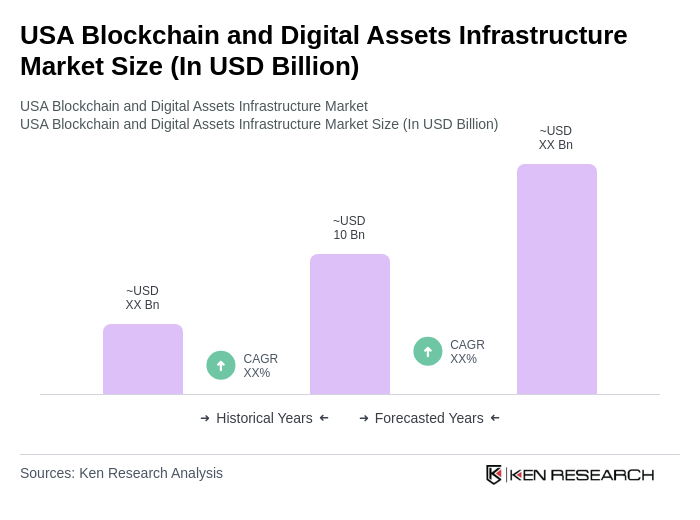
- The USA Blockchain and Digital Assets Infrastructure Market is valued at USD 10 billion, based on a five-year historical analysis. This growth is primarily driven by the increasing adoption of blockchain technology across sectors such as finance, healthcare, supply chain management, and government. Key growth drivers include the surge in venture capital investment, rapid enterprise adoption, and the expanding use of blockchain for smart contracts, payments, and digital identity management. The demand for secure, transparent, and efficient transaction methods continues to fuel significant investments in blockchain infrastructure and digital asset management solutions .
- Key players in this market are concentrated in major cities such as New York, San Francisco, and Chicago, which dominate due to robust financial ecosystems, advanced technological infrastructure, and a high density of blockchain startups and established firms. These cities serve as hubs for venture capital investment, regulatory engagement, and talent acquisition, fostering an environment conducive to blockchain innovation and adoption .
- The Digital Asset Market Structure and Investor Protection Act, introduced by the U.S. House of Representatives in 2023, establishes a comprehensive regulatory framework for digital assets. This legislation, issued by the U.S. Congress, aims to enhance consumer protection, promote responsible innovation, and ensure market integrity by defining operational standards for digital asset issuers, exchanges, and custodians. Key provisions include mandatory registration, anti-money laundering compliance, and clear jurisdictional boundaries between regulatory agencies .
USA Blockchain and Digital Assets Infrastructure Market Segmentation
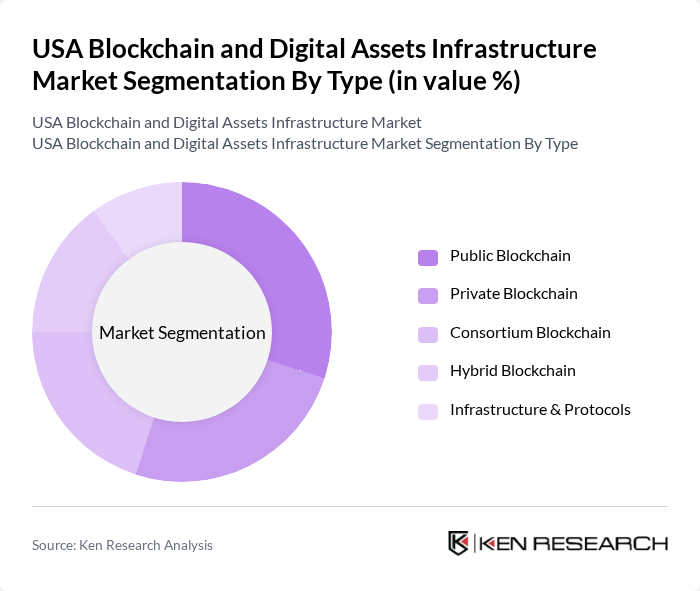
By Type:The market is segmented into Public Blockchain, Private Blockchain, Consortium Blockchain, Hybrid Blockchain, and Infrastructure & Protocols. Public Blockchain is widely adopted for its transparency and decentralization, supporting use cases such as cryptocurrencies and open-source platforms. Private Blockchain is preferred for enterprise solutions requiring privacy, control, and regulatory compliance, especially in sectors like banking, healthcare, and supply chain. Consortium Blockchain enables collaboration among multiple organizations, while Hybrid Blockchain combines features of both public and private systems to address complex enterprise needs. Infrastructure & Protocols underpin the foundational technology stack, supporting scalability, interoperability, and security .
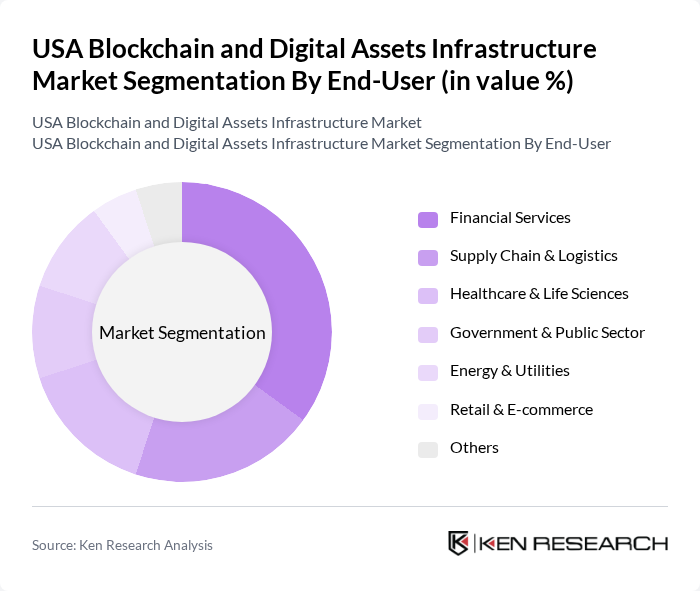
By End-User:The market is further segmented by end-user industries, including Financial Services, Supply Chain & Logistics, Healthcare & Life Sciences, Government & Public Sector, Energy & Utilities, Retail & E-commerce, and Others. Financial Services lead the market, driven by the need for secure transactions, efficient payment systems, and regulatory compliance. Supply Chain & Logistics leverage blockchain for enhanced traceability and transparency. Healthcare & Life Sciences utilize blockchain to improve data integrity and patient privacy. Government & Public Sector applications focus on digital identity and secure record-keeping. Energy & Utilities adopt blockchain for grid management and peer-to-peer energy trading, while Retail & E-commerce use it for supply chain transparency and anti-counterfeiting .
USA Blockchain and Digital Assets Infrastructure Market Competitive Landscape
The USA Blockchain and Digital Assets Infrastructure Market is characterized by a dynamic mix of regional and international players. Leading participants such as Coinbase Global, Inc., Binance.US, Kraken (Payward, Inc.), Bitstamp USA, Inc., Gemini Trust Company, LLC, Anchorage Digital, Chainalysis, Inc., ConsenSys Software Inc., Fireblocks Inc., Ripple Labs Inc., Circle Internet Financial, Inc., Algorand, Inc., Hyperledger Foundation, R3 LLC, Blockdaemon Inc. contribute to innovation, geographic expansion, and service delivery in this space.
USA Blockchain and Digital Assets Infrastructure Market Industry Analysis
Growth Drivers
- Increasing Adoption of Decentralized Finance (DeFi):The DeFi sector has seen explosive growth, with total value locked (TVL) in DeFi protocols reaching approximatelyUSD 80 billionin future. This surge is driven by the demand for financial services that operate without intermediaries, allowing users to lend, borrow, and trade assets directly. The DeFi market's expansion is supported by a growing user base, with over4 million unique walletsinteracting with DeFi platforms, indicating a robust shift towards decentralized financial solutions.
- Rising Demand for Transparency and Security:As businesses and consumers increasingly prioritize data integrity, the demand for blockchain solutions that enhance transparency and security is surging. In future, the global cybersecurity market is projected to reachUSD 300 billion, with blockchain technology being a key component in securing transactions and data. Companies are investing heavily in blockchain to mitigate risks associated with data breaches, with60% of enterprisesconsidering blockchain for its security benefits, according to industry reports.
- Expansion of Cryptocurrency Use Cases:The diversification of cryptocurrency applications is driving market growth, with over10,000 cryptocurrenciesin circulation in future. Use cases now extend beyond trading to include remittances, micropayments, and supply chain management. The total transaction volume in the cryptocurrency market is expected to exceedUSD 1 trillionin future, reflecting a growing acceptance of digital currencies in everyday transactions and business operations, further solidifying their role in the economy.
Market Challenges
- Regulatory Uncertainty:The blockchain and digital assets sector faces significant regulatory challenges, with over50% of companiesciting regulatory compliance as a major barrier to entry. In future, the U.S. government is expected to introduce new regulations that could impact the operational landscape for blockchain firms. This uncertainty can hinder investment and innovation, as companies navigate a complex regulatory environment that varies by state and federal jurisdiction.
- High Energy Consumption Concerns:The energy consumption of blockchain networks, particularly those using proof-of-work mechanisms, has raised environmental concerns. Bitcoin mining alone consumes approximately100 terawatt-hours annually, comparable to the energy usage of entire countries. As sustainability becomes a priority, companies are under pressure to adopt energy-efficient solutions, which may slow down the adoption of certain blockchain technologies unless significant improvements are made.
USA Blockchain and Digital Assets Infrastructure Market Future Outlook
The future of the USA blockchain and digital assets infrastructure market appears promising, driven by technological advancements and increasing institutional interest. As more companies explore blockchain integration, the focus will shift towards enhancing interoperability and developing sustainable solutions. Additionally, the rise of Central Bank Digital Currencies (CBDCs) is expected to reshape the financial landscape, encouraging further adoption of blockchain technologies. The market will likely witness innovative applications that address current challenges while capitalizing on emerging trends in digital finance.
Market Opportunities
- Integration with IoT and AI Technologies:The convergence of blockchain with IoT and AI presents significant opportunities, with the IoT market projected to reachUSD 1.1 trillionin future. Blockchain can enhance data security and integrity in IoT applications, while AI can optimize blockchain operations, creating a synergistic effect that drives innovation and efficiency across industries.
- Development of Blockchain-as-a-Service (BaaS):The BaaS market is expected to grow rapidly, with revenues projected to reachUSD 30 billionin future. This model allows businesses to leverage blockchain technology without the need for extensive infrastructure investments. As more companies seek to implement blockchain solutions, BaaS providers will play a crucial role in facilitating adoption and driving market growth.
Scope of the Report
| Segment | Sub-Segments |
|---|---|
| By Type | Public Blockchain Private Blockchain Consortium Blockchain Hybrid Blockchain Infrastructure & Protocols |
| By End-User | Financial Services Supply Chain & Logistics Healthcare & Life Sciences Government & Public Sector Energy & Utilities Retail & E-commerce Others |
| By Application | Payments & Settlements Smart Contracts Identity & Access Management Asset & Wealth Management Supply Chain Tracking Digital Identity Others |
| By Component | Platform/Solution Middleware Services (Consulting, Integration, Support) |
| By Sales Channel | Direct Sales Online Sales Distributors/Partners |
| By Investment Source | Venture Capital Private Equity Government Grants Corporate Investment |
| By Policy Support | Tax Incentives Grants for Research and Development Regulatory Sandboxes |
Key Target Audience
Investors and Venture Capitalist Firms
Government and Regulatory Bodies (e.g., U.S. Securities and Exchange Commission, Financial Crimes Enforcement Network)
Blockchain Technology Developers
Cryptocurrency Exchanges
Payment Processors
Financial Institutions
Insurance Companies
Telecommunications Companies
Players Mentioned in the Report:
Coinbase Global, Inc.
Binance.US
Kraken (Payward, Inc.)
Bitstamp USA, Inc.
Gemini Trust Company, LLC
Anchorage Digital
Chainalysis, Inc.
ConsenSys Software Inc.
Fireblocks Inc.
Ripple Labs Inc.
Circle Internet Financial, Inc.
Algorand, Inc.
Hyperledger Foundation
R3 LLC
Blockdaemon Inc.
Table of Contents
Market Assessment Phase
1. Executive Summary and Approach
2. USA Blockchain and Digital Assets Infrastructure Market Overview
2.1 Key Insights and Strategic Recommendations
2.2 USA Blockchain and Digital Assets Infrastructure Market Overview
2.3 Definition and Scope
2.4 Evolution of Market Ecosystem
2.5 Timeline of Key Regulatory Milestones
2.6 Value Chain & Stakeholder Mapping
2.7 Business Cycle Analysis
2.8 Policy & Incentive Landscape
3. USA Blockchain and Digital Assets Infrastructure Market Analysis
3.1 Growth Drivers
3.1.1 Increasing Adoption of Decentralized Finance (DeFi)
3.1.2 Rising Demand for Transparency and Security
3.1.3 Expansion of Cryptocurrency Use Cases
3.1.4 Government Support for Blockchain Initiatives
3.2 Market Challenges
3.2.1 Regulatory Uncertainty
3.2.2 High Energy Consumption Concerns
3.2.3 Scalability Issues
3.2.4 Cybersecurity Threats
3.3 Market Opportunities
3.3.1 Integration with IoT and AI Technologies
3.3.2 Development of Blockchain-as-a-Service (BaaS)
3.3.3 Growth in Non-Fungible Tokens (NFTs)
3.3.4 Expansion into Emerging Markets
3.4 Market Trends
3.4.1 Increasing Institutional Investment
3.4.2 Rise of Central Bank Digital Currencies (CBDCs)
3.4.3 Enhanced Interoperability Solutions
3.4.4 Focus on Sustainable Blockchain Solutions
3.5 Government Regulation
3.5.1 SEC Guidelines on Cryptocurrency
3.5.2 State-Level Blockchain Initiatives
3.5.3 Anti-Money Laundering (AML) Regulations
3.5.4 Data Privacy Laws Impacting Blockchain
4. SWOT Analysis
5. Stakeholder Analysis
6. Porter's Five Forces Analysis
7. USA Blockchain and Digital Assets Infrastructure Market Market Size, 2019-2024
7.1 By Value
7.2 By Volume
7.3 By Average Selling Price
8. USA Blockchain and Digital Assets Infrastructure Market Segmentation
8.1 By Type
8.1.1 Public Blockchain
8.1.2 Private Blockchain
8.1.3 Consortium Blockchain
8.1.4 Hybrid Blockchain
8.1.5 Infrastructure & Protocols
8.2 By End-User
8.2.1 Financial Services
8.2.2 Supply Chain & Logistics
8.2.3 Healthcare & Life Sciences
8.2.4 Government & Public Sector
8.2.5 Energy & Utilities
8.2.6 Retail & E-commerce
8.2.7 Others
8.3 By Application
8.3.1 Payments & Settlements
8.3.2 Smart Contracts
8.3.3 Identity & Access Management
8.3.4 Asset & Wealth Management
8.3.5 Supply Chain Tracking
8.3.6 Digital Identity
8.3.7 Others
8.4 By Component
8.4.1 Platform/Solution
8.4.2 Middleware
8.4.3 Services (Consulting, Integration, Support)
8.5 By Sales Channel
8.5.1 Direct Sales
8.5.2 Online Sales
8.5.3 Distributors/Partners
8.6 By Investment Source
8.6.1 Venture Capital
8.6.2 Private Equity
8.6.3 Government Grants
8.6.4 Corporate Investment
8.7 By Policy Support
8.7.1 Tax Incentives
8.7.2 Grants for Research and Development
8.7.3 Regulatory Sandboxes
9. USA Blockchain and Digital Assets Infrastructure Market Competitive Analysis
9.1 Market Share of Key Players
9.2 Cross Comparison of Key Players
9.2.1 Company Name
9.2.2 Company Type (Exchange, Infrastructure Provider, Analytics, Custody, etc.)
9.2.3 Group Size (Large, Medium, or Small as per industry convention)
9.2.4 Annual Revenue
9.2.5 Revenue Growth Rate (YoY %)
9.2.6 Market Penetration Rate (US Market Share %)
9.2.7 Number of Active Users/Clients
9.2.8 Assets Under Management (AUM) / Total Value Locked (TVL), if applicable
9.2.9 Customer Acquisition Cost (CAC)
9.2.10 Customer Retention Rate (%)
9.2.11 Average Transaction Value
9.2.12 Pricing Model (e.g., Subscription, Transaction Fee, Freemium)
9.2.13 Return on Investment (ROI)
9.2.14 Net Promoter Score (NPS)
9.2.15 Compliance Certifications (e.g., SOC 2, ISO 27001)
9.3 SWOT Analysis of Top Players
9.4 Pricing Analysis
9.5 Detailed Profile of Major Companies
9.5.1 Coinbase Global, Inc.
9.5.2 Binance.US
9.5.3 Kraken (Payward, Inc.)
9.5.4 Bitstamp USA, Inc.
9.5.5 Gemini Trust Company, LLC
9.5.6 Anchorage Digital
9.5.7 Chainalysis, Inc.
9.5.8 ConsenSys Software Inc.
9.5.9 Fireblocks Inc.
9.5.10 Ripple Labs Inc.
9.5.11 Circle Internet Financial, Inc.
9.5.12 Algorand, Inc.
9.5.13 Hyperledger Foundation
9.5.14 R3 LLC
9.5.15 Blockdaemon Inc.
10. USA Blockchain and Digital Assets Infrastructure Market End-User Analysis
10.1 Procurement Behavior of Key Ministries
10.1.1 Budget Allocation Trends
10.1.2 Decision-Making Processes
10.1.3 Preferred Procurement Methods
10.2 Corporate Spend on Infrastructure & Energy
10.2.1 Investment Priorities
10.2.2 Spending Patterns
10.2.3 Impact of Blockchain on Cost Reduction
10.3 Pain Point Analysis by End-User Category
10.3.1 Security Concerns
10.3.2 Integration Challenges
10.3.3 Compliance Issues
10.4 User Readiness for Adoption
10.4.1 Awareness Levels
10.4.2 Training Needs
10.4.3 Technology Infrastructure
10.5 Post-Deployment ROI and Use Case Expansion
10.5.1 Measurement of Success
10.5.2 Future Use Cases
10.5.3 Feedback Mechanisms
11. USA Blockchain and Digital Assets Infrastructure Market Future Size, 2025-2030
11.1 By Value
11.2 By Volume
11.3 By Average Selling Price
Go-To-Market Strategy Phase
1. Whitespace Analysis + Business Model Canvas
1.1 Market Gaps Identification
1.2 Value Proposition Development
1.3 Revenue Streams Analysis
1.4 Cost Structure Evaluation
1.5 Key Partnerships Exploration
1.6 Customer Segments Definition
1.7 Channels Strategy
2. Marketing and Positioning Recommendations
2.1 Branding Strategies
2.2 Product USPs
2.3 Target Audience Identification
2.4 Communication Strategy
2.5 Digital Marketing Tactics
3. Distribution Plan
3.1 Urban Retail Strategies
3.2 Rural NGO Tie-Ups
3.3 E-commerce Integration
3.4 Direct Sales Approaches
4. Channel & Pricing Gaps
4.1 Underserved Routes
4.2 Pricing Bands Analysis
4.3 Competitor Pricing Comparison
5. Unmet Demand & Latent Needs
5.1 Category Gaps Identification
5.2 Consumer Segments Analysis
5.3 Emerging Trends Exploration
6. Customer Relationship
6.1 Loyalty Programs Development
6.2 After-sales Service Strategies
6.3 Customer Feedback Mechanisms
7. Value Proposition
7.1 Sustainability Initiatives
7.2 Integrated Supply Chains
7.3 Unique Selling Points
8. Key Activities
8.1 Regulatory Compliance
8.2 Branding Efforts
8.3 Distribution Setup
9. Entry Strategy Evaluation
9.1 Domestic Market Entry Strategy
9.1.1 Product Mix Considerations
9.1.2 Pricing Band Strategy
9.1.3 Packaging Options
9.2 Export Entry Strategy
9.2.1 Target Countries Identification
9.2.2 Compliance Roadmap Development
10. Entry Mode Assessment
10.1 Joint Ventures
10.2 Greenfield Investments
10.3 Mergers & Acquisitions
10.4 Distributor Model Evaluation
11. Capital and Timeline Estimation
11.1 Capital Requirements Analysis
11.2 Timelines for Implementation
12. Control vs Risk Trade-Off
12.1 Ownership Considerations
12.2 Partnerships Evaluation
13. Profitability Outlook
13.1 Breakeven Analysis
13.2 Long-term Sustainability Strategies
14. Potential Partner List
14.1 Distributors Identification
14.2 Joint Ventures Opportunities
14.3 Acquisition Targets
15. Execution Roadmap
15.1 Phased Plan for Market Entry
15.1.1 Market Setup
15.1.2 Market Entry
15.1.3 Growth Acceleration
15.1.4 Scale & Stabilize
15.2 Key Activities and Milestones
15.2.1 Milestone Planning
15.2.2 Activity Tracking
Research Methodology
Phase 1: Approach1
Desk Research
- Analysis of industry reports from blockchain associations and digital asset regulatory bodies
- Review of market trends and forecasts from financial institutions and consultancy firms
- Examination of white papers and case studies published by leading blockchain technology providers
Primary Research
- Interviews with blockchain developers and digital asset custodians
- Surveys targeting financial analysts and investment managers in the digital asset space
- Field interviews with regulatory experts and compliance officers in financial institutions
Validation & Triangulation
- Cross-validation of findings through multiple data sources including market reports and expert opinions
- Triangulation of insights from primary interviews with secondary data trends
- Sanity checks conducted through expert panel discussions and feedback sessions
Phase 2: Market Size Estimation1
Top-down Assessment
- Estimation of market size based on total investment in blockchain technology across sectors
- Segmentation by application areas such as finance, supply chain, and healthcare
- Incorporation of government initiatives promoting blockchain adoption and digital asset regulation
Bottom-up Modeling
- Data collection from leading blockchain firms regarding their revenue and user base
- Operational cost analysis based on service offerings in the digital asset management space
- Volume and transaction value assessments for various blockchain applications
Forecasting & Scenario Analysis
- Multi-variable regression analysis incorporating factors like regulatory changes and market adoption rates
- Scenario modeling based on potential technological advancements and market disruptions
- Development of baseline, optimistic, and pessimistic forecasts through 2030
Phase 3: CATI Sample Composition1
| Scope Item/Segment | Sample Size | Target Respondent Profiles |
|---|---|---|
| Blockchain Technology Adoption in Finance | 120 | Chief Technology Officers, Financial Analysts |
| Digital Asset Custody Solutions | 90 | Compliance Officers, Risk Management Executives |
| Supply Chain Blockchain Applications | 60 | Supply Chain Managers, Operations Directors |
| Healthcare Blockchain Initiatives | 50 | Healthcare Administrators, IT Managers |
| Regulatory Perspectives on Digital Assets | 40 | Legal Advisors, Regulatory Affairs Specialists |
Frequently Asked Questions
What is the current value of the USA Blockchain and Digital Assets Infrastructure Market?
The USA Blockchain and Digital Assets Infrastructure Market is valued at approximately USD 10 billion, reflecting significant growth driven by the increasing adoption of blockchain technology across various sectors, including finance, healthcare, and supply chain management.
What are the key growth drivers for the USA Blockchain and Digital Assets Infrastructure Market?
Which cities are the main hubs for blockchain and digital assets in the USA?
What is the Digital Asset Market Structure and Investor Protection Act?
Other Regional/Country Reports
Indonesia Blockchain and Digital Assets Infrastructure Market
Malaysia Blockchain and Digital Assets Infrastructure Market
KSA Blockchain and Digital Assets Infrastructure Market
APAC Blockchain and Digital Assets Infrastructure Market
SEA Blockchain and Digital Assets Infrastructure Market
Vietnam Blockchain and Digital Assets Infrastructure Market
Other Adjacent Reports
Philippines Cryptocurrency Exchange Market
Vietnam Blockchain Security Market
Saudi Arabia Digital Asset Custody MarketBahrain FinTech Integration Market
Qatar Supply Chain Blockchain Market
GCC Healthcare Blockchain Market Size, Share, Growth Drivers, Trends, Opportunities & Forecast 2025–2030Belgium Government Blockchain Market
Japan Energy Blockchain Market
Vietnam Retail Blockchain Market
Why Buy From Us?

What makes us stand out is that our consultants follow Robust, Refine and Result (RRR) methodology. Robust for clear definitions, approaches and sanity checking, Refine for differentiating respondents' facts and opinions, and Result for presenting data with story.

We have set a benchmark in the industry by offering our clients with syndicated and customized market research reports featuring coverage of entire market as well as meticulous research and analyst insights.

While we don't replace traditional research, we flip the method upside down. Our dual approach of Top Bottom & Bottom Top ensures quality deliverable by not just verifying company fundamentals but also looking at the sector and macroeconomic factors.

With one step in the future, our research team constantly tries to show you the bigger picture. We help with some of the tough questions you may encounter along the way: How is the industry positioned? Best marketing channel? KPI's of competitors? By aligning every element, we help maximize success.

Our report gives you instant access to the answers and sources that other companies might choose to hide. We elaborate each steps of research methodology we have used and showcase you the sample size to earn your trust.

If you need any support, we are here! We pride ourselves on universe strength, data quality, and quick, friendly, and professional service.