About the Report
Base Year 2024Vietnam Eco Friendly Labels Market Overview
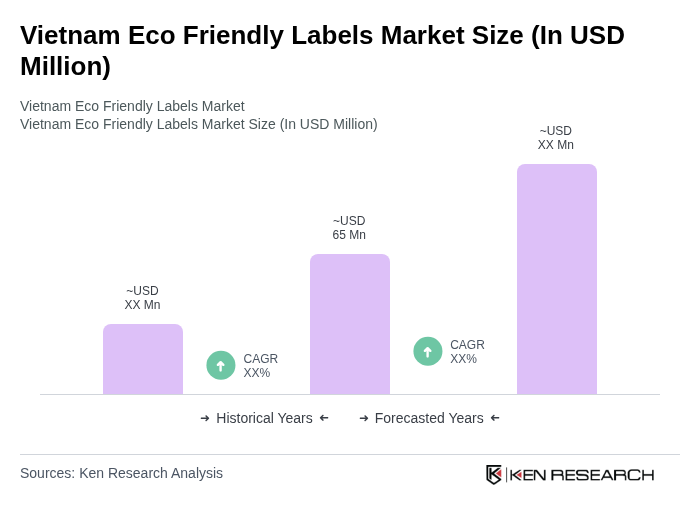
- The Vietnam Eco Friendly Labels Market is valued at USD 65 million, based on a five-year historical analysis. This growth is primarily driven by increasing consumer awareness regarding sustainability, government initiatives promoting eco-friendly products, the rising demand from various industries for environmentally responsible labeling solutions, and the expanding e-commerce sector boosting needs for sustainable packaging labels.
- Key cities such as Ho Chi Minh City and Hanoi dominate the market due to their significant industrial activities and consumer bases. These urban centers are witnessing a surge in eco-conscious consumers, which encourages businesses to adopt eco-friendly labeling practices to meet market demands and regulatory requirements.
- Decree No. 08/2022/N?-CP issued by the Government of Vietnam on the Roadmap to restrict the production and import of single-use plastic products, non-biodegradable plastic packaging, and products containing microplastics requires certification with the Vietnam Eco-label for permitted single-use plastics from 2026, with full prohibition by January 1, 2031, thereby mandating environmentally compliant packaging materials including labels to reduce plastic waste and promote biodegradable alternatives.
Vietnam Eco Friendly Labels Market Segmentation
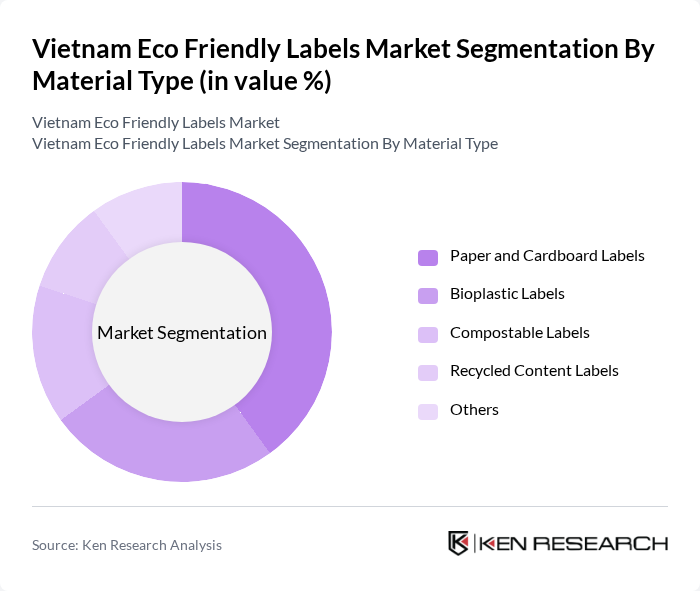
By Material Type:The material type segmentation includes various subsegments such as Paper and Cardboard Labels, Bioplastic Labels, Compostable Labels, Recycled Content Labels, and Others. Among these, Paper and Cardboard Labels are leading the market due to their widespread acceptance and ease of recycling. The growing trend towards sustainable packaging solutions has further propelled the demand for these materials, as consumers increasingly prefer products with minimal environmental impact.
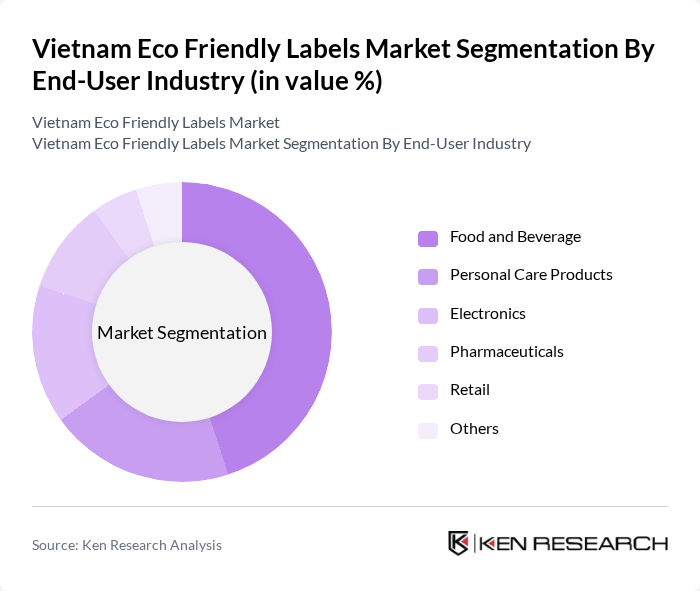
By End-User Industry:The end-user industry segmentation encompasses Food and Beverage, Personal Care Products, Electronics, Pharmaceuticals, Retail, and Others. The Food and Beverage sector is the dominant segment, driven by the increasing demand for sustainable packaging solutions among consumers. This sector's focus on reducing environmental footprints has led to a significant rise in the adoption of eco-friendly labels, making it a key player in the market.
Vietnam Eco Friendly Labels Market Competitive Landscape
The Vietnam Eco Friendly Labels Market is characterized by a dynamic mix of regional and international players. Leading participants such as Unilever Vietnam, Nestlé Vietnam, Coca-Cola Vietnam, Tetra Pak Vietnam, SCG Packaging, Amcor Vietnam, Biopak Vietnam, Ecolean Vietnam, Packtech Vietnam, Vina Kraft Paper, Tan Phat Packaging, Huu Nghi Packaging, Green Pack Vietnam, An Phat Holdings, Binh Minh Plastic contribute to innovation, geographic expansion, and service delivery in this space.
Vietnam Eco Friendly Labels Market Industry Analysis
Growth Drivers
- Increasing Consumer Awareness of Sustainability:The Vietnamese population is becoming increasingly aware of sustainability issues, with 70% of consumers expressing a preference for eco-friendly products in recent surveys. This shift is driven by rising environmental concerns, particularly regarding pollution and waste management. The World Bank reported that Vietnam's environmental degradation costs the economy approximately $11 billion annually, prompting consumers to seek sustainable alternatives. This growing awareness is a significant driver for the eco-friendly labels market, as consumers demand transparency and accountability from brands.
- Government Initiatives Promoting Eco-Friendly Products:The Vietnamese government has implemented various initiatives to promote eco-friendly products, including the National Strategy on Green Growth, which aims to reduce greenhouse gas emissions by 8-10% in future. Additionally, the government allocated approximately $1.6 billion for environmental protection projects. These initiatives encourage businesses to adopt eco-labeling practices, thereby increasing the availability and visibility of eco-friendly products in the market, which is crucial for consumer adoption.
- Rising Demand from Export Markets:Vietnam's eco-friendly products are increasingly sought after in international markets, particularly in Europe and North America, where consumers are willing to pay a premium for sustainable goods. In future, exports of eco-friendly products reached $2.5 billion, reflecting a 15% increase from the previous year. This demand is driven by stricter regulations in importing countries regarding sustainability, prompting Vietnamese manufacturers to adopt eco-labeling to meet these standards and enhance their competitiveness in global markets.
Market Challenges
- High Costs of Certification:The certification process for eco-friendly labels can be prohibitively expensive for many small and medium-sized enterprises (SMEs) in Vietnam. Certification costs can range from $5,500 to $21,000, depending on the label and the complexity of the product. This financial burden limits the ability of SMEs to enter the eco-friendly market, resulting in a slower adoption rate of eco-labels across various industries, which hampers overall market growth.
- Limited Consumer Understanding of Eco Labels:Despite growing awareness, many Vietnamese consumers still lack a clear understanding of eco labels and their significance. A study indicated that only 42% of consumers could correctly identify eco-labels and their benefits. This knowledge gap can lead to skepticism and reluctance to purchase eco-friendly products, ultimately affecting market penetration and growth. Educating consumers about the importance of eco-labels is essential for increasing demand and fostering a sustainable market environment.
Vietnam Eco Friendly Labels Market Future Outlook
The future of the Vietnam eco-friendly labels market appears promising, driven by increasing consumer demand for sustainable products and supportive government policies. As awareness of environmental issues continues to rise, businesses are likely to invest more in eco-labeling to meet consumer expectations. Additionally, advancements in technology will facilitate the development of innovative eco-friendly products, further enhancing market growth. The collaboration between businesses and NGOs will also play a crucial role in promoting eco-labels, ensuring a more sustainable future for the industry.
Market Opportunities
- Expansion into Emerging Markets:There is significant potential for Vietnamese eco-friendly products in emerging markets across Southeast Asia, where demand for sustainable goods is on the rise. By targeting these markets, Vietnamese companies can increase their export volumes and enhance brand visibility, tapping into a growing consumer base that values sustainability.
- Development of New Eco-Friendly Products:The market presents opportunities for innovation in eco-friendly product development, particularly in sectors like packaging and textiles. By investing in research and development, companies can create new products that meet eco-label standards, catering to the evolving preferences of environmentally conscious consumers and gaining a competitive edge in the market.
Scope of the Report
| Segment | Sub-Segments |
|---|---|
| By Material Type | Paper and Cardboard Labels Bioplastic Labels Compostable Labels Recycled Content Labels Others |
| By End-User Industry | Food and Beverage Personal Care Products Electronics Pharmaceuticals Retail Others |
| By Distribution Channel | Online Retail Supermarkets and Hypermarkets Specialty Stores Direct Sales Others |
| By Label Type | Sleeve Labels Pressure-Sensitive Labels In-Mold Labels Glue-Applied Labels Others |
| By Printing Technology | Digital Printing Flexographic Printing Gravure Printing Offset Printing Others |
| By Price Range | Low Price Mid Price High Price |
| By Geographic Region | Northern Vietnam Central Vietnam Southern Vietnam |
Key Target Audience
Investors and Venture Capitalist Firms
Government and Regulatory Bodies (e.g., Ministry of Natural Resources and Environment, Vietnam Standards and Quality Institute)
Manufacturers and Producers of Eco-Friendly Products
Distributors and Retailers of Sustainable Goods
Environmental NGOs and Advocacy Groups
Certification Bodies and Standards Organizations
Industry Associations for Sustainable Practices
Financial Institutions and Green Investment Funds
Players Mentioned in the Report:
Unilever Vietnam
Nestle Vietnam
Coca-Cola Vietnam
Tetra Pak Vietnam
SCG Packaging
Amcor Vietnam
Biopak Vietnam
Ecolean Vietnam
Packtech Vietnam
Vina Kraft Paper
Tan Phat Packaging
Huu Nghi Packaging
Green Pack Vietnam
An Phat Holdings
Binh Minh Plastic
Table of Contents
Market Assessment Phase
1. Executive Summary and Approach
2. Vietnam Eco Friendly Labels Market Overview
2.1 Key Insights and Strategic Recommendations
2.2 Vietnam Eco Friendly Labels Market Overview
2.3 Definition and Scope
2.4 Evolution of Market Ecosystem
2.5 Timeline of Key Regulatory Milestones
2.6 Value Chain & Stakeholder Mapping
2.7 Business Cycle Analysis
2.8 Policy & Incentive Landscape
3. Vietnam Eco Friendly Labels Market Analysis
3.1 Growth Drivers
3.1.1 Increasing Consumer Awareness of Sustainability
3.1.2 Government Initiatives Promoting Eco-Friendly Products
3.1.3 Rising Demand from Export Markets
3.1.4 Technological Advancements in Eco Labeling
3.2 Market Challenges
3.2.1 High Costs of Certification
3.2.2 Limited Consumer Understanding of Eco Labels
3.2.3 Competition from Non-Eco-Friendly Products
3.2.4 Regulatory Compliance Issues
3.3 Market Opportunities
3.3.1 Expansion into Emerging Markets
3.3.2 Development of New Eco-Friendly Products
3.3.3 Partnerships with NGOs for Awareness Campaigns
3.3.4 Leveraging E-commerce for Wider Reach
3.4 Market Trends
3.4.1 Growth of Green Consumerism
3.4.2 Increasing Use of Digital Platforms for Marketing
3.4.3 Shift Towards Circular Economy Practices
3.4.4 Rise in Eco-Friendly Packaging Solutions
3.5 Government Regulation
3.5.1 National Standards for Eco Labels
3.5.2 Incentives for Sustainable Practices
3.5.3 Labeling Requirements for Imported Goods
3.5.4 Environmental Protection Laws
4. SWOT Analysis
5. Stakeholder Analysis
6. Porter's Five Forces Analysis
7. Vietnam Eco Friendly Labels Market Market Size, 2019-2024
7.1 By Value
7.2 By Volume
7.3 By Average Selling Price
8. Vietnam Eco Friendly Labels Market Segmentation
8.1 By Material Type
8.1.1 Paper and Cardboard Labels
8.1.2 Bioplastic Labels
8.1.3 Compostable Labels
8.1.4 Recycled Content Labels
8.1.5 Others
8.2 By End-User Industry
8.2.1 Food and Beverage
8.2.2 Personal Care Products
8.2.3 Electronics
8.2.4 Pharmaceuticals
8.2.5 Retail
8.2.6 Others
8.3 By Distribution Channel
8.3.1 Online Retail
8.3.2 Supermarkets and Hypermarkets
8.3.3 Specialty Stores
8.3.4 Direct Sales
8.3.5 Others
8.4 By Label Type
8.4.1 Sleeve Labels
8.4.2 Pressure-Sensitive Labels
8.4.3 In-Mold Labels
8.4.4 Glue-Applied Labels
8.4.5 Others
8.5 By Printing Technology
8.5.1 Digital Printing
8.5.2 Flexographic Printing
8.5.3 Gravure Printing
8.5.4 Offset Printing
8.5.5 Others
8.6 By Price Range
8.6.1 Low Price
8.6.2 Mid Price
8.6.3 High Price
8.7 By Geographic Region
8.7.1 Northern Vietnam
8.7.2 Central Vietnam
8.7.3 Southern Vietnam
9. Vietnam Eco Friendly Labels Market Competitive Analysis
9.1 Market Share of Key Players
9.2 Cross Comparison of Key Players
9.2.1 Company Name
9.2.2 Market Share (%)
9.2.3 Revenue Growth Rate (CAGR %)
9.2.4 Market Penetration Rate (%)
9.2.5 Customer Retention Rate (%)
9.2.6 Pricing Strategy (Premium/Mid-Range/Budget)
9.2.7 Product Portfolio Breadth (Number of SKUs)
9.2.8 Brand Recognition Score (1-10)
9.2.9 Sustainability Certification Index
9.2.10 Distribution Network Efficiency (Coverage %)
9.3 SWOT Analysis of Top Players
9.4 Pricing Analysis
9.5 Detailed Profile of Major Companies
9.5.1 Unilever Vietnam
9.5.2 Nestlé Vietnam
9.5.3 Coca-Cola Vietnam
9.5.4 Tetra Pak Vietnam
9.5.5 SCG Packaging
9.5.6 Amcor Vietnam
9.5.7 Biopak Vietnam
9.5.8 Ecolean Vietnam
9.5.9 Packtech Vietnam
9.5.10 Vina Kraft Paper
9.5.11 Tan Phat Packaging
9.5.12 Huu Nghi Packaging
9.5.13 Green Pack Vietnam
9.5.14 An Phat Holdings
9.5.15 Binh Minh Plastic
10. Vietnam Eco Friendly Labels Market End-User Analysis
10.1 Procurement Behavior of Key Ministries
10.1.1 Government Procurement Policies
10.1.2 Budget Allocations for Eco-Friendly Products
10.1.3 Evaluation Criteria for Eco Labels
10.1.4 Collaboration with Private Sector
10.2 Corporate Spend on Infrastructure & Energy
10.2.1 Investment in Sustainable Practices
10.2.2 Budget for Eco-Friendly Certifications
10.2.3 Spending on Green Technologies
10.2.4 Others
10.3 Pain Point Analysis by End-User Category
10.3.1 Cost of Eco-Friendly Products
10.3.2 Availability of Certified Products
10.3.3 Consumer Awareness Issues
10.3.4 Others
10.4 User Readiness for Adoption
10.4.1 Awareness Levels
10.4.2 Willingness to Pay for Eco Labels
10.4.3 Adoption Barriers
10.4.4 Others
10.5 Post-Deployment ROI and Use Case Expansion
10.5.1 Measurement of ROI
10.5.2 Case Studies of Successful Adoption
10.5.3 Expansion Opportunities
10.5.4 Others
11. Vietnam Eco Friendly Labels Market Future Size, 2025-2030
11.1 By Value
11.2 By Volume
11.3 By Average Selling Price
Go-To-Market Strategy Phase
1. Whitespace Analysis + Business Model Canvas
1.1 Market Gaps Identification
1.2 Business Model Development
2. Marketing and Positioning Recommendations
2.1 Branding Strategies
2.2 Product USPs
3. Distribution Plan
3.1 Urban Retail Strategies
3.2 Rural NGO Tie-Ups
4. Channel & Pricing Gaps
4.1 Underserved Routes
4.2 Pricing Bands
5. Unmet Demand & Latent Needs
5.1 Category Gaps
5.2 Consumer Segments
6. Customer Relationship
6.1 Loyalty Programs
6.2 After-Sales Service
7. Value Proposition
7.1 Sustainability Initiatives
7.2 Integrated Supply Chains
8. Key Activities
8.1 Regulatory Compliance
8.2 Branding Efforts
8.3 Distribution Setup
9. Entry Strategy Evaluation
9.1 Domestic Market Entry Strategy
9.1.1 Product Mix
9.1.2 Pricing Band
9.1.3 Packaging Considerations
9.2 Export Entry Strategy
9.2.1 Target Countries
9.2.2 Compliance Roadmap
10. Entry Mode Assessment
10.1 Joint Ventures
10.2 Greenfield Investments
10.3 Mergers & Acquisitions
10.4 Distributor Model
11. Capital and Timeline Estimation
11.1 Capital Requirements
11.2 Timelines for Implementation
12. Control vs Risk Trade-Off
12.1 Ownership Considerations
12.2 Partnerships Evaluation
13. Profitability Outlook
13.1 Breakeven Analysis
13.2 Long-Term Sustainability
14. Potential Partner List
14.1 Distributors
14.2 Joint Ventures
14.3 Acquisition Targets
15. Execution Roadmap
15.1 Phased Plan for Market Entry
15.1.1 Market Setup
15.1.2 Market Entry
15.1.3 Growth Acceleration
15.1.4 Scale & Stabilize
15.2 Key Activities and Milestones
15.2.1 Activity Planning
15.2.2 Milestone Tracking
Research Methodology
Phase 1: Approach1
Desk Research
- Analysis of government publications on eco-friendly regulations and standards in Vietnam
- Review of market reports from environmental NGOs and industry associations
- Examination of consumer behavior studies related to eco-friendly products in Vietnam
Primary Research
- Interviews with key stakeholders in the eco-labeling sector, including regulatory bodies
- Surveys with manufacturers of eco-friendly products to assess label adoption
- Focus groups with consumers to understand perceptions of eco-friendly labels
Validation & Triangulation
- Cross-validation of findings through multiple data sources, including trade publications
- Triangulation of consumer insights with sales data from eco-friendly product retailers
- Sanity checks conducted through expert reviews from industry veterans
Phase 2: Market Size Estimation1
Top-down Assessment
- Estimation of the total market size based on national eco-friendly product sales data
- Segmentation of the market by product categories and consumer demographics
- Incorporation of government initiatives promoting eco-friendly practices
Bottom-up Modeling
- Collection of sales data from leading eco-friendly product manufacturers
- Estimation of market penetration rates for eco-labels across various sectors
- Volume and pricing analysis to derive revenue estimates for eco-friendly labels
Forecasting & Scenario Analysis
- Development of growth projections based on current trends in sustainability
- Scenario modeling considering potential regulatory changes and consumer shifts
- Baseline and optimistic forecasts through 2030, factoring in market dynamics
Phase 3: CATI Sample Composition1
| Scope Item/Segment | Sample Size | Target Respondent Profiles |
|---|---|---|
| Eco-Friendly Product Manufacturers | 100 | Product Managers, Sustainability Officers |
| Retailers of Eco-Friendly Products | 80 | Store Managers, Category Buyers |
| Consumers of Eco-Friendly Products | 120 | General Consumers, Eco-Conscious Shoppers |
| Regulatory Bodies and NGOs | 40 | Policy Makers, Environmental Advocates |
| Market Analysts and Consultants | 30 | Market Researchers, Industry Analysts |
Frequently Asked Questions
What is the current value of the Vietnam Eco Friendly Labels Market?
The Vietnam Eco Friendly Labels Market is valued at approximately USD 65 million, reflecting a growing trend towards sustainability and eco-friendly products driven by consumer awareness and government initiatives.
What factors are driving the growth of the Vietnam Eco Friendly Labels Market?
Which cities are leading in the Vietnam Eco Friendly Labels Market?
What government regulations impact the Vietnam Eco Friendly Labels Market?
Other Regional/Country Reports
Other Adjacent Reports
Thailand Eco-Friendly Packaging Market
Bahrain Bioplastics Market Report Size Share Growth Drivers Trends Opportunities & Forecast 2025–2030Japan Recycled Materials Market
Asia Pacific Paper Packaging Market Outlook to 2030: Size, Share, Growth and TrendsOman Food and Beverage Packaging Market
Middle East personal care packaging market size, share, growth drivers, trends, opportunities & forecast 2025–2030Middle East pharmaceutical packaging market size, share, growth drivers, trends, opportunities & forecast 2025–2030Mexico Label Printing Market
Why Buy From Us?

What makes us stand out is that our consultants follow Robust, Refine and Result (RRR) methodology. Robust for clear definitions, approaches and sanity checking, Refine for differentiating respondents' facts and opinions, and Result for presenting data with story.

We have set a benchmark in the industry by offering our clients with syndicated and customized market research reports featuring coverage of entire market as well as meticulous research and analyst insights.

While we don't replace traditional research, we flip the method upside down. Our dual approach of Top Bottom & Bottom Top ensures quality deliverable by not just verifying company fundamentals but also looking at the sector and macroeconomic factors.

With one step in the future, our research team constantly tries to show you the bigger picture. We help with some of the tough questions you may encounter along the way: How is the industry positioned? Best marketing channel? KPI's of competitors? By aligning every element, we help maximize success.

Our report gives you instant access to the answers and sources that other companies might choose to hide. We elaborate each steps of research methodology we have used and showcase you the sample size to earn your trust.

If you need any support, we are here! We pride ourselves on universe strength, data quality, and quick, friendly, and professional service.