About the Report
Base Year 2023Vietnam Loyalty & Rewards Market Overview
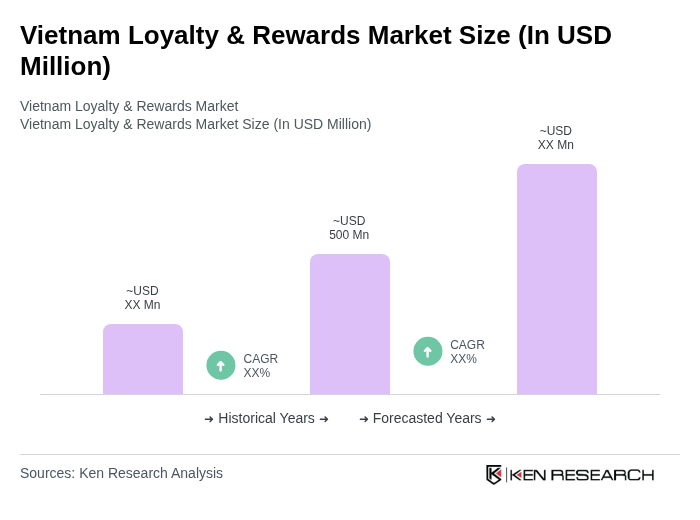
- The Vietnam Loyalty & Rewards Market is valued at approximately USD 500 million, based on a five-year historical analysis. This growth is primarily driven by the increasing adoption of digital payment systems, a rise in consumer spending, and the growing importance of customer retention strategies among businesses. The market has seen a significant shift towards personalized rewards and experiences, catering to the evolving preferences of consumers. The loyalty management market is anticipated to grow over 17% annually, fueled by increasing digitalization and personalized customer engagement strategies.
- Key cities such as Ho Chi Minh City and Hanoi dominate the market due to their high population density, economic activity, and the presence of major retail and service sectors. These urban centers are hubs for e-commerce and digital services, making them ideal locations for loyalty and rewards programs that target tech-savvy consumers seeking value and convenience.
- The Vietnamese government has established regulatory frameworks to promote digital transactions, including guidelines for electronic payment systems and digital commerce operations. This initiative aims to enhance consumer trust and security in digital payments, thereby encouraging businesses to adopt loyalty programs that integrate seamlessly with these platforms, ultimately boosting customer engagement and retention.
Vietnam Loyalty & Rewards Market Segmentation
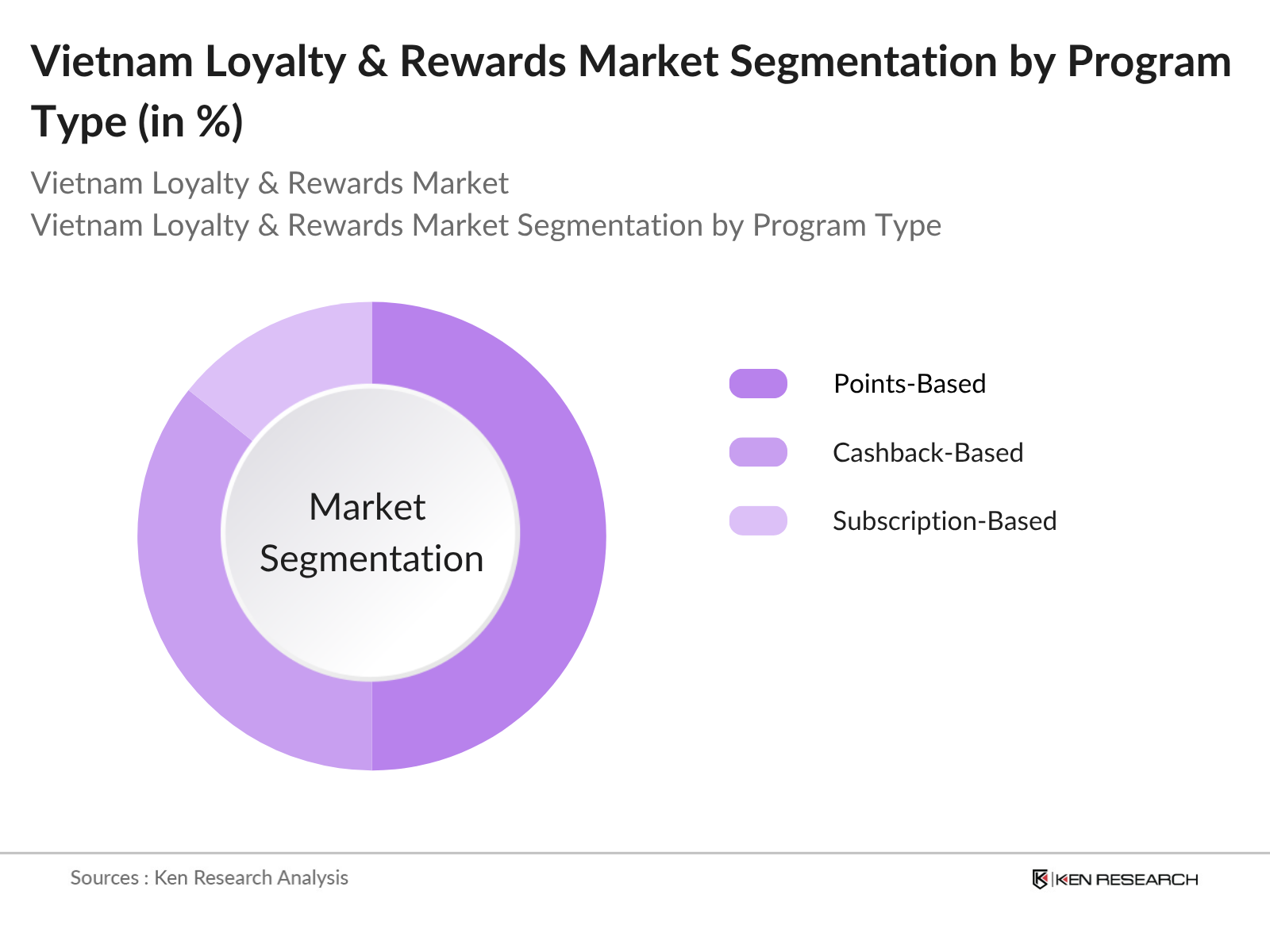
By ProgramType:The loyalty and rewards market is segmented into Points-Based Programs, Subscription-Based Programs, Cashback-Based Programs, and Others. Among these, Points-Based Programs dominate the market due to their widespread adoption and simple earn-and-redeem structure, which appeals to a broad consumer base. Cashback-Based Programs are also gaining strong traction, driven by consumer preference for instant and tangible rewards. Subscription-Based Programs, while smaller in share, are the fastest-growing segment, supported by higher engagement, recurring revenue models, and improved customer retention across digital platforms.
By Industry Type:The loyalty and rewards market is segmented into Retail, E-commerce, Financial Services, Telecom, Travel & Hospitality, and Others. Among these, Retail is the leading segment, driven by widespread adoption of loyalty programs across supermarkets, QSR chains, and consumer brands to enhance customer retention and repeat purchases. E-commerce and Financial Services also contribute significantly, supported by digital wallets, online platforms, and increasing daily user engagement. Telecom and Travel & Hospitality segments play important roles, while Others capture emerging use cases across various industries.
Vietnam Loyalty & Rewards Market Competitive Landscape
The Vietnam Loyalty & Rewards Market is characterized by a dynamic mix of regional and international players. Leading participants such as Techom, MoMo, Viettel, Shopee, and Vinclub contribute to innovation, geographic expansion, and service delivery in this space.
Vietnam Loyalty & Rewards Market Industry Analysis
Growth Drivers
- Young Digital Population Driving Loyalty Adoption:Vietnam’s under-35 population accounts for 54% of the total population, making it one of Southeast Asia’s youngest consumer markets. Over 70% of young consumers prefer researching and shopping online, while younger users show strong engagement with gamified app features such as streaks, points, badges, and missions. This behavior is accelerating mobile-first loyalty adoption across retail, foodservice, travel, and digital commerce platforms.
- Cashless Payments and Mobile Wallets Expanding Reward Usage:Vietnam’s smartphone penetration stands at 89%, while 40% of retail payments are now cashless. Urban consumers are highly active on mobile wallets, with 65% using at least one wallet weekly. Leading wallets such as MoMo, ZaloPay, ShopeePay, and VNPay serve over 70 million active users, embedding rewards through cashback, vouchers, games, and tier-based loyalty systems.
- Modern Retail and Travel Recovery Strengthening Loyalty Programs:Vietnam’s retail market is shifting toward organized formats, with 35% of retail sales expected to come from modern trade by 2030. Supermarkets, convenience stores, pharmacies, and mini-marts are using loyalty to improve repeat visits and basket value. Domestic travel also recorded 125 million trips in 2025, creating a wider loyalty base for airlines, hotels, OTA platforms, and bundled travel rewards.
Market Challenges
- Fragmented Loyalty Landscape Reducing Engagement:Vietnam’s loyalty market is highly fragmented, with the average urban consumer enrolled in 5–7 loyalty programs across banks, wallets, retail, and telecom brands. Top players collectively operate 100+ overlapping schemes, resulting in 20–30% inactive or dormant users per program. This saturation reduces engagement intensity, makes differentiation harder, and forces brands to invest more in personalization and rewards relevance to sustain participation.
- Data Privacy Regulations Limiting Personalization:Stricter consent and data control requirements are restricting how loyalty operators use customer data for personalization and cross-brand targeting. Usable loyalty data has reduced by around 40%, limiting targeted engagement and program effectiveness. Under PDPD Article 24–25, organizations processing personal data must prepare and submit a Data Protection Impact Assessment within 60 days, increasing compliance effort and slowing advanced loyalty initiatives.
Vietnam Loyalty & Rewards Market Future Outlook
The future of the Vietnam loyalty and rewards market appears promising, driven by technological advancements and changing consumer preferences. As businesses increasingly adopt omnichannel strategies, integrating online and offline experiences, customer loyalty is expected to deepen. Additionally, the focus on sustainability will likely shape loyalty programs, with consumers favoring brands that demonstrate social responsibility. Companies that leverage data analytics to personalize offerings will gain a competitive edge, ensuring sustained growth in this dynamic market landscape.
Market Opportunities
- Gamified and Tiered Loyalty Programs Driving Retention:Gamification is turning loyalty into daily behavior loops through tasks, streaks, and challenges, increasing transaction frequency without sharply raising reward costs. Tiered programs such as Silver, Gold, and Platinum further push users to consolidate spending within one ecosystem. This creates opportunities for brands to improve retention, control reward costs, and target offers using granular behavioral data.
- Wallet-Integrated Mobile Loyalty Boosting Everyday Usage:Integrating loyalty programs with e-wallets, QR payments, super apps, and bank apps is converting routine transactions into automatic earn-and-redeem moments. With Vietnam’s e-wallet adoption expected to reach 65.8% by 2025P, mobile-first loyalty programs can scale faster without separate onboarding. This unlocks higher transaction frequency, ecosystem stickiness, and stronger subscription-led monetization.
Scope of the Report
| Segment | Sub-Segments |
|---|---|
| By Program Type | Points-Based Cashback-Based Subscription-Based |
| By Industry Type | Retail Financial E-commerce Travel & Hospitality Telecom Others |
| By Region | South North Central |
| By Program Structure | Single Brand Programs Multi-Brand Programs Hybrid Programs Digital-Only Programs Physical Card Programs Others |
| By Technology Utilization | Mobile Applications Web Platforms In-Store Technology CRM Systems Data Analytics Tools Others |
| By Customer Engagement Strategies | Social Media Engagement Email Marketing SMS Marketing In-App Notifications Personalized Offers Others |
Key Target Audience
Investors and Venture Capitalist Firms
Government and Regulatory Bodies (e.g., Ministry of Industry and Trade, State Bank of Vietnam)
Retail Chains and Supermarket Groups
Telecommunications Companies
Hospitality and Travel Service Providers
Payment Solution Providers
Marketing and Advertising Agencies
Consumer Goods Manufacturers
Players Mentioned in the Report:
Techom Bank
MoMo
Viettel
Shopee
Vinclub
FPT Corporation
VinaPhone
Circle K
Zalo Pay
Vietcombank
Table of Contents
Market Assessment Phase
1. Executive Summary and Approach
2. Vietnam Loyalty & Rewards Market Overview
2.1 Key Insights and Strategic Recommendations
2.2 Vietnam Loyalty & Rewards Market Overview
2.3 Definition and Scope
2.4 Evolution of Market Ecosystem
2.5 Timeline of Key Regulatory Milestones
2.6 Value Chain & Stakeholder Mapping
2.7 Business Cycle Analysis
2.8 Policy & Incentive Landscape
3. Vietnam Loyalty & Rewards Market Analysis
3.1 Growth Drivers
3.1.1 Increasing Consumer Engagement
3.1.2 Rise of Digital Payment Solutions
3.1.3 Expansion of E-commerce Platforms
3.1.4 Growing Demand for Personalized Marketing
3.2 Market Challenges
3.2.1 High Competition Among Providers
3.2.2 Data Privacy Concerns
3.2.3 Limited Consumer Awareness
3.2.4 Fragmented Market Landscape
3.3 Market Opportunities
3.3.1 Integration of AI and Machine Learning
3.3.2 Partnerships with Local Businesses
3.3.3 Expansion into Tier 2 and Tier 3 Cities
3.3.4 Development of Mobile Loyalty Programs
3.4 Market Trends
3.4.1 Shift Towards Omnichannel Loyalty Programs
3.4.2 Increased Focus on Sustainability
3.4.3 Adoption of Blockchain for Transparency
3.4.4 Growth of Social Media Influencer Partnerships
3.5 Government Regulation
3.5.1 Consumer Protection Laws
3.5.2 Data Protection Regulations
3.5.3 E-commerce Guidelines
3.5.4 Tax Incentives for Loyalty Programs
4. SWOT Analysis
5. Stakeholder Analysis
6. Porter's Five Forces Analysis
7. Vietnam Loyalty & Rewards Market Market Size, 2019-2024
7.1 By Value
7.2 By Volume
7.3 By Average Selling Price
8. Vietnam Loyalty & Rewards Market Segmentation
8.1 By Program Type
8.1.1 Points-Based
8.1.2 Cashback-Based
8.1.3 Subscription-Based
8.2 By Industry Type
8.2.1 Retail
8.2.2 Financial
8.2.3 E-commerce
8.2.4 Travel & Hospitality
8.2.5 Telecom
8.2.6 Others
8.3 By Region
8.3.1 South
8.3.2 North
8.3.3 Central
8.4 By Program Structure
8.4.1 Single Brand Programs
8.4.2 Multi-Brand Programs
8.4.3 Hybrid Programs
8.4.4 Digital-Only Programs
8.4.5 Physical Card Programs
8.4.6 Others
8.5 By Technology Utilization
8.5.1 Mobile Applications
8.5.2 Web Platforms
8.5.3 In-Store Technology
8.5.4 CRM Systems
8.5.5 Data Analytics Tools
8.5.6 Others
8.6 By Customer Engagement Strategies
8.6.1 Social Media Engagement
8.6.2 Email Marketing
8.6.3 SMS Marketing
8.6.4 In-App Notifications
8.6.5 Personalized Offers
8.6.6 Others
9. Vietnam Loyalty & Rewards Market Competitive Analysis
9.1 Market Share of Key Players
9.2 Cross Comparison of Key Players
9.2.1 Company Name.
9.2.2 Group Size (Large, Medium, or Small as per industry convention).
9.2.3 Customer Retention Rate
9.2.4 Average Revenue Per User (ARPU)
9.2.5 Customer Acquisition Cost (CAC)
9.2.6 Pricing Strategy
9.2.7 Loyalty Program Participation Rate
9.2.8 Net Promoter Score (NPS)
9.2.9 Return on Investment (ROI)
9.2.10 Market Penetration Rate
9.3 SWOT Analysis of Top Players
9.4 Pricing Analysis
9.5 Detailed Profile of Major Companies
9.5.1 Techom Bank
9.5.2 MoMo
9.5.3 Viettel
9.5.4 Shopee
9.5.5 Vinclub
9.5.6 FPT Corporation
9.5.7 VinaPhone
9.5.8 Circle K
9.5.9 Zalo Pay
9.5.10 Vietcombank
10. Vietnam Loyalty & Rewards Market End-User Analysis
10.1 Procurement Behavior of Key Ministries
10.1.1 Ministry of Industry and Trade
10.1.2 Ministry of Finance
10.1.3 Ministry of Planning and Investment
10.1.4 Ministry of Information and Communications
10.2 Corporate Spend on Infrastructure & Energy
10.2.1 Retail Sector Investments
10.2.2 Hospitality Sector Investments
10.2.3 E-commerce Sector Investments
10.2.4 Technology Sector Investments
10.3 Pain Point Analysis by End-User Category
10.3.1 Retail Pain Points
10.3.2 Hospitality Pain Points
10.3.3 E-commerce Pain Points
10.3.4 Financial Services Pain Points
10.4 User Readiness for Adoption
10.4.1 Awareness Levels
10.4.2 Technology Adoption Rates
10.4.3 Training and Support Needs
10.4.4 Feedback Mechanisms
10.5 Post-Deployment ROI and Use Case Expansion
10.5.1 ROI Measurement Techniques
10.5.2 Use Case Scenarios
10.5.3 Customer Feedback Integration
10.5.4 Long-term Engagement Strategies
11. Vietnam Loyalty & Rewards Market Future Size, 2025-2030
11.1 By Value
11.2 By Volume
11.3 By Average Selling Price
Go-To-Market Strategy Phase
1. Whitespace Analysis + Business Model Canvas
1.1 Market Gaps Identification
1.2 Business Model Framework
2. Marketing and Positioning Recommendations
2.1 Branding Strategies
2.2 Product USPs
3. Distribution Plan
3.1 Urban Retail vs Rural NGO Tie-ups
4. Channel & Pricing Gaps
4.1 Underserved Routes
4.2 Pricing Bands
5. Unmet Demand & Latent Needs
5.1 Category Gaps
5.2 Consumer Segments
6. Customer Relationship
6.1 Loyalty Programs
6.2 After-sales Service
7. Value Proposition
7.1 Sustainability
7.2 Integrated Supply Chains
8. Key Activities
8.1 Regulatory Compliance
8.2 Branding
8.3 Distribution Setup
9. Entry Strategy Evaluation
9.1 Domestic Market Entry Strategy
9.1.1 Product Mix
9.1.2 Pricing Band
9.1.3 Packaging
9.2 Export Entry Strategy
9.2.1 Target Countries
9.2.2 Compliance Roadmap
10. Entry Mode Assessment
10.1 JV
10.2 Greenfield
10.3 M&A
10.4 Distributor Model
11. Capital and Timeline Estimation
11.1 Capital Requirements
11.2 Timelines
12. Control vs Risk Trade-Off
12.1 Ownership vs Partnerships
13. Profitability Outlook
13.1 Breakeven Analysis
13.2 Long-term Sustainability
14. Potential Partner List
14.1 Distributors
14.2 JVs
14.3 Acquisition Targets
15. Execution Roadmap
15.1 Phased Plan for Market Entry
15.1.1 Market Setup
15.1.2 Market Entry
15.1.3 Growth Acceleration
15.1.4 Scale & Stabilize
15.2 Key Activities and Milestones
15.2.1 Milestone Planning
15.2.2 Activity Tracking
Research Methodology
Phase 1: Approach1
Desk Research
- Analysis of industry reports from local market research firms focusing on loyalty and rewards programs
- Review of government publications and economic reports related to consumer spending in Vietnam
- Examination of academic journals and case studies on loyalty programs in Southeast Asia
Primary Research
- Interviews with marketing executives from major retail chains and e-commerce platforms
- Surveys targeting consumers to understand preferences and behaviors regarding loyalty programs
- Focus groups with industry experts and consultants specializing in customer engagement strategies
Validation & Triangulation
- Cross-validation of findings through comparison with international loyalty program benchmarks
- Triangulation of data from consumer surveys, expert interviews, and industry reports
- Sanity checks through feedback from a panel of marketing professionals in the loyalty sector
Phase 2: Market Size Estimation1
Top-down Assessment
- Estimation of total consumer spending in Vietnam to gauge potential loyalty program market size
- Segmentation of the market by industry verticals such as retail, hospitality, and travel
- Incorporation of trends in digital payment adoption and mobile app usage among consumers
Bottom-up Modeling
- Collection of data on loyalty program membership numbers from leading companies
- Analysis of average spend per member in various loyalty programs
- Calculation of total market value based on membership growth rates and average transaction values
Forecasting & Scenario Analysis
- Development of predictive models based on economic indicators and consumer behavior trends
- Scenario analysis considering potential impacts of regulatory changes and market disruptions
- Creation of multiple growth scenarios (baseline, optimistic, and pessimistic) through 2030
Phase 3: CATI Sample Composition1
| Scope Item/Segment | Sample Size | Target Respondent Profiles |
|---|---|---|
| Retail Loyalty Programs | 150 | Marketing Managers, Customer Experience Directors |
| E-commerce Loyalty Initiatives | 120 | eCommerce Managers, Digital Marketing Specialists |
| Hospitality Rewards Programs | 80 | Hotel Managers, Loyalty Program Coordinators |
| Travel Industry Loyalty Schemes | 70 | Travel Agency Owners, Airline Loyalty Managers |
| Consumer Insights on Loyalty | 150 | General Consumers, Frequent Shoppers |
Frequently Asked Questions
What is the current value of the Vietnam Loyalty & Rewards Market?
The Vietnam Loyalty & Rewards Market is valued at approximately USD 500 million, reflecting a significant growth trend driven by digital payment adoption and consumer spending increases.
What factors are driving growth in the Vietnam Loyalty & Rewards Market?
Which cities are the primary markets for loyalty and rewards programs in Vietnam?
How is the Vietnam government supporting the loyalty and rewards market?
Other Regional/Country Reports
Indonesia Loyalty & Rewards Market
Malaysia Loyalty & Rewards Market
KSA Loyalty & Rewards Market
APAC Loyalty & Rewards Market
SEA Loyalty & Rewards Market
Vietnam Loyalty & Rewards Market
Other Adjacent Reports
Germany Mobile Applications Market
New Zealand Customer Relationship Management Market Report Size Share Growth Drivers Trends Opportunities & Forecast 2025–2030Malaysia Retail MarketOman Hospitality MarketSouth East Asia Travel and Tourism MarketGlobal Financial Services Market Outlook to 2030Germany Telecommunications Market
Saudi Arabia data analytics market report Size, Share, Growth Drivers, Trends, Opportunities & Forecast 2025–2030Why Buy From Us?

What makes us stand out is that our consultants follow Robust, Refine and Result (RRR) methodology. Robust for clear definitions, approaches and sanity checking, Refine for differentiating respondents' facts and opinions, and Result for presenting data with story.

We have set a benchmark in the industry by offering our clients with syndicated and customized market research reports featuring coverage of entire market as well as meticulous research and analyst insights.

While we don't replace traditional research, we flip the method upside down. Our dual approach of Top Bottom & Bottom Top ensures quality deliverable by not just verifying company fundamentals but also looking at the sector and macroeconomic factors.

With one step in the future, our research team constantly tries to show you the bigger picture. We help with some of the tough questions you may encounter along the way: How is the industry positioned? Best marketing channel? KPI's of competitors? By aligning every element, we help maximize success.

Our report gives you instant access to the answers and sources that other companies might choose to hide. We elaborate each steps of research methodology we have used and showcase you the sample size to earn your trust.

If you need any support, we are here! We pride ourselves on universe strength, data quality, and quick, friendly, and professional service.