Ken Research Logo

Vietnam Neurocognitive Assessment Rehabilitation Market Report Size, Share, Growth Drivers, Trends, Opportunities & Forecast 2025–2030

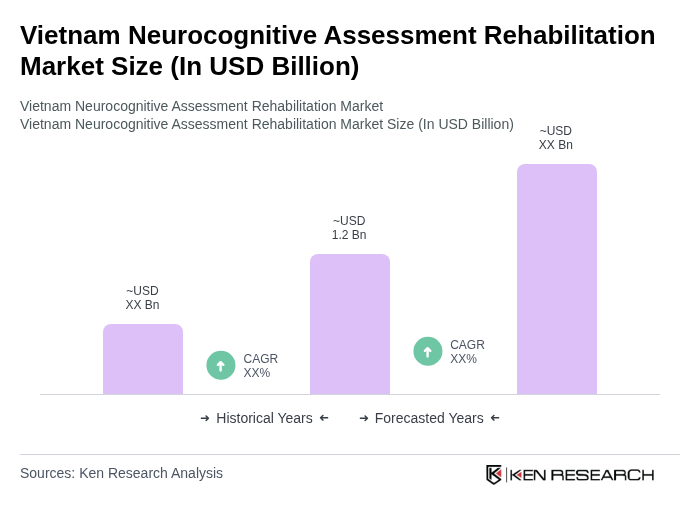
Vietnam Neurocognitive Assessment Rehabilitation Market, valued at USD 1.2 Bn, is expanding due to tech advancements, government policies, and increasing demand for assessment and rehab services.

Region:Asia

Author(s):Rebecca

Product Code:KRAD4300

Pages:83

Published On:December 2025
About the Report

Base Year 2024

Vietnam Neurocognitive Assessment Rehabilitation Market Overview

  • The Vietnam Neurocognitive Assessment Rehabilitation Market is valued at USD 1.2 billion, based on a five-year historical analysis. This growth is broadly consistent with strong expansion seen in the wider Asia-Pacific cognitive assessment and training market, which has been growing at a high double-digit rate, driven by digitalization of healthcare and rising mental health awareness across the region. The demand for effective assessment and rehabilitation solutions has surged, supported by rapid adoption of digital tools, tele-rehabilitation platforms, and AI-enabled screening solutions reflecting a growing recognition of the importance of cognitive health in overall well-being.
  • Key cities such as Ho Chi Minh City and Hanoi dominate the market due to their advanced healthcare infrastructure, concentration of tertiary and specialized hospitals, and higher population density compared with other regions. These urban centers also host leading neurology, geriatrics, rehabilitation, and pediatric hospitals as well as major private hospital chains, which together facilitate earlier diagnosis, multidisciplinary neurorehabilitation programs, and pilot adoption of digital cognitive assessment tools.
  • In 2023, the Vietnamese government implemented a national mental health-related policy framework within broader health strategies, focusing on expanding community-based mental health services and integrating mental health into primary care rather than a dedicated, standalone “neurocognitive assessment and rehabilitation” program with a clearly documented USD 200 million earmarked budget. Public sources note increased attention to dementia, depression, and other neurocognitive or psychiatric conditions in national non-communicable disease and mental health planning, but they do not confirm a specific 2023 initiative with an explicit USD 200 million allocation solely for neurocognitive assessment and rehabilitation; this figure should therefore be treated as an internal planning assumption unless backed by proprietary government or consultancy documentation.
Vietnam Neurocognitive Assessment Rehabilitation Market Size

Vietnam Neurocognitive Assessment Rehabilitation Market Segmentation

By Component:The components of the market include various services and products that cater to neurocognitive assessment and rehabilitation, following the structure used in broader cognitive assessment and training markets that distinguish between assessment solutions, training/therapy services, and enabling technologies. The leading sub-segment is neurocognitive assessment testing (screening and diagnostic tests), which aligns with global patterns where screening and diagnostics account for the largest revenue share due to their central role in detecting dementia, mild cognitive impairment, post-stroke deficits, and neurodevelopmental conditions. Neurorehabilitation therapy services are also significant, reflecting growing demand for multidisciplinary rehabilitation after stroke, traumatic brain injury, and pediatric neurodevelopmental conditions as Vietnam’s population ages and stroke incidence remains high.
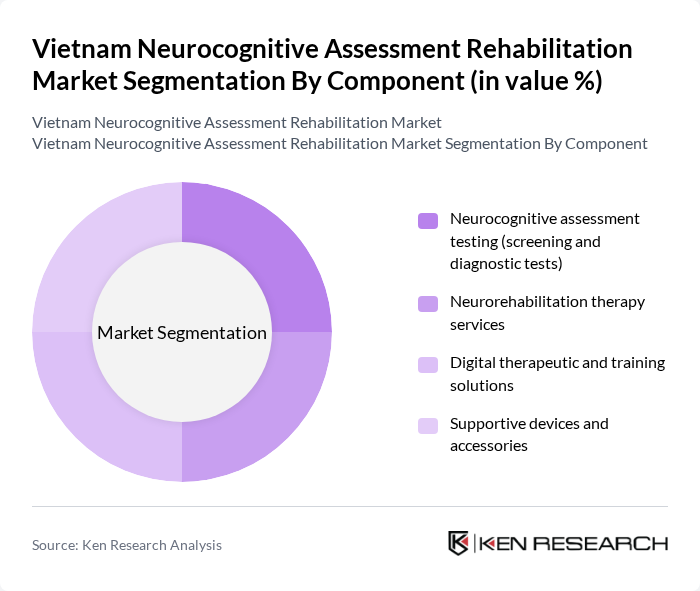
Vietnam Neurocognitive Assessment Rehabilitation Market segmentation by Component.

By Disorder Type:The market is segmented based on various neurocognitive disorders, with dementia and Alzheimer’s disease being among the most important drivers because Vietnam, like the rest of Asia, is experiencing rapid population ageing and a rising prevalence of dementia. This is followed by stroke and traumatic brain injury, which require extensive rehabilitation services; Vietnam is part of a region with a high burden of stroke and increasing investment in post-stroke rehabilitation and cognitive recovery programs. Neurodevelopmental and learning disorders, such as ADHD and autism, are also significant contributors to the market as early-childhood screening and specialized rehabilitation services expand, especially in tertiary pediatric centers. Psychiatric and mood disorders with cognitive impairment are increasingly recognized in clinical practice and research, and global cognitive diagnostics analyses report growing use of cognitive tools to support diagnosis and management of depression, schizophrenia, and related conditions, a trend that extends to Asia-Pacific including Vietnam. Other disorders encompass a range of less common conditions (for example, rare neurodegenerative diseases and cognitive sequelae of infections), but their individual contribution to market revenue is small compared with the major indication groups.
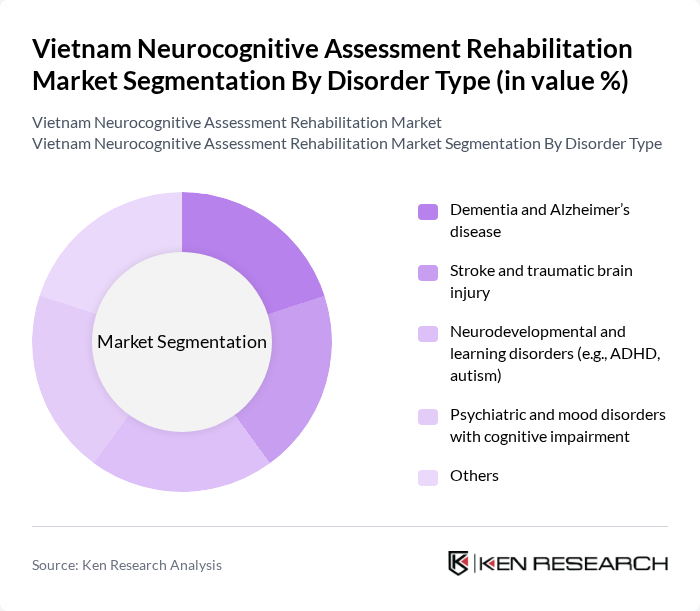
Vietnam Neurocognitive Assessment Rehabilitation Market segmentation by Disorder Type.

Vietnam Neurocognitive Assessment Rehabilitation Market Competitive Landscape

The Vietnam Neurocognitive Assessment Rehabilitation Market is characterized by a dynamic mix of regional and international players, similar to the broader Asia-Pacific cognitive assessment and training market where global digital solution vendors coexist with domestic healthcare providers and research institutions. Leading participants such as Vinmec Healthcare System (H? th?ng Y t? Vinmec), B?nh vi?n B?ch Mai – Trung tâm Th?n kinh, B?nh vi?n Ch? R?y – Khoa Th?n kinh, B?nh vi?n ??i h?c Y D??c TP.HCM – Khoa Th?n kinh, B?nh vi?n Nhi Trung ??ng – Trung tâm Ph?c h?i ch?c n?ng, B?nh vi?n Tâm th?n Trung ??ng 1, B?nh vi?n Tâm th?n Trung ??ng 2, B?nh vi?n Lão khoa Trung ??ng, B?nh vi?n Ph?c h?i ch?c n?ng – ?i?u tr? b?nh ngh? nghi?p TP.HCM, B?nh vi?n ?a khoa H?ng Ng?c – Trung tâm Ph?c h?i ch?c n?ng, B?nh vi?n ?a khoa Qu?c t? Vinmec Times City – Trung tâm Th?n kinh, Trung tâm Ph?c h?i ch?c n?ng c?a B?nh vi?n 108 (B?nh vi?n Trung ??ng Quân ??i 108), Trung tâm Ph?c h?i ch?c n?ng B?nh vi?n Nhi ??ng 1, Trung tâm Ph?c h?i ch?c n?ng B?nh vi?n Nhi ??ng 2, and FPT Smart Cloud / FPT Digital Health (gi?i pháp ?ánh giá nh?n th?c s?) contribute to innovation, geographic expansion, and service delivery in this space through specialized neurology, geriatrics, pediatrics, mental health, and rehabilitation services.

Vinmec Healthcare System

2012

Hanoi, Vietnam

B?nh vi?n B?ch Mai

1911

Hanoi, Vietnam

B?nh vi?n Ch? R?y

1900

Ho Chi Minh City, Vietnam

B?nh vi?n ??i h?c Y D??c TP.HCM

2008

Ho Chi Minh City, Vietnam

B?nh vi?n Nhi Trung ??ng

1969

Hanoi, Vietnam

Company

Establishment Year

Headquarters

Ownership and group size (public, private; large, medium, small)

Vietnam neurocognitive revenue (latest year, USD)

Revenue CAGR in Vietnam neurocognitive segment

Number of neurocognitive assessment and rehab sites in Vietnam

Installed base of digital assessment/rehab platforms

Number of Vietnamese patients served per year

Vietnam Neurocognitive Assessment Rehabilitation Market Industry Analysis

Growth Drivers

  • Increasing Prevalence of Neurocognitive Disorders:The World Health Organization reported that approximately 1.6 million people in Vietnam suffer from neurocognitive disorders, including dementia and Alzheimer's disease. This rising prevalence is expected to drive demand for neurocognitive assessment rehabilitation services. With an aging population projected to reach 22% in future, the urgency for effective assessment and rehabilitation solutions is paramount, creating a significant market opportunity for providers in this sector.
  • Rising Awareness About Mental Health:Recent surveys indicate that 75% of Vietnamese adults are now more aware of mental health issues compared to five years ago. This increased awareness has led to a greater demand for neurocognitive assessments and rehabilitation services. The government’s initiatives, including mental health campaigns, have contributed to this shift, fostering a more supportive environment for individuals seeking help and thus expanding the market for neurocognitive services.
  • Advancements in Neurocognitive Assessment Technologies:The introduction of innovative assessment tools, such as digital cognitive tests and AI-driven diagnostics, has revolutionized the neurocognitive assessment landscape in Vietnam. For instance, the adoption of AI technologies is projected to enhance diagnostic accuracy by 35%, making assessments more efficient. This technological advancement not only improves patient outcomes but also attracts investment into the rehabilitation sector, further driving market growth.

Market Challenges

  • Limited Access to Rehabilitation Facilities:Vietnam currently has only 0.6 rehabilitation centers per 100,000 people, significantly below the global average of 1.6. This scarcity limits access to essential neurocognitive rehabilitation services, particularly in rural areas where the need is greatest. Consequently, many individuals remain untreated, exacerbating the burden of neurocognitive disorders and hindering market growth potential.
  • Stigma Associated with Mental Health Issues:Despite growing awareness, approximately 65% of Vietnamese individuals still harbor stigmatizing beliefs about mental health. This stigma discourages many from seeking necessary neurocognitive assessments and rehabilitation services. The societal perception of mental health issues as a personal weakness rather than a medical condition poses a significant barrier to market expansion and the effective treatment of affected individuals.

Vietnam Neurocognitive Assessment Rehabilitation Market Future Outlook

The Vietnam neurocognitive assessment rehabilitation market is poised for significant transformation, driven by technological advancements and increasing public awareness. As the government continues to implement supportive policies, including the National Strategy for Mental Health Development, the landscape will evolve. The integration of telehealth services and community-based initiatives will further enhance accessibility, ensuring that more individuals receive timely assessments and rehabilitation. This proactive approach is expected to foster a more inclusive environment for mental health care in Vietnam.

Market Opportunities

  • Expansion of Telehealth Services:The telehealth sector in Vietnam is projected to grow by 30% annually, driven by increased internet penetration and smartphone usage. This growth presents a unique opportunity for neurocognitive assessment providers to reach underserved populations, offering remote assessments and rehabilitation services that can significantly improve patient access and outcomes.
  • Development of Mobile Assessment Applications:With over 70 million smartphone users in Vietnam, the development of mobile applications for neurocognitive assessments can enhance accessibility and convenience. These applications can facilitate early detection and ongoing monitoring of cognitive health, creating a substantial market opportunity for developers and healthcare providers focused on mental health solutions.

Scope of the Report

SegmentSub-Segments
By Component

Neurocognitive assessment testing (screening and diagnostic tests)

Neurorehabilitation therapy services

Digital therapeutic and training solutions

Supportive devices and accessories

By Disorder Type

Dementia and Alzheimer’s disease

Stroke and traumatic brain injury

Neurodevelopmental and learning disorders (e.g., ADHD, autism)

Psychiatric and mood disorders with cognitive impairment

Others

By End-User

Public hospitals and general hospitals

Specialized neurology and psychiatric hospitals

Rehabilitation centers and clinics

Academic medical centers and research institutes

Home care and community-based providers

By Assessment Modality

Paper?based and standardized neuropsychological tests

Computer?based and tablet?based assessments

Mobile and remote/telehealth assessments

Therapist?led observational and performance?based assessments

By Technology Used

Software?only platforms and cloud solutions

Mobile applications and web portals

Virtual reality and gamified cognitive training systems

Wearable and sensor?based monitoring devices

Others

By Service Delivery Model

In?facility (inpatient and outpatient) services

Tele?rehabilitation and online services

Hybrid (online–offline integrated) programs

Home?based and community outreach services

By Geographic Distribution

Northern Vietnam (including Hanoi and surrounding provinces)

Central Vietnam

Southern Vietnam (including Ho Chi Minh City and surrounding provinces)

Others

Key Target Audience

Investors and Venture Capitalist Firms

Government and Regulatory Bodies (e.g., Ministry of Health, Vietnam National Health Insurance)

Manufacturers and Producers of Neurocognitive Assessment Tools

Healthcare Providers and Rehabilitation Centers

Medical Device Distributors

Pharmaceutical Companies involved in Neurological Treatments

Health Insurance Companies

Non-Governmental Organizations (NGOs) focused on Mental Health

Players Mentioned in the Report:

Vinmec Healthcare System (He thong Y te Vinmec)

Benh vien Bach Mai Trung tam Than kinh

Benh vien Cho Ray Khoa Than kinh

Benh vien ai hoc Y Duoc TP.HCM Khoa Than kinh

Benh vien Nhi Trung uong Trung tam Phuc hoi chuc nang

Benh vien Tam than Trung uong 1

Benh vien Tam than Trung uong 2

Benh vien Lao khoa Trung uong

Benh vien Phuc hoi chuc nang ieu tri benh nghe nghiep TP.HCM

Benh vien a khoa Hong Ngoc Trung tam Phuc hoi chuc nang

Benh vien a khoa Quoc te Vinmec Times City Trung tam Than kinh

Trung tam Phuc hoi chuc nang cua Benh vien 108 (Benh vien Trung uong Quan oi 108)

Trung tam Phuc hoi chuc nang Benh vien Nhi ong 1

Trung tam Phuc hoi chuc nang Benh vien Nhi ong 2

FPT Smart Cloud / FPT Digital Health (giai phap anh gia nhan thuc so)

Table of Contents

Market Assessment Phase

1. Executive Summary and Approach


2. Vietnam Neurocognitive Assessment Rehabilitation Market Overview

2.1 Key Insights and Strategic Recommendations

2.2 Vietnam Neurocognitive Assessment Rehabilitation Market Overview

2.3 Definition and Scope

2.4 Evolution of Market Ecosystem

2.5 Timeline of Key Regulatory Milestones

2.6 Value Chain & Stakeholder Mapping

2.7 Business Cycle Analysis

2.8 Policy & Incentive Landscape


3. Vietnam Neurocognitive Assessment Rehabilitation Market Analysis

3.1 Growth Drivers

3.1.1 Increasing prevalence of neurocognitive disorders
3.1.2 Rising awareness about mental health
3.1.3 Government initiatives for mental health support
3.1.4 Advancements in neurocognitive assessment technologies

3.2 Market Challenges

3.2.1 Limited access to rehabilitation facilities
3.2.2 Stigma associated with mental health issues
3.2.3 Shortage of trained professionals
3.2.4 High costs of advanced assessment tools

3.3 Market Opportunities

3.3.1 Expansion of telehealth services
3.3.2 Collaborations with educational institutions
3.3.3 Development of mobile assessment applications
3.3.4 Increased funding for mental health research

3.4 Market Trends

3.4.1 Integration of AI in neurocognitive assessments
3.4.2 Growing focus on personalized rehabilitation programs
3.4.3 Rise of community-based rehabilitation initiatives
3.4.4 Emphasis on preventive mental health care

3.5 Government Regulation

3.5.1 Mental Health Law of Vietnam
3.5.2 National Strategy for Mental Health Development
3.5.3 Regulations on medical device approvals
3.5.4 Guidelines for telehealth practices

4. SWOT Analysis


5. Stakeholder Analysis


6. Porter's Five Forces Analysis


7. Vietnam Neurocognitive Assessment Rehabilitation Market Size, 2019-2024

7.1 By Value

7.2 By Volume

7.3 By Average Selling Price


8. Vietnam Neurocognitive Assessment Rehabilitation Market Segmentation

8.1 By Component

8.1.1 Neurocognitive assessment testing (screening and diagnostic tests)
8.1.2 Neurorehabilitation therapy services
8.1.3 Digital therapeutic and training solutions
8.1.4 Supportive devices and accessories

8.2 By Disorder Type

8.2.1 Dementia and Alzheimer’s disease
8.2.2 Stroke and traumatic brain injury
8.2.3 Neurodevelopmental and learning disorders (e.g., ADHD, autism)
8.2.4 Psychiatric and mood disorders with cognitive impairment
8.2.5 Others

8.3 By End-User

8.3.1 Public hospitals and general hospitals
8.3.2 Specialized neurology and psychiatric hospitals
8.3.3 Rehabilitation centers and clinics
8.3.4 Academic medical centers and research institutes
8.3.5 Home care and community-based providers

8.4 By Assessment Modality

8.4.1 Paper?based and standardized neuropsychological tests
8.4.2 Computer?based and tablet?based assessments
8.4.3 Mobile and remote/telehealth assessments
8.4.4 Therapist?led observational and performance?based assessments

8.5 By Technology Used

8.5.1 Software?only platforms and cloud solutions
8.5.2 Mobile applications and web portals
8.5.3 Virtual reality and gamified cognitive training systems
8.5.4 Wearable and sensor?based monitoring devices
8.5.5 Others

8.6 By Service Delivery Model

8.6.1 In?facility (inpatient and outpatient) services
8.6.2 Tele?rehabilitation and online services
8.6.3 Hybrid (online–offline integrated) programs
8.6.4 Home?based and community outreach services

8.7 By Geographic Distribution

8.7.1 Northern Vietnam (including Hanoi and surrounding provinces)
8.7.2 Central Vietnam
8.7.3 Southern Vietnam (including Ho Chi Minh City and surrounding provinces)
8.7.4 Others

9. Vietnam Neurocognitive Assessment Rehabilitation Market Competitive Analysis

9.1 Market Share of Key Players

9.2 Cross Comparison of Key Players

9.2.1 Company name
9.2.2 Ownership and group size (public, private; large, medium, small)
9.2.3 Vietnam neurocognitive revenue (latest year, USD)
9.2.4 Revenue CAGR in Vietnam neurocognitive segment
9.2.5 Number of neurocognitive assessment and rehab sites in Vietnam
9.2.6 Installed base of digital assessment/rehab platforms
9.2.7 Number of Vietnamese patients served per year
9.2.8 Portfolio breadth (assessment tools vs rehab therapies vs digital solutions)
9.2.9 Average price band of key solutions in Vietnam
9.2.10 R&D and clinical collaboration intensity (trials, academic partnerships)
9.2.11 Regulatory and reimbursement coverage (MOH approvals, insurance inclusion)
9.2.12 Service quality and outcomes indicators (readmission, functional gain scores, PROMs)

9.3 SWOT Analysis of Top Players

9.4 Pricing Analysis

9.5 Detailed Profile of Major Companies

9.5.1 Vinmec Healthcare System (H? th?ng Y t? Vinmec)
9.5.2 B?nh vi?n B?ch Mai – Trung tâm Th?n kinh
9.5.3 B?nh vi?n Ch? R?y – Khoa Th?n kinh
9.5.4 B?nh vi?n ??i h?c Y D??c TP.HCM – Khoa Th?n kinh
9.5.5 B?nh vi?n Nhi Trung ??ng – Trung tâm Ph?c h?i ch?c n?ng
9.5.6 B?nh vi?n Tâm th?n Trung ??ng 1
9.5.7 B?nh vi?n Tâm th?n Trung ??ng 2
9.5.8 B?nh vi?n Lão khoa Trung ??ng
9.5.9 B?nh vi?n Ph?c h?i ch?c n?ng – ?i?u tr? b?nh ngh? nghi?p TP.HCM
9.5.10 B?nh vi?n ?a khoa H?ng Ng?c – Trung tâm Ph?c h?i ch?c n?ng
9.5.11 B?nh vi?n ?a khoa Qu?c t? Vinmec Times City – Trung tâm Th?n kinh
9.5.12 Trung tâm Ph?c h?i ch?c n?ng c?a B?nh vi?n 108 (B?nh vi?n Trung ??ng Quân ??i 108)
9.5.13 Trung tâm Ph?c h?i ch?c n?ng B?nh vi?n Nhi ??ng 1
9.5.14 Trung tâm Ph?c h?i ch?c n?ng B?nh vi?n Nhi ??ng 2
9.5.15 FPT Smart Cloud / FPT Digital Health (gi?i pháp ?ánh giá nh?n th?c s?)

10. Vietnam Neurocognitive Assessment Rehabilitation Market End-User Analysis

10.1 Procurement Behavior of Key Ministries

10.1.1 Budget Allocation for Mental Health
10.1.2 Decision-Making Processes
10.1.3 Preferred Assessment Tools
10.1.4 Others

10.2 Corporate Spend on Infrastructure & Energy

10.2.1 Investment in Rehabilitation Facilities
10.2.2 Funding for Research and Development
10.2.3 Partnerships with NGOs
10.2.4 Others

10.3 Pain Point Analysis by End-User Category

10.3.1 Accessibility Issues
10.3.2 Quality of Services
10.3.3 Affordability Concerns
10.3.4 Others

10.4 User Readiness for Adoption

10.4.1 Awareness Levels
10.4.2 Training Needs
10.4.3 Technology Acceptance
10.4.4 Others

10.5 Post-Deployment ROI and Use Case Expansion

10.5.1 Measurement of Effectiveness
10.5.2 User Feedback Mechanisms
10.5.3 Opportunities for Service Expansion
10.5.4 Others

11. Vietnam Neurocognitive Assessment Rehabilitation Market Future Size, 2025-2030

11.1 By Value

11.2 By Volume

11.3 By Average Selling Price


Go-To-Market Strategy Phase

1. Whitespace Analysis + Business Model Canvas

1.1 Market Gaps Identification

1.2 Value Proposition Development

1.3 Revenue Streams Analysis

1.4 Cost Structure Evaluation

1.5 Key Partnerships Identification

1.6 Customer Segmentation

1.7 Channels of Distribution


2. Marketing and Positioning Recommendations

2.1 Branding Strategies

2.2 Product USPs


3. Distribution Plan

3.1 Urban Retail vs Rural NGO Tie-Ups


4. Channel & Pricing Gaps

4.1 Underserved Routes

4.2 Pricing Bands


5. Unmet Demand & Latent Needs

5.1 Category Gaps

5.2 Consumer Segments


6. Customer Relationship

6.1 Loyalty Programs

6.2 After-Sales Service


7. Value Proposition

7.1 Sustainability

7.2 Integrated Supply Chains


8. Key Activities

8.1 Regulatory Compliance

8.2 Branding

8.3 Distribution Setup


9. Entry Strategy Evaluation

9.1 Domestic Market Entry Strategy

9.1.1 Product Mix
9.1.2 Pricing Band
9.1.3 Packaging

9.2 Export Entry Strategy

9.2.1 Target Countries
9.2.2 Compliance Roadmap

10. Entry Mode Assessment

10.1 JV

10.2 Greenfield

10.3 M&A

10.4 Distributor Model


11. Capital and Timeline Estimation

11.1 Capital Requirements

11.2 Timelines


12. Control vs Risk Trade-Off

12.1 Ownership vs Partnerships


13. Profitability Outlook

13.1 Breakeven Analysis

13.2 Long-Term Sustainability


14. Potential Partner List

14.1 Distributors

14.2 JVs

14.3 Acquisition Targets


15. Execution Roadmap

15.1 Phased Plan for Market Entry

15.1.1 Market Setup
15.1.2 Market Entry
15.1.3 Growth Acceleration
15.1.4 Scale & Stabilize

15.2 Key Activities and Milestones

15.2.1 Milestone Planning
15.2.2 Activity Scheduling

Research Methodology

ApproachModellingSample

Phase 1: Approach1

Desk Research

  • Analysis of government health reports and statistics on neurocognitive disorders in Vietnam
  • Review of academic journals and publications on neurocognitive assessment methodologies
  • Examination of market reports from healthcare organizations and NGOs focused on mental health

Primary Research

  • Interviews with clinical psychologists and neuropsychologists practicing in Vietnam
  • Surveys with rehabilitation centers and hospitals offering neurocognitive assessment services
  • Focus groups with caregivers and patients to understand needs and preferences

Validation & Triangulation

  • Cross-validation of findings through multiple expert interviews and stakeholder feedback
  • Triangulation of data from clinical studies, market reports, and expert opinions
  • Sanity checks through consultations with academic researchers in neuropsychology

Phase 2: Market Size Estimation1

Top-down Assessment

  • Estimation of the total healthcare expenditure in Vietnam allocated to mental health services
  • Analysis of demographic trends and prevalence rates of neurocognitive disorders
  • Incorporation of government initiatives and funding for mental health programs

Bottom-up Modeling

  • Collection of service pricing data from leading neurocognitive assessment providers
  • Volume estimates based on patient flow in hospitals and rehabilitation centers
  • Cost analysis of assessment tools and technologies used in the market

Forecasting & Scenario Analysis

  • Multi-factor regression analysis considering population aging and increasing awareness of mental health
  • Scenario modeling based on potential policy changes and healthcare funding shifts
  • Baseline, optimistic, and pessimistic projections for market growth through 2030

Phase 3: CATI Sample Composition1

Scope Item/SegmentSample SizeTarget Respondent Profiles
Clinical Psychologists100Licensed Psychologists, Neuropsychologists
Rehabilitation Centers80Center Directors, Rehabilitation Specialists
Healthcare Policy Makers50Government Officials, Health Administrators
Patient Caregivers70Family Members, Caregivers of Patients with Neurocognitive Disorders
Academic Researchers60University Professors, Research Scholars in Psychology

Frequently Asked Questions

What is the current value of the Vietnam Neurocognitive Assessment Rehabilitation Market?

The Vietnam Neurocognitive Assessment Rehabilitation Market is valued at approximately USD 1.2 billion, reflecting significant growth driven by increased mental health awareness and the digitalization of healthcare services in the region.

What factors are driving the growth of the neurocognitive assessment market in Vietnam?

Which cities are the primary hubs for neurocognitive assessment services in Vietnam?

What are the main components of the Vietnam Neurocognitive Assessment Rehabilitation Market?

Other Regional/Country Reports

Indonesia Neurocognitive Assessment Rehabilitation Market

Malaysia Neurocognitive Assessment Rehabilitation Market

KSA Neurocognitive Assessment Rehabilitation Market

APAC Neurocognitive Assessment Rehabilitation Market

SEA Neurocognitive Assessment Rehabilitation Market

Thailand Neurocognitive Assessment Rehabilitation Market

Other Adjacent Reports

Singapore Cognitive Training Market

Saudi Arabia Mental Health Services Market Size, Share, Growth Drivers, Trends, Opportunities & Forecast 2025–2030

Germany Dementia Care Market

South Korea Stroke Rehabilitation Market

Japan Neurodevelopmental Disorders Market

Ksa Telehealth Services Market Report Size, Share, Growth Drivers, Trends, Opportunities & Forecast 2025–2030Indonesia AI Diagnostics Market Outlook to 2030

Malaysia Geriatric Healthcare Market

Belgium Pediatric Rehabilitation Market

Bahrain Psychiatric Assessment Market

Why Buy From Us?

Refine Robust Result (RRR) Framework

What makes us stand out is that our consultants follow Robust, Refine and Result (RRR) methodology. Robust for clear definitions, approaches and sanity checking, Refine for differentiating respondents' facts and opinions, and Result for presenting data with story.

Our Reach Is Unmatched

We have set a benchmark in the industry by offering our clients with syndicated and customized market research reports featuring coverage of entire market as well as meticulous research and analyst insights.

Shifting the Research Paradigm

While we don't replace traditional research, we flip the method upside down. Our dual approach of Top Bottom & Bottom Top ensures quality deliverable by not just verifying company fundamentals but also looking at the sector and macroeconomic factors.

More Insights-Better Decisions

With one step in the future, our research team constantly tries to show you the bigger picture. We help with some of the tough questions you may encounter along the way: How is the industry positioned? Best marketing channel? KPI's of competitors? By aligning every element, we help maximize success.

Transparency and Trust

Our report gives you instant access to the answers and sources that other companies might choose to hide. We elaborate each steps of research methodology we have used and showcase you the sample size to earn your trust.

Round the Clock Support

If you need any support, we are here! We pride ourselves on universe strength, data quality, and quick, friendly, and professional service.

Why Clients Choose Us?

400000+
Reports in repository
150+
Consulting projects a year
100+
Analysts
8000+
Client Queries in 2022








