Vietnam Self Checkout Systems Market

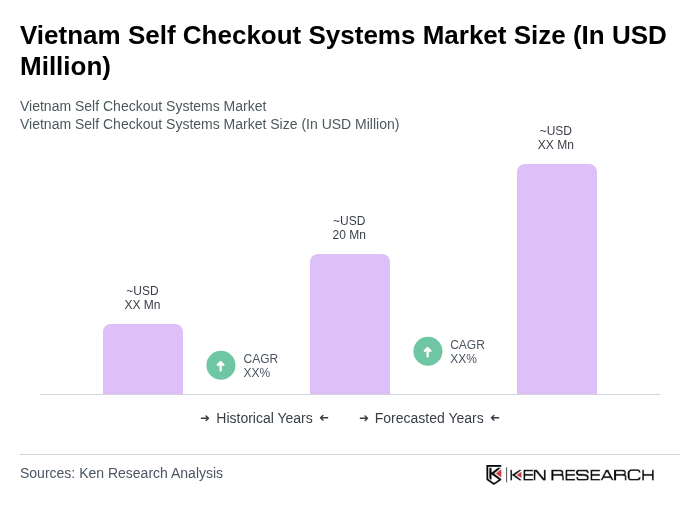
Vietnam Self Checkout Systems Market, valued at USD 20 million, is growing due to automation in retail, consumer demand for faster checkouts, and government digital transformation initiatives.

Region:Asia

Author(s):Geetanshi

Product Code:KRAD7141

Pages:100

Published On:December 2025
About the Report

Base Year 2024

Vietnam Self Checkout Systems Market Overview

  • The Vietnam Self Checkout Systems Market is valued at USD 20 million, based on a five-year historical analysis and benchmarking against the South East Asia Self-Checkout Systems market size reported at USD 81.5 million for the region. This growth is primarily driven by the increasing adoption of automation in retail environments, consumer preference for faster checkout experiences, and the rise of contactless and QR-based payment methods promoted by banks and e-wallet providers in Vietnam. The market has seen a significant uptick in demand as modern grocery chains, convenience stores, and shopping malls deploy self-service technologies to enhance operational efficiency and improve customer satisfaction.
  • Key cities such as Ho Chi Minh City and Hanoi dominate the market due to their high population density, rapid urbanization, and a growing number of retail outlets and shopping centers. These urban centers are witnessing a surge in modern retail formats, including supermarkets, hypermarkets, convenience chains, and specialty stores, which are increasingly incorporating self-checkout systems and interactive kiosks to cater to tech-savvy consumers, support omnichannel retail, and streamline in?store operations.
  • In 2023, the Vietnamese government implemented regulations to promote the use of self-service technologies in retail as part of its broader digital transformation agenda. Under Decision No. 749/QD-TTg on the National Digital Transformation Program to 2025, with orientation toward 2030, issued by the Prime Minister, retail is identified as a priority sector for digitalization, including the application of digital platforms, e-payments, and smart retail technologies such as self-service kiosks and automated checkout. This policy direction is complemented by incentives and guidance under the Law on Investment and related implementing decrees to encourage technology and digital infrastructure investments, including automation and information technology systems in commerce. These measures, together with the rapid expansion of cashless payment infrastructure led by banks and fintechs, support the business case for retailers adopting self-checkout systems to enhance customer service and optimize labor costs.
Vietnam Self Checkout Systems Market Size

Vietnam Self Checkout Systems Market Segmentation

By Type:The market can be segmented into Fixed Self-Checkout Systems, Mobile/Tablet-Based Self-Checkout Systems, Cash-Based Self-Checkout Systems, and Cashless Self-Checkout Systems. Each of these sub-segments caters to different consumer preferences and technological advancements, in line with global market practice where fixed systems remain the primary format and mobile-based self-checkout and app-based “scan and go” are gaining traction.
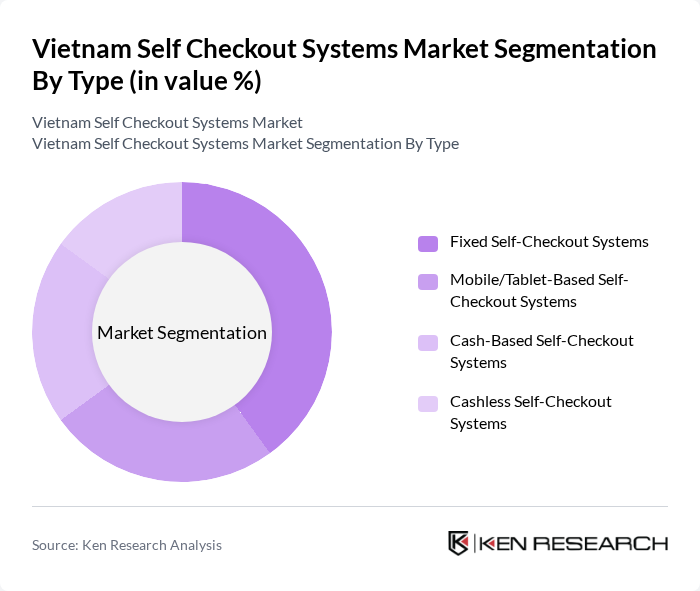
Vietnam Self Checkout Systems Market segmentation by Type.

The Fixed Self-Checkout Systems segment is currently dominating the market due to their widespread implementation in supermarkets and hypermarkets, mirroring global deployment patterns where fixed self-checkout remains the core format in large-format grocery and mass retail. These systems offer a reliable and efficient solution for high-volume transactions, allowing customers to scan and pay for their items independently. The convenience and speed of fixed systems appeal to consumers, particularly in busy retail environments. Additionally, the integration of advanced technologies such as AI and computer vision in these systems enhances their functionality, including loss-prevention and item-recognition capabilities, making them a preferred choice for retailers seeking to reduce shrink and improve throughput.

By Component:The market can also be segmented into Systems (Hardware + Embedded Software), Software & Analytics Platforms, Services (Installation, Maintenance, Managed Services), and Integration & Customization Services. Each component plays a crucial role in the overall functionality and efficiency of self-checkout systems, consistent with global market structures that distinguish between hardware platforms, software solutions, and lifecycle services.
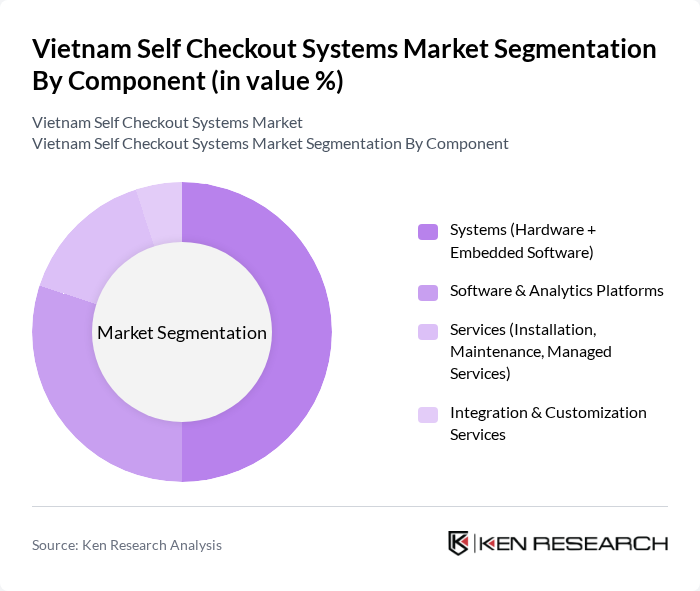
Vietnam Self Checkout Systems Market segmentation by Component.

The Systems (Hardware + Embedded Software) segment leads the market, accounting for a significant share due to the essential role of hardware in the functionality of self-checkout systems, similar to global trends where hardware platforms represent the largest revenue component. Retailers prioritize investing in robust hardware solutions that ensure reliability and efficiency in transaction processing. The demand for integrated software solutions that enhance user experience and provide analytics for inventory, queue, and store performance management further supports the growth of this segment. As retailers increasingly focus on optimizing operations and enabling omnichannel journeys, the hardware component remains a critical investment, typically bundled with device management, remote monitoring, and support services offered by leading vendors.

Vietnam Self Checkout Systems Market Competitive Landscape

The Vietnam Self Checkout Systems Market is characterized by a dynamic mix of regional and international players. Leading participants such as NCR Corporation, Toshiba Global Commerce Solutions, Diebold Nixdorf, Fujitsu, ITAB Group, Pan Oston, StrongPoint ASA, ECR Software Corporation (ECRS), Glory Global Solutions, AURES Technologies, Datalogic, Zebra Technologies, Ingenico (Worldline Group), Verifone, Local & Regional Integrators (e.g., FPT Information System, Viettel Solutions, CMC TSSG) contribute to innovation, geographic expansion, and service delivery in this space, consistent with their roles in the broader Asia-Pacific self-checkout and retail automation markets.

NCR Corporation

1884

Atlanta, Georgia, USA

Toshiba Global Commerce Solutions

2012

Research Triangle Park, North Carolina, USA

Diebold Nixdorf

1859

Hudson, Ohio, USA

Fujitsu

1935

Tokyo, Japan

ITAB Group

1972

Jönköping, Sweden

Company

Establishment Year

Headquarters

Installed Base of Self-Checkout Lanes in Vietnam

Vietnam Self-Checkout Revenue and 3-Year CAGR

Share of Revenue from Vietnam within APAC Portfolio

Number of Active Retail Clients in Vietnam

Average System Selling Price (Hardware + Software)

Share of Recurring Revenue (Service & Software as % of Total)

Vietnam Self Checkout Systems Market Industry Analysis

Growth Drivers

  • Increasing Consumer Preference for Contactless Transactions:The demand for contactless payment options in Vietnam has surged, with a reported 50% increase in contactless transactions in future, according to the State Bank of Vietnam. This shift is driven by consumer concerns over hygiene and convenience, particularly post-pandemic. As more retailers adopt self-checkout systems that support contactless payments, the market is expected to benefit significantly from this growing consumer trend, enhancing overall transaction efficiency and customer satisfaction.
  • Expansion of Retail and Grocery Sectors:Vietnam's retail sector is projected to grow by 9% annually, reaching approximately $220 billion in future, as reported by the Vietnam Retailers Association. This expansion is fueled by urbanization and rising disposable incomes, leading to increased foot traffic in grocery stores and supermarkets. The integration of self-checkout systems in these expanding retail environments is becoming essential for managing customer flow and reducing wait times, thereby driving market growth.
  • Technological Advancements in Payment Systems:The Vietnamese payment landscape is rapidly evolving, with mobile payment transactions expected to exceed $25 billion in future, according to the Ministry of Industry and Trade. Innovations such as QR code payments and digital wallets are gaining traction, facilitating seamless transactions at self-checkout kiosks. This technological progress not only enhances user experience but also encourages retailers to invest in automated checkout solutions, further propelling market growth.

Market Challenges

  • High Initial Investment Costs:The implementation of self-checkout systems requires significant upfront investment, often exceeding $60,000 per unit, including hardware and software costs. Many small to medium-sized retailers in Vietnam face financial constraints, making it challenging to adopt these systems. This high barrier to entry can slow down the overall market growth, as businesses weigh the costs against potential benefits and return on investment.
  • Resistance to Change from Traditional Checkout Methods:A considerable portion of the Vietnamese population remains accustomed to traditional checkout processes, with 65% of consumers preferring human interaction during transactions, as per a recent survey by the Vietnam Chamber of Commerce. This resistance can hinder the adoption of self-checkout systems, as retailers may be reluctant to invest in technology that customers are not yet ready to embrace, impacting market penetration.

Vietnam Self Checkout Systems Market Future Outlook

The future of the self-checkout systems market in Vietnam appears promising, driven by ongoing technological advancements and changing consumer behaviors. As e-commerce continues to grow, retailers are likely to enhance their in-store experiences by integrating self-checkout solutions. Additionally, the increasing focus on customer experience and operational efficiency will encourage more businesses to adopt these systems, paving the way for a more automated retail environment that meets evolving consumer expectations.

Market Opportunities

  • Growth in E-commerce and Online Shopping:The e-commerce sector in Vietnam is expected to reach $40 billion in future, according to the Vietnam E-commerce Association. This growth presents an opportunity for self-checkout systems to integrate with online platforms, allowing for seamless omnichannel experiences that cater to tech-savvy consumers, enhancing convenience and driving sales.
  • Integration with Loyalty Programs and Promotions:Retailers are increasingly focusing on customer retention strategies, with 50% planning to enhance loyalty programs in future. Self-checkout systems that integrate with these programs can provide personalized promotions and rewards, encouraging repeat purchases and fostering customer loyalty, thus creating a significant market opportunity.

Scope of the Report

SegmentSub-Segments
By Type

Fixed Self-Checkout Systems

Mobile/Tablet-Based Self-Checkout Systems

Cash-Based Self-Checkout Systems

Cashless Self-Checkout Systems

By Component

Systems (Hardware + Embedded Software)

Software & Analytics Platforms

Services (Installation, Maintenance, Managed Services)

Integration & Customization Services

By End-User Application

Supermarkets & Hypermarkets

Convenience Stores & Mini-marts

Specialty & Department Stores

Quick-Service Restaurants & Cafés

Pharmacies & Drugstores

Others (Cinemas, DIY Stores, etc.)

By Retailer Size

Large-Format Retail Chains

Medium-Size Retailers

Small & Independent Retailers

Modern Trade vs. Traditional Trade

By Sales Channel

Direct Sales (OEM to Retailer)

Distributor / System Integrator Channel

IT & Payment Solution Providers

OEM Partnerships and Alliances

By Technology Integration

AI- and Computer-Vision-Assisted Systems

RFID-Enabled Self-Checkout

Cloud-Managed & SaaS-Based Systems

IoT-Connected & Remote-Monitoring Systems

By Payment Method

Card Payments (Credit/Debit)

E-Wallets & QR Code Payments

Cash & Hybrid Cash/Cashless

Alternative Digital Payments (Contactless, NFC, etc.)

Key Target Audience

Investors and Venture Capitalist Firms

Government and Regulatory Bodies (e.g., Ministry of Industry and Trade, Ministry of Finance)

Manufacturers and Producers of Self Checkout Systems

Distributors and Retailers in the Retail Sector

Technology Providers and Software Developers

Industry Associations (e.g., Vietnam Retailers Association)

Financial Institutions and Banks

Logistics and Supply Chain Companies

Players Mentioned in the Report:

NCR Corporation

Toshiba Global Commerce Solutions

Diebold Nixdorf

Fujitsu

ITAB Group

Pan Oston

StrongPoint ASA

ECR Software Corporation (ECRS)

Glory Global Solutions

AURES Technologies

Datalogic

Zebra Technologies

Ingenico (Worldline Group)

Verifone

Local & Regional Integrators (e.g., FPT Information System, Viettel Solutions, CMC TSSG)

Table of Contents

Market Assessment Phase

1. Executive Summary and Approach


2. Vietnam Self Checkout Systems Market Overview

2.1 Key Insights and Strategic Recommendations

2.2 Vietnam Self Checkout Systems Market Overview

2.3 Definition and Scope

2.4 Evolution of Market Ecosystem

2.5 Timeline of Key Regulatory Milestones

2.6 Value Chain & Stakeholder Mapping

2.7 Business Cycle Analysis

2.8 Policy & Incentive Landscape


3. Vietnam Self Checkout Systems Market Analysis

3.1 Growth Drivers

3.1.1 Increasing consumer preference for contactless transactions
3.1.2 Expansion of retail and grocery sectors
3.1.3 Technological advancements in payment systems
3.1.4 Government initiatives promoting automation

3.2 Market Challenges

3.2.1 High initial investment costs
3.2.2 Resistance to change from traditional checkout methods
3.2.3 Limited consumer awareness and education
3.2.4 Maintenance and technical support issues

3.3 Market Opportunities

3.3.1 Growth in e-commerce and online shopping
3.3.2 Integration with loyalty programs and promotions
3.3.3 Expansion into underserved rural markets
3.3.4 Partnerships with technology providers for innovation

3.4 Market Trends

3.4.1 Rise of mobile payment solutions
3.4.2 Increasing focus on customer experience
3.4.3 Adoption of AI and machine learning in retail
3.4.4 Sustainability initiatives in retail operations

3.5 Government Regulation

3.5.1 Regulations on data privacy and security
3.5.2 Standards for electronic payment systems
3.5.3 Incentives for technology adoption in retail
3.5.4 Compliance requirements for automated systems

4. SWOT Analysis


5. Stakeholder Analysis


6. Porter's Five Forces Analysis


7. Vietnam Self Checkout Systems Market Market Size, 2019-2024

7.1 By Value

7.2 By Volume

7.3 By Average Selling Price


8. Vietnam Self Checkout Systems Market Segmentation

8.1 By Type

8.1.1 Fixed Self-Checkout Systems
8.1.2 Mobile/Tablet-Based Self-Checkout Systems
8.1.3 Cash-Based Self-Checkout Systems
8.1.4 Cashless Self-Checkout Systems

8.2 By Component

8.2.1 Systems (Hardware + Embedded Software)
8.2.2 Software & Analytics Platforms
8.2.3 Services (Installation, Maintenance, Managed Services)
8.2.4 Integration & Customization Services

8.3 By End-User Application

8.3.1 Supermarkets & Hypermarkets
8.3.2 Convenience Stores & Mini-marts
8.3.3 Specialty & Department Stores
8.3.4 Quick-Service Restaurants & Cafés
8.3.5 Pharmacies & Drugstores
8.3.6 Others (Cinemas, DIY Stores, etc.)

8.4 By Retailer Size

8.4.1 Large-Format Retail Chains
8.4.2 Medium-Size Retailers
8.4.3 Small & Independent Retailers
8.4.4 Modern Trade vs. Traditional Trade

8.5 By Sales Channel

8.5.1 Direct Sales (OEM to Retailer)
8.5.2 Distributor / System Integrator Channel
8.5.3 IT & Payment Solution Providers
8.5.4 OEM Partnerships and Alliances

8.6 By Technology Integration

8.6.1 AI- and Computer-Vision-Assisted Systems
8.6.2 RFID-Enabled Self-Checkout
8.6.3 Cloud-Managed & SaaS-Based Systems
8.6.4 IoT-Connected & Remote-Monitoring Systems

8.7 By Payment Method

8.7.1 Card Payments (Credit/Debit)
8.7.2 E-Wallets & QR Code Payments
8.7.3 Cash & Hybrid Cash/Cashless
8.7.4 Alternative Digital Payments (Contactless, NFC, etc.)

9. Vietnam Self Checkout Systems Market Competitive Analysis

9.1 Market Share of Key Players

9.2 Cross Comparison of Key Players

9.2.1 Company Name
9.2.2 Installed Base of Self-Checkout Lanes in Vietnam
9.2.3 Vietnam Self-Checkout Revenue and 3-Year CAGR
9.2.4 Share of Revenue from Vietnam within APAC Portfolio
9.2.5 Number of Active Retail Clients in Vietnam
9.2.6 Average System Selling Price (Hardware + Software)
9.2.7 Share of Recurring Revenue (Service & Software as % of Total)
9.2.8 Deployment Mix (Cash vs. Cashless vs. Mobile)
9.2.9 Uptime / SLA Compliance in Deployed Stores
9.2.10 Technology Differentiators (AI/Computer Vision/Cloud Capabilities)
9.2.11 Local Partnership Depth (System Integrators, Payment Providers)
9.2.12 Geographic Footprint within Vietnam (North/Central/South)

9.3 SWOT Analysis of Top Players

9.4 Pricing Analysis

9.5 Detailed Profile of Major Companies

9.5.1 NCR Corporation
9.5.2 Toshiba Global Commerce Solutions
9.5.3 Diebold Nixdorf
9.5.4 Fujitsu
9.5.5 ITAB Group
9.5.6 Pan Oston
9.5.7 StrongPoint ASA
9.5.8 ECR Software Corporation (ECRS)
9.5.9 Glory Global Solutions
9.5.10 AURES Technologies
9.5.11 Datalogic
9.5.12 Zebra Technologies
9.5.13 Ingenico (Worldline Group)
9.5.14 Verifone
9.5.15 Local & Regional Integrators (e.g., FPT Information System, Viettel Solutions, CMC TSSG)

10. Vietnam Self Checkout Systems Market End-User Analysis

10.1 Procurement Behavior of Key Ministries

10.1.1 Budget Allocation Trends
10.1.2 Decision-Making Processes
10.1.3 Vendor Selection Criteria
10.1.4 Contract Management Practices

10.2 Corporate Spend on Infrastructure & Energy

10.2.1 Investment Priorities
10.2.2 Spending Patterns
10.2.3 Budget Constraints
10.2.4 Future Spending Projections

10.3 Pain Point Analysis by End-User Category

10.3.1 Operational Inefficiencies
10.3.2 Customer Experience Challenges
10.3.3 Technology Integration Issues
10.3.4 Cost Management Concerns

10.4 User Readiness for Adoption

10.4.1 Training and Support Needs
10.4.2 Technology Familiarity
10.4.3 Attitudes Towards Automation
10.4.4 Feedback Mechanisms

10.5 Post-Deployment ROI and Use Case Expansion

10.5.1 Performance Metrics
10.5.2 Use Case Diversification
10.5.3 Long-term Value Realization
10.5.4 Customer Feedback Integration

11. Vietnam Self Checkout Systems Market Future Size, 2025-2030

11.1 By Value

11.2 By Volume

11.3 By Average Selling Price


Go-To-Market Strategy Phase

1. Whitespace Analysis + Business Model Canvas

1.1 Market Gaps Identification

1.2 Value Proposition Development

1.3 Revenue Streams Analysis

1.4 Cost Structure Evaluation

1.5 Key Partnerships Exploration

1.6 Customer Segmentation Insights

1.7 Channels and Customer Relationships


2. Marketing and Positioning Recommendations

2.1 Branding Strategies

2.2 Product USPs

2.3 Target Market Positioning

2.4 Communication Strategies

2.5 Digital Marketing Approaches

2.6 Customer Engagement Tactics

2.7 Performance Measurement Metrics


3. Distribution Plan

3.1 Urban Retail Strategies

3.2 Rural NGO Tie-ups

3.3 E-commerce Integration

3.4 Logistics and Supply Chain Management

3.5 Distribution Channel Optimization

3.6 Partnership Development

3.7 Performance Tracking


4. Channel & Pricing Gaps

4.1 Underserved Routes Analysis

4.2 Pricing Bands Evaluation

4.3 Competitor Pricing Strategies

4.4 Customer Willingness to Pay

4.5 Price Sensitivity Analysis

4.6 Value-Based Pricing Models

4.7 Pricing Strategy Recommendations


5. Unmet Demand & Latent Needs

5.1 Category Gaps Identification

5.2 Consumer Segments Analysis

5.3 Emerging Trends Exploration

5.4 Customer Feedback Utilization

5.5 Market Demand Forecasting

5.6 Product Development Opportunities

5.7 Strategic Recommendations


6. Customer Relationship

6.1 Loyalty Programs Development

6.2 After-sales Service Strategies

6.3 Customer Feedback Mechanisms

6.4 Relationship Management Tools

6.5 Engagement Strategies

6.6 Performance Metrics

6.7 Continuous Improvement Plans


7. Value Proposition

7.1 Sustainability Initiatives

7.2 Integrated Supply Chains

7.3 Customer-Centric Approaches

7.4 Competitive Differentiation

7.5 Value Communication Strategies

7.6 Performance Measurement

7.7 Long-term Value Creation


8. Key Activities

8.1 Regulatory Compliance

8.2 Branding Initiatives

8.3 Distribution Setup

8.4 Technology Integration

8.5 Training and Development

8.6 Performance Tracking

8.7 Continuous Improvement


9. Entry Strategy Evaluation

9.1 Domestic Market Entry Strategy

9.1.1 Product Mix Considerations
9.1.2 Pricing Band Analysis
9.1.3 Packaging Strategies

9.2 Export Entry Strategy

9.2.1 Target Countries Identification
9.2.2 Compliance Roadmap Development

10. Entry Mode Assessment

10.1 Joint Ventures

10.2 Greenfield Investments

10.3 Mergers & Acquisitions

10.4 Distributor Model Evaluation


11. Capital and Timeline Estimation

11.1 Capital Requirements Analysis

11.2 Timelines for Implementation


12. Control vs Risk Trade-Off

12.1 Ownership vs Partnerships


13. Profitability Outlook

13.1 Breakeven Analysis

13.2 Long-term Sustainability Strategies


14. Potential Partner List

14.1 Distributors Identification

14.2 Joint Ventures Opportunities

14.3 Acquisition Targets


15. Execution Roadmap

15.1 Phased Plan for Market Entry

15.1.1 Market Setup
15.1.2 Market Entry
15.1.3 Growth Acceleration
15.1.4 Scale & Stabilize

15.2 Key Activities and Milestones

15.2.1 Milestone Tracking
15.2.2 Activity Scheduling

Research Methodology

ApproachModellingSample

Phase 1: Approach1

Desk Research

  • Analysis of industry reports from Vietnamese retail associations and market research firms
  • Review of government publications on retail technology adoption and consumer behavior trends
  • Examination of academic journals and case studies focusing on self-checkout systems in Vietnam

Primary Research

  • Interviews with retail managers and IT heads at major supermarket chains
  • Surveys conducted with consumers to gauge acceptance and usage of self-checkout systems
  • Focus group discussions with technology providers and system integrators in the retail sector

Validation & Triangulation

  • Cross-validation of findings through multiple data sources including sales data and consumer feedback
  • Triangulation of insights from primary interviews with secondary data trends
  • Sanity checks through expert reviews from industry analysts and technology consultants

Phase 2: Market Size Estimation1

Top-down Assessment

  • Estimation of market size based on overall retail sales growth in Vietnam
  • Segmentation of the market by retail formats (hypermarkets, supermarkets, convenience stores)
  • Incorporation of trends in consumer preferences towards self-service technologies

Bottom-up Modeling

  • Collection of data on the number of self-checkout units deployed across various retail formats
  • Operational cost analysis based on installation and maintenance expenses of self-checkout systems
  • Revenue projections based on transaction volumes and average basket sizes at self-checkout stations

Forecasting & Scenario Analysis

  • Multi-variable forecasting using factors such as urbanization rates and technological advancements
  • Scenario analysis based on potential regulatory changes and economic conditions affecting retail
  • Development of baseline, optimistic, and pessimistic market growth scenarios through 2030

Phase 3: CATI Sample Composition1

Scope Item/SegmentSample SizeTarget Respondent Profiles
Supermarket Self-Checkout Adoption100Store Managers, IT Directors
Consumer Acceptance of Self-Checkout120Frequent Shoppers, Retail Customers
Technology Providers in Retail80Product Managers, Sales Executives
Impact of Self-Checkout on Sales70Financial Analysts, Retail Strategists
Operational Efficiency of Self-Checkout Systems60Operations Managers, Process Improvement Specialists

Frequently Asked Questions

What is the current value of the Vietnam Self Checkout Systems Market?

The Vietnam Self Checkout Systems Market is valued at approximately USD 20 million, reflecting a growing trend towards automation in retail environments and consumer preferences for faster checkout experiences.

What factors are driving the growth of self-checkout systems in Vietnam?

Which cities in Vietnam are leading in the adoption of self-checkout systems?

What types of self-checkout systems are available in Vietnam?

Other Regional/Country Reports

Saudi Arabia self checkout systems market size, share, growth drivers, trends, opportunities & forecast 2025–2030

Indonesia Self Checkout Systems Market

Malaysia Self Checkout Systems Market

APAC Self Checkout Systems Market

SEA Self Checkout Systems Market

Thailand Self Checkout Systems Market

Other Adjacent Reports

Bahrain Retail Automation Market

Brazil Point of Sale Systems Market

Bahrain Contactless Payment Market

KSA interactive kiosk market Size, Share, Growth Drivers, Trends, Opportunities & Forecast 2025–2030

KSA Retail Analytics Market

KSA Digital Wallet Market

Oman Omnichannel Retail Market

Indonesia Loss Prevention Technology Market

Singapore E-Payment Gateway Market

Malaysia Store Management Software Market

Why Buy From Us?

Refine Robust Result (RRR) Framework

What makes us stand out is that our consultants follow Robust, Refine and Result (RRR) methodology. Robust for clear definitions, approaches and sanity checking, Refine for differentiating respondents' facts and opinions, and Result for presenting data with story.

Our Reach Is Unmatched

We have set a benchmark in the industry by offering our clients with syndicated and customized market research reports featuring coverage of entire market as well as meticulous research and analyst insights.

Shifting the Research Paradigm

While we don't replace traditional research, we flip the method upside down. Our dual approach of Top Bottom & Bottom Top ensures quality deliverable by not just verifying company fundamentals but also looking at the sector and macroeconomic factors.

More Insights-Better Decisions

With one step in the future, our research team constantly tries to show you the bigger picture. We help with some of the tough questions you may encounter along the way: How is the industry positioned? Best marketing channel? KPI's of competitors? By aligning every element, we help maximize success.

Transparency and Trust

Our report gives you instant access to the answers and sources that other companies might choose to hide. We elaborate each steps of research methodology we have used and showcase you the sample size to earn your trust.

Round the Clock Support

If you need any support, we are here! We pride ourselves on universe strength, data quality, and quick, friendly, and professional service.

Why Clients Choose Us?

400000+
Reports in repository
150+
Consulting projects a year
100+
Analysts
8000+
Client Queries in 2022








