Region:Asia
Author(s):Dev
Product Code:KRAC8686
Pages:97
Published On:November 2025
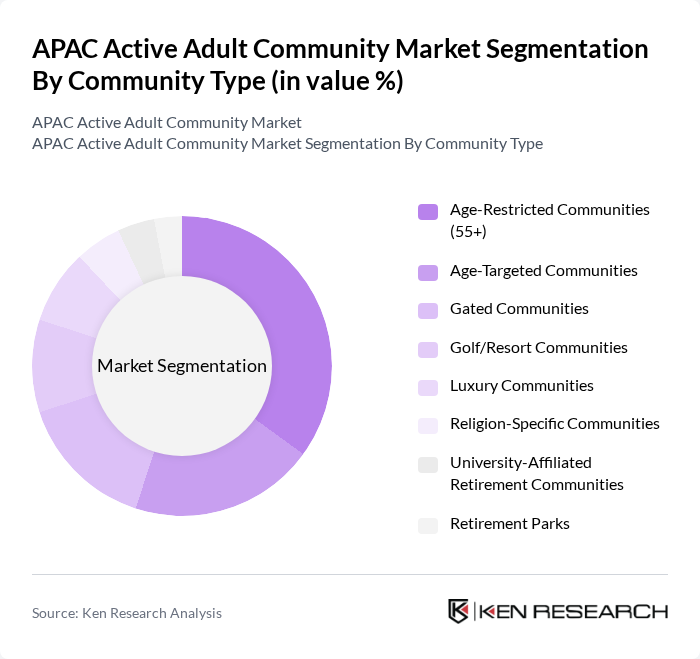
By Community Type:The community type segmentation includes various forms of living arrangements tailored to the needs of active adults. The subsegments include Age-Restricted Communities (55+), Age-Targeted Communities, Gated Communities, Golf/Resort Communities, Luxury Communities, Religion-Specific Communities, University-Affiliated Retirement Communities, and Retirement Parks. Among these, Age-Restricted Communities (55+) are particularly dominant due to their tailored amenities and social activities that cater specifically to older adults, fostering a sense of belonging and community. The trend toward integrated campus models and technology-enabled wellness solutions is also gaining traction, especially in urban centers .
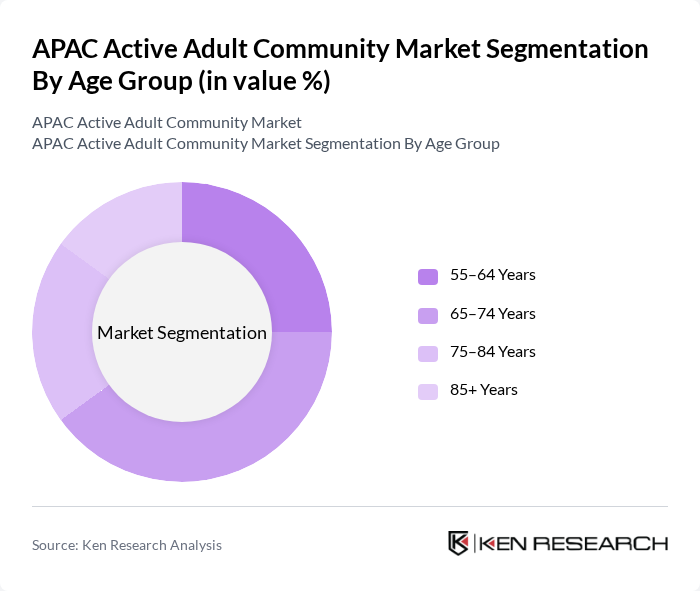
By Age Group:The age group segmentation categorizes active adults into four distinct groups: 55–64 Years, 65–74 Years, 75–84 Years, and 85+ Years. The 65–74 Years age group is currently the most significant segment, as individuals in this range are often looking for community living options that provide both independence and social interaction. This demographic is increasingly seeking environments that offer recreational activities and healthcare services tailored to their needs. The 55–64 segment is also growing, driven by early retirement and downsizing trends .
The APAC Active Adult Community Market is characterized by a dynamic mix of regional and international players. Leading participants such as ORPEA Group (Japan, China, Southeast Asia), China Vanke Co., Ltd. (China), Singapore Press Holdings (SPH) – Orange Valley (Singapore), Ryman Healthcare (Australia, New Zealand), Aveo Group (Australia), Lendlease Retirement Living (Australia, China, Singapore), Senior Living Japan Co., Ltd. (Japan), Greentown China Holdings Limited (China), Beijing Yanda Golden Age Health Nursing Center (China), Sun City Group (Japan), ECH Inc. (Australia), Korian (Asia-Pacific Operations), Pacific Healthcare Holdings Ltd. (Singapore, Malaysia), Legend Senior Living (China), Tata Housing – Riva Residences (India) contribute to innovation, geographic expansion, and service delivery in this space.
The future of the APAC active adult community market appears promising, driven by demographic shifts and evolving consumer preferences. As the aging population continues to grow, there will be an increasing focus on creating environments that foster community engagement and wellness. Additionally, technological advancements will play a crucial role in enhancing living experiences, with smart home features becoming standard. Developers will need to adapt to these trends to remain competitive and meet the diverse needs of residents in this dynamic market.
| Segment | Sub-Segments |
|---|---|
| By Community Type | Age-Restricted Communities (55+) Age-Targeted Communities Gated Communities Golf/Resort Communities Luxury Communities Religion-Specific Communities University-Affiliated Retirement Communities Retirement Parks |
| By Age Group | –64 Years –74 Years –84 Years + Years |
| By Gender | Male Female |
| By Amenities | Recreational Services (Golf, Pools, etc.) Wellness Centers (Fitness, Spa) Social/Educational Services (Clubhouses, Activities) Medical Facilities Transportation Services |
| By Location | Urban Areas Suburban Areas Rural Areas |
| By Tenure Format | Owned Units Rental Units Mixed Tenure |
| By Region | East Asia (Japan, China, South Korea) Southeast Asia (Singapore, Malaysia, Thailand, Indonesia) South Asia (India, Sri Lanka) Oceania (Australia, New Zealand) Others |
| Scope Item/Segment | Sample Size | Target Respondent Profiles |
|---|---|---|
| Active Adult Community Developers | 60 | Project Managers, Business Development Executives |
| Residents of Active Adult Communities | 100 | Current Residents, Community Leaders |
| Healthcare Service Providers | 50 | Healthcare Administrators, Geriatric Care Managers |
| Real Estate Agents Specializing in Senior Housing | 40 | Real Estate Brokers, Market Analysts |
| Urban Planners and Policy Makers | 40 | City Planners, Policy Advisors |
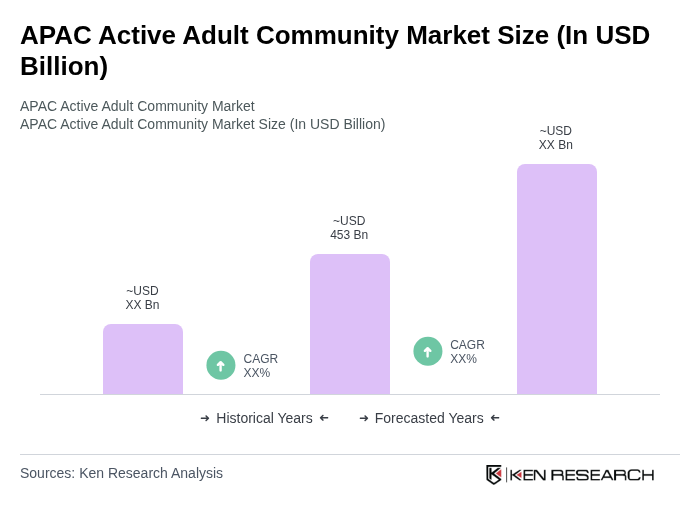
The APAC Active Adult Community Market is valued at approximately USD 453 billion, driven by factors such as an increasing aging population, rising disposable incomes, and a growing preference for community living among older adults.

What makes us stand out is that our consultants follow Robust, Refine and Result (RRR) methodology. Robust for clear definitions, approaches and sanity checking, Refine for differentiating respondents' facts and opinions, and Result for presenting data with story.

We have set a benchmark in the industry by offering our clients with syndicated and customized market research reports featuring coverage of entire market as well as meticulous research and analyst insights.

While we don't replace traditional research, we flip the method upside down. Our dual approach of Top Bottom & Bottom Top ensures quality deliverable by not just verifying company fundamentals but also looking at the sector and macroeconomic factors.

With one step in the future, our research team constantly tries to show you the bigger picture. We help with some of the tough questions you may encounter along the way: How is the industry positioned? Best marketing channel? KPI's of competitors? By aligning every element, we help maximize success.

Our report gives you instant access to the answers and sources that other companies might choose to hide. We elaborate each steps of research methodology we have used and showcase you the sample size to earn your trust.

If you need any support, we are here! We pride ourselves on universe strength, data quality, and quick, friendly, and professional service.













