About the Report
Base Year 2024APAC Automotive eCall Market Overview
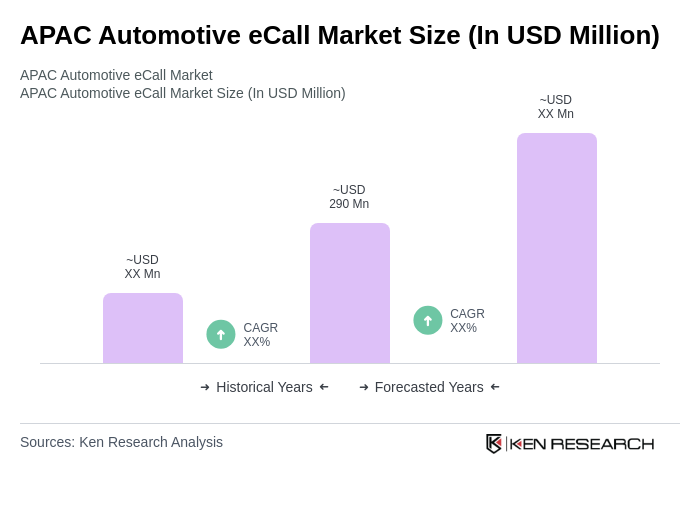
- The APAC Automotive eCall market is valued at USD 290 million, based on a five-year historical analysis. This growth is primarily driven by increasing vehicle safety regulations, advancements in telematics technology, and rising consumer demand for connected vehicle services. The integration of eCall systems in vehicles enhances emergency response capabilities, thereby improving road safety and reducing fatalities in accidents. The rapid expansion of the automotive industry in developing nations like China and India, coupled with rising disposable incomes, increased urbanization, and higher living standards, has spurred significant growth in this market.
- Key players in this market include China, Japan, and South Korea, which dominate due to their robust automotive manufacturing sectors and high adoption rates of advanced technologies. These countries have established strong infrastructure for emergency services and are investing heavily in smart transportation systems, making them leaders in the eCall market. The number of passenger cars in these rising nations that have integrated telematics systems has increased dramatically in recent years, with intense safety improvements and evolving consumer preferences driving the development and application of advanced automotive technologies.
- The Motor Vehicles Act, 1988 (Amendment), issued by the Ministry of Road Transport and Highways, Government of India, mandates advanced safety features in vehicles to enhance road safety and emergency response capabilities. This regulatory framework requires automobile manufacturers to incorporate safety technologies that automatically alert emergency services in the event of accidents, aiming to reduce response times and potentially save lives. The regulation applies to all new vehicle categories manufactured and sold within India, with compliance requirements including installation of automated emergency calling systems that transmit critical crash data including vehicle location, time of incident, and vehicle identification. Vehicle manufacturers must ensure these systems meet specified technical standards for connectivity and data transmission, with periodic inspections to verify system functionality and adherence to safety protocols.
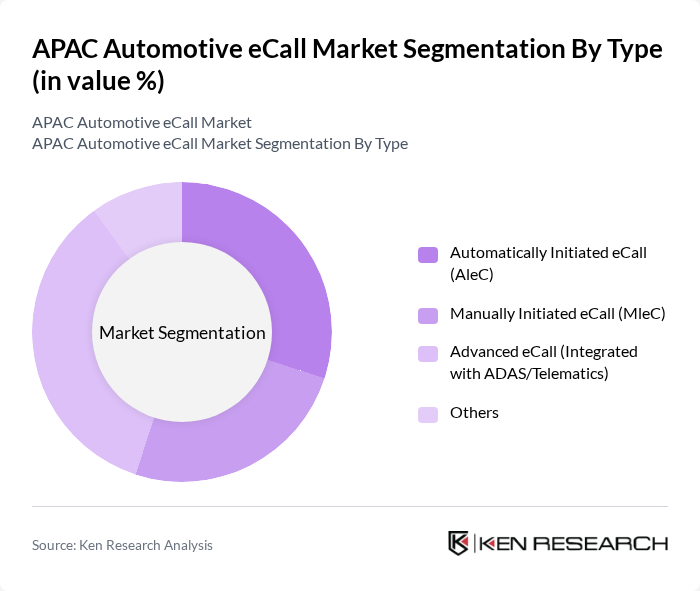
APAC Automotive eCall Market Segmentation
By Type:The segmentation by type includes Automatically Initiated eCall (AleC), Manually Initiated eCall (MleC), Advanced eCall (Integrated with ADAS/Telematics), and Others. The market is witnessing a significant shift towards Advanced eCall systems, which integrate with Advanced Driver Assistance Systems (ADAS) and telematics, providing enhanced safety features and real-time data transmission. This trend is driven by increasing consumer awareness of vehicle safety and the growing demand for connected vehicle technologies. Automatic eCall systems, which are activated automatically upon detecting a severe accident, are gaining prominence over Manual Button eCall, reflecting consumer preference for enhanced safety features and the growing integration of sophisticated accident detection sensors.
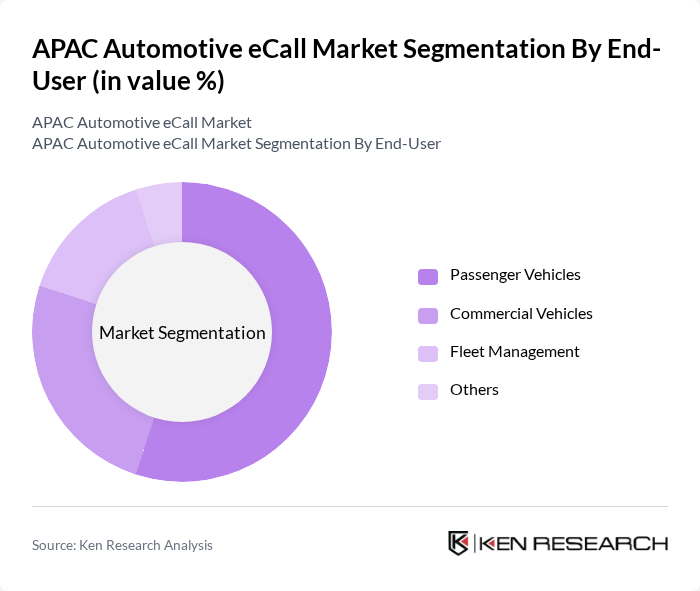
By End-User:The end-user segmentation includes Passenger Vehicles, Commercial Vehicles, Fleet Management, and Others. The Passenger Vehicles segment is currently leading the market due to the increasing number of personal vehicles on the road and the rising consumer preference for safety features. Additionally, the growing trend of connected cars is further propelling the demand for eCall systems in this segment. Both passenger vehicles and commercial vehicles represent significant application segments, with passenger vehicles representing the largest segment due to higher sales volumes and increased focus on vehicle and passenger safety.
APAC Automotive eCall Market Competitive Landscape
The APAC Automotive eCall Market is characterized by a dynamic mix of regional and international players. Leading participants such as Robert Bosch GmbH, Continental AG, DENSO Corporation, Valeo SA, Visteon Corporation, Infineon Technologies AG, STMicroelectronics, Thales Group, Telit Cinterion, u-blox, BYD Company Limited, Geely Automobile Holdings, Mitsubishi Electric Corporation, ZF Friedrichshafen AG, Harman International (Samsung Electronics), Qualcomm Technologies, Inc., Ericsson, NXP Semiconductors, Agero, Inc., Vodafone Group Plc, AT&T Inc. contribute to innovation, geographic expansion, and service delivery in this space.
APAC Automotive eCall Market Industry Analysis
Growth Drivers
- Increasing Road Safety Regulations:The APAC region has seen a significant rise in road safety regulations, with countries like India reporting over 150,000 road fatalities annually. Governments are implementing stricter safety standards, including mandatory eCall systems in new vehicles. For instance, Japan's Ministry of Land, Infrastructure, Transport and Tourism has mandated eCall systems for all new vehicles in future, aiming to reduce response times to accidents, which currently average 10 minutes in urban areas.
- Rising Adoption of Connected Vehicles:The number of connected vehicles in the APAC region is projected to reach 50 million in future, driven by advancements in IoT technology. Countries like South Korea are leading this trend, with over 30% of new vehicles equipped with connectivity features. This surge in connected vehicles enhances the effectiveness of eCall systems, allowing for real-time data transmission and improved emergency response, which is crucial in urban areas with high traffic density.
- Technological Advancements in Communication Systems:The integration of advanced communication technologies, such as 5G, is transforming the automotive landscape in APAC. In future, it is estimated that 5G networks will cover 60% of urban areas in the region, significantly enhancing the speed and reliability of eCall systems. This technological shift is expected to reduce emergency response times by up to 30%, improving overall road safety and encouraging manufacturers to adopt eCall solutions.
Market Challenges
- High Implementation Costs:The initial costs associated with implementing eCall systems can be prohibitive, particularly for smaller manufacturers. For instance, the average cost of integrating eCall technology into a vehicle is estimated at USD 200 per unit. With the APAC automotive market producing over 25 million vehicles annually, the cumulative cost for manufacturers could exceed USD 5 billion, posing a significant barrier to widespread adoption, especially in price-sensitive markets.
- Lack of Standardization Across Regions:The absence of a unified regulatory framework for eCall systems across APAC countries complicates implementation. For example, while the European Union has established clear guidelines, countries like India and Indonesia are still developing their regulations. This lack of standardization can lead to inconsistent service quality and interoperability issues, hindering the effectiveness of eCall systems and creating confusion among consumers and manufacturers alike.
APAC Automotive eCall Market Future Outlook
The future of the APAC automotive eCall market appears promising, driven by technological advancements and increasing regulatory support. As 5G networks expand, the efficiency of eCall systems will improve, leading to faster emergency response times. Additionally, the growing trend of connected vehicles will facilitate better integration of eCall services. Manufacturers are likely to invest in these technologies, enhancing safety features and meeting consumer demand for reliable emergency services, ultimately fostering market growth in the coming years.
Market Opportunities
- Expansion of 5G Networks:The rollout of 5G networks across APAC presents a significant opportunity for eCall systems. With 5G expected to cover a substantial portion of urban areas in future, the enhanced data transmission capabilities will allow for quicker emergency responses, potentially reducing response times by 30%. This technological advancement will encourage manufacturers to adopt eCall systems, improving overall road safety.
- Partnerships with Insurance Companies:Collaborations between automotive manufacturers and insurance companies can create innovative eCall solutions. By integrating eCall systems with insurance services, companies can offer real-time accident alerts and streamlined claims processing. This synergy not only enhances customer experience but also promotes the adoption of eCall systems, as insurers may provide incentives for vehicles equipped with such technology, driving market growth.
Scope of the Report
| Segment | Sub-Segments |
|---|---|
| By Type | Automatically Initiated eCall (AleC) Manually Initiated eCall (MleC) Advanced eCall (Integrated with ADAS/Telematics) Others |
| By End-User | Passenger Vehicles Commercial Vehicles Fleet Management Others |
| By Region | China Japan South Korea India ASEAN (Indonesia, Thailand, Malaysia, Philippines, Vietnam, Singapore) Australia & New Zealand Rest of APAC |
| By Application | Emergency Response Roadside Assistance Vehicle Tracking Others |
| By Sales Channel | OEM (Original Equipment Manufacturer) Aftermarket Online Sales Others |
| By Distribution Mode | Offline Distribution Online Distribution Hybrid Distribution |
| By Pricing Strategy | Premium Pricing Competitive Pricing Value-Based Pricing Others |
Key Target Audience
Investors and Venture Capitalist Firms
Government and Regulatory Bodies (e.g., National Highway Traffic Safety Administration, Ministry of Transport)
Automotive Manufacturers
Telecommunications Service Providers
Insurance Companies
Emergency Response Services
Automotive Technology Developers
Fleet Management Companies
Players Mentioned in the Report:
Robert Bosch GmbH
Continental AG
DENSO Corporation
Valeo SA
Visteon Corporation
Infineon Technologies AG
STMicroelectronics
Thales Group
Telit Cinterion
u-blox
BYD Company Limited
Geely Automobile Holdings
Mitsubishi Electric Corporation
ZF Friedrichshafen AG
Harman International (Samsung Electronics)
Qualcomm Technologies, Inc.
Ericsson
NXP Semiconductors
Agero, Inc.
Vodafone Group Plc
AT&T Inc.
Table of Contents
Market Assessment Phase
1. Executive Summary and Approach
2. APAC Automotive eCall Market Overview
2.1 Key Insights and Strategic Recommendations
2.2 APAC Automotive eCall Market Overview
2.3 Definition and Scope
2.4 Evolution of Market Ecosystem
2.5 Timeline of Key Regulatory Milestones
2.6 Value Chain & Stakeholder Mapping
2.7 Business Cycle Analysis
2.8 Policy & Incentive Landscape
3. APAC Automotive eCall Market Analysis
3.1 Growth Drivers
3.1.1 Increasing Road Safety Regulations
3.1.2 Rising Adoption of Connected Vehicles
3.1.3 Growing Consumer Awareness of Emergency Services
3.1.4 Technological Advancements in Communication Systems
3.2 Market Challenges
3.2.1 High Implementation Costs
3.2.2 Lack of Standardization Across Regions
3.2.3 Data Privacy Concerns
3.2.4 Limited Infrastructure in Rural Areas
3.3 Market Opportunities
3.3.1 Expansion of 5G Networks
3.3.2 Partnerships with Insurance Companies
3.3.3 Development of Advanced AI for Accident Detection
3.3.4 Increasing Demand for Real-Time Data Analytics
3.4 Market Trends
3.4.1 Integration of eCall with Smart City Initiatives
3.4.2 Growth of Subscription-Based Services
3.4.3 Enhanced User Experience through Mobile Applications
3.4.4 Focus on Sustainability and Eco-Friendly Solutions
3.5 Government Regulation
3.5.1 Mandatory eCall Implementation in New Vehicles
3.5.2 Data Protection Regulations for User Information
3.5.3 Incentives for Manufacturers to Adopt eCall Systems
3.5.4 Compliance with International Safety Standards
4. SWOT Analysis
5. Stakeholder Analysis
6. Porter's Five Forces Analysis
7. APAC Automotive eCall Market Market Size, 2019-2024
7.1 By Value
7.2 By Volume
7.3 By Average Selling Price
8. APAC Automotive eCall Market Segmentation
8.1 By Type
8.1.1 Automatically Initiated eCall (AleC)
8.1.2 Manually Initiated eCall (MleC)
8.1.3 Advanced eCall (Integrated with ADAS/Telematics)
8.1.4 Others
8.2 By End-User
8.2.1 Passenger Vehicles
8.2.2 Commercial Vehicles
8.2.3 Fleet Management
8.2.4 Others
8.3 By Region
8.3.1 China
8.3.2 Japan
8.3.3 South Korea
8.3.4 India
8.3.5 ASEAN (Indonesia, Thailand, Malaysia, Philippines, Vietnam, Singapore)
8.3.6 Australia & New Zealand
8.3.7 Rest of APAC
8.4 By Application
8.4.1 Emergency Response
8.4.2 Roadside Assistance
8.4.3 Vehicle Tracking
8.4.4 Others
8.5 By Sales Channel
8.5.1 OEM (Original Equipment Manufacturer)
8.5.2 Aftermarket
8.5.3 Online Sales
8.5.4 Others
8.6 By Distribution Mode
8.6.1 Offline Distribution
8.6.2 Online Distribution
8.6.3 Hybrid Distribution
8.7 By Pricing Strategy
8.7.1 Premium Pricing
8.7.2 Competitive Pricing
8.7.3 Value-Based Pricing
8.7.4 Others
9. APAC Automotive eCall Market Competitive Analysis
9.1 Market Share of Key Players
9.2 Cross Comparison of Key Players
9.2.1 Company Name
9.2.2 Group Size (Tier 1, Tier 2, or Tier 3 as per automotive industry convention)
9.2.3 Revenue Growth Rate (YoY, 3-year CAGR)
9.2.4 Market Penetration Rate (by country/region, % of vehicles equipped)
9.2.5 OEM Partnership Coverage (number of major OEMs served)
9.2.6 R&D Investment (% of revenue)
9.2.7 Product Portfolio Breadth (number of eCall solutions offered)
9.2.8 Time-to-Market for New Features (months)
9.2.9 Customer Satisfaction Score (CSAT, Net Promoter Score)
9.2.10 Brand Recognition Index (survey-based, regional)
9.3 SWOT Analysis of Top Players
9.4 Pricing Analysis
9.5 Detailed Profile of Major Companies
9.5.1 Robert Bosch GmbH
9.5.2 Continental AG
9.5.3 DENSO Corporation
9.5.4 Valeo SA
9.5.5 Visteon Corporation
9.5.6 Infineon Technologies AG
9.5.7 STMicroelectronics
9.5.8 Thales Group
9.5.9 Telit Cinterion
9.5.10 u-blox
9.5.11 BYD Company Limited
9.5.12 Geely Automobile Holdings
9.5.13 Mitsubishi Electric Corporation
9.5.14 ZF Friedrichshafen AG
9.5.15 Harman International (Samsung Electronics)
9.5.16 Qualcomm Technologies, Inc.
9.5.17 Ericsson
9.5.18 NXP Semiconductors
9.5.19 Agero, Inc.
9.5.20 Vodafone Group Plc
9.5.21 AT&T Inc.
10. APAC Automotive eCall Market End-User Analysis
10.1 Procurement Behavior of Key Ministries
10.1.1 Government Budget Allocations
10.1.2 Procurement Processes and Timelines
10.1.3 Key Decision-Makers and Influencers
10.2 Corporate Spend on Infrastructure & Energy
10.2.1 Investment Trends in Automotive Safety
10.2.2 Budgeting for Technology Upgrades
10.2.3 Collaboration with Tech Providers
10.3 Pain Point Analysis by End-User Category
10.3.1 Challenges in Implementation
10.3.2 User Experience Issues
10.3.3 Integration with Existing Systems
10.4 User Readiness for Adoption
10.4.1 Awareness of eCall Benefits
10.4.2 Training and Support Needs
10.4.3 Technological Literacy
10.5 Post-Deployment ROI and Use Case Expansion
10.5.1 Measurement of Success Metrics
10.5.2 Case Studies of Successful Implementations
10.5.3 Future Use Cases and Innovations
11. APAC Automotive eCall Market Future Size, 2025-2030
11.1 By Value
11.2 By Volume
11.3 By Average Selling Price
Go-To-Market Strategy Phase
1. Whitespace Analysis + Business Model Canvas
1.1 Market Gaps Identification
1.2 Value Proposition Development
1.3 Revenue Streams Analysis
1.4 Cost Structure Evaluation
1.5 Key Partnerships Exploration
1.6 Customer Segmentation
1.7 Channels of Distribution
2. Marketing and Positioning Recommendations
2.1 Branding Strategies
2.2 Product USPs
2.3 Target Audience Identification
2.4 Communication Strategies
2.5 Digital Marketing Approaches
3. Distribution Plan
3.1 Urban Retail Strategies
3.2 Rural NGO Tie-Ups
3.3 Online Distribution Channels
3.4 Partnerships with Local Dealers
4. Channel & Pricing Gaps
4.1 Underserved Routes
4.2 Pricing Bands Analysis
4.3 Competitor Pricing Strategies
5. Unmet Demand & Latent Needs
5.1 Category Gaps Identification
5.2 Consumer Segments Analysis
5.3 Emerging Trends and Needs
6. Customer Relationship
6.1 Loyalty Programs
6.2 After-Sales Service Strategies
6.3 Customer Feedback Mechanisms
7. Value Proposition
7.1 Sustainability Initiatives
7.2 Integrated Supply Chains
7.3 Unique Selling Points
8. Key Activities
8.1 Regulatory Compliance
8.2 Branding Initiatives
8.3 Distribution Setup
9. Entry Strategy Evaluation
9.1 Domestic Market Entry Strategy
9.1.1 Product Mix Considerations
9.1.2 Pricing Band Strategy
9.1.3 Packaging Options
9.2 Export Entry Strategy
9.2.1 Target Countries Analysis
9.2.2 Compliance Roadmap Development
10. Entry Mode Assessment
10.1 Joint Ventures
10.2 Greenfield Investments
10.3 Mergers & Acquisitions
10.4 Distributor Model Evaluation
11. Capital and Timeline Estimation
11.1 Capital Requirements Analysis
11.2 Timelines for Market Entry
12. Control vs Risk Trade-Off
12.1 Ownership vs Partnerships
13. Profitability Outlook
13.1 Breakeven Analysis
13.2 Long-Term Sustainability Strategies
14. Potential Partner List
14.1 Distributors
14.2 Joint Ventures
14.3 Acquisition Targets
15. Execution Roadmap
15.1 Phased Plan for Market Entry
15.1.1 Market Setup
15.1.2 Market Entry
15.1.3 Growth Acceleration
15.1.4 Scale & Stabilize
15.2 Key Activities and Milestones
15.2.1 Milestone Planning
15.2.2 Activity Tracking
Research Methodology
Phase 1: Approach1
Desk Research
- Analysis of industry reports from automotive associations across APAC
- Review of government publications on eCall regulations and standards
- Examination of market trends through academic journals and white papers
Primary Research
- Interviews with automotive OEMs and Tier 1 suppliers involved in eCall systems
- Surveys with telematics service providers and technology developers
- Focus groups with end-users to understand consumer perceptions of eCall services
Validation & Triangulation
- Cross-validation of findings with industry expert opinions and market data
- Triangulation of data from regulatory bodies, industry reports, and primary interviews
- Sanity checks through comparative analysis with similar markets globally
Phase 2: Market Size Estimation1
Top-down Assessment
- Estimation of total market size based on vehicle registration statistics in APAC
- Segmentation by vehicle type (passenger cars, commercial vehicles) and region
- Incorporation of projected growth rates from government eCall mandates
Bottom-up Modeling
- Data collection on installed eCall systems from major automotive manufacturers
- Cost analysis of eCall implementation and operational expenses
- Volume estimates based on historical adoption rates and future projections
Forecasting & Scenario Analysis
- Multi-variable forecasting using factors such as accident rates and vehicle safety trends
- Scenario modeling based on varying levels of regulatory enforcement and consumer adoption
- Development of baseline, optimistic, and pessimistic market scenarios through 2030
Phase 3: CATI Sample Composition1
| Scope Item/Segment | Sample Size | Target Respondent Profiles |
|---|---|---|
| OEMs Implementing eCall Systems | 60 | Product Managers, R&D Directors |
| Telematics Service Providers | 50 | Business Development Managers, Technical Leads |
| Regulatory Bodies and Policy Makers | 40 | Regulatory Affairs Specialists, Policy Analysts |
| Consumer Insights on eCall | 100 | General Consumers, Safety Advocates |
| Insurance Companies Evaluating eCall Impact | 45 | Underwriters, Risk Assessment Managers |
Frequently Asked Questions
What is the current value of the APAC Automotive eCall market?
The APAC Automotive eCall market is valued at approximately USD 290 million, driven by increasing vehicle safety regulations, advancements in telematics technology, and rising consumer demand for connected vehicle services.
What factors are driving the growth of the APAC Automotive eCall market?
Which countries are leading in the APAC Automotive eCall market?
What types of eCall systems are available in the market?
Other Regional/Country Reports
Indonesia Automotive eCall Market
Malaysia Automotive eCall Market
KSA Automotive eCall Market
SEA Automotive eCall Market
Vietnam Automotive eCall Market
Other Adjacent Reports
Belgium Connected Vehicles Market
India Advanced Driver Assistance Systems Market Outlook to 2030Brazil Vehicle Safety Systems Market
Brazil Emergency Response Technology Market
Indonesia Automotive IoT Market Outlook to 2030Egypt Fleet Management Solutions MarketNorth America Automotive Sensors Market Outlook to 2030: Size, Share, Growth and TrendsOman Road Safety Equipment Market
Philippines Vehicle-to-Everything Communication Market
Why Buy From Us?

What makes us stand out is that our consultants follow Robust, Refine and Result (RRR) methodology. Robust for clear definitions, approaches and sanity checking, Refine for differentiating respondents' facts and opinions, and Result for presenting data with story.

We have set a benchmark in the industry by offering our clients with syndicated and customized market research reports featuring coverage of entire market as well as meticulous research and analyst insights.

While we don't replace traditional research, we flip the method upside down. Our dual approach of Top Bottom & Bottom Top ensures quality deliverable by not just verifying company fundamentals but also looking at the sector and macroeconomic factors.

With one step in the future, our research team constantly tries to show you the bigger picture. We help with some of the tough questions you may encounter along the way: How is the industry positioned? Best marketing channel? KPI's of competitors? By aligning every element, we help maximize success.

Our report gives you instant access to the answers and sources that other companies might choose to hide. We elaborate each steps of research methodology we have used and showcase you the sample size to earn your trust.

If you need any support, we are here! We pride ourselves on universe strength, data quality, and quick, friendly, and professional service.