About the Report
Base Year 2024New Zealand Automotive Telematics Market Overview
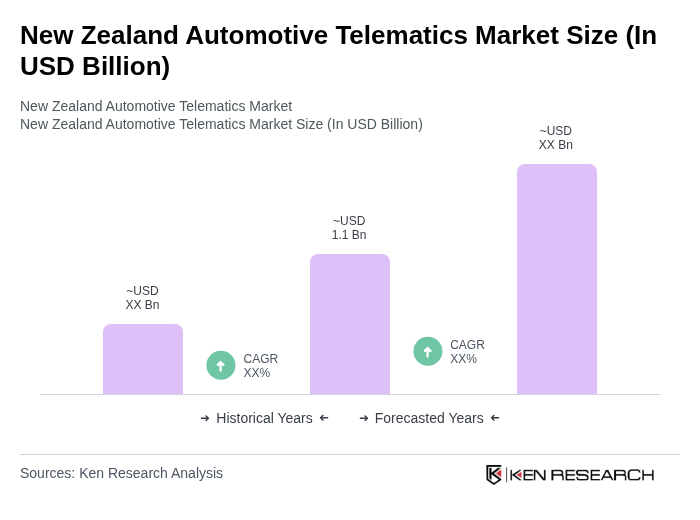
- The New Zealand Automotive Telematics Market is valued at USD 1.1 billion, based on a five-year historical analysis and benchmarking against the share of New Zealand in the broader Asia Pacific and global automotive telematics and connected vehicle domains. This growth is primarily driven by the increasing adoption of connected vehicles, advancements in telematics hardware and software (including GPS tracking, CAN-bus data, and cloud-based analytics), and the rising demand for fleet management and compliance solutions across transport, logistics, construction, and utilities fleets. The integration of telematics in vehicles enhances operational efficiency through route optimization and fuel monitoring, improves safety via driver-behaviour monitoring and incident alerts, and supports regulatory compliance and reporting (for example, electronic logging, maintenance records, and safety programs), making it a crucial component in the New Zealand automotive and fleet ecosystem.
- Auckland, Wellington, and Christchurch are the dominant cities in the New Zealand Automotive Telematics Market, in line with their concentration of vehicle fleets, commercial activity, and transport infrastructure. Auckland, being the largest urban and freight hub, has a significant concentration of businesses, ports, and logistics operations, driving strong demand for fleet tracking, route optimization, and compliance telematics solutions. Wellington, as the political and administrative capital, sees substantial government-led investment in smart transport initiatives, public transport technology, and safety programs that leverage data and connected systems, supporting the uptake of telematics-enabled fleet and public sector vehicles. Christchurch's growing regional economy and rebuild-driven infrastructure development support the adoption of advanced automotive technologies, including telematics across construction, services, and regional freight fleets.
- In 2020, the New Zealand government launched the Road to Zero road safety strategy 2020–2030, aiming to significantly reduce road fatalities and serious injuries, with a long-term vision that no one is killed or seriously injured in road crashes. This strategy emphasizes safer vehicles, safer speeds, safer roads, and safer road use, and encourages the use of technology and data-driven tools, including telematics, for monitoring driver behaviour, speeding, fatigue, and vehicle performance to support safety interventions and fleet risk management. The strategy is complemented operationally by instruments such as the Land Transport Rule: Work Time and Logbooks 2007 issued by Waka Kotahi NZ Transport Agency, which sets legal requirements for managing commercial driver hours, record-keeping, and fatigue, and is increasingly supported by electronic and telematics-based solutions used by transport operators to demonstrate compliance and improve safety outcomes.
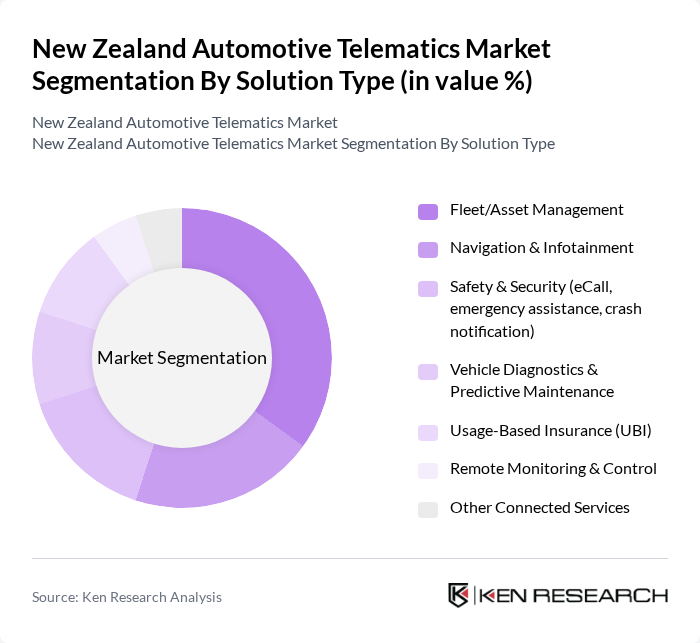
New Zealand Automotive Telematics Market Segmentation
By Solution Type:The solution type segmentation includes various subsegments that cater to different needs within the automotive telematics landscape. The key subsegments are Fleet/Asset Management, Navigation & Infotainment, Safety & Security (eCall, emergency assistance, crash notification), Vehicle Diagnostics & Predictive Maintenance, Usage-Based Insurance (UBI), Remote Monitoring & Control, and Other Connected Services. Fleet/Asset Management is currently the leading subsegment due to the increasing need for efficient fleet operations, cost management, regulatory compliance, and the widespread use of GPS tracking and telematics control units in commercial and government fleets.
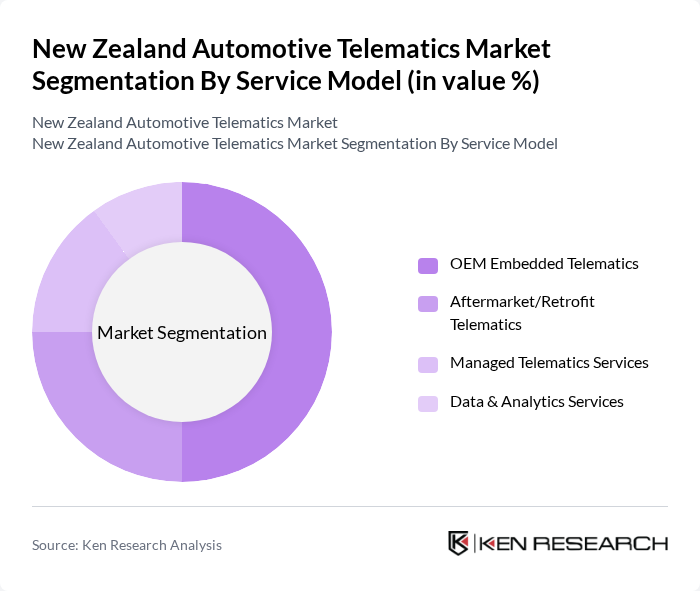
By Service Model:The service model segmentation encompasses OEM Embedded Telematics, Aftermarket/Retrofit Telematics, Managed Telematics Services, and Data & Analytics Services, which is consistent with global telematics value-chain structures. OEM Embedded Telematics is the dominant service model, as manufacturers increasingly integrate factory-fitted connectivity, safety, diagnostics, and infotainment platforms into vehicles, supported by 4G/5G connectivity and over-the-air update capabilities. This trend is driven by consumer demand for advanced connected features, regulatory focus on safety and incident response, and the need for real-time data analytics and subscription-based services that generate ongoing revenue for OEMs and service providers.
New Zealand Automotive Telematics Market Competitive Landscape
The New Zealand Automotive Telematics Market is characterized by a dynamic mix of regional and international players. Leading participants such as Teletrac Navman, EROAD, Coretex (Intelematics / MiX Telematics where relevant), Fleet Complete, Geotab, MiX Telematics, Verizon Connect, Webfleet Solutions (formerly TomTom Telematics), Ctrack, Gurtam, Samsara, Zubie, Inseego, Omnicomm, and other notable local and regional players contribute to innovation, geographic expansion, and service delivery in this space.
New Zealand Automotive Telematics Market Industry Analysis
Growth Drivers
- Increasing Demand for Vehicle Safety and Security:The New Zealand automotive telematics market is driven by a growing emphasis on vehicle safety, with road traffic accidents costing the economy approximately NZD 4.4 billion annually. Enhanced telematics solutions, such as real-time tracking and emergency response systems, are increasingly adopted to mitigate these costs. In future, the government aims to reduce road fatalities by 40%, further propelling the demand for advanced safety features integrated into telematics systems.
- Growth in Connected Vehicle Technology:The proliferation of connected vehicle technology is a significant growth driver, with an estimated 1.5 million connected vehicles projected on New Zealand roads in future. This surge is supported by the increasing availability of high-speed internet and mobile networks, which facilitate seamless data exchange. The integration of telematics with connected vehicle systems enhances user experience and operational efficiency, making it a vital component of modern automotive solutions.
- Rising Fuel Prices and Need for Efficient Fleet Management:With fuel prices in New Zealand averaging NZD 2.30 per liter in future, businesses are increasingly seeking efficient fleet management solutions to reduce operational costs. Telematics systems provide real-time data on fuel consumption and vehicle performance, enabling companies to optimize routes and reduce fuel wastage. This trend is expected to drive the adoption of telematics solutions across various sectors, including logistics and transportation.
Market Challenges
- High Initial Investment Costs:One of the primary challenges facing the New Zealand automotive telematics market is the high initial investment required for telematics systems. Businesses may face costs exceeding NZD 10,000 for comprehensive fleet telematics solutions, which can deter small and medium enterprises from adoption. This financial barrier limits market penetration and slows the overall growth of telematics solutions in the region.
- Data Privacy and Security Concerns:Data privacy and security remain significant challenges in the automotive telematics market. With New Zealand's Privacy Act 2020 imposing strict regulations on data handling, companies must ensure compliance to avoid penalties. Concerns over data breaches and unauthorized access to sensitive information can hinder consumer trust and slow the adoption of telematics solutions, impacting market growth.
New Zealand Automotive Telematics Market Future Outlook
The future of the New Zealand automotive telematics market appears promising, driven by technological advancements and increasing consumer awareness. The expansion of 5G networks is expected to enhance connectivity, enabling more sophisticated telematics applications. Additionally, the integration of artificial intelligence and machine learning will facilitate predictive analytics, improving vehicle maintenance and operational efficiency. As the market evolves, regulatory frameworks will likely adapt to support innovation while ensuring data security and privacy.
Market Opportunities
- Expansion of 5G Networks Enhancing Connectivity:The rollout of 5G networks in New Zealand presents a significant opportunity for the automotive telematics market. With faster data transmission speeds and lower latency, telematics solutions can offer real-time insights and improved functionalities, enhancing user experience and operational efficiency. This technological advancement is expected to attract more businesses to adopt telematics systems.
- Integration of AI and Machine Learning in Telematics:The integration of artificial intelligence and machine learning into telematics systems offers substantial market opportunities. These technologies can analyze vast amounts of data to provide predictive maintenance insights, reducing downtime and operational costs. As businesses increasingly seek data-driven solutions, the demand for AI-enhanced telematics is expected to grow significantly in the coming years.
Scope of the Report
| Segment | Sub-Segments |
|---|---|
| By Solution Type | Fleet/Asset Management Navigation & Infotainment Safety & Security (eCall, emergency assistance, crash notification) Vehicle Diagnostics & Predictive Maintenance Usage-Based Insurance (UBI) Remote Monitoring & Control Other Connected Services |
| By Service Model | OEM Embedded Telematics Aftermarket/Retrofit Telematics Managed Telematics Services Data & Analytics Services |
| By Vehicle Type | Passenger Cars Light Commercial Vehicles (LCVs) Medium & Heavy Commercial Vehicles (MHCVs) Buses & Coaches Off-Highway & Specialist Fleets |
| By Connectivity & Technology | Embedded Telematics Control Units (TCUs) Tethered / Smartphone-Integrated Telematics GPS / GNSS Tracking Devices G / 4G / 5G Cellular Connectivity Satellite & LPWAN Connectivity Video Telematics & Dashcams |
| By End-User / Vertical | Transportation & Logistics Fleets Public Sector & Government Fleets Utilities & Field Services Construction, Mining & Resources Retail, Distribution & Last-Mile Delivery Insurance Providers Individual & Small Business Vehicle Owners |
| By Deployment Mode | Cloud-Based On-Premise Hybrid |
| By Revenue Model | One-Time Hardware Sales Subscription / SaaS Contracts Pay-Per-Use & Usage-Based Models Data Monetization & Value-Added Services |
Key Target Audience
Investors and Venture Capitalist Firms
Government and Regulatory Bodies (e.g., New Zealand Transport Agency, Ministry of Transport)
Automotive Manufacturers
Telematics Solution Providers
Fleet Management Companies
Insurance Companies
Telecommunications Providers
Automotive Aftermarket Service Providers
Players Mentioned in the Report:
Teletrac Navman
EROAD
Coretex (Intelematics / MiX Telematics where relevant)
Fleet Complete
Geotab
MiX Telematics
Verizon Connect
Webfleet Solutions (formerly TomTom Telematics)
Ctrack
Gurtam
Samsara
Zubie
Inseego
Omnicomm
Other Notable Local & Regional Players
Table of Contents
Market Assessment Phase
1. Executive Summary and Approach
2. New Zealand Automotive Telematics Market Overview
2.1 Key Insights and Strategic Recommendations
2.2 New Zealand Automotive Telematics Market Overview
2.3 Definition and Scope
2.4 Evolution of Market Ecosystem
2.5 Timeline of Key Regulatory Milestones
2.6 Value Chain & Stakeholder Mapping
2.7 Business Cycle Analysis
2.8 Policy & Incentive Landscape
3. New Zealand Automotive Telematics Market Analysis
3.1 Growth Drivers
3.1.1 Increasing demand for vehicle safety and security
3.1.2 Growth in connected vehicle technology
3.1.3 Rising fuel prices and need for efficient fleet management
3.1.4 Government initiatives promoting smart transportation
3.2 Market Challenges
3.2.1 High initial investment costs
3.2.2 Data privacy and security concerns
3.2.3 Lack of standardization in telematics solutions
3.2.4 Limited awareness among end-users
3.3 Market Opportunities
3.3.1 Expansion of 5G networks enhancing connectivity
3.3.2 Integration of AI and machine learning in telematics
3.3.3 Increasing adoption of electric vehicles
3.3.4 Growth in e-commerce driving logistics telematics
3.4 Market Trends
3.4.1 Shift towards subscription-based telematics services
3.4.2 Increasing focus on sustainability and eco-friendly solutions
3.4.3 Rise of usage-based insurance models
3.4.4 Enhanced analytics for predictive maintenance
3.5 Government Regulation
3.5.1 Regulations on data protection and privacy
3.5.2 Standards for vehicle safety and emissions
3.5.3 Incentives for adopting telematics in public transport
3.5.4 Compliance requirements for fleet management systems
4. SWOT Analysis
5. Stakeholder Analysis
6. Porter's Five Forces Analysis
7. New Zealand Automotive Telematics Market Market Size, 2019-2024
7.1 By Value
7.2 By Volume
7.3 By Average Selling Price
8. New Zealand Automotive Telematics Market Segmentation
8.1 By Solution Type
8.1.1 Fleet/Asset Management
8.1.2 Navigation & Infotainment
8.1.3 Safety & Security (eCall, emergency assistance, crash notification)
8.1.4 Vehicle Diagnostics & Predictive Maintenance
8.1.5 Usage-Based Insurance (UBI)
8.1.6 Remote Monitoring & Control
8.1.7 Other Connected Services
8.2 By Service Model
8.2.1 OEM Embedded Telematics
8.2.2 Aftermarket/Retrofit Telematics
8.2.3 Managed Telematics Services
8.2.4 Data & Analytics Services
8.3 By Vehicle Type
8.3.1 Passenger Cars
8.3.2 Light Commercial Vehicles (LCVs)
8.3.3 Medium & Heavy Commercial Vehicles (MHCVs)
8.3.4 Buses & Coaches
8.3.5 Off-Highway & Specialist Fleets
8.4 By Connectivity & Technology
8.4.1 Embedded Telematics Control Units (TCUs)
8.4.2 Tethered / Smartphone-Integrated Telematics
8.4.3 GPS / GNSS Tracking Devices
8.4.4 3G / 4G / 5G Cellular Connectivity
8.4.5 Satellite & LPWAN Connectivity
8.4.6 Video Telematics & Dashcams
8.5 By End-User / Vertical
8.5.1 Transportation & Logistics Fleets
8.5.2 Public Sector & Government Fleets
8.5.3 Utilities & Field Services
8.5.4 Construction, Mining & Resources
8.5.5 Retail, Distribution & Last-Mile Delivery
8.5.6 Insurance Providers
8.5.7 Individual & Small Business Vehicle Owners
8.6 By Deployment Mode
8.6.1 Cloud-Based
8.6.2 On-Premise
8.6.3 Hybrid
8.7 By Revenue Model
8.7.1 One-Time Hardware Sales
8.7.2 Subscription / SaaS Contracts
8.7.3 Pay-Per-Use & Usage-Based Models
8.7.4 Data Monetization & Value-Added Services
9. New Zealand Automotive Telematics Market Competitive Analysis
9.1 Market Share of Key Players
9.2 Cross Comparison of Key Players
9.2.1 Company Name
9.2.2 Group Size (Large, Medium, or Small as per industry convention)
9.2.3 New Zealand Automotive Telematics Revenue (Latest Year, NZD Million)
9.2.4 3-Year Revenue CAGR in New Zealand (%)
9.2.5 Number of Connected Vehicles / Active Subscriptions in New Zealand
9.2.6 Average Revenue per User (ARPU) – NZD/Vehicle/Month
9.2.7 Gross Margin (%) on Telematics Services
9.2.8 Customer Acquisition Cost (CAC) – NZD per Customer
9.2.9 Net Revenue Retention / Customer Churn Rate (%)
9.2.10 Share of Recurring Revenue (% of Total)
9.2.11 Market Penetration Rate in Addressable Fleets (%)
9.2.12 Average Contract Tenure (Months/Years)
9.2.13 On-Time Implementation / SLA Compliance Rate (%)
9.2.14 Customer Satisfaction / NPS Score
9.3 SWOT Analysis of Top Players
9.4 Pricing Analysis
9.5 Detailed Profile of Major Companies
9.5.1 Teletrac Navman
9.5.2 EROAD
9.5.3 Coretex (Intelematics / MiX Telematics where relevant)
9.5.4 Fleet Complete
9.5.5 Geotab
9.5.6 MiX Telematics
9.5.7 Verizon Connect
9.5.8 Webfleet Solutions (formerly TomTom Telematics)
9.5.9 Ctrack
9.5.10 Gurtam
9.5.11 Samsara
9.5.12 Zubie
9.5.13 Inseego
9.5.14 Omnicomm
9.5.15 Other Notable Local & Regional Players
10. New Zealand Automotive Telematics Market End-User Analysis
10.1 Procurement Behavior of Key Ministries
10.1.1 Budget Allocation for Telematics Solutions
10.1.2 Decision-Making Process
10.1.3 Preferred Vendors
10.1.4 Evaluation Criteria
10.2 Corporate Spend on Infrastructure & Energy
10.2.1 Investment Trends in Telematics
10.2.2 Budgeting for Technology Upgrades
10.2.3 Spending on Maintenance and Support
10.3 Pain Point Analysis by End-User Category
10.3.1 Challenges in Data Integration
10.3.2 Issues with User Training
10.3.3 Concerns over System Reliability
10.4 User Readiness for Adoption
10.4.1 Awareness of Telematics Benefits
10.4.2 Training and Support Needs
10.5 Post-Deployment ROI and Use Case Expansion
10.5.1 Measurement of ROI
10.5.2 Opportunities for Upselling
10.5.3 Expansion into New Use Cases
11. New Zealand Automotive Telematics Market Future Size, 2025-2030
11.1 By Value
11.2 By Volume
11.3 By Average Selling Price
Go-To-Market Strategy Phase
1. Whitespace Analysis + Business Model Canvas
1.1 Market Gaps Identification
1.2 Business Model Development
2. Marketing and Positioning Recommendations
2.1 Branding Strategies
2.2 Product USPs
3. Distribution Plan
3.1 Urban Retail Strategies
3.2 Rural NGO Tie-Ups
4. Channel & Pricing Gaps
4.1 Underserved Routes
4.2 Pricing Bands Analysis
5. Unmet Demand & Latent Needs
5.1 Category Gaps
5.2 Consumer Segments
6. Customer Relationship
6.1 Loyalty Programs
6.2 After-Sales Service
7. Value Proposition
7.1 Sustainability Initiatives
7.2 Integrated Supply Chains
8. Key Activities
8.1 Regulatory Compliance
8.2 Branding Efforts
8.3 Distribution Setup
9. Entry Strategy Evaluation
9.1 Domestic Market Entry Strategy
9.1.1 Product Mix Considerations
9.1.2 Pricing Band Strategy
9.1.3 Packaging Options
9.2 Export Entry Strategy
9.2.1 Target Countries
9.2.2 Compliance Roadmap
10. Entry Mode Assessment
10.1 Joint Ventures
10.2 Greenfield Investments
10.3 Mergers & Acquisitions
10.4 Distributor Model
11. Capital and Timeline Estimation
11.1 Capital Requirements
11.2 Timelines for Implementation
12. Control vs Risk Trade-Off
12.1 Ownership Considerations
12.2 Partnerships Evaluation
13. Profitability Outlook
13.1 Breakeven Analysis
13.2 Long-Term Sustainability
14. Potential Partner List
14.1 Distributors
14.2 Joint Ventures
14.3 Acquisition Targets
15. Execution Roadmap
15.1 Phased Plan for Market Entry
15.1.1 Market Setup
15.1.2 Market Entry
15.1.3 Growth Acceleration
15.1.4 Scale & Stabilize
15.2 Key Activities and Milestones
15.2.1 Milestone Planning
15.2.2 Activity Tracking
Research Methodology
Phase 1: Approach1
Desk Research
- Analysis of industry reports from New Zealand's Ministry of Transport and automotive associations
- Review of market trends and forecasts from telematics industry publications
- Examination of government regulations and policies impacting automotive telematics
Primary Research
- Interviews with key stakeholders in the automotive telematics sector, including OEMs and telematics service providers
- Surveys targeting fleet managers and logistics companies utilizing telematics solutions
- Focus groups with end-users to understand consumer preferences and usage patterns
Validation & Triangulation
- Cross-validation of findings through multiple data sources, including sales data and user feedback
- Triangulation of insights from industry experts, market reports, and primary research
- Sanity checks conducted through expert panel reviews to ensure data accuracy
Phase 2: Market Size Estimation1
Top-down Assessment
- Estimation of total addressable market based on national automotive sales and telematics adoption rates
- Segmentation of the market by vehicle type, including passenger cars, commercial vehicles, and electric vehicles
- Incorporation of growth factors such as government incentives for telematics adoption
Bottom-up Modeling
- Collection of data on telematics service pricing from leading providers in New Zealand
- Estimation of market penetration rates based on fleet sizes and telematics usage
- Volume x pricing model to calculate revenue potential across different segments
Forecasting & Scenario Analysis
- Multi-variable forecasting using historical growth rates and emerging trends in automotive technology
- Scenario analysis based on varying levels of regulatory support and technological advancements
- Development of baseline, optimistic, and pessimistic market projections through 2030
Phase 3: CATI Sample Composition1
| Scope Item/Segment | Sample Size | Target Respondent Profiles |
|---|---|---|
| Passenger Vehicle Telematics Adoption | 150 | Vehicle Owners, Fleet Managers |
| Commercial Fleet Telematics Solutions | 110 | Logistics Managers, Fleet Operations Directors |
| Telematics Service Providers | 70 | Product Managers, Business Development Executives |
| Consumer Attitudes Towards Telematics | 130 | General Consumers, Automotive Enthusiasts |
| Regulatory Impact on Telematics Adoption | 50 | Policy Makers, Industry Analysts |
Frequently Asked Questions
What is the current value of the New Zealand Automotive Telematics Market?
The New Zealand Automotive Telematics Market is valued at approximately USD 1.1 billion. This valuation is based on a five-year historical analysis and reflects the market's growth driven by connected vehicles and advancements in telematics technology.
What are the main drivers of growth in the New Zealand Automotive Telematics Market?
Which cities are leading in the New Zealand Automotive Telematics Market?
What role does the New Zealand government play in the automotive telematics sector?
Other Regional/Country Reports
Other Adjacent Reports
Japan Vehicle Tracking Market
South Korea Automotive Safety Systems Market
Brazil Usage-Based Insurance Market
Qatar Automotive Infotainment Market
Japan Vehicle Diagnostics Market
Qatar predictive maintenance market size, share, growth drivers, trends, opportunities & forecast 2025–2030Indonesia Automotive IoT Market Outlook to 2030Egypt Automotive Data Analytics Market
Why Buy From Us?

What makes us stand out is that our consultants follow Robust, Refine and Result (RRR) methodology. Robust for clear definitions, approaches and sanity checking, Refine for differentiating respondents' facts and opinions, and Result for presenting data with story.

We have set a benchmark in the industry by offering our clients with syndicated and customized market research reports featuring coverage of entire market as well as meticulous research and analyst insights.

While we don't replace traditional research, we flip the method upside down. Our dual approach of Top Bottom & Bottom Top ensures quality deliverable by not just verifying company fundamentals but also looking at the sector and macroeconomic factors.

With one step in the future, our research team constantly tries to show you the bigger picture. We help with some of the tough questions you may encounter along the way: How is the industry positioned? Best marketing channel? KPI's of competitors? By aligning every element, we help maximize success.

Our report gives you instant access to the answers and sources that other companies might choose to hide. We elaborate each steps of research methodology we have used and showcase you the sample size to earn your trust.

If you need any support, we are here! We pride ourselves on universe strength, data quality, and quick, friendly, and professional service.