Region:Asia
Author(s):Shubham
Product Code:KRAC4245
Pages:99
Published On:October 2025
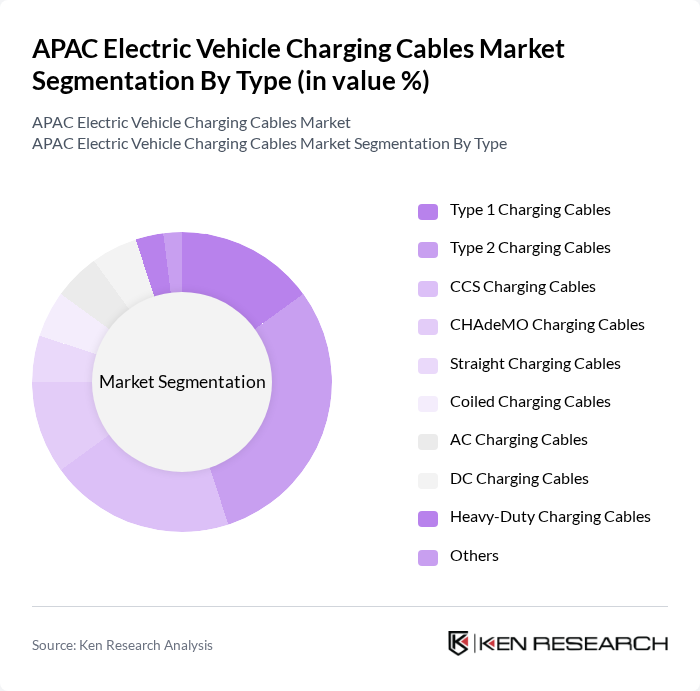
By Type:The market is segmented into various types of charging cables, including Type 1 Charging Cables, Type 2 Charging Cables, CCS Charging Cables, CHAdeMO Charging Cables, Straight Charging Cables, Coiled Charging Cables, AC Charging Cables, DC Charging Cables, Heavy-Duty Charging Cables, and Others. Type 2 Charging Cables currently hold the largest market share, driven by their broad compatibility with various electric vehicle models and widespread adoption in both public and private charging stations. The proliferation of EVs supporting Type 2 connectors and the preference for higher charging speeds have reinforced their position as the preferred choice among consumers and commercial operators .
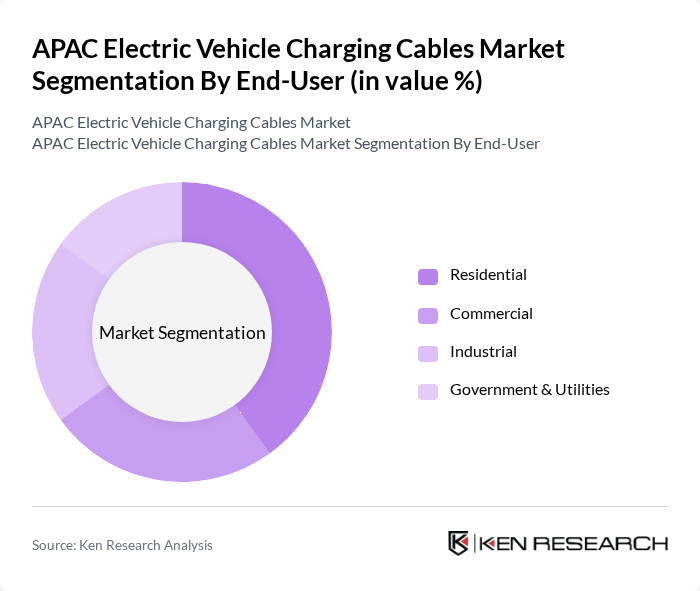
By End-User:The market is segmented by end-user into Residential, Commercial, Industrial, and Government & Utilities. The Residential segment leads the market, fueled by the rising number of EV owners opting for home charging solutions. Convenience, coupled with the increasing availability of residential charging stations and government incentives for home installations, continues to drive growth in this segment. Commercial and industrial segments are also expanding rapidly due to fleet electrification and the rollout of workplace and public charging infrastructure .
The APAC Electric Vehicle Charging Cables Market is characterized by a dynamic mix of regional and international players. Leading participants such as ABB Ltd., Schneider Electric SE, Siemens AG, Leviton Manufacturing Co., Inc., Eaton Corporation plc, Tesla, Inc., Blink Charging Co., ChargePoint, Inc., Webasto SE, Panasonic Corporation, Noodoe Inc., ClipperCreek, Inc., EVBox Group, Tritium DCFC Limited, Wallbox N.V., Sumitomo Electric Industries, Ltd., TE Connectivity Ltd., BizLink Group, Phoenix Contact E-Mobility GmbH, Sinbon Electronics Co., Ltd. contribute to innovation, geographic expansion, and service delivery in this space.
The future of the APAC electric vehicle charging cables market appears promising, driven by ongoing advancements in technology and increasing government support. As the region aims for carbon neutrality in future, the demand for electric vehicles and their associated infrastructure will continue to rise. The integration of renewable energy sources into charging solutions is expected to enhance sustainability. Additionally, the growing trend of smart charging systems will likely improve user experience and operational efficiency, further propelling market growth in the coming years.
| Segment | Sub-Segments |
|---|---|
| By Type | Type 1 Charging Cables Type 2 Charging Cables CCS Charging Cables CHAdeMO Charging Cables Straight Charging Cables Coiled Charging Cables AC Charging Cables DC Charging Cables Heavy-Duty Charging Cables Others |
| By End-User | Residential Commercial Industrial Government & Utilities |
| By Region | China Japan South Korea India Australia Southeast Asia Rest of APAC |
| By Application | Public Charging Stations Private Charging Stations Fleet Charging Solutions Workplace Charging |
| By Investment Source | Domestic Investment Foreign Direct Investment (FDI) Public-Private Partnerships (PPP) Government Schemes |
| By Distribution Mode | Online Sales Offline Retail Direct Sales |
| By Price Range | Budget Range Mid-Range Premium Range Others |
| Scope Item/Segment | Sample Size | Target Respondent Profiles |
|---|---|---|
| Electric Vehicle Manufacturers | 100 | Product Managers, R&D Engineers |
| Charging Station Operators | 80 | Operations Managers, Technical Directors |
| Electric Vehicle Charging Cable Manufacturers | 70 | Production Managers, Quality Assurance Heads |
| Regulatory Bodies and Policy Makers | 40 | Policy Analysts, Regulatory Affairs Managers |
| Installation and Maintenance Professionals | 60 | Field Technicians, Electrical Engineers |
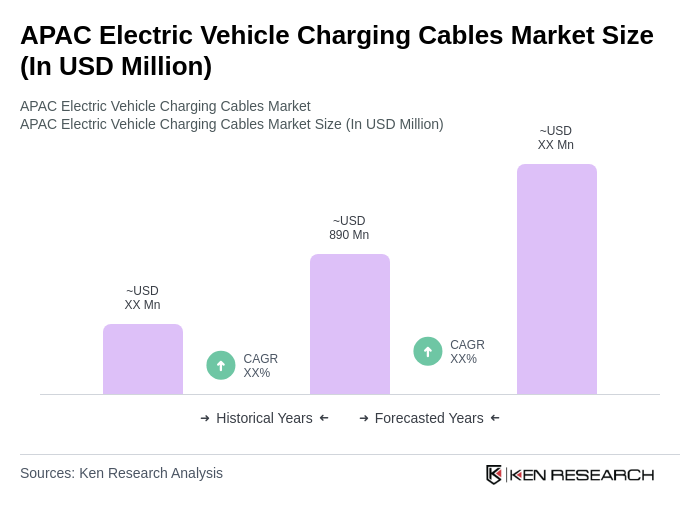
The APAC Electric Vehicle Charging Cables Market is valued at approximately USD 890 million, driven by the increasing adoption of electric vehicles and significant investments in charging infrastructure across the region.

What makes us stand out is that our consultants follow Robust, Refine and Result (RRR) methodology. Robust for clear definitions, approaches and sanity checking, Refine for differentiating respondents' facts and opinions, and Result for presenting data with story.

We have set a benchmark in the industry by offering our clients with syndicated and customized market research reports featuring coverage of entire market as well as meticulous research and analyst insights.

While we don't replace traditional research, we flip the method upside down. Our dual approach of Top Bottom & Bottom Top ensures quality deliverable by not just verifying company fundamentals but also looking at the sector and macroeconomic factors.

With one step in the future, our research team constantly tries to show you the bigger picture. We help with some of the tough questions you may encounter along the way: How is the industry positioned? Best marketing channel? KPI's of competitors? By aligning every element, we help maximize success.

Our report gives you instant access to the answers and sources that other companies might choose to hide. We elaborate each steps of research methodology we have used and showcase you the sample size to earn your trust.

If you need any support, we are here! We pride ourselves on universe strength, data quality, and quick, friendly, and professional service.













