Region:Asia
Author(s):Shubham
Product Code:KRAA8722
Pages:91
Published On:November 2025
By Type:The fencing market can be segmented into various types, including Chain Link Fencing, Wooden Fencing, Vinyl Fencing, Electric Fencing, Composite Fencing, Barbed Wire Fencing, Concrete Fencing, Welded Wire Fencing, and Others. Among these, Chain Link Fencing is the most dominant due to its cost-effectiveness, durability, and versatility, making it a preferred choice for both residential and commercial applications. The increasing focus on security and the need for affordable fencing solutions have further propelled its demand.

By End-User:The end-user segmentation includes Residential, Commercial, Industrial, Government & Utilities, Agriculture, Mining & Energy, and Others. The Residential segment leads the market, driven by increasing home security concerns and the trend of home improvement projects. Consumers are increasingly investing in fencing solutions to enhance property value and ensure safety, which has led to a significant rise in demand within this segment. The residential sector benefits from property value enhancement of 3-6% through fencing installations, while agricultural applications have expanded significantly due to increased livestock farming across India and Southeast Asia.

The APAC Fencing Market is characterized by a dynamic mix of regional and international players. Leading participants such as Tata Steel, JSW Steel, Saint-Gobain, Bekaert, Betafence, Master Halco, Fortress Fencing, Ameristar Fence Products, Long Fence, Merchants Metals, Zhejiang Dahua Metal Products Co., Ltd., Hebei Anping Shengxin Metal Wire Mesh Co., Ltd., Australian Fencing Supplies, ITOCHU Corporation, PT. Kencana Mulia Sejahtera contribute to innovation, geographic expansion, and service delivery in this space.
The APAC fencing market is poised for significant evolution, driven by technological advancements and increasing urbanization. As smart fencing solutions gain traction, the integration of IoT technologies will enhance security and monitoring capabilities. Additionally, the growing emphasis on eco-friendly materials will likely reshape product offerings, aligning with global sustainability trends. Companies that adapt to these changes and invest in innovative solutions will be well-positioned to capture emerging market opportunities and address evolving consumer needs.
| Segment | Sub-Segments |
|---|---|
| By Type | Chain Link Fencing Wooden Fencing Vinyl Fencing Electric Fencing Composite Fencing Barbed Wire Fencing Concrete Fencing Welded Wire Fencing Others |
| By End-User | Residential Commercial Industrial Government & Utilities Agriculture Mining & Energy Others |
| By Region | China India Japan South Korea Australia Southeast Asia Others |
| By Application | Security Fencing Agricultural Fencing Decorative Fencing Sports Fencing Temporary Fencing Others |
| By Material | Steel Aluminum Wood PVC/Vinyl Concrete Others |
| By Installation Type | DIY Installation Professional Installation Others |
| By Pricing Model | Premium Mid-range Budget Others |
| Scope Item/Segment | Sample Size | Target Respondent Profiles |
|---|---|---|
| Fencing Equipment Retailers | 100 | Store Managers, Sales Representatives |
| Fencing Coaches and Trainers | 70 | Head Coaches, Assistant Coaches |
| Fencing Event Organizers | 50 | Event Coordinators, Sports Administrators |
| Fencing Club Administrators | 60 | Club Managers, Program Directors |
| Sports Equipment Manufacturers | 80 | Product Managers, Marketing Directors |
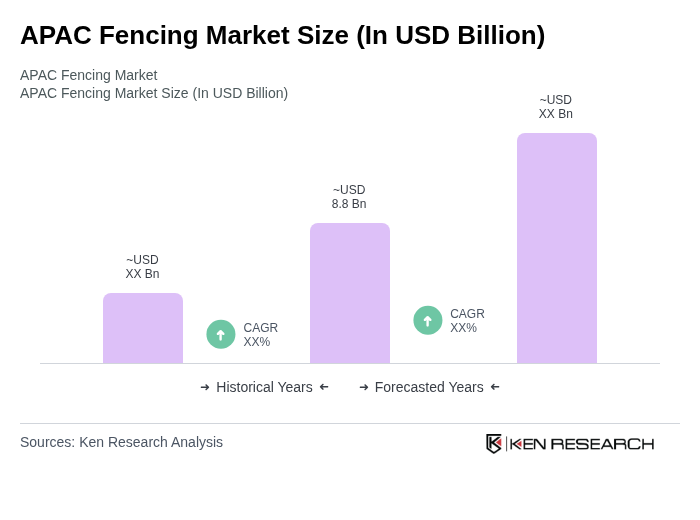
The APAC Fencing Market is valued at approximately USD 8.8 billion, driven by urbanization, infrastructure development, and increasing security concerns across the region. This growth reflects a significant demand for both security and decorative fencing solutions in residential and commercial sectors.

What makes us stand out is that our consultants follow Robust, Refine and Result (RRR) methodology. Robust for clear definitions, approaches and sanity checking, Refine for differentiating respondents' facts and opinions, and Result for presenting data with story.

We have set a benchmark in the industry by offering our clients with syndicated and customized market research reports featuring coverage of entire market as well as meticulous research and analyst insights.

While we don't replace traditional research, we flip the method upside down. Our dual approach of Top Bottom & Bottom Top ensures quality deliverable by not just verifying company fundamentals but also looking at the sector and macroeconomic factors.

With one step in the future, our research team constantly tries to show you the bigger picture. We help with some of the tough questions you may encounter along the way: How is the industry positioned? Best marketing channel? KPI's of competitors? By aligning every element, we help maximize success.

Our report gives you instant access to the answers and sources that other companies might choose to hide. We elaborate each steps of research methodology we have used and showcase you the sample size to earn your trust.

If you need any support, we are here! We pride ourselves on universe strength, data quality, and quick, friendly, and professional service.













