About the Report
Base Year 2024Listen to the audio summary
APAC Lottery Market Overview
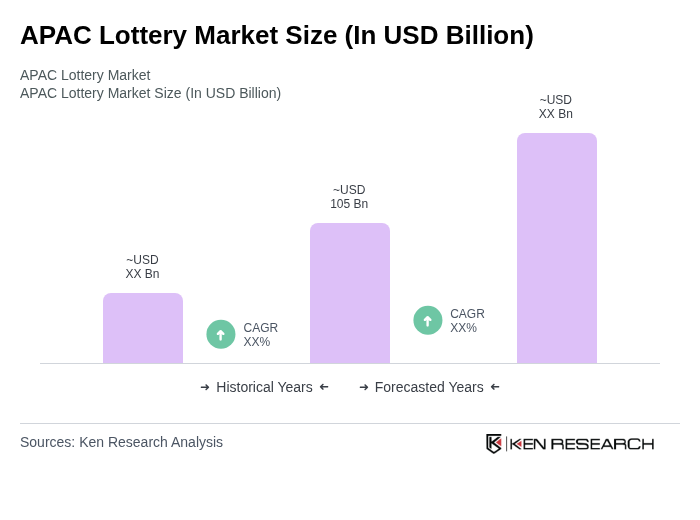
- The APAC Lottery Market is valued at USD 105 billion, based on a five-year historical analysis. This growth is primarily driven by increasing disposable incomes, urbanization, and the rising popularity of online gaming platforms. The market has seen a significant shift towards digital lottery solutions, which cater to the tech-savvy population in the region.
- Countries such as China, Japan, and Australia dominate the APAC Lottery Market due to their large populations, established gaming regulations, and cultural acceptance of lottery games. These nations have well-developed infrastructure and a strong presence of both traditional and online lottery systems, contributing to their market leadership.
- In 2023, the government of Japan implemented a new regulation aimed at enhancing the transparency and security of lottery operations. This regulation mandates that all lottery operators must adopt advanced technology for ticket sales and prize distribution, ensuring a fair and secure gaming environment for consumers.
APAC Lottery Market Segmentation
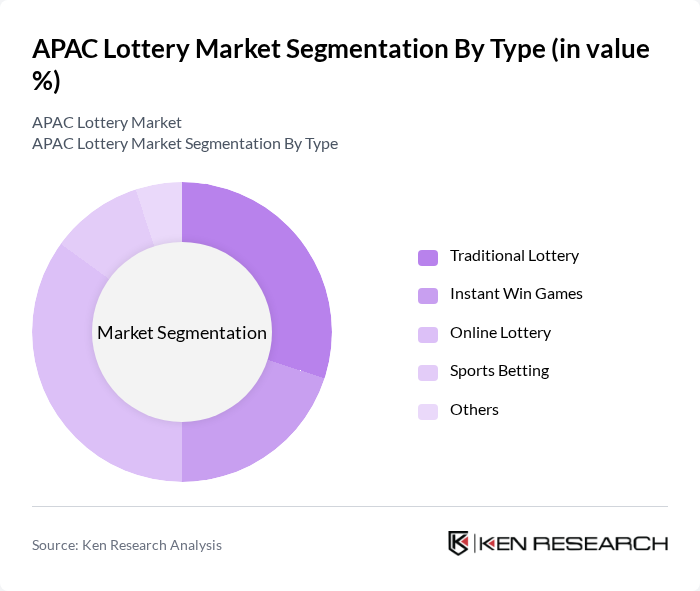
By Type:The APAC Lottery Market is segmented into various types, including Traditional Lottery, Instant Win Games, Online Lottery, Sports Betting, and Others. Among these, Online Lottery has gained significant traction due to the increasing penetration of smartphones and internet access, allowing players to participate conveniently from anywhere. Traditional Lottery remains popular, especially in regions with established practices, while Instant Win Games and Sports Betting are also witnessing growth due to changing consumer preferences.
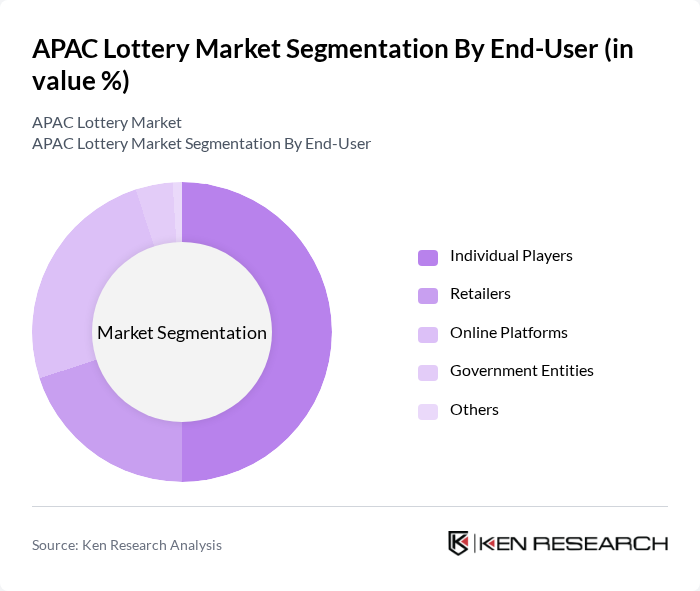
By End-User:The market is also segmented by end-users, which include Individual Players, Retailers, Online Platforms, Government Entities, and Others. Individual Players dominate the market as they represent the largest consumer base, driven by the increasing popularity of lottery games. Online Platforms are also gaining ground, providing a convenient way for players to engage with lottery games, while Government Entities play a crucial role in regulating and overseeing lottery operations.
APAC Lottery Market Competitive Landscape
The APAC Lottery Market is characterized by a dynamic mix of regional and international players. Leading participants such as Singapore Pools, Tatts Group, Hong Kong Jockey Club, Intralot, Scientific Games, Camelot, Lottomatica, Veikkaus, Lotto NZ, Philippine Charity Sweepstakes Office, Malaysia Sports Toto, New Zealand Lotteries, Sugalaya, BCLC (British Columbia Lottery Corporation), Lotería Nacional de España contribute to innovation, geographic expansion, and service delivery in this space.
APAC Lottery Market Industry Analysis
Growth Drivers
- Increasing Disposable Income:The APAC region has witnessed a significant rise in disposable income, with an average increase of 5.5% annually, reaching approximately $4,500 per capita in future. This economic growth enables consumers to allocate more funds towards discretionary spending, including lottery participation. Countries like China and India are leading this trend, with disposable incomes projected to rise by $1,200 and $1,000 respectively, fostering a more favorable environment for lottery sales and engagement.
- Technological Advancements in Lottery Systems:The integration of advanced technologies in lottery systems has revolutionized the industry. In future, the global investment in lottery technology is expected to exceed $1.5 billion, enhancing user experience through improved security and accessibility. Innovations such as biometric authentication and real-time data analytics are becoming standard, allowing operators to streamline operations and attract tech-savvy consumers, particularly in urban areas across APAC.
- Rising Popularity of Online Lottery Platforms:Online lottery platforms are experiencing exponential growth, with user registrations increasing by 35% year-on-year, reaching over 60 million users in future. This surge is driven by the convenience of mobile access and the proliferation of smartphones, with over 85% of the population in urban APAC countries owning a smartphone. The shift towards digital platforms is reshaping consumer behavior, making lottery participation more accessible and appealing to younger demographics.
Market Challenges
- Regulatory Hurdles:The lottery industry in APAC faces significant regulatory challenges, with over 65% of countries implementing stringent licensing requirements. For instance, in India, the lack of a unified regulatory framework complicates operations for lottery operators, leading to inconsistencies and legal uncertainties. These hurdles can deter investment and innovation, ultimately stifling market growth and limiting consumer access to legitimate lottery options.
- Competition from Illegal Lottery Operations:Illegal lottery operations pose a substantial threat to the legitimate market, with estimates suggesting that they account for nearly 45% of total lottery sales in some APAC countries. The prevalence of unregulated online platforms undermines consumer trust and siphons revenue from government-sanctioned lotteries. This challenge necessitates stronger enforcement measures and public awareness campaigns to protect consumers and ensure fair competition.
APAC Lottery Market Future Outlook
The APAC lottery market is poised for transformative growth, driven by technological innovations and evolving consumer preferences. As digital platforms gain traction, operators are likely to enhance user engagement through personalized experiences and gamification strategies. Additionally, the integration of blockchain technology may improve transparency and security, fostering consumer trust. With increasing government support for regulated lotteries, the market is expected to adapt to changing dynamics, creating a more robust and sustainable environment for growth.
Market Opportunities
- Expansion of Mobile Lottery Applications:The rise of mobile lottery applications presents a significant opportunity, with downloads projected to reach 120 million by the end of future. This trend is driven by the increasing smartphone penetration and consumer preference for convenience, allowing operators to tap into a broader audience and enhance user engagement through interactive features and real-time updates.
- Partnerships with Local Businesses:Collaborations with local businesses can enhance lottery visibility and accessibility, potentially increasing sales by 25% in targeted regions. By leveraging local networks and marketing channels, lottery operators can create tailored promotions that resonate with community values, driving participation and fostering a sense of local pride in supporting state-sponsored initiatives.
Scope of the Report
| Segment | Sub-Segments |
|---|---|
| By Type | Traditional Lottery Instant Win Games Online Lottery Sports Betting Others |
| By End-User | Individual Players Retailers Online Platforms Government Entities Others |
| By Region | East Asia Southeast Asia South Asia Oceania |
| By Game Format | Number Draw Games Scratch-Off Games Keno Others |
| By Distribution Channel | Retail Outlets Online Platforms Mobile Applications Others |
| By Prize Structure | Fixed Prize Progressive Jackpot Others |
| By Marketing Strategy | Digital Marketing Traditional Advertising Promotions and Discounts Others |
Key Target Audience
Investors and Venture Capitalist Firms
Government and Regulatory Bodies (e.g., National Lottery Authority, Gaming Commission)
Lottery Operators and Administrators
Technology Providers and Software Developers
Advertising and Marketing Agencies
Retail Partners and Distribution Networks
Payment Processing Companies
Legal and Compliance Advisors
Players Mentioned in the Report:
Singapore Pools
Tatts Group
Hong Kong Jockey Club
Intralot
Scientific Games
Camelot
Lottomatica
Veikkaus
Lotto NZ
Philippine Charity Sweepstakes Office
Malaysia Sports Toto
New Zealand Lotteries
Sugalaya
BCLC (British Columbia Lottery Corporation)
Loteria Nacional de Espana
Table of Contents
Market Assessment Phase
1. Executive Summary and Approach
2. APAC Lottery Market Overview
2.1 Key Insights and Strategic Recommendations
2.2 APAC Lottery Market Overview
2.3 Definition and Scope
2.4 Evolution of Market Ecosystem
2.5 Timeline of Key Regulatory Milestones
2.6 Value Chain & Stakeholder Mapping
2.7 Business Cycle Analysis
2.8 Policy & Incentive Landscape
3. APAC Lottery Market Analysis
3.1 Growth Drivers
3.1.1 Increasing disposable income
3.1.2 Technological advancements in lottery systems
3.1.3 Rising popularity of online lottery platforms
3.1.4 Government support and regulation
3.2 Market Challenges
3.2.1 Regulatory hurdles
3.2.2 Competition from illegal lottery operations
3.2.3 Public perception and stigma
3.2.4 Economic fluctuations affecting consumer spending
3.3 Market Opportunities
3.3.1 Expansion of mobile lottery applications
3.3.2 Partnerships with local businesses
3.3.3 Introduction of new game formats
3.3.4 Increasing digital marketing efforts
3.4 Market Trends
3.4.1 Growth of social media engagement
3.4.2 Integration of blockchain technology
3.4.3 Focus on responsible gaming initiatives
3.4.4 Emergence of personalized lottery experiences
3.5 Government Regulation
3.5.1 Licensing requirements for operators
3.5.2 Age restrictions for lottery participation
3.5.3 Taxation policies on lottery winnings
3.5.4 Advertising regulations for lottery promotions
4. SWOT Analysis
5. Stakeholder Analysis
6. Porter's Five Forces Analysis
7. APAC Lottery Market Market Size, 2019-2024
7.1 By Value
7.2 By Volume
7.3 By Average Selling Price
8. APAC Lottery Market Segmentation
8.1 By Type
8.1.1 Traditional Lottery
8.1.2 Instant Win Games
8.1.3 Online Lottery
8.1.4 Sports Betting
8.1.5 Others
8.2 By End-User
8.2.1 Individual Players
8.2.2 Retailers
8.2.3 Online Platforms
8.2.4 Government Entities
8.2.5 Others
8.3 By Region
8.3.1 East Asia
8.3.2 Southeast Asia
8.3.3 South Asia
8.3.4 Oceania
8.4 By Game Format
8.4.1 Number Draw Games
8.4.2 Scratch-Off Games
8.4.3 Keno
8.4.4 Others
8.5 By Distribution Channel
8.5.1 Retail Outlets
8.5.2 Online Platforms
8.5.3 Mobile Applications
8.5.4 Others
8.6 By Prize Structure
8.6.1 Fixed Prize
8.6.2 Progressive Jackpot
8.6.3 Others
8.7 By Marketing Strategy
8.7.1 Digital Marketing
8.7.2 Traditional Advertising
8.7.3 Promotions and Discounts
8.7.4 Others
9. APAC Lottery Market Competitive Analysis
9.1 Market Share of Key Players
9.2 Cross Comparison of Key Players
9.2.1 Company Name
9.2.2 Group Size (Large, Medium, or Small as per industry convention)
9.2.3 Revenue Growth Rate
9.2.4 Customer Acquisition Cost
9.2.5 Market Penetration Rate
9.2.6 Customer Retention Rate
9.2.7 Pricing Strategy
9.2.8 Average Ticket Sales per Game
9.2.9 Digital Engagement Metrics
9.2.10 Brand Recognition Score
9.3 SWOT Analysis of Top Players
9.4 Pricing Analysis
9.5 Detailed Profile of Major Companies
9.5.1 Singapore Pools
9.5.2 Tatts Group
9.5.3 Hong Kong Jockey Club
9.5.4 Intralot
9.5.5 Scientific Games
9.5.6 Camelot
9.5.7 Lottomatica
9.5.8 Veikkaus
9.5.9 Lotto NZ
9.5.10 Philippine Charity Sweepstakes Office
9.5.11 Malaysia Sports Toto
9.5.12 New Zealand Lotteries
9.5.13 Sugalaya
9.5.14 BCLC (British Columbia Lottery Corporation)
9.5.15 Lotería Nacional de España
10. APAC Lottery Market End-User Analysis
10.1 Procurement Behavior of Key Ministries
10.1.1 Budget Allocation for Lottery Programs
10.1.2 Decision-Making Processes
10.1.3 Evaluation Criteria for Lottery Partnerships
10.1.4 Compliance and Regulatory Considerations
10.2 Corporate Spend on Infrastructure & Energy
10.2.1 Investment in Lottery Infrastructure
10.2.2 Spending on Technology Upgrades
10.2.3 Budget for Marketing and Promotions
10.2.4 Allocation for Responsible Gaming Initiatives
10.3 Pain Point Analysis by End-User Category
10.3.1 Accessibility Issues
10.3.2 Trust and Transparency Concerns
10.3.3 Game Variety Limitations
10.3.4 Customer Support Challenges
10.4 User Readiness for Adoption
10.4.1 Awareness of Lottery Options
10.4.2 Comfort with Online Transactions
10.4.3 Engagement with Lottery Promotions
10.4.4 Feedback Mechanisms
10.5 Post-Deployment ROI and Use Case Expansion
10.5.1 Measurement of Lottery Success
10.5.2 User Retention Strategies
10.5.3 Expansion into New Game Formats
10.5.4 Long-term Engagement Plans
11. APAC Lottery Market Future Size, 2025-2030
11.1 By Value
11.2 By Volume
11.3 By Average Selling Price
Go-To-Market Strategy Phase
1. Whitespace Analysis + Business Model Canvas
1.1 Market Gaps Identification
1.2 Business Model Development
2. Marketing and Positioning Recommendations
2.1 Branding Strategies
2.2 Product USPs
3. Distribution Plan
3.1 Urban Retail vs Rural NGO Tie-ups
4. Channel & Pricing Gaps
4.1 Underserved Routes
4.2 Pricing Bands
5. Unmet Demand & Latent Needs
5.1 Category Gaps
5.2 Consumer Segments
6. Customer Relationship
6.1 Loyalty Programs
6.2 After-sales Service
7. Value Proposition
7.1 Sustainability
7.2 Integrated Supply Chains
8. Key Activities
8.1 Regulatory Compliance
8.2 Branding
8.3 Distribution Setup
9. Entry Strategy Evaluation
9.1 Domestic Market Entry Strategy
9.1.1 Product Mix
9.1.2 Pricing Band
9.1.3 Packaging
9.2 Export Entry Strategy
9.2.1 Target Countries
9.2.2 Compliance Roadmap
10. Entry Mode Assessment
10.1 JV
10.2 Greenfield
10.3 M&A
10.4 Distributor Model
11. Capital and Timeline Estimation
11.1 Capital Requirements
11.2 Timelines
12. Control vs Risk Trade-Off
12.1 Ownership vs Partnerships
13. Profitability Outlook
13.1 Breakeven Analysis
13.2 Long-term Sustainability
14. Potential Partner List
14.1 Distributors
14.2 JVs
14.3 Acquisition Targets
15. Execution Roadmap
15.1 Phased Plan for Market Entry
15.1.1 Market Setup
15.1.2 Market Entry
15.1.3 Growth Acceleration
15.1.4 Scale & Stabilize
15.2 Key Activities and Milestones
15.2.1 Milestone Planning
Research Methodology
Phase 1: Approach1
Desk Research
- Analysis of market reports from government agencies and industry associations in the APAC region
- Review of academic journals and publications focusing on lottery market trends and consumer behavior
- Examination of financial reports and press releases from major lottery operators across APAC countries
Primary Research
- Interviews with executives from national lottery organizations and private lottery operators
- Surveys targeting lottery players to understand preferences and spending habits
- Focus group discussions with stakeholders in the gaming and entertainment sectors
Validation & Triangulation
- Cross-validation of findings through comparison with historical lottery revenue data
- Triangulation of insights from primary interviews with secondary data sources
- Sanity checks conducted through expert panels comprising industry veterans and analysts
Phase 2: Market Size Estimation1
Top-down Assessment
- Estimation of total lottery market size based on GDP contribution from gaming sectors in APAC
- Segmentation of market size by lottery type (e.g., traditional, online, instant) and geography
- Incorporation of regulatory impacts and changes in consumer spending patterns
Bottom-up Modeling
- Collection of sales data from major lottery operators to establish baseline revenue figures
- Analysis of ticket sales volume and average ticket price across different lottery formats
- Estimation of growth rates based on historical performance and emerging market trends
Forecasting & Scenario Analysis
- Development of predictive models using historical data and market growth drivers
- Scenario analysis based on potential regulatory changes and technological advancements in lottery systems
- Creation of multiple forecasts (baseline, optimistic, and pessimistic) through 2030
Phase 3: CATI Sample Composition1
| Scope Item/Segment | Sample Size | Target Respondent Profiles |
|---|---|---|
| National Lottery Participation | 120 | Lottery Players, Marketing Managers |
| Online Lottery Engagement | 100 | Digital Marketing Specialists, Online Players |
| Instant Win Games | 80 | Retail Managers, Game Developers |
| Regulatory Impact Assessment | 60 | Regulatory Officials, Compliance Officers |
| Consumer Behavior Analysis | 90 | Lottery Enthusiasts, Market Researchers |
Frequently Asked Questions
What is the current value of the APAC Lottery Market?
The APAC Lottery Market is valued at approximately USD 105 billion, reflecting significant growth driven by increasing disposable incomes, urbanization, and the rising popularity of online gaming platforms in the region.
Which countries dominate the APAC Lottery Market?
What recent regulations have been implemented in Japan's lottery sector?
What types of lotteries are prevalent in the APAC region?
Other Regional/Country Reports
Indonesia Lottery Market
Malaysia Lottery Market
KSA Lottery Market
SEA Lottery Market
Vietnam Lottery Market
Other Adjacent Reports
KSA Casino Gaming Market
Vietnam Mobile Gaming Market
Malaysia Digital Payment Market
Belgium Gaming Software Market
Oman Entertainment Market
Comoros Fintech Market Regulatory Compliance MarketSoutheast Asia Advertising MarketWhy Buy From Us?

What makes us stand out is that our consultants follow Robust, Refine and Result (RRR) methodology. Robust for clear definitions, approaches and sanity checking, Refine for differentiating respondents' facts and opinions, and Result for presenting data with story.

We have set a benchmark in the industry by offering our clients with syndicated and customized market research reports featuring coverage of entire market as well as meticulous research and analyst insights.

While we don't replace traditional research, we flip the method upside down. Our dual approach of Top Bottom & Bottom Top ensures quality deliverable by not just verifying company fundamentals but also looking at the sector and macroeconomic factors.

With one step in the future, our research team constantly tries to show you the bigger picture. We help with some of the tough questions you may encounter along the way: How is the industry positioned? Best marketing channel? KPI's of competitors? By aligning every element, we help maximize success.

Our report gives you instant access to the answers and sources that other companies might choose to hide. We elaborate each steps of research methodology we have used and showcase you the sample size to earn your trust.

If you need any support, we are here! We pride ourselves on universe strength, data quality, and quick, friendly, and professional service.