Apac Polyhydroxyalkanoates Pha Films Market Report Size, Share, Growth Drivers, Trends, Opportunities & Forecast 2025–2030

The APAC PHA Films Market, worth USD 4.6 Bn, grows with rising eco-friendly material demand in packaging and agriculture across China, Japan, South Korea, and India.

Region:Asia

Author(s):Rebecca

Product Code:KRAD5021

Pages:90

Published On:December 2025

About the Report

Base Year 2024

APAC Polyhydroxyalkanoates (PHA) Films Market Overview

  • The APAC Polyhydroxyalkanoates (PHA) Films Market is valued at approximately USD 4.6 billion, based on a five-year analysis. This growth is primarily driven by the increasing demand for biodegradable and compostable materials in packaging and agriculture, as well as rising consumer awareness regarding environmental sustainability. The shift towards eco-friendly alternatives to conventional plastics, especially in food and beverage, agriculture mulch films, and medical packaging, has significantly boosted the adoption of PHA films across various industries.
  • Key players in this market include China, Japan, South Korea, and India, which collectively drive regional growth due to their advanced manufacturing capabilities, strong research and development infrastructure, and supportive government policies promoting sustainable materials. These countries have established themselves as leading hubs for bioplastics production and application development, leveraging technological advancements, expanding agricultural and packaging sectors, and a growing consumer base focused on sustainability.
  • In India, plastic waste management and single-use plastic restrictions are accelerating the shift towards biodegradable materials in packaging for food and beverage and other consumer applications, supporting demand for PHA films in the region. The Plastic Waste Management (Amendment) Rules, 2021 issued by the Ministry of Environment, Forest and Climate Change introduced phased prohibitions on identified single-use plastic items and mandated extended producer responsibility for plastic packaging, encouraging the adoption of certified compostable and biodegradable alternatives, including PHA-based films, by packaging value-chain stakeholders.
APAC Polyhydroxyalkanoates (PHA) Films Market Size

APAC Polyhydroxyalkanoates (PHA) Films Market Segmentation

By Type:The market is segmented into various types of PHA films, including Short-chain-length (SCL) PHA films, Medium-chain-length (MCL) PHA films, PHA blends with other biopolymers (e.g., PLA, PBAT, starch), and PHA-based multilayer and coated films. SCL PHA films, such as poly(3-hydroxybutyrate) and its copolymers, are widely adopted due to their good stiffness, tensile strength, and high biodegradability in industrial composting and soil environments, making them suitable for packaging and agricultural films. MCL PHA films offer higher flexibility and toughness, which make them attractive in medical, hygiene, and specialty packaging applications, while PHA blends and multilayer structures are increasingly used to tailor barrier, processability, and cost-performance balance for food packaging and functional agricultural films.
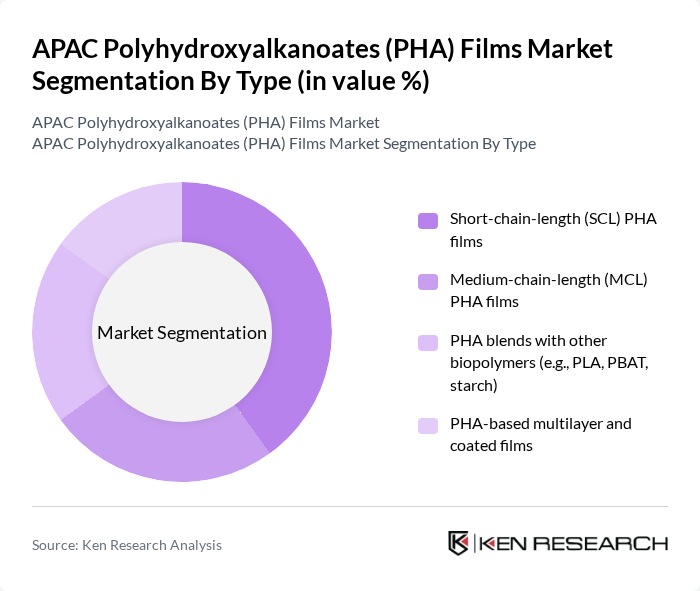
APAC Polyhydroxyalkanoates (PHA) Films Market segmentation by Type.

By End-User:The end-user segmentation includes Food & beverage packaging, Consumer goods & retail packaging, Agriculture & horticulture (mulch and agricultural films), Medical & healthcare packaging, and Others. The food and beverage packaging segment is the most significant, aligned with industry analyses indicating that food and beverage packaging accounts for around half of global PHA film demand, supported by brand-owner sustainability targets and regulations on single-use plastics. Agriculture and horticulture use of PHA films, particularly mulch films and controlled-release applications, is also expanding rapidly in Asia Pacific as growers look for biodegradable solutions that avoid soil contamination from conventional polyethylene films.
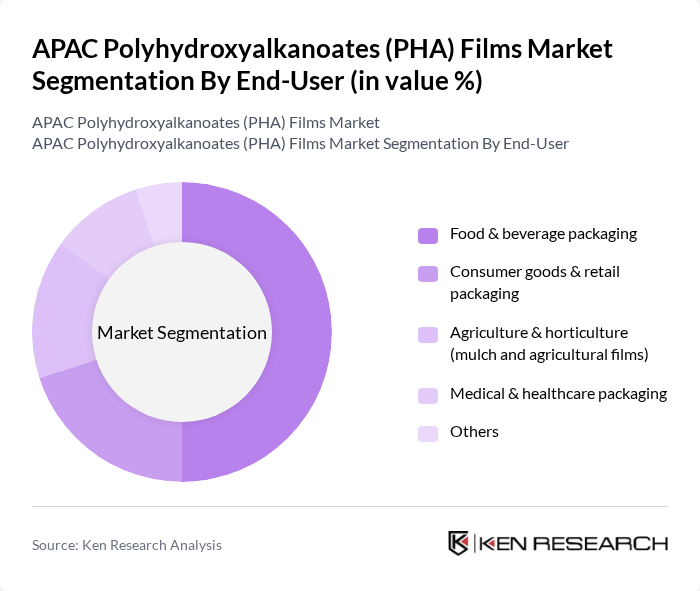
APAC Polyhydroxyalkanoates (PHA) Films Market segmentation by End-User.

APAC Polyhydroxyalkanoates (PHA) Films Market Competitive Landscape

The APAC Polyhydroxyalkanoates (PHA) Films Market is characterized by a dynamic mix of regional and international players. Leading participants such as Kaneka Corporation, Danimer Scientific, Inc., CJ Biomaterials, Inc. (CJ CheilJedang), Tianjin GreenBio Materials Co., Ltd., Bluepha Co., Ltd., PolyFerm Canada, Inc., Newlight Technologies, Inc., Full Cycle Bioplastics, Inc., RWDC Industries Limited, Mango Materials, Inc., NatureWorks LLC, Danone SA (PHA-based packaging initiatives in APAC), BASF SE (biodegradable polymer solutions in APAC), TotalEnergies Corbion PLA (complementary biopolymer films in APAC), FKuR Kunststoff GmbH contribute to innovation, geographic expansion, and service delivery in this space.

Kaneka Corporation

1949

Osaka, Japan

Danimer Scientific, Inc.

2004

Bainbridge, Georgia, USA

CJ Biomaterials, Inc. (CJ CheilJedang)

1953

Seoul, South Korea

Tianjin GreenBio Materials Co., Ltd.

2009

Tianjin, China

Bluepha Co., Ltd.

2016

Beijing, China

Company

Establishment Year

Headquarters

Group size (Large, Medium, or Small as per industry convention)

APAC PHA films revenue and 3-year CAGR

APAC PHA films capacity (kilo tons/year) and utilization rate

Application mix (share of packaging, agriculture, medical, others)

Market penetration (number of APAC countries served, key customers)

Average selling price band and pricing strategy

APAC Polyhydroxyalkanoates (PHA) Films Market Industry Analysis

Growth Drivers

  • Increasing Demand for Biodegradable Materials:The global biodegradable materials market is projected to reach $15 billion by 2025, driven by heightened consumer demand for sustainable alternatives. In the APAC region, the demand for biodegradable films, including PHA, is expected to grow significantly, with countries like Japan and South Korea leading the charge. This shift is supported by a 20% annual increase in eco-friendly product purchases, reflecting a strong consumer preference for sustainable packaging solutions.
  • Government Initiatives Promoting Sustainable Packaging:Governments across the APAC region are implementing policies to reduce plastic waste, with initiatives such as the ban on single-use plastics in countries like India and Thailand. In future, it is estimated that over 40% of APAC countries will have adopted regulations favoring biodegradable materials. This regulatory environment is fostering investment in PHA film production, as companies seek to comply with new standards and capitalize on government incentives.
  • Rising Consumer Awareness Regarding Environmental Issues:A recent survey indicated that 75% of consumers in the APAC region are willing to pay a premium for eco-friendly products. This growing awareness is driving demand for PHA films, as consumers increasingly prioritize sustainability in their purchasing decisions. The rise in environmental consciousness is also reflected in the 30% increase in sales of biodegradable products over the past two years, indicating a robust market shift towards sustainable options.

Market Challenges

  • High Production Costs of PHA Films:The production cost of PHA films remains a significant barrier, with estimates indicating costs are approximately 25% higher than conventional plastic films. This price disparity is primarily due to the complex fermentation processes required for PHA production. As of future, the average cost of producing PHA is around $2,500 per ton, which limits its competitiveness in price-sensitive markets, hindering broader adoption.
  • Limited Availability of Raw Materials:The production of PHA films relies on specific feedstocks, such as plant oils and sugars, which are not always readily available. In future, the supply of these raw materials is projected to be constrained, with a 15% increase in demand for agricultural products globally. This scarcity can lead to volatility in raw material prices, further complicating the production landscape for PHA films in the APAC region.

APAC Polyhydroxyalkanoates (PHA) Films Market Future Outlook

The APAC PHA films market is poised for significant growth as sustainability becomes a central focus for both consumers and businesses. With increasing regulatory support and a shift towards circular economy practices, companies are likely to invest in innovative production methods and applications. The anticipated rise in eco-labeling and consumer preference for biodegradable products will further drive market expansion. As the industry adapts to these trends, collaboration between manufacturers and packaging companies will be crucial for overcoming existing challenges and capitalizing on emerging opportunities.

Market Opportunities

  • Expansion into New Geographical Markets:Companies can explore untapped markets in Southeast Asia, where demand for sustainable packaging is on the rise. With a projected market growth rate of 10% in these regions, entering new territories can significantly enhance revenue streams and market presence for PHA films.
  • Development of Innovative PHA Film Applications:There is a growing opportunity to develop specialized PHA film applications in sectors such as agriculture and food packaging. Innovations in these areas could lead to a 20% increase in market share, as businesses seek to differentiate their products and meet specific consumer needs for sustainability.

Scope of the Report

SegmentSub-Segments
By Type

Short-chain-length (SCL) PHA films

Medium-chain-length (MCL) PHA films

PHA blends with other biopolymers (e.g., PLA, PBAT, starch)

PHA-based multilayer and coated films

By End-User

Food & beverage packaging

Consumer goods & retail packaging

Agriculture & horticulture (mulch and agricultural films)

Medical & healthcare packaging

Others

By Region

China

Japan

South Korea

India

Southeast Asia (Indonesia, Thailand, Malaysia, Vietnam, others)

Rest of APAC (Australia, New Zealand, others)

By Application

Packaging films (flexible)

Packaging films (rigid & semi-rigid)

Agricultural and mulch films

Biomedical and hygiene films

Others

By Market Channel

Direct sales to converters and brand owners

Distributors/compounders

Online and digital procurement platforms

Others

By Product Form

Monolayer films

Multilayer films

Shrink and stretch films

Bags, pouches, and converted film products

Others

By Sustainability Certification

Industrial compostable (e.g., EN 13432, ASTM D6400)

Home compostable certification

Marine and soil biodegradability certification

Bio-based carbon content certification

Others

Key Target Audience

Investors and Venture Capitalist Firms

Government and Regulatory Bodies (e.g., Ministry of Environment, Ministry of Industry and Trade)

Manufacturers and Producers of Bioplastics

Distributors and Retailers of Sustainable Packaging Solutions

Biotechnology Firms

Environmental NGOs and Advocacy Groups

Packaging Industry Associations

Financial Institutions and Investment Banks

Players Mentioned in the Report:

Kaneka Corporation

Danimer Scientific, Inc.

CJ Biomaterials, Inc. (CJ CheilJedang)

Tianjin GreenBio Materials Co., Ltd.

Bluepha Co., Ltd.

PolyFerm Canada, Inc.

Newlight Technologies, Inc.

Full Cycle Bioplastics, Inc.

RWDC Industries Limited

Mango Materials, Inc.

NatureWorks LLC

Danone SA (PHA-based packaging initiatives in APAC)

BASF SE (biodegradable polymer solutions in APAC)

TotalEnergies Corbion PLA (complementary biopolymer films in APAC)

FKuR Kunststoff GmbH

Table of Contents

Market Assessment Phase

1. Executive Summary and Approach


2. APAC Polyhydroxyalkanoates (PHA) Films Market Overview

2.1 Key Insights and Strategic Recommendations

2.2 APAC Polyhydroxyalkanoates (PHA) Films Market Overview

2.3 Definition and Scope

2.4 Evolution of Market Ecosystem

2.5 Timeline of Key Regulatory Milestones

2.6 Value Chain & Stakeholder Mapping

2.7 Business Cycle Analysis

2.8 Policy & Incentive Landscape


3. APAC Polyhydroxyalkanoates (PHA) Films Market Analysis

3.1 Growth Drivers

3.1.1 Increasing demand for biodegradable materials
3.1.2 Government initiatives promoting sustainable packaging
3.1.3 Rising consumer awareness regarding environmental issues
3.1.4 Technological advancements in PHA production

3.2 Market Challenges

3.2.1 High production costs of PHA films
3.2.2 Limited availability of raw materials
3.2.3 Competition from conventional plastic films
3.2.4 Regulatory hurdles in different APAC countries

3.3 Market Opportunities

3.3.1 Expansion into new geographical markets
3.3.2 Development of innovative PHA film applications
3.3.3 Collaborations with packaging companies
3.3.4 Investment in R&D for cost reduction

3.4 Market Trends

3.4.1 Growing trend towards circular economy
3.4.2 Increased focus on sustainable supply chains
3.4.3 Adoption of eco-labeling by brands
3.4.4 Rise in consumer preference for eco-friendly products

3.5 Government Regulation

3.5.1 Implementation of plastic bans in several APAC countries
3.5.2 Incentives for using biodegradable materials
3.5.3 Standards for PHA film production and usage
3.5.4 Regulations on waste management and recycling

4. SWOT Analysis


5. Stakeholder Analysis


6. Porter's Five Forces Analysis


7. APAC Polyhydroxyalkanoates (PHA) Films Market Market Size, 2019-2024

7.1 By Value

7.2 By Volume

7.3 By Average Selling Price


8. APAC Polyhydroxyalkanoates (PHA) Films Market Segmentation

8.1 By Type

8.1.1 Short-chain-length (SCL) PHA films
8.1.2 Medium-chain-length (MCL) PHA films
8.1.3 PHA blends with other biopolymers (e.g., PLA, PBAT, starch)
8.1.4 PHA-based multilayer and coated films

8.2 By End-User

8.2.1 Food & beverage packaging
8.2.2 Consumer goods & retail packaging
8.2.3 Agriculture & horticulture (mulch and agricultural films)
8.2.4 Medical & healthcare packaging
8.2.5 Others

8.3 By Region

8.3.1 China
8.3.2 Japan
8.3.3 South Korea
8.3.4 India
8.3.5 Southeast Asia (Indonesia, Thailand, Malaysia, Vietnam, others)
8.3.6 Rest of APAC (Australia, New Zealand, others)

8.4 By Application

8.4.1 Packaging films (flexible)
8.4.2 Packaging films (rigid & semi-rigid)
8.4.3 Agricultural and mulch films
8.4.4 Biomedical and hygiene films
8.4.5 Others

8.5 By Market Channel

8.5.1 Direct sales to converters and brand owners
8.5.2 Distributors/compounders
8.5.3 Online and digital procurement platforms
8.5.4 Others

8.6 By Product Form

8.6.1 Monolayer films
8.6.2 Multilayer films
8.6.3 Shrink and stretch films
8.6.4 Bags, pouches, and converted film products
8.6.5 Others

8.7 By Sustainability Certification

8.7.1 Industrial compostable (e.g., EN 13432, ASTM D6400)
8.7.2 Home compostable certification
8.7.3 Marine and soil biodegradability certification
8.7.4 Bio-based carbon content certification
8.7.5 Others

9. APAC Polyhydroxyalkanoates (PHA) Films Market Competitive Analysis

9.1 Market Share of Key Players

9.2 Cross Comparison of Key Players

9.2.1 Company name and headquarters (APAC footprint)
9.2.2 Group size (Large, Medium, or Small as per industry convention)
9.2.3 APAC PHA films revenue and 3-year CAGR
9.2.4 APAC PHA films capacity (kilo tons/year) and utilization rate
9.2.5 Application mix (share of packaging, agriculture, medical, others)
9.2.6 Market penetration (number of APAC countries served, key customers)
9.2.7 Average selling price band and pricing strategy
9.2.8 R&D intensity (R&D spend as % of sales, patent portfolio in PHA films)
9.2.9 Product portfolio breadth (grades, film formats, certifications)
9.2.10 Distribution and converter partnerships in APAC
9.2.11 Sustainability and circularity KPIs (GHG reduction, compostability, bio-based content)

9.3 SWOT Analysis of Top Players

9.4 Pricing Analysis

9.5 Detailed Profile of Major Companies

9.5.1 Kaneka Corporation
9.5.2 Danimer Scientific, Inc.
9.5.3 CJ Biomaterials, Inc. (CJ CheilJedang)
9.5.4 Tianjin GreenBio Materials Co., Ltd.
9.5.5 Bluepha Co., Ltd.
9.5.6 PolyFerm Canada, Inc.
9.5.7 Newlight Technologies, Inc.
9.5.8 Full Cycle Bioplastics, Inc.
9.5.9 RWDC Industries Limited
9.5.10 Mango Materials, Inc.
9.5.11 NatureWorks LLC
9.5.12 Danone SA (PHA-based packaging initiatives in APAC)
9.5.13 BASF SE (biodegradable polymer solutions in APAC)
9.5.14 TotalEnergies Corbion PLA (complementary biopolymer films in APAC)
9.5.15 FKuR Kunststoff GmbH

10. APAC Polyhydroxyalkanoates (PHA) Films Market End-User Analysis

10.1 Procurement Behavior of Key Ministries

10.1.1 Government procurement policies
10.1.2 Budget allocation for sustainable materials
10.1.3 Collaboration with private sectors
10.1.4 Others

10.2 Corporate Spend on Infrastructure & Energy

10.2.1 Investment in sustainable packaging
10.2.2 Budget for R&D in biodegradable materials
10.2.3 Expenditure on compliance and certifications
10.2.4 Others

10.3 Pain Point Analysis by End-User Category

10.3.1 Cost concerns
10.3.2 Supply chain disruptions
10.3.3 Quality and performance issues
10.3.4 Others

10.4 User Readiness for Adoption

10.4.1 Awareness of PHA benefits
10.4.2 Availability of alternatives
10.4.3 Training and support needs
10.4.4 Others

10.5 Post-Deployment ROI and Use Case Expansion

10.5.1 Measurement of sustainability impact
10.5.2 Cost savings analysis
10.5.3 Expansion into new applications
10.5.4 Others

11. APAC Polyhydroxyalkanoates (PHA) Films Market Future Size, 2025-2030

11.1 By Value

11.2 By Volume

11.3 By Average Selling Price


Go-To-Market Strategy Phase

1. Whitespace Analysis + Business Model Canvas

1.1 Market gaps identification

1.2 Value proposition development

1.3 Revenue model exploration

1.4 Customer segmentation analysis

1.5 Competitive landscape overview

1.6 Key partnerships identification

1.7 Risk assessment


2. Marketing and Positioning Recommendations

2.1 Branding strategies

2.2 Product USPs

2.3 Target audience definition

2.4 Communication strategy

2.5 Digital marketing approach

2.6 Trade show participation

2.7 Customer engagement tactics


3. Distribution Plan

3.1 Urban retail strategies

3.2 Rural NGO tie-ups

3.3 E-commerce integration

3.4 Logistics and supply chain management

3.5 Distribution partnerships

3.6 Inventory management

3.7 Performance metrics


4. Channel & Pricing Gaps

4.1 Underserved routes

4.2 Pricing bands analysis

4.3 Competitor pricing comparison

4.4 Value-based pricing strategies

4.5 Discount and promotion strategies

4.6 Channel conflict resolution

4.7 Pricing elasticity assessment


5. Unmet Demand & Latent Needs

5.1 Category gaps identification

5.2 Consumer segments analysis

5.3 Product development opportunities

5.4 Market entry barriers

5.5 Customer feedback incorporation

5.6 Trend analysis

5.7 Future demand forecasting


6. Customer Relationship

6.1 Loyalty programs

6.2 After-sales service

6.3 Customer feedback mechanisms

6.4 Community engagement

6.5 Customer education initiatives

6.6 Relationship management tools

6.7 Performance tracking


7. Value Proposition

7.1 Sustainability benefits

7.2 Integrated supply chains

7.3 Cost-effectiveness

7.4 Quality assurance

7.5 Customer-centric approach

7.6 Innovation focus

7.7 Market differentiation


8. Key Activities

8.1 Regulatory compliance

8.2 Branding initiatives

8.3 Distribution setup

8.4 Market research

8.5 Training and development

8.6 Stakeholder engagement

8.7 Performance evaluation


9. Entry Strategy Evaluation

9.1 Domestic Market Entry Strategy

9.1.1 Product mix
9.1.2 Pricing band
9.1.3 Packaging considerations
9.1.4 Marketing approach
9.1.5 Distribution channels
9.1.6 Customer acquisition strategies
9.1.7 Risk management

9.2 Export Entry Strategy

9.2.1 Target countries
9.2.2 Compliance roadmap
9.2.3 Market entry barriers
9.2.4 Distribution partnerships
9.2.5 Marketing localization
9.2.6 Regulatory considerations
9.2.7 Risk assessment

10. Entry Mode Assessment

10.1 Joint Ventures

10.2 Greenfield Investments

10.3 Mergers & Acquisitions

10.4 Distributor Model

10.5 Strategic Alliances

10.6 Licensing Agreements

10.7 Franchising Opportunities


11. Capital and Timeline Estimation

11.1 Capital requirements

11.2 Timelines for market entry

11.3 Funding sources

11.4 Financial projections

11.5 Investment risks

11.6 Return on Investment (ROI) analysis

11.7 Milestone tracking


12. Control vs Risk Trade-Off

12.1 Ownership considerations

12.2 Partnership dynamics

12.3 Risk management strategies

12.4 Control mechanisms

12.5 Exit strategies

12.6 Performance monitoring

12.7 Stakeholder alignment


13. Profitability Outlook


Research Methodology

ApproachModellingSample

Phase 1: Approach1

Desk Research

  • Industry reports from relevant trade associations and market research firms
  • Analysis of published academic papers on PHA production and applications
  • Government publications on bioplastics regulations and sustainability initiatives

Primary Research

  • Interviews with key stakeholders in the PHA supply chain, including manufacturers and distributors
  • Surveys targeting end-users in packaging, agriculture, and medical sectors
  • Field visits to production facilities to gather insights on operational practices

Validation & Triangulation

  • Cross-referencing data from multiple sources to ensure consistency and accuracy
  • Engagement with industry experts for qualitative insights and validation of findings
  • Sanity checks through comparison with historical market trends and forecasts

Phase 2: Market Size Estimation1

Top-down Assessment

  • Analysis of the overall bioplastics market size to estimate PHA segment share
  • Segmentation by application areas such as packaging, agriculture, and consumer goods
  • Incorporation of regional growth rates and trends in sustainability practices

Bottom-up Modeling

  • Estimation of production capacities of major PHA manufacturers in the APAC region
  • Calculation of market demand based on consumption patterns in various industries
  • Cost analysis of PHA production to determine pricing strategies and market entry points

Forecasting & Scenario Analysis

  • Development of predictive models based on historical data and market dynamics
  • Scenario planning considering regulatory changes and shifts in consumer preferences
  • Creation of multiple forecast scenarios (baseline, optimistic, pessimistic) through 2030

Phase 3: CATI Sample Composition1

Scope Item/SegmentSample SizeTarget Respondent Profiles
PHA Packaging Solutions120Packaging Engineers, Product Managers
Agricultural Applications of PHA90Agronomists, Farm Managers
Medical Device Manufacturers80Quality Assurance Managers, R&D Directors
Consumer Goods Sector110Brand Managers, Sustainability Officers
PHA Research Institutions60Research Scientists, Academic Professors

Frequently Asked Questions

What is the current value of the APAC Polyhydroxyalkanoates (PHA) Films Market?

The APAC Polyhydroxyalkanoates (PHA) Films Market is valued at approximately USD 4.6 billion, driven by the increasing demand for biodegradable materials in packaging and agriculture, as well as rising consumer awareness regarding environmental sustainability.

What are the main drivers of growth in the APAC PHA Films Market?

Which countries are leading in the APAC PHA Films Market?

How are government regulations impacting the PHA Films Market in APAC?

Other Regional/Country Reports

Indonesia Polyhydroxyalkanoates Pha Films Market

Malaysia Polyhydroxyalkanoates Pha Films Market

KSA Polyhydroxyalkanoates Pha Films Market

SEA Polyhydroxyalkanoates Pha Films Market

Vietnam Polyhydroxyalkanoates Pha Films Market

Thailand Polyhydroxyalkanoates Pha Films Market

Other Adjacent Reports

Saudi Arabia biodegradable packaging market report Size, Share, Growth Drivers, Trends, Opportunities & Forecast 2025–2030Bahrain Bioplastics Market Report Size Share Growth Drivers Trends Opportunities & Forecast 2025–2030

Oman Sustainable Agriculture Films Market

Germany Food and Beverage Packaging Market

Oman Medical Packaging Market

UAE Compostable Films Market

Kuwait Eco-Friendly Mulch Films Market

Kuwait Biopolymer Blends Market

Kuwait flexible packaging market size, share, growth drivers, trends, opportunities & forecast 2025–2030

Bahrain Green Polymer Materials Market

Why Buy From Us?

Refine Robust Result (RRR) Framework

What makes us stand out is that our consultants follow Robust, Refine and Result (RRR) methodology. Robust for clear definitions, approaches and sanity checking, Refine for differentiating respondents' facts and opinions, and Result for presenting data with story.

Our Reach Is Unmatched

We have set a benchmark in the industry by offering our clients with syndicated and customized market research reports featuring coverage of entire market as well as meticulous research and analyst insights.

Shifting the Research Paradigm

While we don't replace traditional research, we flip the method upside down. Our dual approach of Top Bottom & Bottom Top ensures quality deliverable by not just verifying company fundamentals but also looking at the sector and macroeconomic factors.

More Insights-Better Decisions

With one step in the future, our research team constantly tries to show you the bigger picture. We help with some of the tough questions you may encounter along the way: How is the industry positioned? Best marketing channel? KPI's of competitors? By aligning every element, we help maximize success.

Transparency and Trust

Our report gives you instant access to the answers and sources that other companies might choose to hide. We elaborate each steps of research methodology we have used and showcase you the sample size to earn your trust.

Round the Clock Support

If you need any support, we are here! We pride ourselves on universe strength, data quality, and quick, friendly, and professional service.

Why Clients Choose Us?

400000+
Reports in repository
150+
Consulting projects a year
100+
Analysts
8000+
Client Queries in 2022








