Region:Asia
Author(s):Geetanshi
Product Code:KRAA0572
Pages:94
Published On:December 2025
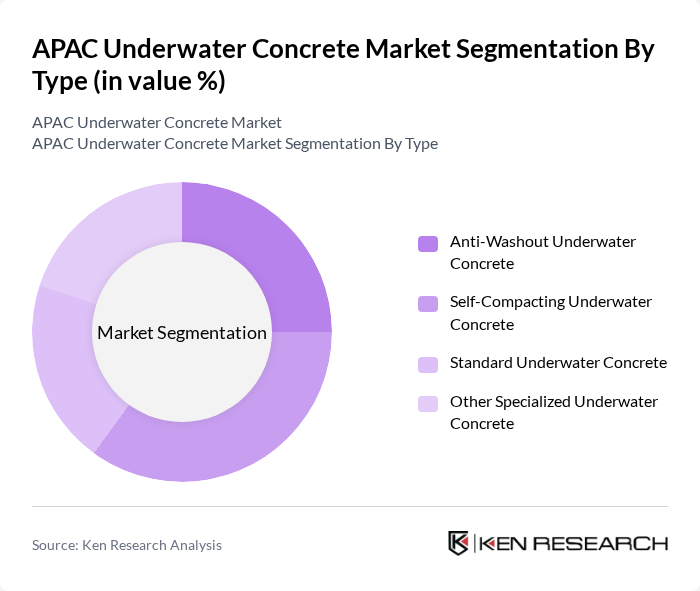
By Type:The underwater concrete market is segmented into various types, including Anti-Washout Underwater Concrete, Self-Compacting Underwater Concrete, Standard Underwater Concrete, and Other Specialized Underwater Concrete. Among these, Self-Compacting Underwater Concrete is gaining traction due to its ability to flow and fill complex forms without the need for mechanical vibration, making it ideal for intricate marine structures. The demand for Anti-Washout Underwater Concrete is also significant, particularly in areas with strong currents, as it provides enhanced stability and durability.
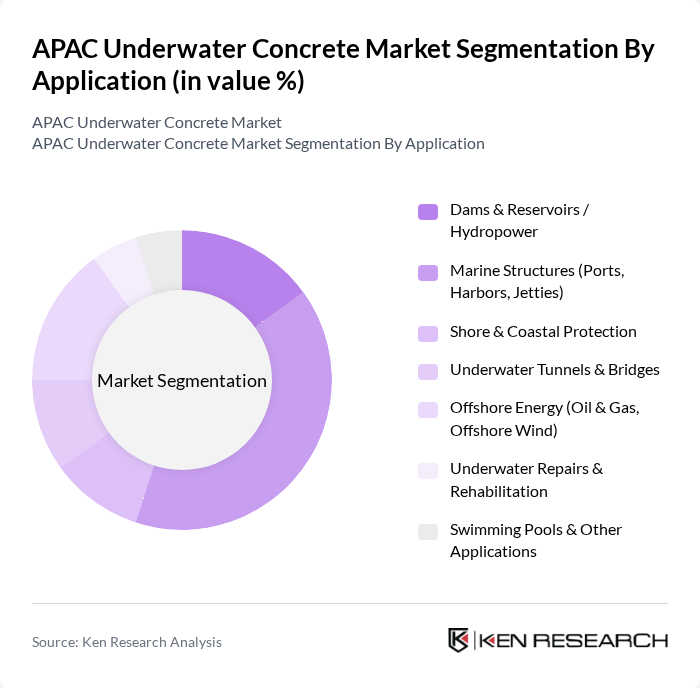
By Application:The applications of underwater concrete are diverse, including Dams & Reservoirs / Hydropower, Marine Structures (Ports, Harbors, Jetties), Shore & Coastal Protection, Underwater Tunnels & Bridges, Offshore Energy (Oil & Gas, Offshore Wind), Underwater Repairs & Rehabilitation, and Swimming Pools & Other Applications. The Marine Structures segment is particularly dominant due to the increasing investments in port infrastructure and coastal development projects across the Asia-Pacific region, driven by urbanization and trade expansion.
The APAC Underwater Concrete Market is characterized by a dynamic mix of regional and international players. Leading participants such as Sika AG, MBCC Group (including former BASF Construction Chemicals), CEMEX S.A.B. de C.V., Holcim Group, Lafarge (Holcim Lafarge brands), Boral Limited, Heidelberg Materials AG, Doka GmbH, Xypex Chemical Corporation, GCP Applied Technologies Inc. (an STG Company), CEMEX Holdings Philippines, Inc., Kilsaran International, Tarmac (CRH company), Concrete Canvas Ltd., U.S. Concrete, Inc. (a Vulcan Materials Company) contribute to innovation, geographic expansion, and service delivery in this space.
The future of the APAC underwater concrete market appears promising, driven by a growing emphasis on sustainability and technological innovation. The adoption of eco-friendly materials, such as bio-based additives, is expected to reduce carbon emissions significantly, with pilot projects demonstrating up to a 35% reduction in the future. Additionally, the integration of digital technologies for real-time monitoring is gaining traction, enhancing the efficiency and safety of underwater construction projects. These trends indicate a shift towards more sustainable and technologically advanced practices in the industry.
| Segment | Sub-Segments |
|---|---|
| By Type | Anti-Washout Underwater Concrete Self-Compacting Underwater Concrete Standard Underwater Concrete Other Specialized Underwater Concrete |
| By Application | Dams & Reservoirs / Hydropower Marine Structures (Ports, Harbors, Jetties) Shore & Coastal Protection Underwater Tunnels & Bridges Offshore Energy (Oil & Gas, Offshore Wind) Underwater Repairs & Rehabilitation Swimming Pools & Other Applications |
| By End-Use Sector | Infrastructure & Transport Energy & Utilities Industrial & Commercial Others |
| By Placement / Laying Technique | Tremie Method Bucket Placing Pump Method Others |
| By Raw Material Category | Cement Aggregates Admixtures Others |
| By Country (APAC) | China Japan India South Korea Australia & New Zealand ASEAN Rest of APAC |
| By Project Lifecycle | New Construction Repair & Rehabilitation Maintenance |
| Scope Item/Segment | Sample Size | Target Respondent Profiles |
|---|---|---|
| Marine Infrastructure Projects | 120 | Project Managers, Civil Engineers |
| Underwater Construction Materials | 90 | Material Suppliers, Product Development Managers |
| Government Infrastructure Planning | 70 | Policy Makers, Urban Planners |
| Research & Development in Underwater Technologies | 50 | R&D Managers, Technical Directors |
| Environmental Impact Assessments | 60 | Environmental Consultants, Compliance Officers |
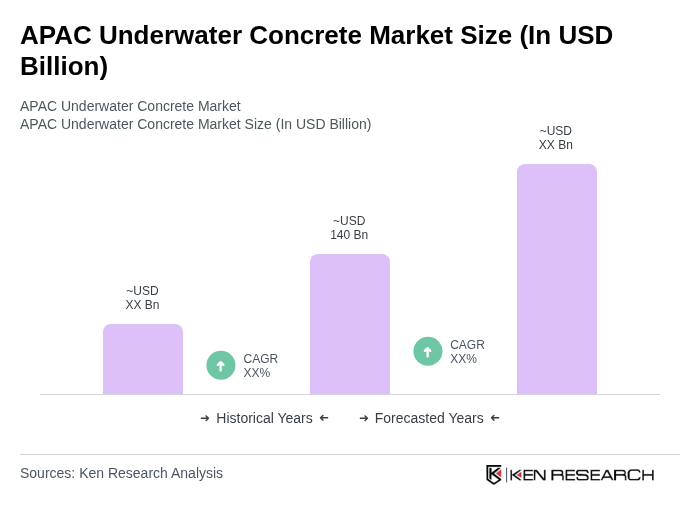
The APAC Underwater Concrete Market is valued at approximately USD 140 billion, driven by significant investments in marine infrastructure projects, including ports and offshore foundations, as well as increasing demand for hydropower and dam infrastructure.

What makes us stand out is that our consultants follow Robust, Refine and Result (RRR) methodology. Robust for clear definitions, approaches and sanity checking, Refine for differentiating respondents' facts and opinions, and Result for presenting data with story.

We have set a benchmark in the industry by offering our clients with syndicated and customized market research reports featuring coverage of entire market as well as meticulous research and analyst insights.

While we don't replace traditional research, we flip the method upside down. Our dual approach of Top Bottom & Bottom Top ensures quality deliverable by not just verifying company fundamentals but also looking at the sector and macroeconomic factors.

With one step in the future, our research team constantly tries to show you the bigger picture. We help with some of the tough questions you may encounter along the way: How is the industry positioned? Best marketing channel? KPI's of competitors? By aligning every element, we help maximize success.

Our report gives you instant access to the answers and sources that other companies might choose to hide. We elaborate each steps of research methodology we have used and showcase you the sample size to earn your trust.

If you need any support, we are here! We pride ourselves on universe strength, data quality, and quick, friendly, and professional service.













