Australia Carbon Capture and Storage (CCS) Market

The Australia CCS market, worth USD 59 million, grows with emission reduction efforts, tech advancements, and integration in energy sectors like power and oil & gas.

Region:Global

Author(s):Geetanshi

Product Code:KRAB4506

Pages:83

Published On:October 2025

About the Report

Base Year 2024

Australia Carbon Capture and Storage (CCS) Market Overview

  • The Australia Carbon Capture and Storage (CCS) market is valued at approximately USD 59 million, based on a five-year historical analysis. This growth is primarily driven by increasing government initiatives aimed at reducing carbon emissions, alongside rising investments in sustainable technologies. The urgency to address climate change, Australia’s net-zero commitments, and integration with the hydrogen economy have propelled the adoption of CCS technologies across various sectors. Key trends include rising demand for low-carbon solutions in energy and industry, and expanding export opportunities for captured carbon .
  • Key players in this market include major cities such as Melbourne, Sydney, and Brisbane, which dominate due to their robust industrial bases and commitment to sustainability. These urban centers are home to significant energy and manufacturing sectors that are increasingly integrating CCS solutions to mitigate their carbon footprints, thus driving market growth .
  • The principal regulatory instrument governing CCS in Australia is the Offshore Petroleum and Greenhouse Gas Storage Act 2006, issued by the Australian Government. This Act establishes the legal framework for licensing, operation, and monitoring of greenhouse gas storage activities, including requirements for site selection, environmental impact assessments, and ongoing compliance. The Act covers offshore storage sites, sets operational thresholds, and mandates reporting and verification of stored carbon dioxide .
Australia Carbon Capture and Storage (CCS) Market Size

Australia Carbon Capture and Storage (CCS) Market Segmentation

By Type:The market is segmented into various types of carbon capture technologies, including Pre-Combustion Capture, Post-Combustion Capture, Oxy-Fuel Combustion, Direct Air Capture, Bioenergy with Carbon Capture and Storage (BECCS), and Others. Each of these technologies plays a crucial role in the overall CCS landscape, with specific applications and efficiencies that cater to different industrial needs. Pre-Combustion and Post-Combustion Capture are most widely adopted in power generation and industrial sectors, while Direct Air Capture and BECCS are gaining traction for negative emissions and integration with renewable energy .
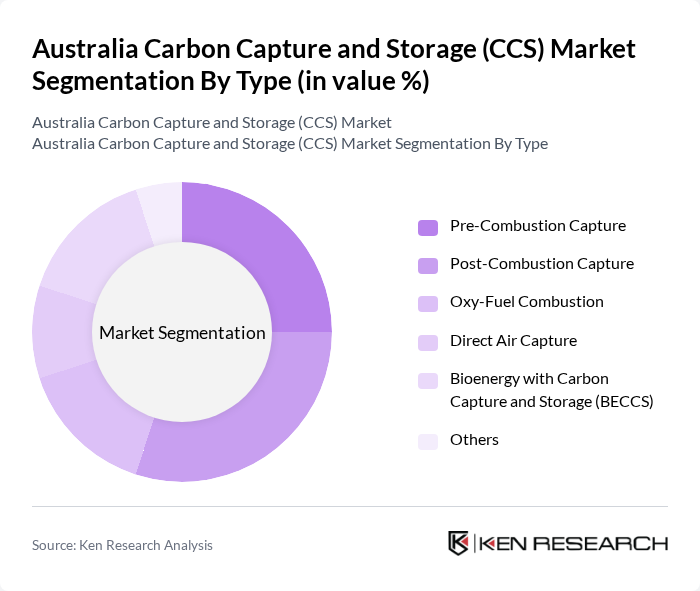
Australia Carbon Capture and Storage (CCS) Market segmentation by Type.

By End-User:The end-user segmentation includes Power Generation, Oil and Gas, Cement Production, Chemical Manufacturing, Iron and Steel, and Others. Each sector utilizes CCS technologies differently, with varying levels of adoption based on regulatory pressures and sustainability goals. Power Generation and Oil & Gas remain the largest adopters due to emission reduction mandates and integration with energy transition strategies. Cement, chemicals, and steel sectors are expanding CCS deployment to meet decarbonization targets and comply with stricter emissions standards .
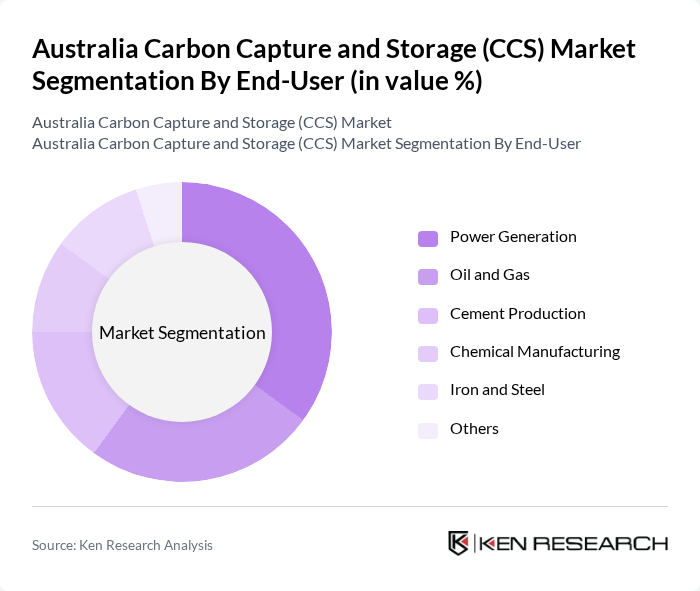
Australia Carbon Capture and Storage (CCS) Market segmentation by End-User.
--- COMPETITIVE LANDSCAPE SECTION ---

Australia Carbon Capture and Storage (CCS) Market Competitive Landscape

The Australia Carbon Capture and Storage (CCS) Market is characterized by a dynamic mix of regional and international players. Leading participants such as AGL Energy Limited, Santos Limited, Woodside Energy Group Ltd, Carbon Clean Solutions Limited, Shell Australia Pty Ltd, BP Australia Pty Ltd, Chevron Australia Pty Ltd, Origin Energy Limited, CO2CRC Limited, CSIRO (Commonwealth Scientific and Industrial Research Organisation), Net Zero Australia (University of Melbourne-led consortium), Australian National University, The University of Queensland, Monash University, Glencore Australia Holdings Pty Ltd contribute to innovation, geographic expansion, and service delivery in this space.

AGL Energy Limited

1837

Sydney, Australia

Santos Limited

1954

Adelaide, Australia

Woodside Energy Group Ltd

1954

Perth, Australia

Carbon Clean Solutions Limited

2009

London, UK

Shell Australia Pty Ltd

1901

Melbourne, Australia

Company

Establishment Year

Headquarters

Group Size (Large, Medium, or Small as per industry convention)

Revenue from CCS Operations (AUD, latest FY)

Installed CCS Capacity (Mtpa)

Number of CCS Projects (Operational/Planned)

Market Share in Australia CCS Market (%)

Project Completion Rate (%)

Australia Carbon Capture and Storage (CCS) Market Industry Analysis

Growth Drivers

  • Increasing Regulatory Pressure on Emissions:Australia has committed to reducing greenhouse gas emissions by 43% by 2030, as outlined in the National Climate Change Policy. This regulatory framework is driving investments in CCS technologies, with the government allocating AUD 1.5 billion to support emissions reduction initiatives. The urgency to meet these targets is propelling industries to adopt CCS solutions, which are essential for achieving compliance and maintaining operational licenses in a tightening regulatory environment.
  • Technological Advancements in CCS:Significant advancements in CCS technologies have been made, with the Australian government investing AUD 300 million in research and development for innovative carbon capture methods. These technologies are becoming more efficient, with capture rates improving to over 90% in some facilities. Enhanced performance and reduced costs are making CCS a more viable option for industries, particularly in sectors like power generation and manufacturing, where emissions are substantial.
  • Investment in Renewable Energy Integration:The Australian government aims to achieve 82% renewable energy generation by 2030, necessitating the integration of CCS to manage emissions from fossil fuel sources. In future, investments in renewable energy projects are projected to exceed AUD 20 billion, with CCS playing a critical role in ensuring that these projects can operate sustainably. This integration is vital for balancing energy needs while transitioning to a low-carbon economy.

Market Challenges

  • High Initial Capital Investment:The implementation of CCS technologies requires substantial upfront capital, often exceeding AUD 1 billion for large-scale projects. This financial barrier can deter investment, particularly for smaller companies or those with limited access to funding. The high costs associated with infrastructure development, including capture facilities and transportation networks, pose significant challenges to widespread adoption and scalability of CCS solutions in Australia.
  • Public Perception and Acceptance Issues:Public skepticism regarding CCS technologies remains a significant challenge, with only 40% of Australians supporting large-scale CCS projects, according to recent surveys. Concerns about safety, environmental impact, and the long-term viability of CO2 storage contribute to this hesitance. Addressing these perceptions through education and transparent communication is essential for gaining public trust and facilitating the deployment of CCS initiatives across the country.

Australia Carbon Capture and Storage (CCS) Market Future Outlook

The future of the Australia CCS market appears promising, driven by increasing investments in technology and regulatory support. As the government intensifies its focus on achieving net-zero emissions by 2050, CCS will play a pivotal role in decarbonizing hard-to-abate sectors. Collaborative efforts between public and private sectors are expected to enhance innovation, while the expansion of carbon markets will provide financial incentives for CCS projects, fostering a more sustainable energy landscape in Australia.

Market Opportunities

  • Expansion of Carbon Markets:The establishment of a robust carbon market in Australia, projected to reach AUD 2 billion in future, presents significant opportunities for CCS projects. This market will incentivize emissions reductions, allowing companies to monetize their carbon credits, thus enhancing the financial viability of CCS investments and encouraging broader participation across various industries.
  • Collaboration with Industrial Sectors:Partnerships between CCS technology providers and industrial sectors, such as cement and steel manufacturing, are expected to grow. With these industries accounting for approximately 30% of Australia’s emissions, collaborative efforts can lead to tailored CCS solutions that address specific challenges, driving innovation and efficiency while significantly reducing carbon footprints.

Scope of the Report

SegmentSub-Segments
By Type

Pre-Combustion Capture

Post-Combustion Capture

Oxy-Fuel Combustion

Direct Air Capture

Bioenergy with Carbon Capture and Storage (BECCS)

Others

By End-User

Power Generation

Oil and Gas

Cement Production

Chemical Manufacturing

Iron and Steel

Others

By Application

Enhanced Oil Recovery

Industrial Processes

Geological Storage

Carbon Utilization (e.g., E-fuels, Building Materials)

Others

By Investment Source

Private Investments

Government Funding

International Grants

Public-Private Partnerships

By Policy Support

Tax Incentives

Subsidies for CCS Projects

Regulatory Frameworks

Carbon Credits/Offsets

Others

By Technology

Chemical Absorption

Physical Absorption

Membrane Separation

Cryogenic Separation

Others

By Market Segment

Large Scale Projects

Small Scale Projects

Pilot Projects

Research & Demonstration Projects

Others

Key Target Audience

Investors and Venture Capitalist Firms

Government and Regulatory Bodies (e.g., Department of Industry, Science, Energy and Resources)

Energy Producers and Utilities

Oil and Gas Companies

Environmental NGOs and Advocacy Groups

Carbon Offset Project Developers

Infrastructure and Engineering Firms

Financial Institutions and Banks

Players Mentioned in the Report:

AGL Energy Limited

Santos Limited

Woodside Energy Group Ltd

Carbon Clean Solutions Limited

Shell Australia Pty Ltd

BP Australia Pty Ltd

Chevron Australia Pty Ltd

Origin Energy Limited

CO2CRC Limited

CSIRO (Commonwealth Scientific and Industrial Research Organisation)

Net Zero Australia (University of Melbourne-led consortium)

Australian National University

The University of Queensland

Monash University

Glencore Australia Holdings Pty Ltd

Table of Contents

Market Assessment Phase

1. Executive Summary and Approach


2. Australia Carbon Capture and Storage (CCS) Market Overview

2.1 Key Insights and Strategic Recommendations

2.2 Australia Carbon Capture and Storage (CCS) Market Overview

2.3 Definition and Scope

2.4 Evolution of Market Ecosystem

2.5 Timeline of Key Regulatory Milestones

2.6 Value Chain & Stakeholder Mapping

2.7 Business Cycle Analysis

2.8 Policy & Incentive Landscape


3. Australia Carbon Capture and Storage (CCS) Market Analysis

3.1 Growth Drivers

3.1.1 Increasing Regulatory Pressure on Emissions
3.1.2 Technological Advancements in CCS
3.1.3 Investment in Renewable Energy Integration
3.1.4 Corporate Sustainability Goals

3.2 Market Challenges

3.2.1 High Initial Capital Investment
3.2.2 Public Perception and Acceptance Issues
3.2.3 Limited Infrastructure for CO2 Transport
3.2.4 Regulatory Uncertainty

3.3 Market Opportunities

3.3.1 Expansion of Carbon Markets
3.3.2 Collaboration with Industrial Sectors
3.3.3 Development of Carbon Utilization Technologies
3.3.4 International Partnerships and Funding

3.4 Market Trends

3.4.1 Growing Investment in R&D for CCS
3.4.2 Increasing Role of Private Sector in CCS Projects
3.4.3 Focus on Circular Economy Initiatives
3.4.4 Integration of CCS with Hydrogen Production

3.5 Government Regulation

3.5.1 National Greenhouse and Energy Reporting Act
3.5.2 Safeguard Mechanism
3.5.3 Emissions Reduction Fund
3.5.4 Clean Energy Finance Corporation Guidelines

4. SWOT Analysis


5. Stakeholder Analysis


6. Porter's Five Forces Analysis


7. Australia Carbon Capture and Storage (CCS) Market Market Size, 2019-2024

7.1 By Value

7.2 By Volume

7.3 By Average Selling Price


8. Australia Carbon Capture and Storage (CCS) Market Segmentation

8.1 By Type

8.1.1 Pre-Combustion Capture
8.1.2 Post-Combustion Capture
8.1.3 Oxy-Fuel Combustion
8.1.4 Direct Air Capture
8.1.5 Bioenergy with Carbon Capture and Storage (BECCS)
8.1.6 Others

8.2 By End-User

8.2.1 Power Generation
8.2.2 Oil and Gas
8.2.3 Cement Production
8.2.4 Chemical Manufacturing
8.2.5 Iron and Steel
8.2.6 Others

8.3 By Application

8.3.1 Enhanced Oil Recovery
8.3.2 Industrial Processes
8.3.3 Geological Storage
8.3.4 Carbon Utilization (e.g., E-fuels, Building Materials)
8.3.5 Others

8.4 By Investment Source

8.4.1 Private Investments
8.4.2 Government Funding
8.4.3 International Grants
8.4.4 Public-Private Partnerships

8.5 By Policy Support

8.5.1 Tax Incentives
8.5.2 Subsidies for CCS Projects
8.5.3 Regulatory Frameworks
8.5.4 Carbon Credits/Offsets
8.5.5 Others

8.6 By Technology

8.6.1 Chemical Absorption
8.6.2 Physical Absorption
8.6.3 Membrane Separation
8.6.4 Cryogenic Separation
8.6.5 Others

8.7 By Market Segment

8.7.1 Large Scale Projects
8.7.2 Small Scale Projects
8.7.3 Pilot Projects
8.7.4 Research & Demonstration Projects
8.7.5 Others

9. Australia Carbon Capture and Storage (CCS) Market Competitive Analysis

9.1 Market Share of Key Players(Micro, Small, Medium, Large Enterprises)

9.2 Cross Comparison of Key Players

9.2.1 Company Name
9.2.2 Group Size (Large, Medium, or Small as per industry convention)
9.2.3 Revenue from CCS Operations (AUD, latest FY)
9.2.4 Installed CCS Capacity (Mtpa)
9.2.5 Number of CCS Projects (Operational/Planned)
9.2.6 Market Share in Australia CCS Market (%)
9.2.7 Project Completion Rate (%)
9.2.8 R&D Investment as % of Revenue
9.2.9 Technology Portfolio Breadth
9.2.10 Partnerships & Collaborations (Count)
9.2.11 Innovation Index
9.2.12 Emissions Abated (MtCO?/year)
9.2.13 Safety/Compliance Record

9.3 SWOT Analysis of Top Players

9.4 Pricing Analysis(By Class and Payload)

9.5 Detailed Profile of Major Companies

9.5.1 AGL Energy Limited
9.5.2 Santos Limited
9.5.3 Woodside Energy Group Ltd
9.5.4 Carbon Clean Solutions Limited
9.5.5 Shell Australia Pty Ltd
9.5.6 BP Australia Pty Ltd
9.5.7 Chevron Australia Pty Ltd
9.5.8 Origin Energy Limited
9.5.9 CO2CRC Limited
9.5.10 CSIRO (Commonwealth Scientific and Industrial Research Organisation)
9.5.11 Net Zero Australia (University of Melbourne-led consortium)
9.5.12 Australian National University
9.5.13 The University of Queensland
9.5.14 Monash University
9.5.15 Glencore Australia Holdings Pty Ltd

10. Australia Carbon Capture and Storage (CCS) Market End-User Analysis

10.1 Procurement Behavior of Key Ministries

10.1.1 Government Funding Priorities
10.1.2 Procurement Processes and Timelines
10.1.3 Collaboration with Private Sector

10.2 Corporate Spend on Infrastructure & Energy

10.2.1 Investment in Sustainable Technologies
10.2.2 Budget Allocation for CCS Projects
10.2.3 Long-term Energy Contracts

10.3 Pain Point Analysis by End-User Category

10.3.1 Cost Management Challenges
10.3.2 Regulatory Compliance Issues
10.3.3 Technology Integration Difficulties

10.4 User Readiness for Adoption

10.4.1 Awareness of CCS Benefits
10.4.2 Training and Skill Development Needs
10.4.3 Financial Readiness for Investment

10.5 Post-Deployment ROI and Use Case Expansion

10.5.1 Measurement of Emission Reductions
10.5.2 Expansion into New Markets
10.5.3 Long-term Sustainability Assessments

11. Australia Carbon Capture and Storage (CCS) Market Future Size, 2025-2030

11.1 By Value

11.2 By Volume

11.3 By Average Selling Price


Go-To-Market Strategy Phase

1. Whitespace Analysis + Business Model Canvas

1.1 Identification of Market Gaps

1.2 Value Proposition Development

1.3 Revenue Streams Analysis

1.4 Cost Structure Evaluation

1.5 Key Partnerships Identification

1.6 Customer Segmentation

1.7 Channels to Market


2. Marketing and Positioning Recommendations

2.1 Branding Strategies

2.2 Product USPs

2.3 Target Audience Identification

2.4 Communication Strategies

2.5 Digital Marketing Approaches


3. Distribution Plan

3.1 Urban Retail Strategies

3.2 Rural NGO Tie-ups

3.3 Online Distribution Channels

3.4 Direct Sales Approaches


4. Channel & Pricing Gaps

4.1 Underserved Routes

4.2 Pricing Bands Analysis

4.3 Competitor Pricing Strategies


5. Unmet Demand & Latent Needs

5.1 Category Gaps Identification

5.2 Consumer Segments Analysis

5.3 Emerging Trends in Consumer Preferences


6. Customer Relationship

6.1 Loyalty Programs

6.2 After-sales Service Strategies

6.3 Customer Feedback Mechanisms


7. Value Proposition

7.1 Sustainability Initiatives

7.2 Integrated Supply Chains

7.3 Competitive Advantages


8. Key Activities

8.1 Regulatory Compliance

8.2 Branding Initiatives

8.3 Distribution Setup


9. Entry Strategy Evaluation

9.1 Domestic Market Entry Strategy

9.1.1 Product Mix Considerations
9.1.2 Pricing Band Strategies
9.1.3 Packaging Innovations

9.2 Export Entry Strategy

9.2.1 Target Countries Identification
9.2.2 Compliance Roadmap Development

10. Entry Mode Assessment

10.1 Joint Ventures

10.2 Greenfield Investments

10.3 Mergers & Acquisitions

10.4 Distributor Model Evaluation


11. Capital and Timeline Estimation

11.1 Capital Requirements Analysis

11.2 Timelines for Implementation


12. Control vs Risk Trade-Off

12.1 Ownership vs Partnerships

12.2 Risk Management Strategies


13. Profitability Outlook

13.1 Breakeven Analysis

13.2 Long-term Sustainability Considerations


14. Potential Partner List

14.1 Distributors

14.2 Joint Ventures

14.3 Acquisition Targets


15. Execution Roadmap

15.1 Phased Plan for Market Entry

15.1.1 Market Setup
15.1.2 Market Entry
15.1.3 Growth Acceleration
15.1.4 Scale & Stabilize

15.2 Key Activities and Milestones

15.2.1 Milestone Planning
15.2.2 Activity Tracking

Research Methodology

ApproachModellingSample

Phase 1: Approach1

Desk Research

  • Analysis of government reports on carbon emissions and climate policy in Australia
  • Review of industry publications and white papers on CCS technologies and market trends
  • Examination of academic journals focusing on environmental science and carbon management

Primary Research

  • Interviews with key stakeholders in the CCS sector, including project developers and technology providers
  • Surveys targeting environmental consultants and regulatory bodies involved in CCS initiatives
  • Field interviews with operational managers at existing CCS facilities across Australia

Validation & Triangulation

  • Cross-validation of findings through multiple data sources, including government and industry reports
  • Triangulation of qualitative insights from interviews with quantitative data from market reports
  • Sanity checks conducted through expert panel reviews comprising industry veterans and academics

Phase 2: Market Size Estimation1

Top-down Assessment

  • Estimation of total carbon emissions in Australia to determine potential CCS market size
  • Breakdown of emissions by sector (e.g., energy, industrial, transportation) to identify key opportunities
  • Incorporation of government targets for carbon neutrality and their impact on CCS adoption

Bottom-up Modeling

  • Analysis of existing CCS projects to establish benchmarks for capacity and investment
  • Operational cost assessments based on technology types and project scales
  • Volume x cost calculations to derive potential revenue streams from carbon credits

Forecasting & Scenario Analysis

  • Multi-factor regression analysis incorporating economic growth, regulatory changes, and technological advancements
  • Scenario modeling based on varying levels of government support and market adoption rates
  • Development of baseline, optimistic, and pessimistic forecasts through 2030

Phase 3: CATI Sample Composition1

Scope Item/SegmentSample SizeTarget Respondent Profiles
Energy Sector CCS Projects100Project Managers, Energy Analysts
Industrial Emissions Reduction Initiatives80Environmental Compliance Officers, Operations Managers
Research Institutions Focused on CCS50Research Scientists, Policy Advisors
Government Regulatory Bodies40Regulatory Affairs Specialists, Policy Makers
Technology Providers in CCS60Product Development Managers, Sales Directors

Frequently Asked Questions

What is the current value of the Australia Carbon Capture and Storage (CCS) market?

The Australia Carbon Capture and Storage (CCS) market is valued at approximately USD 59 million, driven by government initiatives to reduce carbon emissions and investments in sustainable technologies.

What are the key drivers of growth in the Australia CCS market?

Which sectors are the largest adopters of CCS technologies in Australia?

What are the main types of carbon capture technologies used in Australia?

Other Regional/Country Reports

Global Carbon Capture and Storage (CCS) Market Outlook to 2030

Indonesia Carbon Capture and Storage (CCS) Market

Malaysia Carbon Capture and Storage (CCS) Market

KSA Carbon Capture and Storage (CCS) Market

APAC Carbon Capture and Storage (CCS) Market

SEA Carbon Capture and Storage (CCS) Market

Other Adjacent Reports

USA Green Hydrogen Production Market

South Korea Renewable Energy Integration Market

Mexico Oil and Gas Decarbonization Market

Germany Power Generation Emissions Control Market

Brazil Cement Industry Sustainability Market

Qatar Chemical Manufacturing Carbon Management Market

Egypt Iron and Steel Decarbonization Market

Japan Carbon Trading Market

Kuwait Direct Air Capture Technology Market

Egypt Bioenergy with Carbon Capture Market

Why Buy From Us?

Refine Robust Result (RRR) Framework

What makes us stand out is that our consultants follow Robust, Refine and Result (RRR) methodology. Robust for clear definitions, approaches and sanity checking, Refine for differentiating respondents' facts and opinions, and Result for presenting data with story.

Our Reach Is Unmatched

We have set a benchmark in the industry by offering our clients with syndicated and customized market research reports featuring coverage of entire market as well as meticulous research and analyst insights.

Shifting the Research Paradigm

While we don't replace traditional research, we flip the method upside down. Our dual approach of Top Bottom & Bottom Top ensures quality deliverable by not just verifying company fundamentals but also looking at the sector and macroeconomic factors.

More Insights-Better Decisions

With one step in the future, our research team constantly tries to show you the bigger picture. We help with some of the tough questions you may encounter along the way: How is the industry positioned? Best marketing channel? KPI's of competitors? By aligning every element, we help maximize success.

Transparency and Trust

Our report gives you instant access to the answers and sources that other companies might choose to hide. We elaborate each steps of research methodology we have used and showcase you the sample size to earn your trust.

Round the Clock Support

If you need any support, we are here! We pride ourselves on universe strength, data quality, and quick, friendly, and professional service.

Why Clients Choose Us?

400000+
Reports in repository
150+
Consulting projects a year
100+
Analysts
8000+
Client Queries in 2022








