About the Report
Base Year 2024Australia Chemical Protective Clothing Market Overview
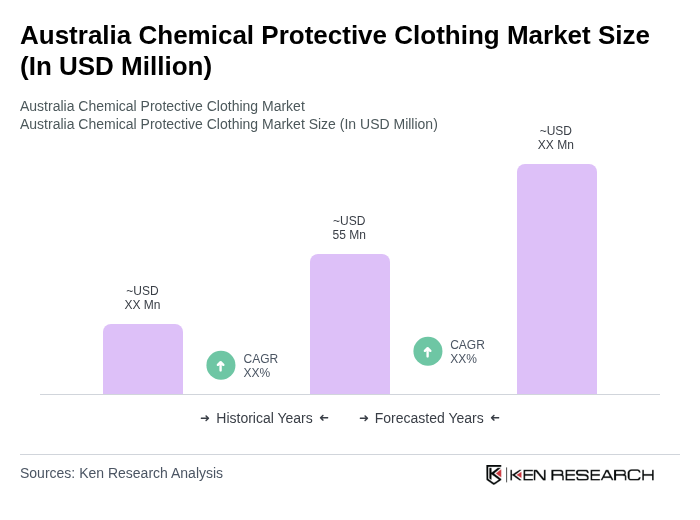
- The Australia Chemical Protective Clothing Market is valued at USD 55 million, based on a five-year historical analysis. This growth is primarily driven by increasing safety regulations across various industries, heightened awareness of workplace safety, rising demand for protective gear in hazardous environments, and expansion in sectors such as chemical manufacturing and oil and gas.The market has seen a significant uptick in investments from both public and private sectors to enhance safety standards and compliance.
- Key cities such as Sydney, Melbourne, and Brisbane dominate the market due to their robust industrial sectors, including manufacturing, healthcare, and construction. These urban centers are characterized by a high concentration of industries that require chemical protective clothing, thus driving demand. Additionally, the presence of major manufacturers and suppliers in these regions further solidifies their market dominance.
- The Work Health and Safety Regulations 2011 issued by Safe Work Australia mandate the use of appropriate personal protective equipment (PPE) in workplaces dealing with hazardous substances. This regulation requires risk assessments, selection of PPE compliant with Australian Standards such as AS/NZS 4501 for occupational protective clothing, and employer provision of training and maintenance to minimize risks associated with chemical exposure, significantly influencing the demand for chemical protective clothing across various sectors.
Australia Chemical Protective Clothing Market Segmentation
By Type:The market is segmented into various types of materials used in chemical protective clothing. The primary materials include Aramid & Blends, Polybenzimidazole (PBI), Polyamide, Cotton Fiber, Laminated Polyesters, Polyolefin & Blends, UHMW Polyethylene, and Others. Each material offers unique properties that cater to specific industry needs, influencing consumer preferences and market dynamics.
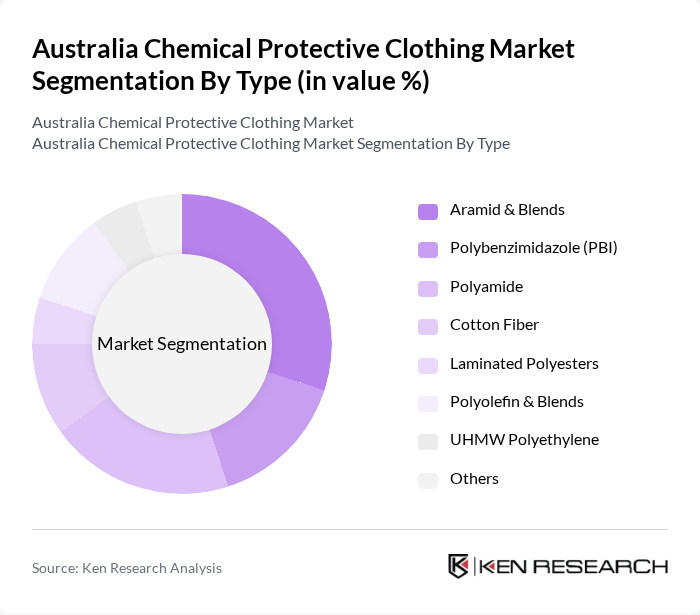
The Aramid & Blends segment is currently dominating the market due to its exceptional heat and flame resistance, making it a preferred choice in industries such as oil and gas, manufacturing, and firefighting. The increasing focus on safety standards and regulations has led to a surge in demand for high-performance materials that can withstand extreme conditions. Additionally, the versatility of Aramid fibers in various applications contributes to its leading position in the market.
By End-User:The market is segmented based on end-user industries, including Manufacturing, Oil & Gas, Healthcare, Construction, Chemicals, Food, Mining, Pharmaceuticals, Transportation, and Others. Each sector has distinct requirements for chemical protective clothing, driven by the nature of operations and exposure to hazardous materials.
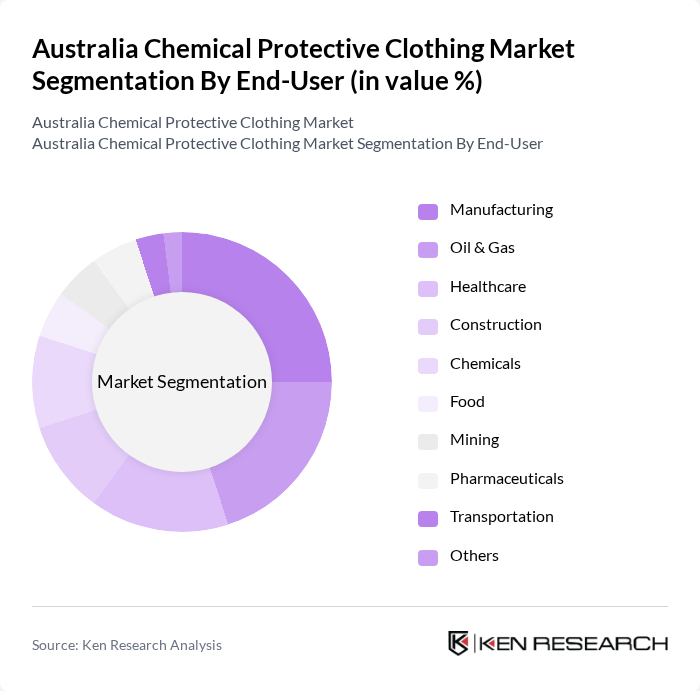
The Manufacturing sector is the leading end-user of chemical protective clothing, driven by stringent safety regulations and the need to protect workers from hazardous materials. The sector's diverse applications, ranging from automotive to electronics, require specialized protective gear, thus fueling demand. Additionally, the Oil & Gas industry follows closely, necessitating high-performance protective clothing due to the inherent risks associated with chemical exposure and extreme working conditions.
Australia Chemical Protective Clothing Market Competitive Landscape
The Australia Chemical Protective Clothing Market is characterized by a dynamic mix of regional and international players. Leading participants such as Honeywell International Inc, Lakeland Industries Inc, Kimberly-Clark Corp, Ansell Ltd, Teijin Ltd, DuPont de Nemours Inc, TenCate, VF Corp, W.L. Gore & Associates, PBI Performance Products, Bennett Safetywear, Australian Defence Apparel contribute to innovation, geographic expansion, and service delivery in this space.
Australia Chemical Protective Clothing Market Industry Analysis
Growth Drivers
- Increasing Industrial Safety Regulations:The Australian government has implemented stringent safety regulations, including the Work Health and Safety Act 2011, which mandates protective clothing in hazardous environments. In future, the Australian industrial sector is projected to invest approximately AUD 1.7 billion in safety compliance measures. This regulatory push is driving demand for chemical protective clothing, as companies seek to meet legal requirements and ensure employee safety, thereby enhancing market growth.
- Rising Awareness of Workplace Safety:With workplace accidents costing Australian businesses an estimated AUD 65 billion annually, there is a growing emphasis on safety measures. In future, awareness campaigns and training programs are expected to increase, leading to a projected 22% rise in the adoption of protective clothing across various industries. This heightened focus on safety is a significant driver for the chemical protective clothing market, as organizations prioritize employee well-being.
- Growth in the Chemical Manufacturing Sector:The Australian chemical manufacturing sector is anticipated to grow by 4% in future, driven by increased production and export demands. This growth translates to a higher requirement for protective clothing, as safety standards in chemical handling become more stringent. The sector's expansion is expected to generate an additional AUD 250 million in demand for chemical protective clothing, further propelling market growth.
Market Challenges
- High Cost of Advanced Protective Clothing:The average cost of advanced chemical protective clothing can range from AUD 350 to AUD 1,200 per unit, which poses a significant barrier for small and medium-sized enterprises (SMEs). In future, SMEs are projected to account for 98% of Australian businesses, yet many struggle to allocate budgets for such high-cost safety gear. This financial constraint limits market penetration and growth potential in the protective clothing sector.
- Limited Awareness Among Small Businesses:Despite the increasing focus on safety, many small businesses remain unaware of the specific requirements for chemical protective clothing. In future, it is estimated that 42% of SMEs lack knowledge about compliance standards, which hinders their ability to invest in necessary protective gear. This gap in awareness presents a challenge for market growth, as education and outreach efforts are needed to inform these businesses about the importance of protective clothing.
Australia Chemical Protective Clothing Market Future Outlook
The future of the Australia chemical protective clothing market appears promising, driven by ongoing regulatory changes and a heightened focus on workplace safety. As industries evolve, the demand for innovative and multifunctional protective gear is expected to rise. Additionally, the integration of smart textiles and sustainable materials will likely shape product offerings, catering to environmentally conscious consumers. The market is poised for growth as companies increasingly prioritize safety and compliance in their operations.
Market Opportunities
- Expansion in Emerging Industries:The rise of industries such as renewable energy and biotechnology presents significant opportunities for the chemical protective clothing market. In future, these sectors are projected to grow by 6% and 5%, respectively, increasing the demand for specialized protective gear. This trend offers manufacturers a chance to innovate and cater to new market segments, enhancing their competitive edge.
- Development of Eco-Friendly Materials:As sustainability becomes a priority, the development of eco-friendly protective clothing materials is gaining traction. In future, the market for sustainable textiles is expected to reach AUD 600 million, providing an opportunity for manufacturers to differentiate their products. By investing in sustainable practices, companies can attract environmentally conscious consumers and enhance their brand reputation in the chemical protective clothing market.
Scope of the Report
| Segment | Sub-Segments |
|---|---|
| By Type | Aramid & Blends Polybenzimidazole (PBI) Polyamide Cotton Fiber Laminated Polyesters Polyolefin & Blends UHMW Polyethylene Others |
| By End-User | Manufacturing Oil & Gas Healthcare Construction Chemicals Food Mining Pharmaceuticals Transportation Others |
| By Product Category | Heat & Flame Protection Chemical Defending Clean Room Clothing Mechanical Protective Clothing Limited General Use Other Products |
| By Region | New South Wales Victoria & Tasmania Queensland Western Australia Australia Capital Territory Northern Territory & Southern Australia |
| By Distribution Channel | Online Stores Offline Stores Direct Sales Distributors Others |
Key Target Audience
Investors and Venture Capitalist Firms
Government and Regulatory Bodies (e.g., Safe Work Australia, Australian Competition and Consumer Commission)
Manufacturers and Producers
Distributors and Retailers
Industry Associations (e.g., Australian Industry Group)
Health and Safety Organizations
Environmental Protection Agencies (e.g., Department of Agriculture, Water and the Environment)
Insurance Companies and Risk Management Firms
Players Mentioned in the Report:
Honeywell International Inc
Lakeland Industries Inc
Kimberly-Clark Corp
Ansell Ltd
Teijin Ltd
DuPont de Nemours Inc
TenCate
VF Corp
W.L. Gore & Associates
PBI Performance Products
Bennett Safetywear
Australian Defence Apparel
Table of Contents
Market Assessment Phase
1. Executive Summary and Approach
2. Australia Chemical Protective Clothing Market Overview
2.1 Key Insights and Strategic Recommendations
2.2 Australia Chemical Protective Clothing Market Overview
2.3 Definition and Scope
2.4 Evolution of Market Ecosystem
2.5 Timeline of Key Regulatory Milestones
2.6 Value Chain & Stakeholder Mapping
2.7 Business Cycle Analysis
2.8 Policy & Incentive Landscape
3. Australia Chemical Protective Clothing Market Analysis
3.1 Growth Drivers
3.1.1 Increasing industrial safety regulations
3.1.2 Rising awareness of workplace safety
3.1.3 Growth in the chemical manufacturing sector
3.1.4 Technological advancements in fabric materials
3.2 Market Challenges
3.2.1 High cost of advanced protective clothing
3.2.2 Limited awareness among small businesses
3.2.3 Stringent compliance requirements
3.2.4 Competition from low-cost alternatives
3.3 Market Opportunities
3.3.1 Expansion in emerging industries
3.3.2 Development of eco-friendly materials
3.3.3 Customization of protective clothing
3.3.4 Growth in e-commerce for safety gear
3.4 Market Trends
3.4.1 Increasing demand for multi-functional clothing
3.4.2 Adoption of smart textiles
3.4.3 Focus on sustainability in production
3.4.4 Rise in online sales channels
3.5 Government Regulation
3.5.1 AS/NZS 4602.1:2011 for high visibility clothing
3.5.2 Work Health and Safety Act 2011
3.5.3 Australian Standards for protective clothing
3.5.4 Chemical Safety Regulations
4. SWOT Analysis
5. Stakeholder Analysis
6. Porter's Five Forces Analysis
7. Australia Chemical Protective Clothing Market Market Size, 2019-2024
7.1 By Value
7.2 By Volume
7.3 By Average Selling Price
8. Australia Chemical Protective Clothing Market Segmentation
8.1 By Type
8.1.1 Aramid & Blends
8.1.2 Polybenzimidazole (PBI)
8.1.3 Polyamide
8.1.4 Cotton Fiber
8.1.5 Laminated Polyesters
8.1.6 Polyolefin & Blends
8.1.7 UHMW Polyethylene
8.1.8 Others
8.2 By End-User
8.2.1 Manufacturing
8.2.2 Oil & Gas
8.2.3 Healthcare
8.2.4 Construction
8.2.5 Chemicals
8.2.6 Food
8.2.7 Mining
8.2.8 Pharmaceuticals
8.2.9 Transportation
8.2.10 Others
8.3 By Product Category
8.3.1 Heat & Flame Protection
8.3.2 Chemical Defending
8.3.3 Clean Room Clothing
8.3.4 Mechanical Protective Clothing
8.3.5 Limited General Use
8.3.6 Other Products
8.4 By Region
8.4.1 New South Wales
8.4.2 Victoria & Tasmania
8.4.3 Queensland
8.4.4 Western Australia
8.4.5 Australia Capital Territory
8.4.6 Northern Territory & Southern Australia
8.5 By Distribution Channel
8.5.1 Online Stores
8.5.2 Offline Stores
8.5.3 Direct Sales
8.5.4 Distributors
8.5.5 Others
9. Australia Chemical Protective Clothing Market Competitive Analysis
9.1 Market Share of Key Players
9.2 Cross Comparison of Key Players
9.2.1 Company Name
9.2.2 Revenue (USD Million)
9.2.3 Revenue Growth Rate (%)
9.2.4 Market Share (%)
9.2.5 Geographic Presence
9.2.6 Product Portfolio Breadth
9.2.7 Pricing Strategy (Premium/Mid-Range/Budget)
9.2.8 Brand Recognition Score (1-10)
9.2.9 Distribution Network Strength
9.2.10 R&D Investment Rate (%)
9.3 SWOT Analysis of Top Players
9.4 Pricing Analysis
9.5 Detailed Profile of Major Companies
9.5.1 Honeywell International Inc
9.5.2 Lakeland Industries Inc
9.5.3 Kimberly-Clark Corp
9.5.4 Ansell Ltd
9.5.5 Teijin Ltd
9.5.6 DuPont de Nemours Inc
9.5.7 TenCate
9.5.8 VF Corp
9.5.9 W.L. Gore & Associates
9.5.10 PBI Performance Products
9.5.11 Bennett Safetywear
9.5.12 Australian Defence Apparel
10. Australia Chemical Protective Clothing Market End-User Analysis
10.1 Procurement Behavior of Key Ministries
10.1.1 Government procurement policies
10.1.2 Budget allocation for safety gear
10.1.3 Supplier selection criteria
10.1.4 Compliance with safety standards
10.2 Corporate Spend on Infrastructure & Energy
10.2.1 Investment in safety training
10.2.2 Budget for protective equipment
10.2.3 Infrastructure upgrades for safety
10.2.4 Energy efficiency initiatives
10.3 Pain Point Analysis by End-User Category
10.3.1 Manufacturing sector challenges
10.3.2 Healthcare sector needs
10.3.3 Construction industry requirements
10.3.4 Agricultural safety concerns
10.4 User Readiness for Adoption
10.4.1 Awareness of protective clothing benefits
10.4.2 Training programs for end-users
10.4.3 Availability of products in the market
10.4.4 Feedback from early adopters
10.5 Post-Deployment ROI and Use Case Expansion
10.5.1 Cost savings from reduced injuries
10.5.2 Increased productivity metrics
10.5.3 Expansion into new applications
10.5.4 Long-term benefits of compliance
11. Australia Chemical Protective Clothing Market Future Size, 2025-2030
11.1 By Value
11.2 By Volume
11.3 By Average Selling Price
12. Whitespace Analysis + Business Model Canvas
12.1 Market gaps identification
12.2 Value proposition development
12.3 Revenue model exploration
12.4 Customer segmentation analysis
12.5 Competitive landscape overview
13. Marketing and Positioning Recommendations
13.1 Branding strategies
13.2 Product USPs
13.3 Target audience identification
13.4 Communication strategy
13.5 Digital marketing initiatives
14. Distribution Plan
14.1 Urban retail strategies
14.2 Rural NGO tie-ups
14.3 E-commerce partnerships
14.4 Direct sales approach
14.5 Distribution channel optimization
15. Channel & Pricing Gaps
15.1 Underserved routes
15.2 Pricing bands analysis
15.3 Competitor pricing comparison
15.4 Value-based pricing strategies
15.5 Discount and promotion strategies
16. Unmet Demand & Latent Needs
16.1 Category gaps identification
16.2 Consumer segments analysis
16.3 Product development opportunities
16.4 Market entry barriers
16.5 Future trends forecasting
17. Customer Relationship
17.1 Loyalty programs
17.2 After-sales service
17.3 Customer feedback mechanisms
17.4 Community engagement initiatives
17.5 Relationship management tools
18. Value Proposition
18.1 Sustainability initiatives
18.2 Integrated supply chains
18.3 Customization options
18.4 Quality assurance processes
18.5 Brand differentiation strategies
19. Key Activities
19.1 Regulatory compliance
19.2 Branding efforts
19.3 Distribution setup
19.4 Training and development
19.5 Market research activities
20. Entry Strategy Evaluation
20.1 Domestic Market Entry Strategy
20.1.1 Product mix considerations
20.1.2 Pricing band analysis
20.1.3 Packaging strategies
20.2 Export Entry Strategy
20.2.1 Target countries selection
20.2.2 Compliance roadmap development
21. Entry Mode Assessment
21.1 Joint Ventures
21.2 Greenfield investments
21.3 Mergers & Acquisitions
21.4 Distributor Model
21.5 Risk assessment
22. Capital and Timeline Estimation
22.1 Capital requirements
22.2 Timelines for market entry
22.3 Resource allocation
22.4 Financial projections
22.5 Milestone tracking
23. Control vs Risk Trade-Off
23.1 Ownership considerations
23.2 Partnerships evaluation
23.3 Risk management strategies
23.4 Control mechanisms
23.5 Long-term sustainability
24. Profitability Outlook
24.1 Breakeven analysis
24.2 Long-term sustainability strategies
24.3 Profit margin optimization
24.4 Revenue growth strategies
24.5 Cost management practices
25. Potential Partner List
25.1 Distributors
25.2 Joint Ventures
25.3 Acquisition targets
25.4 Strategic alliances
25.5 Supplier partnerships
26. Execution Roadmap
26.1 Phased Plan for Market Entry
26.1.1 Market Setup
26.1.2 Market Entry
26.1.3 Growth Acceleration
26.1.4 Scale & Stabilize
26.2 Key Activities and Milestones
26.2.1 Activity tracking
26.2.2 Milestone achievements
26.2.3 Performance evaluation
26.2.4 Adjustments and pivots
27. Disclaimer
Research Methodology
Phase 1: Approach1
Desk Research
- Industry reports from Australian safety and health organizations
- Market analysis publications from chemical industry associations
- Government regulations and standards related to chemical protective clothing
Primary Research
- Interviews with safety officers in manufacturing and construction sectors
- Surveys with procurement managers in chemical and pharmaceutical companies
- Field interviews with end-users of chemical protective clothing
Validation & Triangulation
- Cross-validation of data from multiple industry sources and reports
- Triangulation of findings from primary interviews and secondary data
- Sanity checks through expert panels comprising industry veterans
Phase 2: Market Size Estimation1
Top-down Assessment
- Analysis of total market size based on national safety equipment expenditure
- Segmentation by industry verticals such as healthcare, manufacturing, and construction
- Incorporation of growth trends in workplace safety regulations
Bottom-up Modeling
- Volume estimates based on sales data from leading manufacturers of protective clothing
- Cost analysis derived from pricing models of various protective clothing types
- Estimation of market share based on distribution channels and end-user adoption rates
Forecasting & Scenario Analysis
- Multi-variable regression analysis considering economic growth and safety compliance trends
- Scenario modeling based on potential regulatory changes and market disruptions
- Development of baseline, optimistic, and pessimistic forecasts through 2030
Phase 3: CATI Sample Composition1
| Scope Item/Segment | Sample Size | Target Respondent Profiles |
|---|---|---|
| Manufacturing Sector | 100 | Safety Managers, Production Supervisors |
| Construction Industry | 80 | Site Managers, Health and Safety Officers |
| Healthcare Facilities | 70 | Infection Control Specialists, Procurement Officers |
| Chemical Processing Plants | 60 | Operations Managers, Safety Compliance Officers |
| Research Laboratories | 50 | Lab Managers, Safety Coordinators |
Frequently Asked Questions
What is the current value of the Australia Chemical Protective Clothing Market?
The Australia Chemical Protective Clothing Market is valued at approximately USD 55 million, reflecting a five-year historical analysis. This growth is driven by increasing safety regulations and heightened awareness of workplace safety across various industries.
What factors are driving the growth of the chemical protective clothing market in Australia?
Which cities in Australia dominate the chemical protective clothing market?
What regulations influence the demand for chemical protective clothing in Australia?
Other Regional/Country Reports
Other Adjacent Reports
Philippines Industrial Safety Gear Market
Thailand Flame Retardant Clothing Market
Thailand Disposable Protective Apparel Market
Belgium Chemical Resistant Gloves Market
Indonesia Respiratory Protection Equipment Market
KSA Hazardous Materials Handling Market
Mexico Oil and Gas Protective Clothing Market
Kuwait Healthcare Protective Gear Market
Egypt Mining Safety Equipment Market
Why Buy From Us?

What makes us stand out is that our consultants follow Robust, Refine and Result (RRR) methodology. Robust for clear definitions, approaches and sanity checking, Refine for differentiating respondents' facts and opinions, and Result for presenting data with story.

We have set a benchmark in the industry by offering our clients with syndicated and customized market research reports featuring coverage of entire market as well as meticulous research and analyst insights.

While we don't replace traditional research, we flip the method upside down. Our dual approach of Top Bottom & Bottom Top ensures quality deliverable by not just verifying company fundamentals but also looking at the sector and macroeconomic factors.

With one step in the future, our research team constantly tries to show you the bigger picture. We help with some of the tough questions you may encounter along the way: How is the industry positioned? Best marketing channel? KPI's of competitors? By aligning every element, we help maximize success.

Our report gives you instant access to the answers and sources that other companies might choose to hide. We elaborate each steps of research methodology we have used and showcase you the sample size to earn your trust.

If you need any support, we are here! We pride ourselves on universe strength, data quality, and quick, friendly, and professional service.