About the Report
Base Year 2024Australia Dental Bonding Agent Market Overview
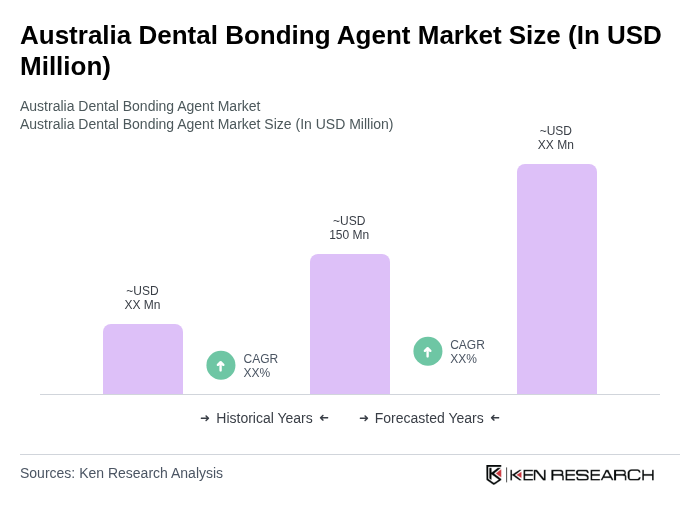
- The Australia Dental Bonding Agent Market is valued at USD 150 million, based on a five-year historical analysis. This growth is primarily driven by the increasing prevalence of dental disorders, rising awareness about oral health, and advancements in dental technology. The demand for effective bonding agents in restorative dentistry has surged, leading to a robust market environment.
- Key cities such as Sydney, Melbourne, and Brisbane dominate the market due to their high concentration of dental clinics and hospitals. These urban centers benefit from advanced healthcare infrastructure, a large population base, and a growing number of dental professionals, which collectively enhance the demand for dental bonding agents.
- In 2023, the Australian government implemented regulations mandating the use of biocompatible materials in dental procedures. This regulation aims to ensure patient safety and improve treatment outcomes, thereby influencing the market dynamics for dental bonding agents as manufacturers adapt to comply with these standards.
Australia Dental Bonding Agent Market Segmentation
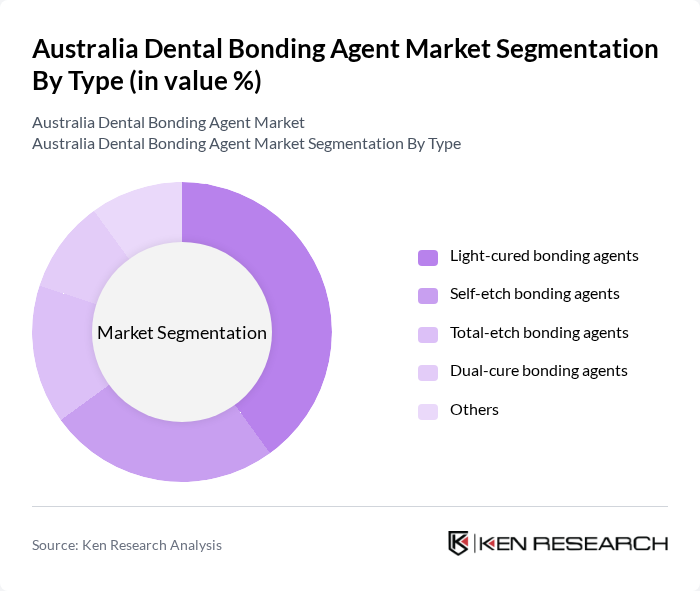
By Type:The market is segmented into various types of bonding agents, including light-cured bonding agents, self-etch bonding agents, total-etch bonding agents, dual-cure bonding agents, and others. Among these, light-cured bonding agents are gaining significant traction due to their ease of use and quick setting times, making them a preferred choice in dental practices. Self-etch bonding agents are also popular for their ability to simplify the bonding process, thus catering to the growing demand for efficient dental solutions.
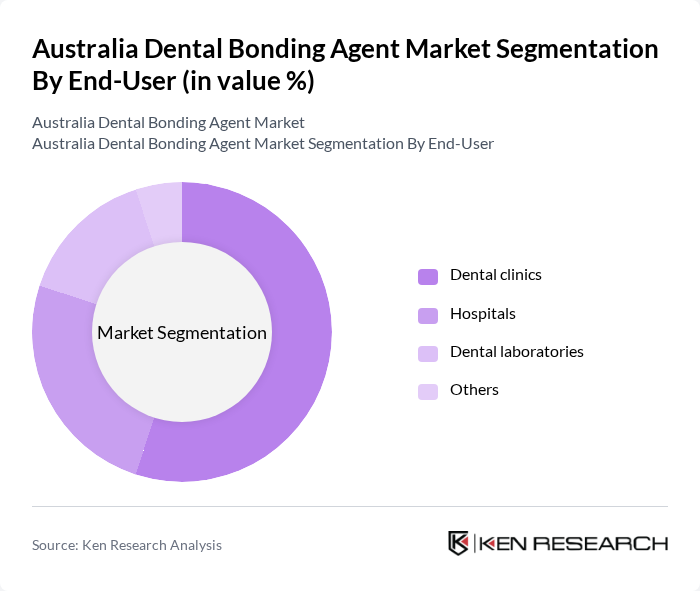
By End-User:The end-user segmentation includes dental clinics, hospitals, dental laboratories, and others. Dental clinics are the leading end-users, driven by the increasing number of dental procedures performed and the growing patient base seeking cosmetic and restorative treatments. Hospitals also contribute significantly, particularly in providing comprehensive dental care services, while dental laboratories support the market by fabricating dental prosthetics and restorations.
Australia Dental Bonding Agent Market Competitive Landscape
The Australia Dental Bonding Agent Market is characterized by a dynamic mix of regional and international players. Leading participants such as 3M Australia, Dentsply Sirona, Ivoclar Vivadent, Kuraray Noritake Dental, GC Corporation, Henry Schein, Bisco Dental Products, Coltene Holding AG, Shofu Dental Corporation, Ultradent Products, VOCO GmbH, Mitsui Chemicals, Zhermack, DMG Chemisch-Pharmazeutische Fabrik, Renfert GmbH contribute to innovation, geographic expansion, and service delivery in this space.
Australia Dental Bonding Agent Market Industry Analysis
Growth Drivers
- Increasing Demand for Cosmetic Dentistry:The Australian cosmetic dentistry market is projected to reach AUD 1.5 billion by 2024, driven by a growing preference for aesthetic dental procedures. This surge is attributed to the rising disposable income, with household income in Australia expected to increase by 2.5% in the future. As more individuals seek cosmetic enhancements, the demand for dental bonding agents, essential for procedures like veneers and tooth repairs, is anticipated to rise significantly, supporting market growth.
- Advancements in Dental Technology:The dental technology sector in Australia is expected to grow at a rate of 6% annually, with innovations such as 3D printing and digital imaging enhancing the efficiency of dental procedures. These advancements facilitate the use of high-quality bonding agents, improving patient outcomes and satisfaction. As dental practices adopt these technologies, the demand for effective bonding agents will likely increase, further propelling market growth in the future.
- Rising Awareness About Oral Health:According to the Australian Institute of Health and Welfare, 90% of Australians aged 15 and over reported having a dental check-up in the last two years. This heightened awareness of oral health is leading to increased visits to dental professionals, who are more likely to recommend bonding agents for restorative and cosmetic procedures. As public health campaigns continue to emphasize the importance of oral hygiene, the market for dental bonding agents is expected to expand.
Market Challenges
- High Cost of Dental Bonding Agents:The average cost of dental bonding agents in Australia can range from AUD 200 to AUD 600 per procedure, which may deter some patients from opting for these treatments. With the rising cost of dental care, many individuals are seeking more affordable alternatives, impacting the overall demand for bonding agents. This challenge is compounded by the economic pressures faced by consumers, particularly in the wake of inflationary trends projected to reach 3% in the future.
- Stringent Regulatory Requirements:The Australian Therapeutic Goods Administration (TGA) imposes rigorous standards for dental products, including bonding agents. Compliance with these regulations can be costly and time-consuming for manufacturers, potentially limiting the entry of new products into the market. As the TGA continues to enforce these standards, companies may face challenges in innovation and product development, which could hinder market growth and competitiveness.
Australia Dental Bonding Agent Market Future Outlook
The future of the Australia dental bonding agent market appears promising, driven by ongoing advancements in dental technology and a growing emphasis on cosmetic procedures. As the population ages and the demand for aesthetic dental solutions increases, the market is likely to see a rise in innovative bonding materials. Additionally, the expansion of dental clinics into underserved areas will enhance accessibility, further stimulating market growth. Overall, the landscape is set for significant transformation, aligning with broader health trends and consumer preferences.
Market Opportunities
- Expansion of Dental Clinics in Rural Areas:The Australian government has allocated AUD 50 million for the establishment of dental clinics in rural regions by 2024. This initiative aims to improve access to dental care, creating opportunities for bonding agents as more patients seek cosmetic and restorative treatments in these areas, thereby expanding the market reach.
- Introduction of Innovative Bonding Materials:Research and development in dental materials are projected to receive AUD 20 million in funding over the next two years. This investment is expected to lead to the introduction of advanced bonding agents that offer improved durability and aesthetic appeal, catering to the evolving preferences of consumers and dental professionals alike.
Scope of the Report
| Segment | Sub-Segments |
|---|---|
| By Type | Light-cured bonding agents Self-etch bonding agents Total-etch bonding agents Dual-cure bonding agents Others |
| By End-User | Dental clinics Hospitals Dental laboratories Others |
| By Application | Aesthetic restorations Preventive dentistry Orthodontics Others |
| By Material Composition | Resin-based bonding agents Glass ionomer bonding agents Hybrid bonding agents Others |
| By Distribution Channel | Direct sales Online sales Distributors Others |
| By Region | New South Wales Victoria Queensland Western Australia South Australia Tasmania Others |
| By Customer Type | Individual patients Corporate clients Insurance providers Others |
Key Target Audience
Investors and Venture Capitalist Firms
Government and Regulatory Bodies (e.g., Therapeutic Goods Administration, Australian Competition and Consumer Commission)
Manufacturers and Producers
Distributors and Retailers
Dental Clinics and Practices
Dental Product Wholesalers
Industry Associations (e.g., Australian Dental Association)
Financial Institutions
Players Mentioned in the Report:
3M Australia
Dentsply Sirona
Ivoclar Vivadent
Kuraray Noritake Dental
GC Corporation
Henry Schein
Bisco Dental Products
Coltene Holding AG
Shofu Dental Corporation
Ultradent Products
VOCO GmbH
Mitsui Chemicals
Zhermack
DMG Chemisch-Pharmazeutische Fabrik
Renfert GmbH
Table of Contents
Market Assessment Phase
1. Executive Summary and Approach
2. Australia Dental Bonding Agent Market Overview
2.1 Key Insights and Strategic Recommendations
2.2 Australia Dental Bonding Agent Market Overview
2.3 Definition and Scope
2.4 Evolution of Market Ecosystem
2.5 Timeline of Key Regulatory Milestones
2.6 Value Chain & Stakeholder Mapping
2.7 Business Cycle Analysis
2.8 Policy & Incentive Landscape
3. Australia Dental Bonding Agent Market Analysis
3.1 Growth Drivers
3.1.1 Increasing demand for cosmetic dentistry
3.1.2 Advancements in dental technology
3.1.3 Rising awareness about oral health
3.1.4 Growth in dental tourism in Australia
3.2 Market Challenges
3.2.1 High cost of dental bonding agents
3.2.2 Stringent regulatory requirements
3.2.3 Competition from alternative dental solutions
3.2.4 Limited availability of skilled dental professionals
3.3 Market Opportunities
3.3.1 Expansion of dental clinics in rural areas
3.3.2 Introduction of innovative bonding materials
3.3.3 Collaborations with dental schools for research
3.3.4 Increasing investment in dental health initiatives
3.4 Market Trends
3.4.1 Shift towards eco-friendly dental products
3.4.2 Growing popularity of minimally invasive procedures
3.4.3 Rise in online dental consultations
3.4.4 Integration of digital technologies in dental practices
3.5 Government Regulation
3.5.1 Compliance with Australian Therapeutic Goods Administration (TGA)
3.5.2 Adherence to Australian Dental Association (ADA) guidelines
3.5.3 Regulations on advertising dental products
3.5.4 Standards for dental materials safety and efficacy
4. SWOT Analysis
5. Stakeholder Analysis
6. Porter's Five Forces Analysis
7. Australia Dental Bonding Agent Market Size, 2019-2024
7.1 By Value
7.2 By Volume
7.3 By Average Selling Price
8. Australia Dental Bonding Agent Market Segmentation
8.1 By Type
8.1.1 Light-cured bonding agents
8.1.2 Self-etch bonding agents
8.1.3 Total-etch bonding agents
8.1.4 Dual-cure bonding agents
8.1.5 Others
8.2 By End-User
8.2.1 Dental clinics
8.2.2 Hospitals
8.2.3 Dental laboratories
8.2.4 Others
8.3 By Application
8.3.1 Aesthetic restorations
8.3.2 Preventive dentistry
8.3.3 Orthodontics
8.3.4 Others
8.4 By Material Composition
8.4.1 Resin-based bonding agents
8.4.2 Glass ionomer bonding agents
8.4.3 Hybrid bonding agents
8.4.4 Others
8.5 By Distribution Channel
8.5.1 Direct sales
8.5.2 Online sales
8.5.3 Distributors
8.5.4 Others
8.6 By Region
8.6.1 New South Wales
8.6.2 Victoria
8.6.3 Queensland
8.6.4 Western Australia
8.6.5 South Australia
8.6.6 Tasmania
8.6.7 Others
8.7 By Customer Type
8.7.1 Individual patients
8.7.2 Corporate clients
8.7.3 Insurance providers
8.7.4 Others
9. Australia Dental Bonding Agent Market Competitive Analysis
9.1 Market Share of Key Players
9.2 Cross Comparison of Key Players
9.2.1 Company Name
9.2.2 Group Size (Large, Medium, or Small as per industry convention)
9.2.3 Revenue Growth Rate
9.2.4 Market Penetration Rate
9.2.5 Customer Retention Rate
9.2.6 Product Innovation Rate
9.2.7 Distribution Efficiency
9.2.8 Pricing Strategy
9.2.9 Brand Recognition Score
9.2.10 Customer Satisfaction Index
9.3 SWOT Analysis of Top Players
9.4 Pricing Analysis
9.5 Detailed Profile of Major Companies
9.5.1 3M Australia
9.5.2 Dentsply Sirona
9.5.3 Ivoclar Vivadent
9.5.4 Kuraray Noritake Dental
9.5.5 GC Corporation
9.5.6 Henry Schein
9.5.7 Bisco Dental Products
9.5.8 Coltene Holding AG
9.5.9 Shofu Dental Corporation
9.5.10 Ultradent Products
9.5.11 VOCO GmbH
9.5.12 Mitsui Chemicals
9.5.13 Zhermack
9.5.14 DMG Chemisch-Pharmazeutische Fabrik
9.5.15 Renfert GmbH
10. Australia Dental Bonding Agent Market End-User Analysis
10.1 Procurement Behavior of Key Ministries
10.1.1 Budget allocation for dental health
10.1.2 Procurement processes and timelines
10.1.3 Preferred suppliers and products
10.1.4 Compliance with health regulations
10.2 Corporate Spend on Infrastructure & Energy
10.2.1 Investment in dental infrastructure
10.2.2 Spending on dental technology
10.2.3 Budget for training and development
10.2.4 Others
10.3 Pain Point Analysis by End-User Category
10.3.1 Cost of dental procedures
10.3.2 Accessibility of dental services
10.3.3 Quality of dental materials
10.3.4 Others
10.4 User Readiness for Adoption
10.4.1 Awareness of dental bonding benefits
10.4.2 Willingness to pay for quality
10.4.3 Availability of dental insurance
10.4.4 Others
10.5 Post-Deployment ROI and Use Case Expansion
10.5.1 Measurement of treatment success
10.5.2 Patient feedback and satisfaction
10.5.3 Opportunities for upselling
10.5.4 Others
11. Australia Dental Bonding Agent Market Future Size, 2025-2030
11.1 By Value
11.2 By Volume
11.3 By Average Selling Price
Go-To-Market Strategy Phase
1. Whitespace Analysis + Business Model Canvas
1.1 Market gaps and opportunities
1.2 Value proposition development
1.3 Revenue model identification
1.4 Key partnerships and resources
1.5 Customer segments and relationships
1.6 Cost structure analysis
1.7 Channels for delivery
2. Marketing and Positioning Recommendations
2.1 Branding strategies
2.2 Product USPs
2.3 Target audience identification
2.4 Marketing channels selection
2.5 Messaging and communication strategy
3. Distribution Plan
3.1 Urban retail vs rural NGO tie-ups
3.2 Distribution channel optimization
3.3 Logistics and supply chain management
3.4 Partnerships with distributors
3.5 Inventory management strategies
4. Channel & Pricing Gaps
4.1 Underserved routes
4.2 Pricing bands
4.3 Competitive pricing analysis
4.4 Value-based pricing strategies
4.5 Discounts and promotions
5. Unmet Demand & Latent Needs
5.1 Category gaps
5.2 Consumer segments
5.3 Emerging trends and preferences
5.4 Product development opportunities
5.5 Customer feedback incorporation
6. Customer Relationship
6.1 Loyalty programs
6.2 After-sales service
6.3 Customer engagement strategies
6.4 Feedback and improvement loops
6.5 Community building initiatives
7. Value Proposition
7.1 Sustainability
7.2 Integrated supply chains
7.3 Unique selling points
7.4 Customer-centric approach
7.5 Long-term benefits
8. Key Activities
8.1 Regulatory compliance
8.2 Branding
8.3 Distribution setup
8.4 Training and development
8.5 Market research and analysis
9. Entry Strategy Evaluation
9.1 Domestic Market Entry Strategy
9.1.1 Product mix
9.1.2 Pricing band
9.1.3 Packaging
9.1.4 Marketing approach
9.1.5 Distribution strategy
9.2 Export Entry Strategy
9.2.1 Target countries
9.2.2 Compliance roadmap
9.2.3 Market entry barriers
9.2.4 Distribution channels
9.2.5 Marketing strategies
10. Entry Mode Assessment
10.1 JV
10.2 Greenfield
10.3 M&A
10.4 Distributor Model
10.5 Risk assessment
11. Capital and Timeline Estimation
11.1 Capital requirements
11.2 Timelines
11.3 Funding sources
11.4 Financial projections
11.5 Milestones
12. Control vs Risk Trade-Off
12.1 Ownership vs Partnerships
12.2 Risk management strategies
12.3 Control mechanisms
12.4 Partnership evaluation
12.5 Exit strategies
13. Profitability Outlook
13.1 Breakeven analysis
13.2 Long-term sustainability
13.3 Profit margins
13.4 Revenue forecasts
13.5 Cost management
14. Potential Partner List
14.1 Distributors
14.2 JVs
14.3 Acquisition targets
14.4 Strategic alliances
14.5 Partnership criteria
15. Execution Roadmap
15.1 Phased Plan for Market Entry
15.1.1 Market Setup
15.1.2 Market Entry
15.1.3 Growth Acceleration
15.1.4 Scale & Stabilize
15.2 Key Activities and Milestones
15.2.1 Activity timelines
15.2.2 Milestone tracking
15.2.3 Resource allocation
15.2.4 Performance metrics
Research Methodology
Phase 1: Approach1
Desk Research
- Industry reports from dental associations and market research firms
- Published articles and white papers on dental bonding technologies
- Government publications on dental health regulations and standards in Australia
Primary Research
- Interviews with dental practitioners and orthodontists across Australia
- Surveys targeting dental supply chain managers and distributors
- Focus groups with dental technicians to gather insights on bonding agent preferences
Validation & Triangulation
- Cross-validation of data from multiple industry sources and expert opinions
- Triangulation of market trends with sales data from dental product suppliers
- Sanity checks through expert panel reviews comprising dental industry veterans
Phase 2: Market Size Estimation1
Top-down Assessment
- Analysis of overall dental market growth rates and segment contributions
- Estimation of bonding agent market share within the dental materials sector
- Incorporation of demographic trends affecting dental health services in Australia
Bottom-up Modeling
- Volume estimates based on sales data from leading dental bonding agent manufacturers
- Cost analysis of bonding agents used in various dental procedures
- Calculation of market size based on average usage rates per dental practice
Forecasting & Scenario Analysis
- Multi-factor regression analysis considering factors like population aging and dental health awareness
- Scenario modeling based on potential regulatory changes and technological advancements
- Baseline, optimistic, and pessimistic forecasts through 2030
Phase 3: CATI Sample Composition1
| Scope Item/Segment | Sample Size | Target Respondent Profiles |
|---|---|---|
| General Dental Practices | 150 | Dentists, Practice Managers |
| Orthodontic Clinics | 100 | Orthodontists, Treatment Coordinators |
| Dental Supply Distributors | 80 | Sales Managers, Product Specialists |
| Dental Laboratories | 70 | Lab Technicians, Operations Managers |
| Dental Education Institutions | 60 | Instructors, Curriculum Developers |
Frequently Asked Questions
What is the current value of the Australia Dental Bonding Agent Market?
The Australia Dental Bonding Agent Market is valued at approximately USD 150 million, reflecting a robust growth driven by increasing dental disorders, heightened awareness of oral health, and advancements in dental technology.
Which cities are the primary markets for dental bonding agents in Australia?
What regulations have impacted the dental bonding agent market in Australia?
What types of dental bonding agents are available in the Australian market?
Other Regional/Country Reports
Other Adjacent Reports
Oman Dental Composites Market
Kuwait Restorative Dentistry Market Size, Share, Growth Drivers, Trends, Opportunities & Forecast 2025–2030Middle East cosmetic dentistry market size, share, growth drivers, trends, opportunities & forecast 2025–2030South Africa Dental Adhesives Market
Philippines Dental Sealants Market
United States Dental Equipment Market Outlook to 2030: Size, Share, Growth and TrendsAustralia + New Zealand Dental Implants Market Report Size Share Growth Drivers Trends Opportunities & Forecast 2025–2030APAC dental prosthetics market report Size, Share, Growth Drivers, Trends, Opportunities & Forecast 2025–2030Bahrain Oral Hygiene Products Market
Japan Dental Cements Market
Why Buy From Us?

What makes us stand out is that our consultants follow Robust, Refine and Result (RRR) methodology. Robust for clear definitions, approaches and sanity checking, Refine for differentiating respondents' facts and opinions, and Result for presenting data with story.

We have set a benchmark in the industry by offering our clients with syndicated and customized market research reports featuring coverage of entire market as well as meticulous research and analyst insights.

While we don't replace traditional research, we flip the method upside down. Our dual approach of Top Bottom & Bottom Top ensures quality deliverable by not just verifying company fundamentals but also looking at the sector and macroeconomic factors.

With one step in the future, our research team constantly tries to show you the bigger picture. We help with some of the tough questions you may encounter along the way: How is the industry positioned? Best marketing channel? KPI's of competitors? By aligning every element, we help maximize success.

Our report gives you instant access to the answers and sources that other companies might choose to hide. We elaborate each steps of research methodology we have used and showcase you the sample size to earn your trust.

If you need any support, we are here! We pride ourselves on universe strength, data quality, and quick, friendly, and professional service.