About the Report
Base Year 2024Japan Dental Bonding Agent Market Overview
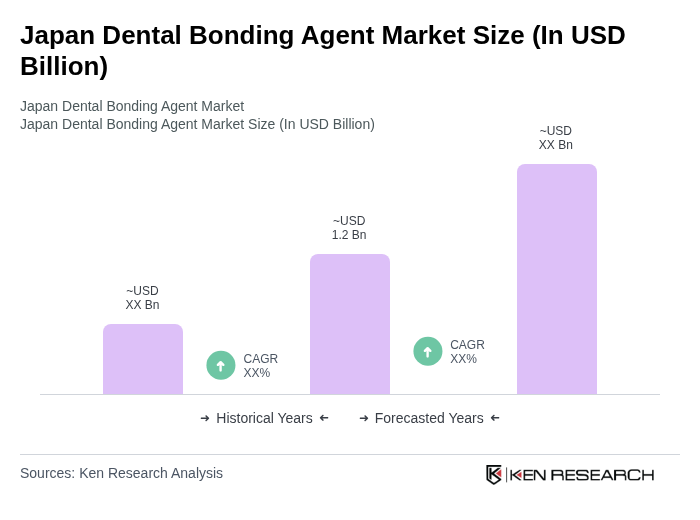
- The Japan Dental Bonding Agent Market is valued at USD 1.2 billion, based on a five-year historical analysis. This growth is primarily driven by the increasing prevalence of dental disorders, rising awareness about oral health, and advancements in dental technology. The demand for effective bonding agents in restorative and preventive dentistry has significantly contributed to the market's expansion.
- Key cities such as Tokyo, Osaka, and Yokohama dominate the market due to their high population density, advanced healthcare infrastructure, and concentration of dental professionals. These urban centers are also home to numerous dental clinics and hospitals, which further drives the demand for dental bonding agents.
- In 2023, the Japanese government implemented regulations mandating the use of biocompatible materials in dental procedures. This regulation aims to enhance patient safety and promote the use of environmentally friendly products in the dental industry, thereby influencing the types of bonding agents available in the market.
Japan Dental Bonding Agent Market Segmentation
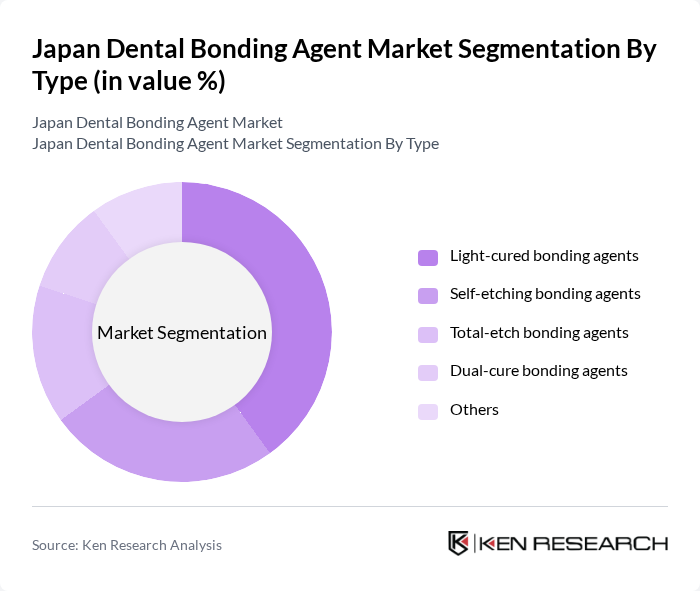
By Type:The market is segmented into various types of bonding agents, including light-cured bonding agents, self-etching bonding agents, total-etch bonding agents, dual-cure bonding agents, and others. Among these, light-cured bonding agents are gaining significant traction due to their ease of use and quick setting times, making them a preferred choice for dental professionals. Self-etching bonding agents are also popular for their ability to simplify the bonding process, thus enhancing efficiency in dental procedures.
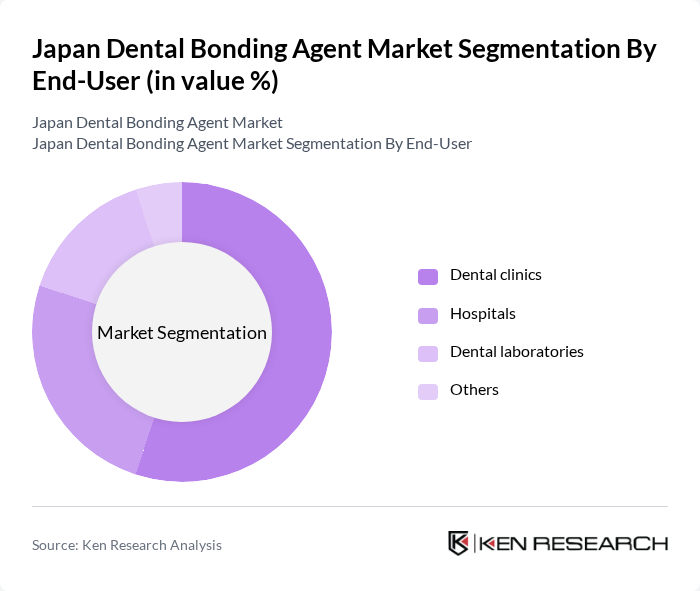
By End-User:The end-user segmentation includes dental clinics, hospitals, dental laboratories, and others. Dental clinics are the leading end-users of bonding agents, driven by the increasing number of dental procedures performed in these settings. Hospitals also contribute significantly to the market, particularly in surgical and restorative dentistry. The growing trend of dental chains further enhances the demand for bonding agents in the market.
Japan Dental Bonding Agent Market Competitive Landscape
The Japan Dental Bonding Agent Market is characterized by a dynamic mix of regional and international players. Leading participants such as 3M Japan Limited, Kuraray Noritake Dental Inc., GC Corporation, Dentsply Sirona Inc., Shofu Inc., Ivoclar Vivadent AG, Tokuyama Dental Corporation, Bisco Inc., Coltene Holding AG, Mitsui Chemicals, Inc., Henkel AG & Co. KGaA, Voco GmbH, FGM Produtos Odontológicos, SDI Limited, Prime Dental Supply contribute to innovation, geographic expansion, and service delivery in this space.
Japan Dental Bonding Agent Market Industry Analysis
Growth Drivers
- Increasing Demand for Aesthetic Dental Procedures:The Japanese dental market is witnessing a surge in aesthetic procedures, with a reported increase of 15% in cosmetic dental treatments from 2022 to 2023. This trend is driven by a growing consumer preference for visually appealing dental solutions, particularly among younger demographics. The total expenditure on aesthetic dentistry reached approximately ¥300 billion in future, indicating a robust market for dental bonding agents that enhance aesthetic outcomes.
- Advancements in Dental Technology:The integration of advanced technologies in dental practices is significantly boosting the demand for dental bonding agents. In future, over 60% of dental clinics in Japan adopted digital imaging and CAD/CAM systems, enhancing precision in aesthetic procedures. This technological shift is expected to increase the efficiency of dental bonding applications, leading to a projected growth in bonding agent usage by 20% over the next year, as practitioners seek to improve patient outcomes.
- Rising Awareness About Oral Health:Public awareness campaigns and educational initiatives have led to a notable increase in oral health consciousness among the Japanese population. According to the Ministry of Health, Labor and Welfare, 70% of adults now prioritize regular dental check-ups, up from 55% in the past. This heightened awareness is driving demand for preventive and aesthetic dental solutions, including bonding agents, which are essential for maintaining oral health and enhancing smiles.
Market Challenges
- High Cost of Dental Bonding Agents:The cost of dental bonding agents remains a significant barrier to market growth. Premium bonding products can range from ¥10,000 to ¥30,000 per unit, making them less accessible for budget-conscious patients. This high price point limits the adoption of advanced bonding solutions, particularly in lower-income demographics, which account for approximately 30% of the population, thereby constraining overall market expansion.
- Stringent Regulatory Requirements:The dental industry in Japan is subject to rigorous regulatory standards, particularly under the Pharmaceutical and Medical Device Act. Compliance with these regulations can delay product launches and increase operational costs for manufacturers. In future, the average time for regulatory approval for new dental products was reported at 18 months, which poses a challenge for companies aiming to innovate and respond to market demands swiftly.
Japan Dental Bonding Agent Market Future Outlook
The future of the Japan dental bonding agent market appears promising, driven by ongoing technological advancements and a growing emphasis on aesthetic dentistry. As digital technologies continue to integrate into dental practices, the efficiency and effectiveness of bonding agents are expected to improve. Additionally, the increasing focus on preventive care and oral health education will likely sustain demand for bonding solutions, positioning the market for steady growth in the coming years.
Market Opportunities
- Expansion of Dental Clinics in Rural Areas:The Japanese government is actively promoting the establishment of dental clinics in rural regions, where access to dental care is limited. This initiative is expected to increase the demand for dental bonding agents by approximately 25% in these underserved areas, providing a significant opportunity for manufacturers to expand their market reach.
- Increasing Investment in Dental Research and Development:With the Japanese dental market witnessing a surge in R&D investments, estimated at ¥15 billion in future, there is a growing opportunity for innovation in bonding materials. This investment is likely to lead to the development of more effective and eco-friendly bonding agents, catering to the evolving preferences of consumers and dental professionals alike.
Scope of the Report
| Segment | Sub-Segments |
|---|---|
| By Type | Light-cured bonding agents Self-etching bonding agents Total-etch bonding agents Dual-cure bonding agents Others |
| By End-User | Dental clinics Hospitals Dental laboratories Others |
| By Application | Restorative dentistry Orthodontics Preventive dentistry Others |
| By Material Composition | Resin-based bonding agents Glass ionomer bonding agents Hybrid bonding agents Others |
| By Distribution Channel | Direct sales Distributors Online sales Others |
| By Region | Kanto Kansai Chubu Others |
| By Customer Type | Individual dentists Dental chains Educational institutions Others |
Key Target Audience
Investors and Venture Capitalist Firms
Government and Regulatory Bodies (e.g., Ministry of Health, Labour and Welfare)
Manufacturers and Producers
Distributors and Retailers
Dental Clinics and Practices
Dental Product Wholesalers
Industry Associations (e.g., Japan Dental Association)
Financial Institutions
Players Mentioned in the Report:
3M Japan Limited
Kuraray Noritake Dental Inc.
GC Corporation
Dentsply Sirona Inc.
Shofu Inc.
Ivoclar Vivadent AG
Tokuyama Dental Corporation
Bisco Inc.
Coltene Holding AG
Mitsui Chemicals, Inc.
Henkel AG & Co. KGaA
Voco GmbH
FGM Produtos Odontologicos
SDI Limited
Prime Dental Supply
Table of Contents
Market Assessment Phase
1. Executive Summary and Approach
2. Japan Dental Bonding Agent Market Overview
2.1 Key Insights and Strategic Recommendations
2.2 Japan Dental Bonding Agent Market Overview
2.3 Definition and Scope
2.4 Evolution of Market Ecosystem
2.5 Timeline of Key Regulatory Milestones
2.6 Value Chain & Stakeholder Mapping
2.7 Business Cycle Analysis
2.8 Policy & Incentive Landscape
3. Japan Dental Bonding Agent Market Analysis
3.1 Growth Drivers
3.1.1 Increasing demand for aesthetic dental procedures
3.1.2 Advancements in dental technology
3.1.3 Rising awareness about oral health
3.1.4 Growth in the geriatric population
3.2 Market Challenges
3.2.1 High cost of dental bonding agents
3.2.2 Stringent regulatory requirements
3.2.3 Competition from alternative dental materials
3.2.4 Limited availability of skilled dental professionals
3.3 Market Opportunities
3.3.1 Expansion of dental clinics in rural areas
3.3.2 Increasing investment in dental research and development
3.3.3 Growing trend of cosmetic dentistry
3.3.4 Collaborations with dental schools and institutions
3.4 Market Trends
3.4.1 Shift towards eco-friendly dental materials
3.4.2 Rise in online dental consultations
3.4.3 Integration of digital technologies in dental practices
3.4.4 Customization of dental bonding solutions
3.5 Government Regulation
3.5.1 Compliance with the Pharmaceutical and Medical Device Act
3.5.2 Guidelines for dental product safety and efficacy
3.5.3 Regulations on advertising dental products
3.5.4 Standards for dental material testing and certification
4. SWOT Analysis
5. Stakeholder Analysis
6. Porter's Five Forces Analysis
7. Japan Dental Bonding Agent Market Size, 2019-2024
7.1 By Value
7.2 By Volume
7.3 By Average Selling Price
8. Japan Dental Bonding Agent Market Segmentation
8.1 By Type
8.1.1 Light-cured bonding agents
8.1.2 Self-etching bonding agents
8.1.3 Total-etch bonding agents
8.1.4 Dual-cure bonding agents
8.1.5 Others
8.2 By End-User
8.2.1 Dental clinics
8.2.2 Hospitals
8.2.3 Dental laboratories
8.2.4 Others
8.3 By Application
8.3.1 Restorative dentistry
8.3.2 Orthodontics
8.3.3 Preventive dentistry
8.3.4 Others
8.4 By Material Composition
8.4.1 Resin-based bonding agents
8.4.2 Glass ionomer bonding agents
8.4.3 Hybrid bonding agents
8.4.4 Others
8.5 By Distribution Channel
8.5.1 Direct sales
8.5.2 Distributors
8.5.3 Online sales
8.5.4 Others
8.6 By Region
8.6.1 Kanto
8.6.2 Kansai
8.6.3 Chubu
8.6.4 Others
8.7 By Customer Type
8.7.1 Individual dentists
8.7.2 Dental chains
8.7.3 Educational institutions
8.7.4 Others
9. Japan Dental Bonding Agent Market Competitive Analysis
9.1 Market Share of Key Players
9.2 Cross Comparison of Key Players
9.2.1 Company Name
9.2.2 Group Size (Large, Medium, or Small as per industry convention)
9.2.3 Revenue Growth Rate
9.2.4 Market Penetration Rate
9.2.5 Customer Retention Rate
9.2.6 Product Innovation Rate
9.2.7 Distribution Efficiency
9.2.8 Pricing Strategy
9.2.9 Brand Recognition
9.2.10 Customer Satisfaction Score
9.3 SWOT Analysis of Top Players
9.4 Pricing Analysis
9.5 Detailed Profile of Major Companies
9.5.1 3M Japan Limited
9.5.2 Kuraray Noritake Dental Inc.
9.5.3 GC Corporation
9.5.4 Dentsply Sirona Inc.
9.5.5 Shofu Inc.
9.5.6 Ivoclar Vivadent AG
9.5.7 Tokuyama Dental Corporation
9.5.8 Bisco Inc.
9.5.9 Coltene Holding AG
9.5.10 Mitsui Chemicals, Inc.
9.5.11 Henkel AG & Co. KGaA
9.5.12 Voco GmbH
9.5.13 FGM Produtos Odontológicos
9.5.14 SDI Limited
9.5.15 Prime Dental Supply
10. Japan Dental Bonding Agent Market End-User Analysis
10.1 Procurement Behavior of Key Ministries
10.1.1 Budget allocation for dental supplies
10.1.2 Preference for local vs. international suppliers
10.1.3 Evaluation criteria for procurement
10.1.4 Frequency of procurement cycles
10.2 Corporate Spend on Infrastructure & Energy
10.2.1 Investment in dental infrastructure
10.2.2 Spending on dental technology upgrades
10.2.3 Budget for training and development
10.2.4 Others
10.3 Pain Point Analysis by End-User Category
10.3.1 Challenges faced by dental clinics
10.3.2 Issues in supply chain management
10.3.3 Customer service challenges
10.3.4 Others
10.4 User Readiness for Adoption
10.4.1 Awareness of new dental bonding technologies
10.4.2 Training needs for dental professionals
10.4.3 Acceptance of digital solutions in dentistry
10.4.4 Others
10.5 Post-Deployment ROI and Use Case Expansion
10.5.1 Measurement of ROI from dental bonding agents
10.5.2 Case studies of successful implementations
10.5.3 Opportunities for expanding use cases
10.5.4 Others
11. Japan Dental Bonding Agent Market Future Size, 2025-2030
11.1 By Value
11.2 By Volume
11.3 By Average Selling Price
Go-To-Market Strategy Phase
1. Whitespace Analysis + Business Model Canvas
1.1 Market gaps and opportunities
1.2 Value proposition development
1.3 Revenue model identification
1.4 Key partnerships and alliances
1.5 Customer segmentation
1.6 Cost structure analysis
1.7 Competitive landscape overview
2. Marketing and Positioning Recommendations
2.1 Branding strategies
2.2 Product USPs
2.3 Target audience identification
2.4 Marketing channels selection
2.5 Messaging and communication strategy
2.6 Performance metrics
2.7 Budget allocation
3. Distribution Plan
3.1 Urban retail strategies
3.2 Rural NGO tie-ups
3.3 Online distribution channels
3.4 Logistics and supply chain management
3.5 Partnership with dental suppliers
3.6 Inventory management
3.7 Distribution performance metrics
4. Channel & Pricing Gaps
4.1 Underserved routes
4.2 Pricing bands analysis
4.3 Competitor pricing strategies
4.4 Customer willingness to pay
4.5 Price elasticity of demand
4.6 Recommendations for pricing adjustments
4.7 Monitoring pricing trends
5. Unmet Demand & Latent Needs
5.1 Category gaps
5.2 Consumer segments analysis
5.3 Emerging trends and needs
5.4 Recommendations for product development
5.5 Market entry strategies for unmet needs
5.6 Customer feedback mechanisms
5.7 Future demand forecasting
6. Customer Relationship
6.1 Loyalty programs
6.2 After-sales service
6.3 Customer engagement strategies
6.4 Feedback and improvement processes
6.5 Building long-term relationships
6.6 Customer satisfaction measurement
6.7 Retention strategies
7. Value Proposition
7.1 Sustainability initiatives
7.2 Integrated supply chains
7.3 Unique selling points
7.4 Customer-centric approach
7.5 Competitive advantages
7.6 Value delivery mechanisms
7.7 Performance metrics
8. Key Activities
8.1 Regulatory compliance
8.2 Branding efforts
8.3 Distribution setup
8.4 Marketing campaigns
8.5 Training and development
8.6 Performance monitoring
8.7 Continuous improvement processes
9. Entry Strategy Evaluation
9.1 Domestic Market Entry Strategy
9.1.1 Product mix considerations
9.1.2 Pricing band analysis
9.1.3 Packaging strategies
9.2 Export Entry Strategy
9.2.1 Target countries identification
9.2.2 Compliance roadmap development
10. Entry Mode Assessment
10.1 Joint Ventures
10.2 Greenfield investments
10.3 Mergers & Acquisitions
10.4 Distributor Model
10.5 Risk assessment
10.6 Strategic fit evaluation
10.7 Long-term sustainability considerations
11. Capital and Timeline Estimation
11.1 Capital requirements
11.2 Timelines for market entry
11.3 Budget allocation
11.4 Financial projections
11.5 Funding sources
11.6 Risk management strategies
11.7 Milestones tracking
12. Control vs Risk Trade-Off
12.1 Ownership considerations
12.2 Partnerships evaluation
12.3 Risk mitigation strategies
12.4 Control mechanisms
12.5 Long-term implications
12.6 Performance monitoring
12.7 Strategic adjustments
13. Profitability Outlook
13.1 Breakeven analysis
13.2 Long-term sustainability
13.3 Profit margin projections
13.4 Cost management strategies
13.5 Revenue growth strategies
13.6 Financial health assessment
13.7 Market conditions impact
14. Potential Partner List
14.1 Distributors
14.2 Joint Ventures
14.3 Acquisition targets
14.4 Strategic alliances
14.5 Partnership evaluation criteria
14.6 Collaboration opportunities
14.7 Long-term partnership strategies
15. Execution Roadmap
15.1 Phased Plan for Market Entry
15.1.1 Market Setup
15.1.2 Market Entry
15.1.3 Growth Acceleration
15.1.4 Scale & Stabilize
15.2 Key Activities and Milestones
15.2.1 Activity planning
15.2.2 Milestone tracking
15.2.3 Performance evaluation
15.2.4 Adjustments and improvements
Research Methodology
Phase 1: Approach1
Desk Research
- Analysis of industry reports from dental associations and market research firms
- Review of academic journals and publications on dental materials and bonding agents
- Examination of regulatory guidelines and standards from Japan's Ministry of Health, Labour and Welfare
Primary Research
- Interviews with dental practitioners and specialists in restorative dentistry
- Surveys targeting dental product distributors and suppliers in Japan
- Field visits to dental clinics and laboratories to gather firsthand insights
Validation & Triangulation
- Cross-validation of findings through multiple expert interviews and focus groups
- Triangulation of data from sales figures, market trends, and regulatory changes
- Sanity checks conducted through feedback from industry panels and stakeholders
Phase 2: Market Size Estimation1
Top-down Assessment
- Estimation of market size based on national dental care expenditure and growth rates
- Segmentation of the market by product type, application, and end-user demographics
- Incorporation of trends in dental health awareness and preventive care initiatives
Bottom-up Modeling
- Collection of sales data from leading dental bonding agent manufacturers
- Estimation of market penetration rates based on clinic and hospital usage
- Volume and pricing analysis based on product categories and distribution channels
Forecasting & Scenario Analysis
- Multi-variable forecasting using historical data and projected dental care trends
- Scenario analysis based on potential regulatory changes and technological advancements
- Development of baseline, optimistic, and pessimistic market growth scenarios through 2030
Phase 3: CATI Sample Composition1
| Scope Item/Segment | Sample Size | Target Respondent Profiles |
|---|---|---|
| General Dental Practices | 150 | Dentists, Clinic Managers |
| Dental Laboratories | 100 | Lab Technicians, Operations Managers |
| Dental Product Distributors | 80 | Sales Representatives, Distribution Managers |
| Dental Schools and Training Institutions | 60 | Educators, Curriculum Developers |
| Regulatory Bodies and Associations | 50 | Policy Makers, Industry Analysts |
Frequently Asked Questions
What is the current value of the Japan Dental Bonding Agent Market?
The Japan Dental Bonding Agent Market is valued at approximately USD 1.2 billion, reflecting a significant growth driven by the rising prevalence of dental disorders and advancements in dental technology.
What factors are driving the growth of the Japan Dental Bonding Agent Market?
Which cities are the primary markets for dental bonding agents in Japan?
What types of dental bonding agents are available in the Japanese market?
Other Regional/Country Reports
Other Adjacent Reports
Singapore Dental Adhesives Market
Indonesia Dental Composites Market
Kuwait Restorative Dentistry Market Size, Share, Growth Drivers, Trends, Opportunities & Forecast 2025–2030Middle East cosmetic dentistry market size, share, growth drivers, trends, opportunities & forecast 2025–2030United States Dental Equipment Market Outlook to 2030: Size, Share, Growth and TrendsSaudi Arabia Oral Care Products MarketAustralia + New Zealand Dental Implants Market Report Size Share Growth Drivers Trends Opportunities & Forecast 2025–2030Indonesia Dental Sealants Market
South Korea Orthodontics Market
Philippines Dental Biomaterials Market Size, Share & Forecast, By Product Type, Application & End User, 2026-2031Why Buy From Us?

What makes us stand out is that our consultants follow Robust, Refine and Result (RRR) methodology. Robust for clear definitions, approaches and sanity checking, Refine for differentiating respondents' facts and opinions, and Result for presenting data with story.

We have set a benchmark in the industry by offering our clients with syndicated and customized market research reports featuring coverage of entire market as well as meticulous research and analyst insights.

While we don't replace traditional research, we flip the method upside down. Our dual approach of Top Bottom & Bottom Top ensures quality deliverable by not just verifying company fundamentals but also looking at the sector and macroeconomic factors.

With one step in the future, our research team constantly tries to show you the bigger picture. We help with some of the tough questions you may encounter along the way: How is the industry positioned? Best marketing channel? KPI's of competitors? By aligning every element, we help maximize success.

Our report gives you instant access to the answers and sources that other companies might choose to hide. We elaborate each steps of research methodology we have used and showcase you the sample size to earn your trust.

If you need any support, we are here! We pride ourselves on universe strength, data quality, and quick, friendly, and professional service.