About the Report
Base Year 2024Australia Digital Printed Textile Market Overview
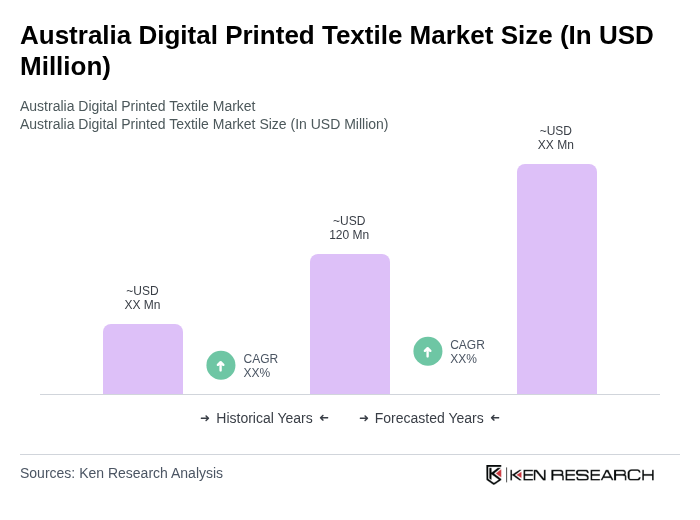
- The Australia Digital Printed Textile Market is valued at USD 120 million, based on a five-year historical analysis. This growth is primarily driven by the increasing demand for customized and sustainable textile solutions, alongside advancements in digital printing technologies that enhance production efficiency and reduce waste, including inkjet technology, eco-friendly inks, automation, and rapid e-commerce expansion. The market has seen a significant shift towards eco-friendly materials and processes, reflecting a broader trend in consumer preferences for sustainable products.
- Key cities such as Sydney, Melbourne, and Brisbane dominate the market due to their robust fashion industries, high consumer spending, and a strong presence of textile manufacturers. These urban centers are hubs for innovation and creativity, attracting both local and international brands that seek to leverage digital printing technologies for unique and personalized textile products.
- The Recycling and Waste Reduction Act, 2020 issued by the Australian Parliament requires manufacturers to meet product stewardship obligations for textiles, including establishing take-back schemes, meeting minimum recycled content thresholds of 50% for certain products, and reporting annual waste diversion metrics to promote sustainable practices within the textile industry. This regulation encourages manufacturers to adopt digital printing technologies that minimize waste and enhance the lifecycle of textile products, aligning with the country's broader environmental goals.
Australia Digital Printed Textile Market Segmentation
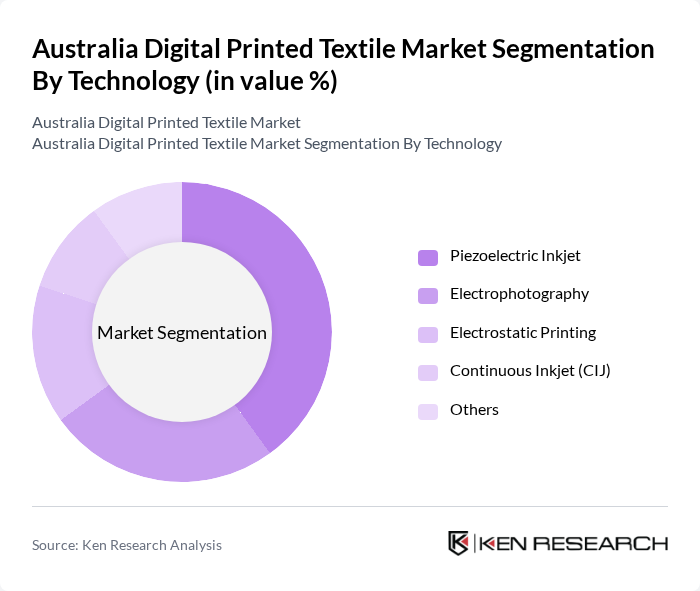
By Technology:The digital printed textile market is segmented by technology into various sub-segments, including Piezoelectric Inkjet, Electrophotography, Electrostatic Printing, Continuous Inkjet (CIJ), and Others. Among these, Piezoelectric Inkjet technology is leading due to its versatility and ability to produce high-quality prints on a wide range of materials. The demand for this technology is driven by its efficiency and the growing trend of customization in textile printing.
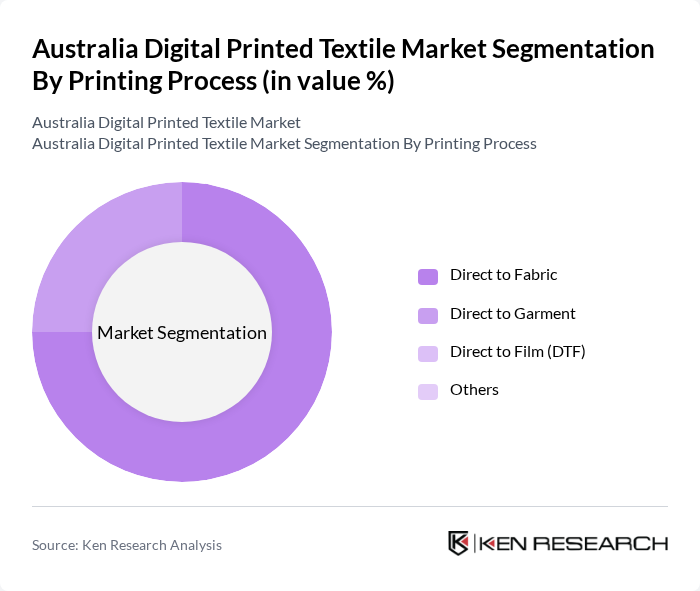
By Printing Process:The market is also segmented by printing process, which includes Direct to Fabric, Direct to Garment, Direct to Film (DTF), and Others. The Direct to Garment process is currently the most dominant due to its ability to produce intricate designs and vibrant colors directly on garments, catering to the growing demand for personalized apparel. This method is favored by small businesses and startups looking to offer unique products without large inventory costs.
Australia Digital Printed Textile Market Competitive Landscape
The Australia Digital Printed Textile Market is characterized by a dynamic mix of regional and international players. Leading participants such as Mereton Textiles, Sublitech Printing, Digital Fabrics, Visual Solutions Australia, GJS Group Australia, Mimaki Australia, Impression Technology Australia, YSAA Group, Kissel & Wolf Australia, Select Textiles, Seiko Epson Corp, Kornit Digital Ltd, Roland DG Corp, Konica Minolta Inc, Brother Industries Ltd contribute to innovation, geographic expansion, and service delivery in this space.
Australia Digital Printed Textile Market Industry Analysis
Growth Drivers
- Increasing Demand for Customization:The Australian digital printed textile market is experiencing a surge in demand for customized products, driven by consumer preferences for unique designs. In future, the customization segment is projected to account for approximately AUD 160 million, reflecting a 20% increase from the previous year. This trend is supported by the rise of online platforms that facilitate personalized textile orders, catering to both individual consumers and businesses seeking bespoke solutions.
- Advancements in Printing Technology:Technological innovations in digital printing are significantly enhancing production capabilities in Australia. In future, the adoption of advanced printing technologies, such as direct-to-garment (DTG) and dye-sublimation, is expected to increase by 35%, allowing for faster turnaround times and improved print quality. This shift is supported by a growing investment in R&D, with the Australian textile industry allocating over AUD 55 million towards technology upgrades in the past year.
- Sustainability Trends in Textile Production:The push for sustainable practices is reshaping the Australian textile landscape. In future, approximately 45% of consumers are willing to pay a premium for eco-friendly textiles, translating to an estimated AUD 220 million market segment. This trend is bolstered by government initiatives promoting sustainable manufacturing, with the Australian government investing AUD 35 million in programs aimed at reducing textile waste and promoting recycling within the industry.
Market Challenges
- High Initial Investment Costs:One of the significant barriers to entry in the digital printed textile market is the high initial investment required for advanced printing equipment. In future, the average cost of setting up a digital printing facility is estimated at AUD 550,000, which can deter small businesses from entering the market. This financial hurdle is compounded by the need for ongoing maintenance and technology upgrades, further straining resources for new entrants.
- Competition from Traditional Textile Printing:The digital printed textile market faces stiff competition from traditional textile printing methods, which are often more established and cost-effective. In future, traditional printing methods are projected to hold a market share of approximately 65%, limiting the growth potential for digital alternatives. This competition is exacerbated by the lower production costs associated with traditional methods, making it challenging for digital printers to compete on price.
Australia Digital Printed Textile Market Future Outlook
The future of the Australia digital printed textile market appears promising, driven by increasing consumer demand for personalized and sustainable products. As technology continues to evolve, the integration of smart textiles and on-demand printing capabilities will likely reshape production processes. Additionally, the growing emphasis on eco-friendly practices will encourage manufacturers to innovate, ensuring that they meet consumer expectations while adhering to regulatory standards. This dynamic environment presents a fertile ground for growth and transformation in the industry.
Market Opportunities
- Expansion into Eco-friendly Products:There is a significant opportunity for businesses to expand their offerings into eco-friendly digital printed textiles. With the Australian market increasingly prioritizing sustainability, companies that invest in organic and recycled materials can tap into a growing consumer base, potentially increasing sales by AUD 120 million in future.
- Collaborations with Fashion Designers:Collaborating with fashion designers presents a lucrative opportunity for digital printed textile manufacturers. By partnering with emerging and established designers, companies can create exclusive collections that leverage unique prints, potentially boosting revenue by 30% in the next two years as demand for innovative fashion solutions rises.
Scope of the Report
| Segment | Sub-Segments |
|---|---|
| By Technology | Piezoelectric Inkjet Electrophotography Electrostatic Printing Continuous Inkjet (CIJ) Others |
| By Printing Process | Direct to Fabric Direct to Garment Direct to Film (DTF) Others |
| By Application | Clothing & Apparel Home Decor Soft Signage Industrial Textiles Others |
| By Material | Cotton Polyester Silk Blends Others |
| By Distribution Channel | Direct Sales Online Sales Retail Stores Others |
| By Region | New South Wales Victoria Queensland Western Australia Others |
| By Customer Segment | B2B B2C Others |
Key Target Audience
Investors and Venture Capitalist Firms
Government and Regulatory Bodies (e.g., Australian Competition and Consumer Commission, Department of Industry, Science, Energy and Resources)
Manufacturers and Producers
Distributors and Retailers
Textile Designers and Innovators
Fashion Brands and Apparel Companies
Textile Equipment Suppliers
Environmental and Sustainability Organizations
Players Mentioned in the Report:
Mereton Textiles
Sublitech Printing
Digital Fabrics
Visual Solutions Australia
GJS Group Australia
Mimaki Australia
Impression Technology Australia
YSAA Group
Kissel & Wolf Australia
Select Textiles
Seiko Epson Corp
Kornit Digital Ltd
Roland DG Corp
Konica Minolta Inc
Brother Industries Ltd
Table of Contents
Market Assessment Phase
1. Executive Summary and Approach
2. Australia Digital Printed Textile Market Overview
2.1 Key Insights and Strategic Recommendations
2.2 Australia Digital Printed Textile Market Overview
2.3 Definition and Scope
2.4 Evolution of Market Ecosystem
2.5 Timeline of Key Regulatory Milestones
2.6 Value Chain & Stakeholder Mapping
2.7 Business Cycle Analysis
2.8 Policy & Incentive Landscape
3. Australia Digital Printed Textile Market Analysis
3.1 Growth Drivers
3.1.1 Increasing Demand for Customization
3.1.2 Advancements in Printing Technology
3.1.3 Sustainability Trends in Textile Production
3.1.4 Growth of E-commerce in Fashion
3.2 Market Challenges
3.2.1 High Initial Investment Costs
3.2.2 Competition from Traditional Textile Printing
3.2.3 Regulatory Compliance Issues
3.2.4 Limited Awareness Among Small Businesses
3.3 Market Opportunities
3.3.1 Expansion into Eco-friendly Products
3.3.2 Collaborations with Fashion Designers
3.3.3 Growth in Home Décor Segment
3.3.4 Technological Innovations in Fabric Printing
3.4 Market Trends
3.4.1 Rise of Digital Fabric Printing
3.4.2 Personalization and On-Demand Printing
3.4.3 Integration of Smart Textiles
3.4.4 Shift Towards Sustainable Practices
3.5 Government Regulation
3.5.1 Environmental Protection Regulations
3.5.2 Trade Tariffs on Imported Textiles
3.5.3 Standards for Textile Safety
3.5.4 Incentives for Sustainable Manufacturing
4. SWOT Analysis
5. Stakeholder Analysis
6. Porter's Five Forces Analysis
7. Australia Digital Printed Textile Market Market Size, 2019-2024
7.1 By Value
7.2 By Volume
7.3 By Average Selling Price
8. Australia Digital Printed Textile Market Segmentation
8.1 By Technology
8.1.1 Piezoelectric Inkjet
8.1.2 Electrophotography
8.1.3 Electrostatic Printing
8.1.4 Continuous Inkjet (CIJ)
8.1.5 Others
8.2 By Printing Process
8.2.1 Direct to Fabric
8.2.2 Direct to Garment
8.2.3 Direct to Film (DTF)
8.2.4 Others
8.3 By Application
8.3.1 Clothing & Apparel
8.3.2 Home Decor
8.3.3 Soft Signage
8.3.4 Industrial Textiles
8.3.5 Others
8.4 By Material
8.4.1 Cotton
8.4.2 Polyester
8.4.3 Silk
8.4.4 Blends
8.4.5 Others
8.5 By Distribution Channel
8.5.1 Direct Sales
8.5.2 Online Sales
8.5.3 Retail Stores
8.5.4 Others
8.6 By Region
8.6.1 New South Wales
8.6.2 Victoria
8.6.3 Queensland
8.6.4 Western Australia
8.6.5 Others
8.7 By Customer Segment
8.7.1 B2B
8.7.2 B2C
8.7.3 Others
9. Australia Digital Printed Textile Market Competitive Analysis
9.1 Market Share of Key Players
9.2 Cross Comparison of Key Players
9.2.1 Company Name
9.2.2 Market Revenue (USD Million)
9.2.3 Revenue Growth Rate (CAGR %)
9.2.4 Market Share (%)
9.2.5 Production Capacity
9.2.6 Technology Portfolio
9.2.7 Geographic Presence
9.2.8 Customer Base Size
9.2.9 R&D Investment
9.2.10 Distribution Network Strength
9.3 SWOT Analysis of Top Players
9.4 Pricing Analysis
9.5 Detailed Profile of Major Companies
9.5.1 Mereton Textiles
9.5.2 Sublitech Printing
9.5.3 Digital Fabrics
9.5.4 Visual Solutions Australia
9.5.5 GJS Group Australia
9.5.6 Mimaki Australia
9.5.7 Impression Technology Australia
9.5.8 YSAA Group
9.5.9 Kissel & Wolf Australia
9.5.10 Select Textiles
9.5.11 Seiko Epson Corp
9.5.12 Kornit Digital Ltd
9.5.13 Roland DG Corp
9.5.14 Konica Minolta Inc
9.5.15 Brother Industries Ltd
10. Australia Digital Printed Textile Market End-User Analysis
10.1 Procurement Behavior of Key Ministries
10.1.1 Government Contracts
10.1.2 Sustainability Initiatives
10.1.3 Local Sourcing Preferences
10.1.4 Compliance with Standards
10.2 Corporate Spend on Infrastructure & Energy
10.2.1 Investment in Sustainable Practices
10.2.2 Budget Allocation for Textile Innovations
10.2.3 Partnerships with Local Manufacturers
10.2.4 Others
10.3 Pain Point Analysis by End-User Category
10.3.1 Cost Management
10.3.2 Quality Assurance
10.3.3 Supply Chain Disruptions
10.3.4 Others
10.4 User Readiness for Adoption
10.4.1 Awareness of Digital Printing Benefits
10.4.2 Training and Skill Development
10.4.3 Investment in Technology
10.4.4 Others
10.5 Post-Deployment ROI and Use Case Expansion
10.5.1 Measurement of ROI
10.5.2 Case Studies of Successful Implementations
10.5.3 Feedback Mechanisms
10.5.4 Others
11. Australia Digital Printed Textile Market Future Size, 2025-2030
11.1 By Value
11.2 By Volume
11.3 By Average Selling Price
Go-To-Market Strategy Phase
1. Whitespace Analysis + Business Model Canvas
1.1 Market Gaps Identification
1.2 Value Proposition Development
1.3 Revenue Streams
1.4 Cost Structure Analysis
1.5 Key Partnerships
1.6 Customer Segments
1.7 Channels
2. Marketing and Positioning Recommendations
2.1 Branding Strategies
2.2 Product USPs
3. Distribution Plan
3.1 Urban Retail Strategies
3.2 Rural NGO Tie-ups
4. Channel & Pricing Gaps
4.1 Underserved Routes
4.2 Pricing Bands
5. Unmet Demand & Latent Needs
5.1 Category Gaps
5.2 Consumer Segments
6. Customer Relationship
6.1 Loyalty Programs
6.2 After-sales Service
7. Value Proposition
7.1 Sustainability Initiatives
7.2 Integrated Supply Chains
8. Key Activities
8.1 Regulatory Compliance
8.2 Branding Efforts
8.3 Distribution Setup
9. Entry Strategy Evaluation
9.1 Domestic Market Entry Strategy
9.1.1 Product Mix
9.1.2 Pricing Band
9.1.3 Packaging
9.2 Export Entry Strategy
9.2.1 Target Countries
9.2.2 Compliance Roadmap
10. Entry Mode Assessment
10.1 Joint Ventures
10.2 Greenfield Investments
10.3 Mergers & Acquisitions
10.4 Distributor Model
11. Capital and Timeline Estimation
11.1 Capital Requirements
11.2 Timelines
12. Control vs Risk Trade-Off
12.1 Ownership vs Partnerships
13. Profitability Outlook
13.1 Breakeven Analysis
13.2 Long-term Sustainability
14. Potential Partner List
14.1 Distributors
14.2 Joint Ventures
14.3 Acquisition Targets
15. Execution Roadmap
15.1 Phased Plan for Market Entry
15.1.1 Market Setup
15.1.2 Market Entry
15.1.3 Growth Acceleration
15.1.4 Scale & Stabilize
15.2 Key Activities and Milestones
15.2.1 Milestone Planning
15.2.2 Activity Tracking
Research Methodology
Phase 1: Approach1
Desk Research
- Industry reports from Australian textile associations and market research firms
- Government publications on textile manufacturing and digital printing regulations
- Academic journals and case studies focusing on digital textile printing technologies
Primary Research
- Interviews with key stakeholders in textile manufacturing, including production managers
- Surveys targeting designers and brands utilizing digital printed textiles
- Focus groups with consumers to understand preferences and trends in textile design
Validation & Triangulation
- Cross-validation of findings through multiple industry expert interviews
- Triangulation of data from trade publications, market reports, and primary research
- Sanity checks through feedback from a panel of textile industry experts
Phase 2: Market Size Estimation1
Top-down Assessment
- Analysis of overall textile market size in Australia and its growth trajectory
- Segmentation of the market by application areas such as fashion, home décor, and industrial textiles
- Incorporation of trends in sustainability and eco-friendly printing technologies
Bottom-up Modeling
- Estimation of production volumes from leading digital textile printing firms
- Cost analysis based on material inputs, printing technology, and labor
- Volume x price modeling to derive revenue estimates for various segments
Forecasting & Scenario Analysis
- Multi-variable forecasting using growth rates in e-commerce and consumer demand for customization
- Scenario analysis based on potential regulatory changes and technological advancements
- Development of baseline, optimistic, and pessimistic market projections through 2030
Phase 3: CATI Sample Composition1
| Scope Item/Segment | Sample Size | Target Respondent Profiles |
|---|---|---|
| Fashion Industry Stakeholders | 100 | Fashion Designers, Brand Managers |
| Home Décor Manufacturers | 80 | Product Development Managers, Interior Designers |
| Textile Printing Technology Providers | 60 | Technical Sales Representatives, R&D Managers |
| Retail Buyers and Merchandisers | 90 | Merchandising Managers, Retail Buyers |
| Consumer Focus Groups | 45 | End Consumers, Trend Analysts |
Frequently Asked Questions
What is the current value of the Australia Digital Printed Textile Market?
The Australia Digital Printed Textile Market is valued at approximately USD 120 million, reflecting a significant growth trend driven by consumer demand for customized and sustainable textile solutions, as well as advancements in digital printing technologies.
What are the key drivers of growth in the Australia Digital Printed Textile Market?
Which cities are the main hubs for the Australia Digital Printed Textile Market?
What technologies are leading in the Australia Digital Printed Textile Market?
Other Regional/Country Reports
Other Adjacent Reports
Philippines Sustainable Textiles Market
Oman Fashion Apparel Market
Belgium Digital Printing Equipment Market
Qatar printing inks market size, share, growth drivers, trends, opportunities & forecast 2025–2030Egypt Dye-Sublimation Market
Malaysia Custom Garment Market
Saudi Arabia Home Textiles Market Size, Share, Growth Drivers, Trends, Opportunities & Forecast 2025–2030Thailand Eco-friendly Fabrics Market
India Smart Textiles Market Outlook to 2030Why Buy From Us?

What makes us stand out is that our consultants follow Robust, Refine and Result (RRR) methodology. Robust for clear definitions, approaches and sanity checking, Refine for differentiating respondents' facts and opinions, and Result for presenting data with story.

We have set a benchmark in the industry by offering our clients with syndicated and customized market research reports featuring coverage of entire market as well as meticulous research and analyst insights.

While we don't replace traditional research, we flip the method upside down. Our dual approach of Top Bottom & Bottom Top ensures quality deliverable by not just verifying company fundamentals but also looking at the sector and macroeconomic factors.

With one step in the future, our research team constantly tries to show you the bigger picture. We help with some of the tough questions you may encounter along the way: How is the industry positioned? Best marketing channel? KPI's of competitors? By aligning every element, we help maximize success.

Our report gives you instant access to the answers and sources that other companies might choose to hide. We elaborate each steps of research methodology we have used and showcase you the sample size to earn your trust.

If you need any support, we are here! We pride ourselves on universe strength, data quality, and quick, friendly, and professional service.