About the Report
Base Year 2024Australia Long Term Care Private Insurance Market Overview
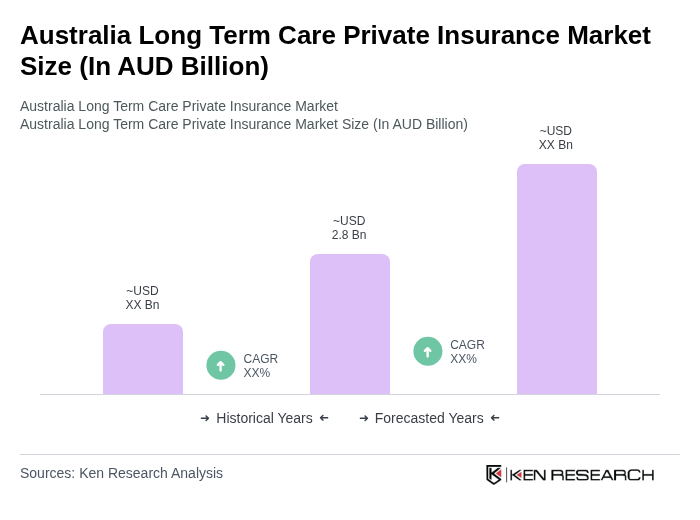
- The Australia Long Term Care Private Insurance Market is valued at approximately AUD 2.8 billion, based on a five-year historical analysis and benchmarking against the broader Australia aged care and long-term care expenditure landscape. This growth is primarily driven by an aging population, increasing healthcare and aged care costs, and a growing awareness of the need for long-term care funding and protection solutions among consumers. The rising prevalence of chronic diseases, higher life expectancy, and the desire for quality home and residential aged care options have further fueled demand for private insurance and related financial protection products that help cover long-term care expenses.
- Key regions dominating the market include New South Wales, Victoria, and Queensland. These areas have a higher concentration of elderly populations, as they host the largest absolute numbers of older Australians, and a greater number of hospitals, residential aged care facilities, and home care providers, which contribute to the demand for long-term care funding and insurance solutions. Additionally, higher urbanization levels, stronger household incomes, and greater availability of private health and life insurance distribution channels in these regions support the growth of private insurance offerings linked to long-term care needs.
- In 2023, the Australian Government progressed a series of reforms under the Aged Care Quality and Safety Commission framework, building on the Aged Care Quality and Safety Commission Act 2018 administered by the Aged Care Quality and Safety Commission and the Department of Health and Aged Care. These reforms tighten clinical care, governance, and reporting obligations for approved aged care providers through the Aged Care Quality Standards and associated compliance requirements, including continuous quality improvement, incident management, and mandatory reporting. The heightened focus on quality, accountability, and safety in aged care services is encouraging individuals and families to consider private insurance and financial protection products as a means to secure access to higher-quality care options and to manage out-of-pocket long-term care costs.
Australia Long Term Care Private Insurance Market Segmentation
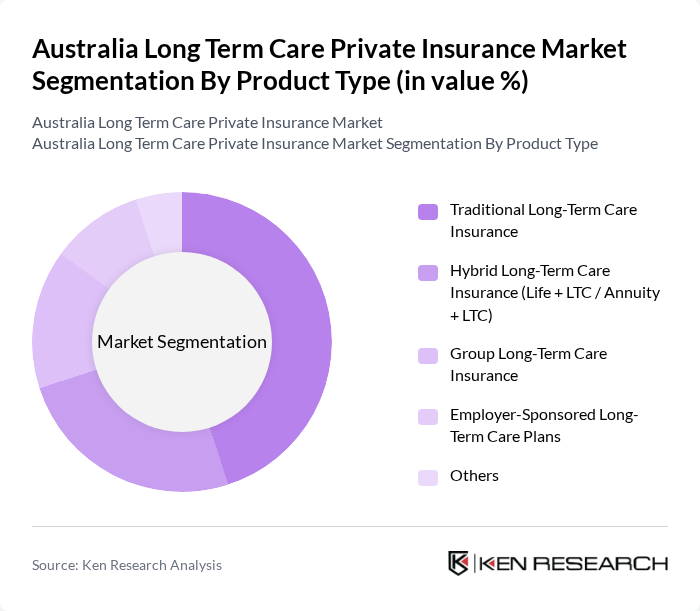
By Product Type:The product type segmentation includes various forms of long-term care oriented insurance and protection products that cater to different consumer needs. The subsegments are Traditional Long-Term Care Insurance, Hybrid Long-Term Care Insurance (Life + LTC / Annuity + LTC), Group Long-Term Care Insurance, Employer-Sponsored Long-Term Care Plans, and Others. In practice, most long-term care-related cover in Australia is embedded within life, income protection, disability, and health insurance products rather than stand-alone LTC policies, but traditional long-term care style coverages remain the most dominant within this niche, driven by their comprehensive benefits for aged care services, consumer familiarity with benefit structures, and their use in retirement and estate planning solutions.
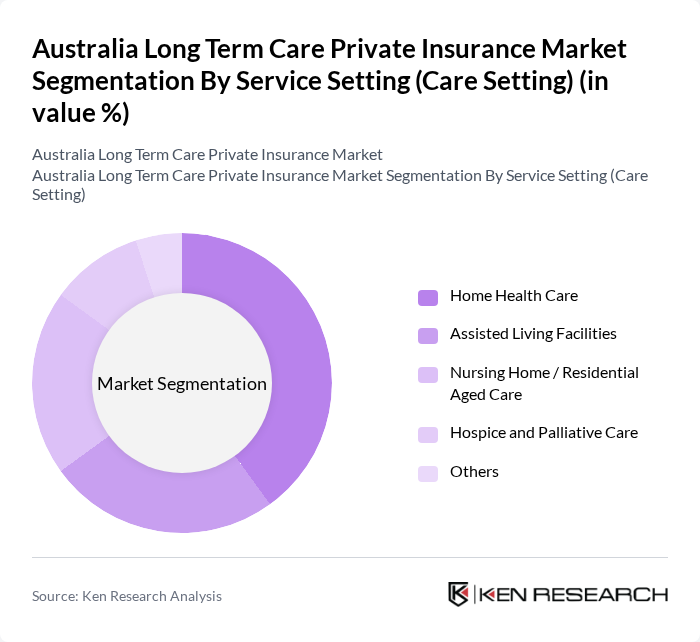
By Service Setting (Care Setting):This segmentation focuses on the various environments where long-term care services are provided and for which consumers seek financial protection through private insurance, savings, or funding products. The subsegments include Home Health Care, Assisted Living Facilities, Nursing Home / Residential Aged Care, Hospice and Palliative Care, and Others. Home Health Care is currently the leading segment, aligned with the broader Australia long-term care and aged care market where home healthcare accounts for the largest revenue share, driven by consumer preference for receiving care in familiar surroundings, government emphasis on ageing-in-place, and the increasing availability of home-based nursing, personal care, and allied health services supported by digital health and remote monitoring.
Australia Long Term Care Private Insurance Market Competitive Landscape
The Australia Long Term Care Private Insurance Market is characterized by a dynamic mix of regional and international players participating through private health insurance, life insurance, income protection, and related products that help fund long-term care and aged care expenses. Leading participants such as Medibank Private Limited, Bupa Australia Pty Ltd, HCF (The Hospitals Contribution Fund of Australia) / HCF Life Insurance, AIA Australia Limited, Allianz Australia Insurance Limited, Suncorp Group Limited, QBE Insurance Group Limited, TAL Life Limited, Zurich Australia Limited, CUA Health (now HCF-owned), Australian Unity Limited, ClearView Wealth Limited, OnePath Life (Resolution Life Australia), Asteron Life & Superannuation Limited, NobleOak Life Limited contribute to innovation, geographic expansion, and service delivery in this space through product design (for example, chronic illness and disability coverage relevant to aged care), digital distribution, and tailored offerings for retirees and pre-retirees.
Australia Long Term Care Private Insurance Market Industry Analysis
Growth Drivers
- Aging Population:Australia’s population aged 65 and over is projected to reach 6.0 million in future, representing 17% of the total population. This demographic shift is a significant driver for long-term care private insurance, as older individuals typically require more healthcare services. The Australian Bureau of Statistics indicates that the number of people aged 85 and over will double to 1.6 million in future, further increasing demand for long-term care solutions.
- Increased Awareness of Long-Term Care Needs:A survey by the Australian Institute of Health and Welfare found that 70% of Australians are now aware of the importance of long-term care insurance. This growing awareness is fueled by educational campaigns and media coverage, leading to a rise in policy inquiries. As more individuals recognize the potential financial burden of long-term care, the demand for private insurance products is expected to increase significantly.
- Rising Healthcare Costs:The Australian healthcare expenditure is projected to reach AUD 240 billion in future, driven by increasing costs associated with chronic diseases and aging. According to the Australian Institute of Health and Welfare, out-of-pocket expenses for healthcare have risen by 30% over the past five years. This financial pressure is prompting individuals to seek private insurance options to mitigate potential long-term care costs, thereby driving market growth.
Market Challenges
- High Premium Costs:The average annual premium for long-term care insurance in Australia is approximately AUD 3,500, which can be a significant financial burden for many households. This high cost can deter potential policyholders, particularly among younger demographics who may not yet perceive the need for such coverage. As a result, the market faces challenges in attracting a broader customer base, limiting overall growth potential.
- Limited Consumer Understanding:A report from the Financial Services Council revealed that 60% of Australians lack a clear understanding of long-term care insurance products. This knowledge gap leads to misconceptions about coverage and benefits, hindering informed decision-making. The complexity of insurance policies can further alienate potential customers, making it difficult for insurers to effectively communicate the value of their offerings and expand their market reach.
Australia Long Term Care Private Insurance Market Future Outlook
The future of the long-term care private insurance market in Australia appears promising, driven by demographic changes and increasing healthcare costs. As the population ages, insurers are likely to innovate their product offerings to meet diverse consumer needs. Additionally, advancements in technology will facilitate better service delivery and customer engagement. The market is expected to see a shift towards more flexible insurance models that cater to individual preferences, enhancing accessibility and affordability for consumers.
Market Opportunities
- Product Innovation:There is a significant opportunity for insurers to develop tailored products that address specific long-term care needs. By incorporating features such as telehealth services and wellness programs, insurers can enhance their value proposition and attract a wider customer base, particularly among younger consumers who prioritize preventive care.
- Partnerships with Healthcare Providers:Collaborating with healthcare providers can create synergies that enhance service delivery and customer satisfaction. By forming strategic alliances, insurers can offer integrated care solutions that combine insurance coverage with healthcare services, improving the overall value for policyholders and fostering loyalty in a competitive market.
Scope of the Report
| Segment | Sub-Segments |
|---|---|
| By Product Type | Traditional Long-Term Care Insurance Hybrid Long-Term Care Insurance (Life + LTC / Annuity + LTC) Group Long-Term Care Insurance Employer-Sponsored Long-Term Care Plans Others |
| By Service Setting (Care Setting) | Home Health Care Assisted Living Facilities Nursing Home / Residential Aged Care Hospice and Palliative Care Others |
| By Age Group | Under 65 Years –74 Years –84 Years Years and Above |
| By Premium Payment Structure | Single Premium Level Premium Stepped / Graded Premium Return of Premium Others |
| By Distribution Channel | Direct Sales (Insurer-Owned) Insurance Brokers and Agents Banks and Financial Advisers Online / Digital Platforms Others |
| By Policyholder Type | Individual Policies Family / Joint Policies Corporate / Group Policies Others |
| By State / Territory | New South Wales Victoria Queensland Western Australia South Australia Tasmania Australian Capital Territory Northern Territory |
Key Target Audience
Investors and Venture Capitalist Firms
Government and Regulatory Bodies (e.g., Australian Prudential Regulation Authority, Department of Health)
Insurance Providers
Healthcare Service Providers
Industry Associations (e.g., Australian Health Insurance Association)
Financial Institutions
Policy Makers
Technology Providers
Players Mentioned in the Report:
Medibank Private Limited
Bupa Australia Pty Ltd
HCF (The Hospitals Contribution Fund of Australia) / HCF Life Insurance
AIA Australia Limited
Allianz Australia Insurance Limited
Suncorp Group Limited
QBE Insurance Group Limited
TAL Life Limited
Zurich Australia Limited
CUA Health (now HCF-owned)
Australian Unity Limited
ClearView Wealth Limited
OnePath Life (Resolution Life Australia)
Asteron Life & Superannuation Limited
NobleOak Life Limited
Table of Contents
Market Assessment Phase
1. Executive Summary and Approach
2. Australia Long Term Care Private Insurance Market Overview
2.1 Key Insights and Strategic Recommendations
2.2 Australia Long Term Care Private Insurance Market Overview
2.3 Definition and Scope
2.4 Evolution of Market Ecosystem
2.5 Timeline of Key Regulatory Milestones
2.6 Value Chain & Stakeholder Mapping
2.7 Business Cycle Analysis
2.8 Policy & Incentive Landscape
3. Australia Long Term Care Private Insurance Market Analysis
3.1 Growth Drivers
3.1.1 Aging Population
3.1.2 Increased Awareness of Long-Term Care Needs
3.1.3 Rising Healthcare Costs
3.1.4 Government Support and Subsidies
3.2 Market Challenges
3.2.1 High Premium Costs
3.2.2 Limited Consumer Understanding
3.2.3 Regulatory Compliance Issues
3.2.4 Competition from Public Healthcare Options
3.3 Market Opportunities
3.3.1 Product Innovation
3.3.2 Digital Transformation in Insurance
3.3.3 Partnerships with Healthcare Providers
3.3.4 Expansion into Underserved Regions
3.4 Market Trends
3.4.1 Personalization of Insurance Products
3.4.2 Integration of Technology in Services
3.4.3 Focus on Preventive Care
3.4.4 Shift Towards Hybrid Insurance Models
3.5 Government Regulation
3.5.1 Mandatory Reporting Standards
3.5.2 Consumer Protection Laws
3.5.3 Tax Incentives for Policyholders
3.5.4 Licensing Requirements for Insurers
4. SWOT Analysis
5. Stakeholder Analysis
6. Porter's Five Forces Analysis
7. Australia Long Term Care Private Insurance Market Market Size, 2019-2024
7.1 By Value
7.2 By Volume
7.3 By Average Selling Price
8. Australia Long Term Care Private Insurance Market Segmentation
8.1 By Product Type
8.1.1 Traditional Long-Term Care Insurance
8.1.2 Hybrid Long-Term Care Insurance (Life + LTC / Annuity + LTC)
8.1.3 Group Long-Term Care Insurance
8.1.4 Employer-Sponsored Long-Term Care Plans
8.1.5 Others
8.2 By Service Setting (Care Setting)
8.2.1 Home Health Care
8.2.2 Assisted Living Facilities
8.2.3 Nursing Home / Residential Aged Care
8.2.4 Hospice and Palliative Care
8.2.5 Others
8.3 By Age Group
8.3.1 Under 65 Years
8.3.2 65–74 Years
8.3.3 75–84 Years
8.3.4 85 Years and Above
8.4 By Premium Payment Structure
8.4.1 Single Premium
8.4.2 Level Premium
8.4.3 Stepped / Graded Premium
8.4.4 Return of Premium
8.4.5 Others
8.5 By Distribution Channel
8.5.1 Direct Sales (Insurer-Owned)
8.5.2 Insurance Brokers and Agents
8.5.3 Banks and Financial Advisers
8.5.4 Online / Digital Platforms
8.5.5 Others
8.6 By Policyholder Type
8.6.1 Individual Policies
8.6.2 Family / Joint Policies
8.6.3 Corporate / Group Policies
8.6.4 Others
8.7 By State / Territory
8.7.1 New South Wales
8.7.2 Victoria
8.7.3 Queensland
8.7.4 Western Australia
8.7.5 South Australia
8.7.6 Tasmania
8.7.7 Australian Capital Territory
8.7.8 Northern Territory
9. Australia Long Term Care Private Insurance Market Competitive Analysis
9.1 Market Share of Key Players
9.2 Cross Comparison of Key Players
9.2.1 Company Name
9.2.2 Gross Written Premiums (GWP) – Long-Term Care Related
9.2.3 Number of In-Force Long-Term Care Policies
9.2.4 Market Share in Long-Term Care Private Insurance (%)
9.2.5 Solvency Coverage Ratio / Capital Adequacy
9.2.6 Combined Ratio / Loss Ratio for Long-Term Care Portfolio
9.2.7 Claims Paid and Claims Settlement Ratio
9.2.8 Average Claims Processing Time (Days)
9.2.9 Policy Renewal / Persistency Rate
9.2.10 Average Premium per Policy
9.2.11 Distribution Mix (Agency, Bancassurance, Direct, Digital)
9.2.12 Customer Satisfaction / Net Promoter Score (NPS)
9.3 SWOT Analysis of Top Players
9.4 Pricing Analysis
9.5 Detailed Profile of Major Companies
9.5.1 Medibank Private Limited
9.5.2 Bupa Australia Pty Ltd
9.5.3 HCF (The Hospitals Contribution Fund of Australia) / HCF Life Insurance
9.5.4 AIA Australia Limited
9.5.5 Allianz Australia Insurance Limited
9.5.6 Suncorp Group Limited
9.5.7 QBE Insurance Group Limited
9.5.8 TAL Life Limited
9.5.9 Zurich Australia Limited
9.5.10 CUA Health (now HCF-owned)
9.5.11 Australian Unity Limited
9.5.12 ClearView Wealth Limited
9.5.13 OnePath Life (Resolution Life Australia)
9.5.14 Asteron Life & Superannuation Limited
9.5.15 NobleOak Life Limited
10. Australia Long Term Care Private Insurance Market End-User Analysis
10.1 Procurement Behavior of Key Ministries
10.1.1 Budget Allocation Trends
10.1.2 Decision-Making Processes
10.1.3 Preferred Providers
10.1.4 Contracting Practices
10.2 Corporate Spend on Infrastructure & Energy
10.2.1 Investment Trends
10.2.2 Budget Prioritization
10.2.3 Long-Term Planning
10.3 Pain Point Analysis by End-User Category
10.3.1 Accessibility Issues
10.3.2 Affordability Concerns
10.3.3 Service Quality Expectations
10.4 User Readiness for Adoption
10.4.1 Awareness Levels
10.4.2 Technology Adoption Rates
10.5 Post-Deployment ROI and Use Case Expansion
10.5.1 Performance Metrics
10.5.2 Future Investment Plans
11. Australia Long Term Care Private Insurance Market Future Size, 2025-2030
11.1 By Value
11.2 By Volume
11.3 By Average Selling Price
Go-To-Market Strategy Phase
1. Whitespace Analysis + Business Model Canvas
1.1 Market Gaps Identification
1.2 Value Proposition Development
1.3 Revenue Model Exploration
2. Marketing and Positioning Recommendations
2.1 Branding Strategies
2.2 Product USPs
3. Distribution Plan
3.1 Urban Retail vs Rural NGO Tie-Ups
4. Channel & Pricing Gaps
4.1 Underserved Routes
4.2 Pricing Bands
5. Unmet Demand & Latent Needs
5.1 Category Gaps
5.2 Consumer Segments
6. Customer Relationship
6.1 Loyalty Programs
6.2 After-Sales Service
7. Value Proposition
7.1 Sustainability
7.2 Integrated Supply Chains
8. Key Activities
8.1 Regulatory Compliance
8.2 Branding
8.3 Distribution Setup
9. Entry Strategy Evaluation
9.1 Domestic Market Entry Strategy
9.1.1 Product Mix
9.1.2 Pricing Band
9.1.3 Packaging
9.2 Export Entry Strategy
9.2.1 Target Countries
9.2.2 Compliance Roadmap
10. Entry Mode Assessment
10.1 JV
10.2 Greenfield
10.3 M&A
10.4 Distributor Model
11. Capital and Timeline Estimation
11.1 Capital Requirements
11.2 Timelines
12. Control vs Risk Trade-Off
12.1 Ownership vs Partnerships
13. Profitability Outlook
13.1 Breakeven Analysis
13.2 Long-Term Sustainability
14. Potential Partner List
14.1 Distributors
14.2 JVs
14.3 Acquisition Targets
15. Execution Roadmap
15.1 Phased Plan for Market Entry
15.1.1 Market Setup
15.1.2 Market Entry
15.1.3 Growth Acceleration
15.1.4 Scale & Stabilize
15.2 Key Activities and Milestones
15.2.1 Milestone Tracking
15.2.2 Activity Scheduling
Research Methodology
Phase 1: Approach1
Desk Research
- Analysis of government reports on long-term care policies and insurance regulations in Australia
- Review of industry publications and market reports from insurance associations and health care organizations
- Examination of demographic data and trends from the Australian Bureau of Statistics relevant to aging populations
Primary Research
- Interviews with executives from leading private insurance companies specializing in long-term care
- Surveys conducted with financial advisors and insurance brokers to understand market dynamics
- Focus groups with policyholders to gather insights on customer satisfaction and service expectations
Validation & Triangulation
- Cross-validation of findings through comparison with historical market data and growth trends
- Triangulation of insights from primary interviews with secondary data sources to ensure consistency
- Sanity checks through expert panel reviews involving industry veterans and academic professionals
Phase 2: Market Size Estimation1
Top-down Assessment
- Estimation of total addressable market based on national health expenditure and insurance penetration rates
- Segmentation of the market by age demographics and types of long-term care services offered
- Incorporation of government funding and support programs impacting private insurance uptake
Bottom-up Modeling
- Collection of premium data from major insurance providers to establish average policy costs
- Analysis of claims data to determine average payout amounts and frequency of claims
- Estimation of market growth based on new policy sales and renewals over the past five years
Forecasting & Scenario Analysis
- Development of predictive models using demographic shifts and economic indicators affecting insurance demand
- Scenario analysis based on potential changes in government policy and healthcare funding
- Creation of baseline, optimistic, and pessimistic forecasts for the next decade
Phase 3: CATI Sample Composition1
| Scope Item/Segment | Sample Size | Target Respondent Profiles |
|---|---|---|
| Private Insurance Policyholders | 150 | Individuals aged 50+, current policyholders |
| Insurance Brokers | 120 | Licensed insurance brokers specializing in health and long-term care |
| Healthcare Providers | 90 | Administrators and financial officers in aged care facilities |
| Regulatory Bodies | 60 | Officials from health and insurance regulatory agencies |
| Financial Advisors | 80 | Financial planners with experience in retirement and long-term care planning |
Frequently Asked Questions
What is the current value of the Australia Long Term Care Private Insurance Market?
The Australia Long Term Care Private Insurance Market is valued at approximately AUD 2.8 billion. This valuation reflects a five-year historical analysis and is influenced by factors such as an aging population and rising healthcare costs.
What factors are driving the growth of long-term care private insurance in Australia?
Which regions in Australia have the highest demand for long-term care insurance?
What types of long-term care insurance products are available in Australia?
Other Regional/Country Reports
Other Adjacent Reports
KSA Aged Care Services Market
Kuwait Private Health Insurance Market
Qatar Life Insurance Market Size, Share & Forecast, By Product Type, Customer Segment & Distribution Channel, 2026–2032Belgium Income Protection Insurance Market
Vietnam Home Healthcare Market Size, Share & Forecast, By Service Type, Care Setting & End User, 2025-2031Qatar Assisted Living Facilities Market
Egypt Nursing Home Market
Oman Hospice Care Market
Middle East Chronic Disease Management Market Size, Share, Growth Drivers, Trends, Opportunities & Forecast 2025–2030Thailand Retirement Planning Market
Why Buy From Us?

What makes us stand out is that our consultants follow Robust, Refine and Result (RRR) methodology. Robust for clear definitions, approaches and sanity checking, Refine for differentiating respondents' facts and opinions, and Result for presenting data with story.

We have set a benchmark in the industry by offering our clients with syndicated and customized market research reports featuring coverage of entire market as well as meticulous research and analyst insights.

While we don't replace traditional research, we flip the method upside down. Our dual approach of Top Bottom & Bottom Top ensures quality deliverable by not just verifying company fundamentals but also looking at the sector and macroeconomic factors.

With one step in the future, our research team constantly tries to show you the bigger picture. We help with some of the tough questions you may encounter along the way: How is the industry positioned? Best marketing channel? KPI's of competitors? By aligning every element, we help maximize success.

Our report gives you instant access to the answers and sources that other companies might choose to hide. We elaborate each steps of research methodology we have used and showcase you the sample size to earn your trust.

If you need any support, we are here! We pride ourselves on universe strength, data quality, and quick, friendly, and professional service.