About the Report
Base Year 2024Oman Long Term Care Private Insurance Market Overview
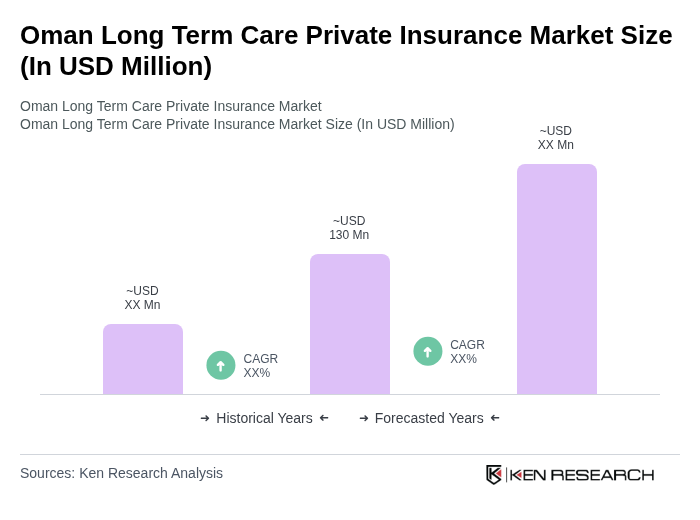
- The Oman Long Term Care Private Insurance Market is valued at USD 130 million, based on a five-year historical analysis of Oman’s broader insurance and home healthcare spending, and calibrated against the Oman home healthcare market, which generated around USD 120 million in revenue from services and equipment in the same period. This growth is primarily driven by an aging population, rising prevalence of chronic diseases, increasing healthcare costs, expansion of private health insurance, and growing awareness of long-term care needs among both citizens and expatriates.
- Muscat, the capital city, dominates the market due to its higher concentration of tertiary healthcare facilities, specialist clinics, and affluent residents, as well as the clustering of major insurers’ headquarters in the city. Additionally, other cities like Salalah and Sohar are emerging as significant players due to their growing populations, infrastructure development, and increasing demand for home healthcare and long-term care services, supported by regional hospital expansions.
- The Omani government has strengthened mandatory health coverage for expatriates in the private sector and is progressively expanding health insurance adoption through employer-based schemes, which indirectly supports the development of long-term care–related coverage. Under this framework, health insurers operating in Oman must comply with the Unified Health Insurance Policy (UHIP) and related rules issued by the Capital Market Authority of Oman, which standardize minimum health benefits, require coverage for a defined set of medical services, and set obligations on employers and insurers regarding enrollment, premium payment, and claims handling.
Oman Long Term Care Private Insurance Market Segmentation
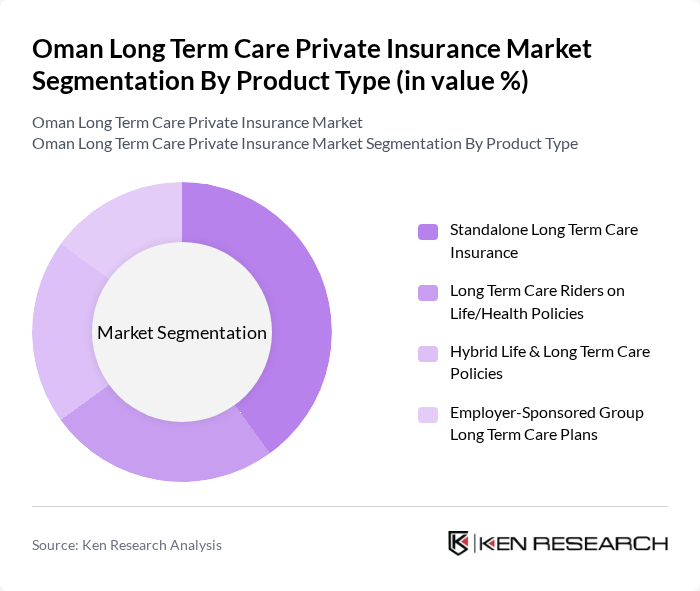
By Product Type:The product type segmentation includes various forms of long-term care–related insurance products that cater to different consumer needs. The subsegments are Standalone Long Term Care Insurance, Long Term Care Riders on Life/Health Policies, Hybrid Life & Long Term Care Policies, and Employer-Sponsored Group Long Term Care Plans. In the current Omani context, long-term care cover is more commonly embedded as riders or added benefits within health and life insurance policies offered by local insurers, with employer-sponsored group health plans for expatriates and nationals forming a key distribution channel. Standalone Long Term Care Insurance is at a nascent stage but is gradually gaining traction among higher-income segments as awareness of aging-related care needs and the cost of extended home healthcare increases.
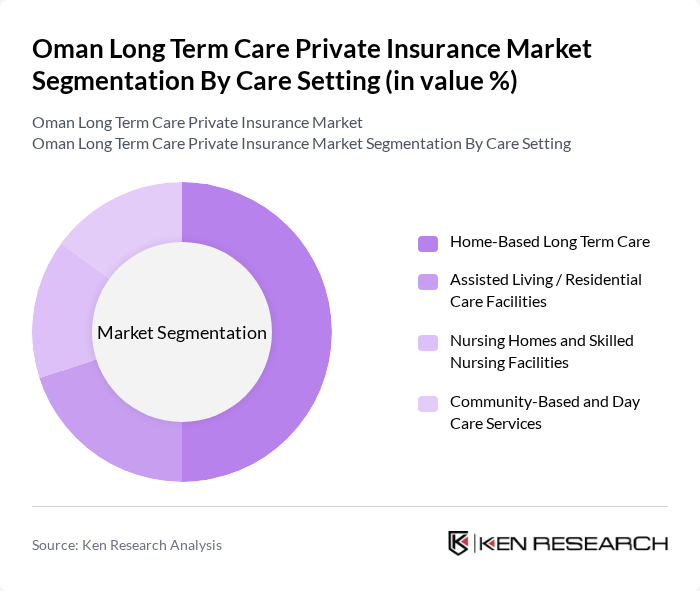
By Care Setting:The care setting segmentation encompasses various environments where long-term care services are provided. This includes Home-Based Long Term Care, Assisted Living / Residential Care Facilities, Nursing Homes and Skilled Nursing Facilities, and Community-Based and Day Care Services. Home-Based Long Term Care is currently the leading subsegment, aligning with the rapid expansion of Oman’s home healthcare market and cultural preferences for family-based care, where patients receive nursing, rehabilitation, and chronic disease management services at home supported by professional providers and family members. Assisted Living and Nursing Home facilities remain comparatively limited but are gradually developing as private providers invest in specialized geriatric and rehabilitation centers in major urban areas.
Oman Long Term Care Private Insurance Market Competitive Landscape
The Oman Long Term Care Private Insurance Market is characterized by a dynamic mix of regional and international players. Leading participants such as National Life & General Insurance Company, Dhofar Insurance Company, Oman United Insurance Company, Takaful Oman Insurance, Al Madina Insurance (Al Madina Takaful), Arabia Falcon Insurance Company, Al Ahlia Insurance Company, Oman Reinsurance Company (Oman Re), Vision Insurance SAOG, Alizz Islamic Bank, Bank Muscat, Oman Arab Bank, Sohar International Bank, HSBC Bank Oman, Other Emerging Insurtech and Distribution Partners contribute to innovation, geographic expansion, and service delivery in this space.
Oman Long Term Care Private Insurance Market Industry Analysis
Growth Drivers
- Increasing Aging Population:The aging population in Oman is projected to reach 1.5 million in future, representing approximately 15% of the total population. This demographic shift is driving demand for long-term care services, as older adults typically require more healthcare support. The World Bank indicates that the dependency ratio is expected to rise to 15% in future, further emphasizing the need for private insurance solutions tailored to this demographic.
- Rising Healthcare Costs:Oman’s healthcare expenditure is anticipated to exceed OMR 2 billion in future, reflecting a significant increase in costs associated with medical services and long-term care. The Ministry of Health reports that healthcare costs have risen by 10% annually, prompting individuals to seek private insurance options to mitigate financial burdens. This trend is expected to drive the growth of long-term care insurance as consumers look for comprehensive coverage.
- Growing Awareness of Long Term Care Needs:Awareness campaigns by the Omani government and healthcare organizations have increased public understanding of long-term care needs. In future, it is estimated that 75% of the population will recognize the importance of long-term care insurance, up from 40% in 2020. This shift is crucial as it encourages individuals to invest in private insurance, ensuring better financial security for future healthcare needs.
Market Challenges
- Limited Consumer Awareness:Despite growing awareness, approximately 40% of Omani citizens remain unaware of the benefits of long-term care insurance. This lack of understanding poses a significant barrier to market growth. The Insurance Authority of Oman has noted that educational initiatives are necessary to bridge this gap, as many potential customers do not fully comprehend policy details or the importance of coverage.
- Regulatory Hurdles:The regulatory environment in Oman presents challenges for insurance providers, with stringent licensing requirements and compliance standards. As of in future, only 20 out of 30 insurance companies have successfully navigated these regulations to offer long-term care products. This limited participation restricts consumer choices and can hinder market growth, as potential entrants face significant barriers to entry.
Oman Long Term Care Private Insurance Market Future Outlook
The future of the Oman long-term care private insurance market appears promising, driven by demographic changes and increasing healthcare costs. As the population ages, the demand for tailored insurance products will likely rise, prompting providers to innovate. Additionally, the integration of technology in insurance services is expected to enhance customer engagement and streamline claims processes. Overall, the market is poised for growth as awareness and accessibility improve, creating a more informed consumer base.
Market Opportunities
- Expansion of Digital Insurance Platforms:The rise of digital platforms presents a significant opportunity for insurance providers to reach a broader audience. In future, it is projected that 80% of consumers will prefer online insurance services, allowing companies to streamline operations and reduce costs while enhancing customer experience.
- Customization of Insurance Products:There is a growing demand for personalized insurance solutions that cater to individual needs. In future, approximately 65% of consumers are expected to seek customized long-term care policies, prompting insurers to develop flexible offerings that address specific health conditions and financial situations.
Scope of the Report
| Segment | Sub-Segments |
|---|---|
| By Product Type | Standalone Long Term Care Insurance Long Term Care Riders on Life/Health Policies Hybrid Life & Long Term Care Policies Employer-Sponsored Group Long Term Care Plans |
| By Care Setting | Home-Based Long Term Care Assisted Living / Residential Care Facilities Nursing Homes and Skilled Nursing Facilities Community-Based and Day Care Services |
| By Benefit Structure | Reimbursement Policies Indemnity / Fixed Benefit Policies Cash Benefit Policies Combination Benefit Structures |
| By Payer / Funding Source | Individual Self-Paid Policies Employer-Funded Corporate Plans Co-Paid (Employer–Employee) Plans Family-Paid Policies |
| By Duration of Coverage | Short-Term Coverage (< 2 Years) Medium-Term Coverage (2–5 Years) Long-Term Coverage (> 5 Years) Lifetime Coverage |
| By Distribution Channel | Brokers and Agents Bancassurance Direct Sales Force Digital / Online Channels Other Institutional Partnerships |
| By Customer Segment | Mass Affluent Individuals High-Net-Worth Individuals (HNWIs) Expatriates SMEs and Corporate Employers Government and Semi-Government Employees |
Key Target Audience
Investors and Venture Capitalist Firms
Government and Regulatory Bodies (e.g., Ministry of Health, Capital Market Authority)
Insurance Providers
Healthcare Service Providers
Pharmaceutical Companies
Technology Providers
Industry Associations (e.g., Oman Insurance Association)
Financial Institutions
Players Mentioned in the Report:
National Life & General Insurance Company
Dhofar Insurance Company
Oman United Insurance Company
Takaful Oman Insurance
Al Madina Insurance (Al Madina Takaful)
Arabia Falcon Insurance Company
Al Ahlia Insurance Company
Oman Reinsurance Company (Oman Re)
Vision Insurance SAOG
Alizz Islamic Bank
Bank Muscat
Oman Arab Bank
Sohar International Bank
HSBC Bank Oman
Other Emerging Insurtech and Distribution Partners
Table of Contents
Market Assessment Phase
1. Executive Summary and Approach
2. Oman Long Term Care Private Insurance Market Overview
2.1 Key Insights and Strategic Recommendations
2.2 Oman Long Term Care Private Insurance Market Overview
2.3 Definition and Scope
2.4 Evolution of Market Ecosystem
2.5 Timeline of Key Regulatory Milestones
2.6 Value Chain & Stakeholder Mapping
2.7 Business Cycle Analysis
2.8 Policy & Incentive Landscape
3. Oman Long Term Care Private Insurance Market Analysis
3.1 Growth Drivers
3.1.1 Increasing Aging Population
3.1.2 Rising Healthcare Costs
3.1.3 Growing Awareness of Long Term Care Needs
3.1.4 Government Initiatives to Promote Private Insurance
3.2 Market Challenges
3.2.1 Limited Consumer Awareness
3.2.2 Regulatory Hurdles
3.2.3 High Competition Among Providers
3.2.4 Economic Fluctuations Affecting Disposable Income
3.3 Market Opportunities
3.3.1 Expansion of Digital Insurance Platforms
3.3.2 Customization of Insurance Products
3.3.3 Partnerships with Healthcare Providers
3.3.4 Increasing Demand for Comprehensive Coverage
3.4 Market Trends
3.4.1 Shift Towards Preventive Care
3.4.2 Integration of Technology in Insurance Services
3.4.3 Rise of Telehealth Services
3.4.4 Focus on Customer-Centric Insurance Solutions
3.5 Government Regulation
3.5.1 Licensing Requirements for Insurance Providers
3.5.2 Consumer Protection Regulations
3.5.3 Tax Incentives for Long Term Care Insurance
3.5.4 Guidelines for Policy Coverage and Exclusions
4. SWOT Analysis
5. Stakeholder Analysis
6. Porter's Five Forces Analysis
7. Oman Long Term Care Private Insurance Market Market Size, 2019-2024
7.1 By Value
7.2 By Volume
7.3 By Average Selling Price
8. Oman Long Term Care Private Insurance Market Segmentation
8.1 By Product Type
8.1.1 Standalone Long Term Care Insurance
8.1.2 Long Term Care Riders on Life/Health Policies
8.1.3 Hybrid Life & Long Term Care Policies
8.1.4 Employer-Sponsored Group Long Term Care Plans
8.2 By Care Setting
8.2.1 Home-Based Long Term Care
8.2.2 Assisted Living / Residential Care Facilities
8.2.3 Nursing Homes and Skilled Nursing Facilities
8.2.4 Community-Based and Day Care Services
8.3 By Benefit Structure
8.3.1 Reimbursement Policies
8.3.2 Indemnity / Fixed Benefit Policies
8.3.3 Cash Benefit Policies
8.3.4 Combination Benefit Structures
8.4 By Payer / Funding Source
8.4.1 Individual Self-Paid Policies
8.4.2 Employer-Funded Corporate Plans
8.4.3 Co-Paid (Employer–Employee) Plans
8.4.4 Family-Paid Policies
8.5 By Duration of Coverage
8.5.1 Short-Term Coverage (< 2 Years)
8.5.2 Medium-Term Coverage (2–5 Years)
8.5.3 Long-Term Coverage (> 5 Years)
8.5.4 Lifetime Coverage
8.6 By Distribution Channel
8.6.1 Brokers and Agents
8.6.2 Bancassurance
8.6.3 Direct Sales Force
8.6.4 Digital / Online Channels
8.6.5 Other Institutional Partnerships
8.7 By Customer Segment
8.7.1 Mass Affluent Individuals
8.7.2 High-Net-Worth Individuals (HNWIs)
8.7.3 Expatriates
8.7.4 SMEs and Corporate Employers
8.7.5 Government and Semi-Government Employees
9. Oman Long Term Care Private Insurance Market Competitive Analysis
9.1 Market Share of Key Players
9.2 Cross Comparison of Key Players
9.2.1 Company Name
9.2.2 Market Share (by GWP from LTC Private Insurance)
9.2.3 Gross Written Premium – Long Term Care Portfolio
9.2.4 Number of Active Long Term Care Policies
9.2.5 Average Annual Premium per Policy
9.2.6 Loss Ratio (Claims Paid / Earned Premium)
9.2.7 Claims Settlement Turnaround Time (Average Days)
9.2.8 Policy Renewal / Persistency Rate
9.2.9 New Business Growth Rate (LTC Premium CAGR)
9.2.10 Distribution Mix (Agency, Bancassurance, Digital, Others)
9.2.11 Combined Ratio
9.2.12 Return on Equity (ROE) – Overall and LTC Segment (where available)
9.3 SWOT Analysis of Top Players
9.4 Pricing Analysis
9.5 Detailed Profile of Major Companies
9.5.1 National Life & General Insurance Company
9.5.2 Dhofar Insurance Company
9.5.3 Oman United Insurance Company
9.5.4 Takaful Oman Insurance
9.5.5 Al Madina Insurance (Al Madina Takaful)
9.5.6 Arabia Falcon Insurance Company
9.5.7 Al Ahlia Insurance Company
9.5.8 Oman Reinsurance Company (Oman Re)
9.5.9 Vision Insurance SAOG
9.5.10 Alizz Islamic Bank
9.5.11 Bank Muscat
9.5.12 Oman Arab Bank
9.5.13 Sohar International Bank
9.5.14 HSBC Bank Oman
9.5.15 Other Emerging Insurtech and Distribution Partners
10. Oman Long Term Care Private Insurance Market End-User Analysis
10.1 Procurement Behavior of Key Ministries
10.1.1 Ministry of Health
10.1.2 Ministry of Social Development
10.1.3 Ministry of Finance
10.1.4 Others
10.2 Corporate Spend on Infrastructure & Energy
10.2.1 Healthcare Facilities
10.2.2 Long Term Care Facilities
10.2.3 Insurance Providers
10.2.4 Others
10.3 Pain Point Analysis by End-User Category
10.3.1 Individuals
10.3.2 Families
10.3.3 Corporates
10.3.4 Government Entities
10.4 User Readiness for Adoption
10.4.1 Awareness Levels
10.4.2 Financial Readiness
10.4.3 Technological Readiness
10.4.4 Others
10.5 Post-Deployment ROI and Use Case Expansion
10.5.1 Cost Savings
10.5.2 Improved Health Outcomes
10.5.3 Enhanced Customer Satisfaction
10.5.4 Others
11. Oman Long Term Care Private Insurance Market Future Size, 2025-2030
11.1 By Value
11.2 By Volume
11.3 By Average Selling Price
Go-To-Market Strategy Phase
1. Whitespace Analysis + Business Model Canvas
1.1 Market Gaps Identification
1.2 Business Model Development
2. Marketing and Positioning Recommendations
2.1 Branding Strategies
2.2 Product USPs
3. Distribution Plan
3.1 Urban Retail Strategies
3.2 Rural NGO Tie-Ups
4. Channel & Pricing Gaps
4.1 Underserved Routes
4.2 Pricing Bands
5. Unmet Demand & Latent Needs
5.1 Category Gaps
5.2 Consumer Segments
6. Customer Relationship
6.1 Loyalty Programs
6.2 After-Sales Service
7. Value Proposition
7.1 Sustainability
7.2 Integrated Supply Chains
8. Key Activities
8.1 Regulatory Compliance
8.2 Branding
8.3 Distribution Setup
9. Entry Strategy Evaluation
9.1 Domestic Market Entry Strategy
9.1.1 Product Mix
9.1.2 Pricing Band
9.1.3 Packaging
9.2 Export Entry Strategy
9.2.1 Target Countries
9.2.2 Compliance Roadmap
10. Entry Mode Assessment
10.1 Joint Ventures
10.2 Greenfield Investments
10.3 Mergers & Acquisitions
10.4 Distributor Model
11. Capital and Timeline Estimation
11.1 Capital Requirements
11.2 Timelines
12. Control vs Risk Trade-Off
12.1 Ownership vs Partnerships
13. Profitability Outlook
13.1 Breakeven Analysis
13.2 Long-Term Sustainability
14. Potential Partner List
14.1 Distributors
14.2 Joint Ventures
14.3 Acquisition Targets
15. Execution Roadmap
15.1 Phased Plan for Market Entry
15.1.1 Market Setup
15.1.2 Market Entry
15.1.3 Growth Acceleration
15.1.4 Scale & Stabilize
15.2 Key Activities and Milestones
15.2.1 Milestone Planning
15.2.2 Activity Tracking
Research Methodology
Phase 1: Approach1
Desk Research
- Analysis of government reports on healthcare expenditure and insurance regulations in Oman
- Review of industry publications and white papers on long-term care insurance trends
- Examination of demographic data and aging population statistics from national statistical agencies
Primary Research
- Interviews with insurance executives and product managers in the long-term care sector
- Surveys with healthcare providers and facilities offering long-term care services
- Focus groups with potential policyholders to understand consumer attitudes and preferences
Validation & Triangulation
- Cross-validation of findings through multiple data sources including market reports and expert opinions
- Triangulation of qualitative insights from interviews with quantitative data from surveys
- Sanity checks through expert panel reviews comprising industry veterans and analysts
Phase 2: Market Size Estimation1
Top-down Assessment
- Estimation of total healthcare spending in Oman and allocation to long-term care insurance
- Analysis of the growth rate of the aging population and its impact on insurance demand
- Incorporation of government initiatives aimed at promoting private insurance uptake
Bottom-up Modeling
- Collection of premium data from existing long-term care insurance policies in the market
- Estimation of potential market size based on the number of eligible policyholders
- Calculation of average policy costs and expected claims ratios to project revenue
Forecasting & Scenario Analysis
- Multi-factor regression analysis incorporating economic indicators and healthcare trends
- Scenario modeling based on varying levels of insurance penetration and regulatory changes
- Development of baseline, optimistic, and pessimistic forecasts through 2030
Phase 3: CATI Sample Composition1
| Scope Item/Segment | Sample Size | Target Respondent Profiles |
|---|---|---|
| Insurance Providers | 60 | Product Managers, Underwriters |
| Healthcare Facilities | 70 | Facility Administrators, Care Managers |
| Potential Policyholders | 120 | Individuals aged 50+, Family Caregivers |
| Regulatory Bodies | 40 | Policy Makers, Health Economists |
| Industry Experts | 40 | Consultants, Analysts |
Frequently Asked Questions
What is the current value of the Oman Long Term Care Private Insurance Market?
The Oman Long Term Care Private Insurance Market is valued at approximately USD 130 million, based on a five-year historical analysis of the broader insurance and home healthcare spending in Oman.
What factors are driving the growth of long-term care insurance in Oman?
Which city in Oman dominates the long-term care insurance market?
What types of long-term care insurance products are available in Oman?
Other Regional/Country Reports
Other Adjacent Reports
UAE Geriatric Care Market
Middle East Chronic Disease Management Market Size, Share, Growth Drivers, Trends, Opportunities & Forecast 2025–2030Kuwait Assisted Living Facilities Market
South Africa Nursing Home Market
Germany Reinsurance MarketUAE insurtech market size, share, growth drivers, trends, opportunities & forecast 2025–2030UAE pharmaceutical market report size, share, growth drivers, trends, opportunities & forecast 2025–2030Why Buy From Us?

What makes us stand out is that our consultants follow Robust, Refine and Result (RRR) methodology. Robust for clear definitions, approaches and sanity checking, Refine for differentiating respondents' facts and opinions, and Result for presenting data with story.

We have set a benchmark in the industry by offering our clients with syndicated and customized market research reports featuring coverage of entire market as well as meticulous research and analyst insights.

While we don't replace traditional research, we flip the method upside down. Our dual approach of Top Bottom & Bottom Top ensures quality deliverable by not just verifying company fundamentals but also looking at the sector and macroeconomic factors.

With one step in the future, our research team constantly tries to show you the bigger picture. We help with some of the tough questions you may encounter along the way: How is the industry positioned? Best marketing channel? KPI's of competitors? By aligning every element, we help maximize success.

Our report gives you instant access to the answers and sources that other companies might choose to hide. We elaborate each steps of research methodology we have used and showcase you the sample size to earn your trust.

If you need any support, we are here! We pride ourselves on universe strength, data quality, and quick, friendly, and professional service.