About the Report
Base Year 2024Philippines Long Term Care Private Insurance Market Overview
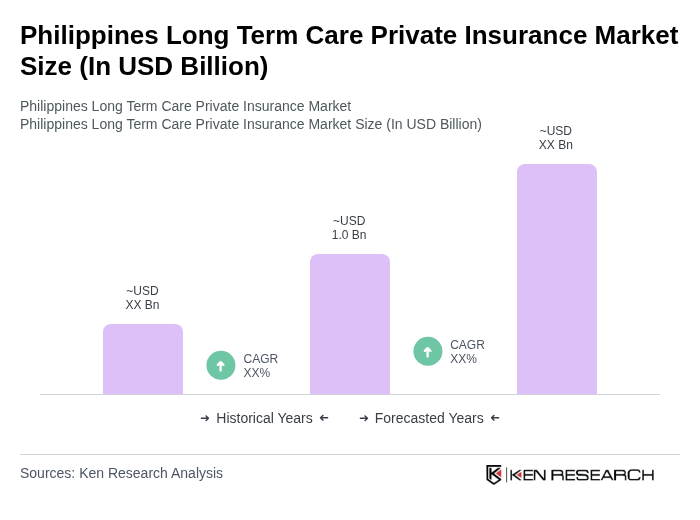
- The Philippines Long Term Care Private Insurance Market is valued at USD 1.0 billion, based on a five-year historical analysis and considering the share of long-term care–related products within the broader private health and life insurance segment in the country. This growth is primarily driven by an aging population, increasing healthcare costs, and a growing awareness of the need for long-term care solutions among Filipinos, as private insurers increasingly fill coverage gaps left by public schemes. The market is also supported by rising disposable incomes, expansion of the middle class, and a shift towards private healthcare services and supplementary health insurance.
- Metro Manila, Cebu, and Davao are the dominant regions in the Philippines Long Term Care Private Insurance Market. Metro Manila (National Capital Region) leads due to its high population density, economic activity, and concentration of hospitals and private healthcare providers, which also makes it the largest regional market for healthcare and health insurance. Cebu and Davao follow, benefiting from growing urbanization, rising household incomes, and increasing demand for private healthcare services, which in turn drives demand for long-term care–oriented insurance products.
- The key regulatory framework is the Universal Health Care Act (Republic Act No. 11223), signed in 2019 and implemented through the implementing rules and regulations issued by the Department of Health and the Philippine Health Insurance Corporation, which seeks to ensure all Filipinos are automatically enrolled in the National Health Insurance Program with comprehensive primary care and hospital benefits. This regulation encourages private insurance providers to design complementary and supplementary products, including long-term care riders and health plans that enhance PhilHealth benefits, enabling individuals to augment public coverage with private options and strengthening the overall healthcare financing system.
Philippines Long Term Care Private Insurance Market Segmentation
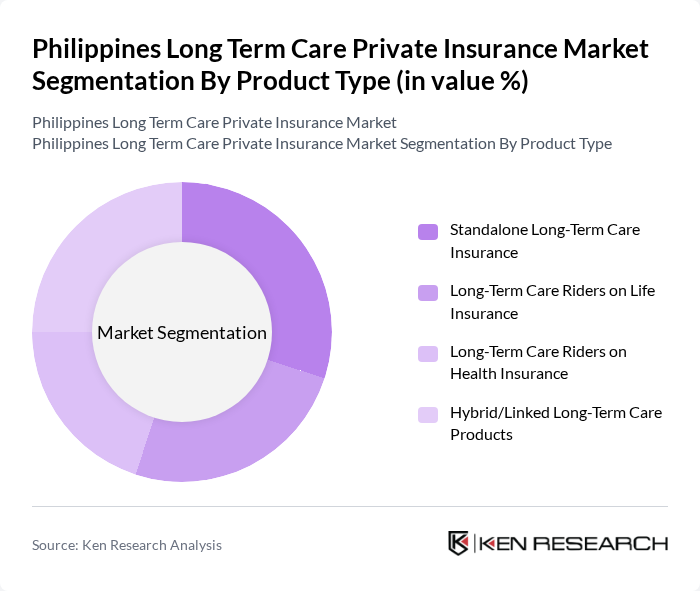
By Product Type:The product type segmentation includes various offerings tailored to meet the diverse needs of consumers. The subsegments are Standalone Long-Term Care Insurance, Long-Term Care Riders on Life Insurance, Long-Term Care Riders on Health Insurance, and Hybrid/Linked Long-Term Care Products. In the Philippines, long-term care benefits are more commonly embedded as riders or benefits within life and health insurance plans offered by major insurers, rather than pure standalone policies, in line with the broader health and life insurance market structure. Standalone Long-Term Care Insurance is gradually gaining traction among higher-income and retirement-focused segments for its dedicated coverage, while riders on life and health insurance remain popular due to their flexibility, affordability, and integration with existing protection and savings policies distributed through agency, bancassurance, and digital channels.
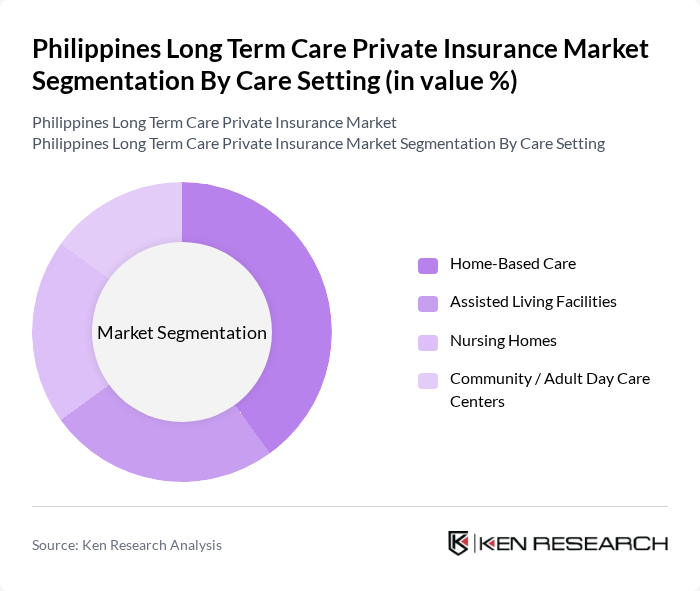
By Care Setting:The care setting segmentation encompasses various environments where long-term care services are provided. This includes Home-Based Care, Assisted Living Facilities, Nursing Homes, and Community/Adult Day Care Centers. Home-Based Care is increasingly preferred due to its convenience, family-centered culture, and lower relative cost versus institutional care, aligning with the way many Filipinos manage chronic illness and elder care at home. Assisted Living Facilities and Nursing Homes cater to those requiring more intensive or institutional support, often in urban centers where private long-term care facilities are emerging alongside private hospitals and HMOs. Community/Adult Day Care Centers are also gaining attention as local governments and private providers expand community-based elder care and rehabilitation services that can be supported by health and accident coverage or riders within private insurance plans.
Philippines Long Term Care Private Insurance Market Competitive Landscape
The Philippines Long Term Care Private Insurance Market is characterized by a dynamic mix of regional and international players. Leading participants such as AIA Philippines Life and General Insurance Company, Inc., Sun Life of Canada (Philippines), Inc., Manulife Philippines (The Manufacturers Life Insurance Co. (Phils.), Inc.), BPI AIA Life Assurance Corporation, FWD Life Insurance Corporation, Pru Life Insurance Corporation of U.K. (Pru Life UK), AXA Philippines (AXA Life Insurance Corporation), Allianz PNB Life Insurance, Inc., Insular Life Assurance Co., Ltd. (InLife), Philippine American Life and General Insurance Company (Philam Life, now AIA Philippines), EastWest Ageas Life Insurance Corporation, COCOLIFE (United Coconut Planters Life Assurance Corporation), Generali Life Assurance Philippines, Inc., The Standard Insurance Company, Inc., Other Emerging Long-Term Care Insurance Providers contribute to innovation, geographic expansion, and service delivery in this space, leveraging agency networks, bancassurance partnerships, HMOs, and digital platforms to distribute health, life, and long-term care–related products.
Philippines Long Term Care Private Insurance Market Industry Analysis
Growth Drivers
- Aging Population:The Philippines is experiencing a significant demographic shift, with the population aged 60 and above projected to reach 12 million in the future, up from 9 million in the past. This growing elderly demographic is increasing the demand for long-term care services, as older adults typically require more healthcare support. The aging population is expected to drive the private insurance market, as families seek financial solutions to cover long-term care expenses, which can average around PHP 35,000 monthly for nursing homes.
- Increasing Healthcare Costs:Healthcare expenditure in the Philippines is projected to rise to PHP 1.5 trillion in the future, reflecting a 10% increase from the previous year. This surge in costs is primarily driven by advancements in medical technology and rising service fees. As healthcare becomes more expensive, individuals are increasingly recognizing the need for long-term care insurance to mitigate out-of-pocket expenses. The average cost of long-term care services is expected to reach PHP 1.8 million annually, prompting families to seek insurance solutions.
- Rising Awareness of Long-Term Care Needs:Public awareness regarding the importance of long-term care insurance is growing, with 70% of Filipinos now acknowledging the need for such coverage, compared to 50% in the past. This shift is influenced by educational campaigns and the increasing visibility of long-term care issues in media. As more individuals understand the potential financial burden of long-term care, the demand for private insurance products is expected to rise, leading to a more robust market environment.
Market Challenges
- Limited Consumer Awareness:Despite the growing recognition of long-term care needs, approximately 30% of the population remains unaware of the benefits of private insurance. This lack of understanding hampers market growth, as many potential customers do not see the value in investing in long-term care insurance. Educational initiatives are crucial to bridging this gap, but the current level of awareness poses a significant challenge for insurers aiming to expand their customer base.
- High Premium Costs:The average premium for long-term care insurance in the Philippines is around PHP 30,000 annually, which can be prohibitive for many families. This high cost limits accessibility, particularly for lower-income households. As a result, many individuals opt for public health programs, which may not provide comprehensive coverage. Insurers must find ways to offer more affordable options to attract a broader audience and enhance market penetration.
Philippines Long Term Care Private Insurance Market Future Outlook
The future of the long-term care private insurance market in the Philippines appears promising, driven by demographic changes and increasing healthcare costs. As the elderly population continues to grow, the demand for tailored insurance products is expected to rise. Additionally, advancements in technology and digital marketing strategies will likely enhance consumer engagement and education. Insurers that adapt to these trends and address affordability will be well-positioned to capture a larger share of the market, fostering sustainable growth in the coming years.
Market Opportunities
- Product Innovation:There is a significant opportunity for insurers to develop innovative products that cater to the specific needs of the aging population. Customized plans that include features like home care services and wellness programs can attract more customers. By addressing the unique requirements of older adults, insurers can differentiate themselves in a competitive market and enhance customer satisfaction.
- Partnership with Healthcare Providers:Collaborating with healthcare providers can create synergies that benefit both insurers and consumers. By forming partnerships, insurers can offer integrated services that combine insurance coverage with healthcare delivery. This approach not only enhances the value proposition for customers but also streamlines care management, ultimately leading to improved health outcomes and customer loyalty.
Scope of the Report
| Segment | Sub-Segments |
|---|---|
| By Product Type | Standalone Long-Term Care Insurance Long-Term Care Riders on Life Insurance Long-Term Care Riders on Health Insurance Hybrid/Linked Long-Term Care Products |
| By Care Setting | Home-Based Care Assisted Living Facilities Nursing Homes Community / Adult Day Care Centers |
| By Funding / Premium Structure | Employer-Sponsored Group Plans Individual Retail Plans Bancassurance-Distributed Plans Microinsurance & Low-Ticket Plans |
| By Benefit Design | Indemnity (Reimbursement) Policies Cash Benefit Policies Shared / Pooled Benefit Policies Inflation-Indexed Benefit Policies |
| By Customer Segment | Mass Market Emerging Affluent Affluent / High-Net-Worth Individuals Overseas Filipino Workers & Families |
| By Age Group at Entry | –39 Years –59 Years Years & Above |
| By Distribution Channel | Agency Force Bancassurance Brokers & Corporate Channels Digital & Direct-to-Consumer Channels |
Key Target Audience
Investors and Venture Capitalist Firms
Government and Regulatory Bodies (e.g., Insurance Commission, Department of Health)
Insurance Providers and Underwriters
Healthcare Service Providers
Financial Advisors and Planners
Senior Care Facilities and Organizations
Pharmaceutical Companies
Technology Providers for Health Insurance Solutions
Players Mentioned in the Report:
AIA Philippines Life and General Insurance Company, Inc.
Sun Life of Canada (Philippines), Inc.
Manulife Philippines (The Manufacturers Life Insurance Co. (Phils.), Inc.)
BPI AIA Life Assurance Corporation
FWD Life Insurance Corporation
Pru Life Insurance Corporation of U.K. (Pru Life UK)
AXA Philippines (AXA Life Insurance Corporation)
Allianz PNB Life Insurance, Inc.
Insular Life Assurance Co., Ltd. (InLife)
Philippine American Life and General Insurance Company (Philam Life, now AIA Philippines)
EastWest Ageas Life Insurance Corporation
COCOLIFE (United Coconut Planters Life Assurance Corporation)
Generali Life Assurance Philippines, Inc.
The Standard Insurance Company, Inc.
Other Emerging Long-Term Care Insurance Providers
Table of Contents
Market Assessment Phase
1. Executive Summary and Approach
2. Philippines Long Term Care Private Insurance Market Overview
2.1 Key Insights and Strategic Recommendations
2.2 Philippines Long Term Care Private Insurance Market Overview
2.3 Definition and Scope
2.4 Evolution of Market Ecosystem
2.5 Timeline of Key Regulatory Milestones
2.6 Value Chain & Stakeholder Mapping
2.7 Business Cycle Analysis
2.8 Policy & Incentive Landscape
3. Philippines Long Term Care Private Insurance Market Analysis
3.1 Growth Drivers
3.1.1 Aging Population
3.1.2 Increasing Healthcare Costs
3.1.3 Rising Awareness of Long-Term Care Needs
3.1.4 Government Initiatives for Health Insurance
3.2 Market Challenges
3.2.1 Limited Consumer Awareness
3.2.2 High Premium Costs
3.2.3 Regulatory Hurdles
3.2.4 Competition from Public Health Programs
3.3 Market Opportunities
3.3.1 Product Innovation
3.3.2 Partnership with Healthcare Providers
3.3.3 Expansion into Rural Areas
3.3.4 Digital Marketing Strategies
3.4 Market Trends
3.4.1 Increased Use of Technology in Insurance
3.4.2 Customization of Insurance Products
3.4.3 Focus on Preventive Care
3.4.4 Growth of Telehealth Services
3.5 Government Regulation
3.5.1 Licensing Requirements for Insurers
3.5.2 Consumer Protection Laws
3.5.3 Tax Incentives for Long-Term Care Insurance
3.5.4 Compliance with International Standards
4. SWOT Analysis
5. Stakeholder Analysis
6. Porter's Five Forces Analysis
7. Philippines Long Term Care Private Insurance Market Market Size, 2019-2024
7.1 By Value
7.2 By Volume
7.3 By Average Selling Price
8. Philippines Long Term Care Private Insurance Market Segmentation
8.1 By Product Type
8.1.1 Standalone Long-Term Care Insurance
8.1.2 Long-Term Care Riders on Life Insurance
8.1.3 Long-Term Care Riders on Health Insurance
8.1.4 Hybrid/Linked Long-Term Care Products
8.2 By Care Setting
8.2.1 Home-Based Care
8.2.2 Assisted Living Facilities
8.2.3 Nursing Homes
8.2.4 Community / Adult Day Care Centers
8.3 By Funding / Premium Structure
8.3.1 Employer-Sponsored Group Plans
8.3.2 Individual Retail Plans
8.3.3 Bancassurance-Distributed Plans
8.3.4 Microinsurance & Low-Ticket Plans
8.4 By Benefit Design
8.4.1 Indemnity (Reimbursement) Policies
8.4.2 Cash Benefit Policies
8.4.3 Shared / Pooled Benefit Policies
8.4.4 Inflation-Indexed Benefit Policies
8.5 By Customer Segment
8.5.1 Mass Market
8.5.2 Emerging Affluent
8.5.3 Affluent / High-Net-Worth Individuals
8.5.4 Overseas Filipino Workers & Families
8.6 By Age Group at Entry
8.6.1 18–39 Years
8.6.2 40–59 Years
8.6.3 60 Years & Above
8.7 By Distribution Channel
8.7.1 Agency Force
8.7.2 Bancassurance
8.7.3 Brokers & Corporate Channels
8.7.4 Digital & Direct-to-Consumer Channels
9. Philippines Long Term Care Private Insurance Market Competitive Analysis
9.1 Market Share of Key Players
9.2 Cross Comparison of Key Players
9.2.1 Company Name
9.2.2 Scale (Gross Written Premium / In-Force LTC Premiums)
9.2.3 Number of In-Force Long-Term Care Policies
9.2.4 New Business Annual Premium Equivalent (NBAPE) – Long-Term Care
9.2.5 Policy Retention / Persistency Rate (13th & 25th Month)
9.2.6 Claims Settlement Ratio & Average Claims Turnaround Time
9.2.7 Average Premium per Policy
9.2.8 Loss Ratio & Combined Ratio
9.2.9 Distribution Mix (Agency, Bancassurance, Digital, Others)
9.2.10 3-Year Revenue and Profit Growth (CAGR)
9.3 SWOT Analysis of Top Players
9.4 Pricing Analysis
9.5 Detailed Profile of Major Companies
9.5.1 AIA Philippines Life and General Insurance Company, Inc.
9.5.2 Sun Life of Canada (Philippines), Inc.
9.5.3 Manulife Philippines (The Manufacturers Life Insurance Co. (Phils.), Inc.)
9.5.4 BPI AIA Life Assurance Corporation
9.5.5 FWD Life Insurance Corporation
9.5.6 Pru Life Insurance Corporation of U.K. (Pru Life UK)
9.5.7 AXA Philippines (AXA Life Insurance Corporation)
9.5.8 Allianz PNB Life Insurance, Inc.
9.5.9 Insular Life Assurance Co., Ltd. (InLife)
9.5.10 Philippine American Life and General Insurance Company (Philam Life, now AIA Philippines)
9.5.11 EastWest Ageas Life Insurance Corporation
9.5.12 COCOLIFE (United Coconut Planters Life Assurance Corporation)
9.5.13 Generali Life Assurance Philippines, Inc.
9.5.14 The Standard Insurance Company, Inc.
9.5.15 Other Emerging Long-Term Care Insurance Providers
10. Philippines Long Term Care Private Insurance Market End-User Analysis
10.1 Procurement Behavior of Key Ministries
10.1.1 Budget Allocation for Long-Term Care
10.1.2 Decision-Making Process
10.1.3 Preferred Insurance Providers
10.1.4 Others
10.2 Corporate Spend on Infrastructure & Energy
10.2.1 Investment in Employee Benefits
10.2.2 Long-Term Care Insurance Adoption Rates
10.2.3 Others
10.3 Pain Point Analysis by End-User Category
10.3.1 Affordability Issues
10.3.2 Lack of Awareness
10.3.3 Complexity of Policies
10.3.4 Others
10.4 User Readiness for Adoption
10.4.1 Awareness Levels
10.4.2 Financial Preparedness
10.4.3 Others
10.5 Post-Deployment ROI and Use Case Expansion
10.5.1 Cost Savings from Preventive Care
10.5.2 Increased Customer Retention
10.5.3 Others
11. Philippines Long Term Care Private Insurance Market Future Size, 2025-2030
11.1 By Value
11.2 By Volume
11.3 By Average Selling Price
Go-To-Market Strategy Phase
1. Whitespace Analysis + Business Model Canvas
1.1 Market Gaps Identification
1.2 Business Model Development
2. Marketing and Positioning Recommendations
2.1 Branding Strategies
2.2 Product USPs
3. Distribution Plan
3.1 Urban Retail vs Rural NGO Tie-ups
4. Channel & Pricing Gaps
4.1 Underserved Routes
4.2 Pricing Bands
5. Unmet Demand & Latent Needs
5.1 Category Gaps
5.2 Consumer Segments
6. Customer Relationship
6.1 Loyalty Programs
6.2 After-sales Service
7. Value Proposition
7.1 Sustainability
7.2 Integrated Supply Chains
8. Key Activities
8.1 Regulatory Compliance
8.2 Branding
8.3 Distribution Setup
9. Entry Strategy Evaluation
9.1 Domestic Market Entry Strategy
9.1.1 Product Mix
9.1.2 Pricing Band
9.1.3 Packaging
9.2 Export Entry Strategy
9.2.1 Target Countries
9.2.2 Compliance Roadmap
10. Entry Mode Assessment
10.1 JV
10.2 Greenfield
10.3 M&A
10.4 Distributor Model
11. Capital and Timeline Estimation
11.1 Capital Requirements
11.2 Timelines
12. Control vs Risk Trade-Off
12.1 Ownership vs Partnerships
13. Profitability Outlook
13.1 Breakeven Analysis
13.2 Long-term Sustainability
14. Potential Partner List
14.1 Distributors
14.2 JVs
14.3 Acquisition Targets
15. Execution Roadmap
15.1 Phased Plan for Market Entry
15.1.1 Market Setup
15.1.2 Market Entry
15.1.3 Growth Acceleration
15.1.4 Scale & Stabilize
15.2 Key Activities and Milestones
15.2.1 Milestone Planning
15.2.2 Activity Tracking
Research Methodology
Phase 1: Approach1
Desk Research
- Analysis of government reports on aging population statistics and healthcare trends in the Philippines
- Review of existing literature on long-term care insurance products and market dynamics
- Examination of demographic data from the Philippine Statistics Authority and relevant health organizations
Primary Research
- Interviews with insurance company executives specializing in long-term care products
- Surveys with financial advisors and insurance brokers to gauge market sentiment and consumer awareness
- Focus groups with potential policyholders to understand their needs and preferences regarding long-term care
Validation & Triangulation
- Cross-validation of findings through multiple data sources, including industry reports and expert opinions
- Triangulation of qualitative insights from interviews with quantitative data from surveys
- Sanity checks through expert panel reviews to ensure the reliability of the data collected
Phase 2: Market Size Estimation1
Top-down Assessment
- Estimation of the total addressable market based on the aging population and healthcare expenditure trends
- Segmentation of the market by insurance product types and demographic profiles
- Incorporation of government initiatives and policies promoting long-term care insurance adoption
Bottom-up Modeling
- Collection of premium data from leading insurance providers to establish a baseline for market size
- Analysis of policy uptake rates and average coverage amounts across different demographics
- Calculation of market size based on the number of policies sold and average premium rates
Forecasting & Scenario Analysis
- Development of growth projections based on demographic shifts and economic factors influencing insurance uptake
- Scenario modeling to assess the impact of regulatory changes and market entry of new players
- Creation of baseline, optimistic, and pessimistic forecasts for the long-term care insurance market through 2030
Phase 3: CATI Sample Composition1
| Scope Item/Segment | Sample Size | Target Respondent Profiles |
|---|---|---|
| Insurance Providers | 60 | Product Managers, Marketing Directors |
| Financial Advisors | 80 | Independent Financial Planners, Insurance Brokers |
| Potential Policyholders | 120 | Individuals aged 45+, Caregivers |
| Healthcare Professionals | 70 | Geriatricians, Nursing Home Administrators |
| Regulatory Bodies | 40 | Policy Makers, Health Insurance Regulators |
Frequently Asked Questions
What is the current value of the Philippines Long Term Care Private Insurance Market?
The Philippines Long Term Care Private Insurance Market is valued at approximately USD 1.0 billion. This valuation reflects a five-year historical analysis and considers the share of long-term care products within the broader private health and life insurance segment in the country.
What factors are driving the growth of long-term care insurance in the Philippines?
Which regions in the Philippines dominate the long-term care insurance market?
What are the main types of long-term care insurance products available in the Philippines?
Other Regional/Country Reports
Other Adjacent Reports
Qatar Retirement Planning Market
Saudi Arabia Home Healthcare Services Market Outlook to 2030: Size, Share, Growth and TrendsBrazil Assisted Living Facilities Market
UAE Nursing Home Services Market
Qatar Adult Day Care Services Market
Mexico Geriatric Care Market
Indonesia Healthcare Providers Market Outlook to 2030Why Buy From Us?

What makes us stand out is that our consultants follow Robust, Refine and Result (RRR) methodology. Robust for clear definitions, approaches and sanity checking, Refine for differentiating respondents' facts and opinions, and Result for presenting data with story.

We have set a benchmark in the industry by offering our clients with syndicated and customized market research reports featuring coverage of entire market as well as meticulous research and analyst insights.

While we don't replace traditional research, we flip the method upside down. Our dual approach of Top Bottom & Bottom Top ensures quality deliverable by not just verifying company fundamentals but also looking at the sector and macroeconomic factors.

With one step in the future, our research team constantly tries to show you the bigger picture. We help with some of the tough questions you may encounter along the way: How is the industry positioned? Best marketing channel? KPI's of competitors? By aligning every element, we help maximize success.

Our report gives you instant access to the answers and sources that other companies might choose to hide. We elaborate each steps of research methodology we have used and showcase you the sample size to earn your trust.

If you need any support, we are here! We pride ourselves on universe strength, data quality, and quick, friendly, and professional service.