Australia Railway Wiring Harness Market Size Share Growth Drivers Trends Opportunities & Forecast 2025–2030

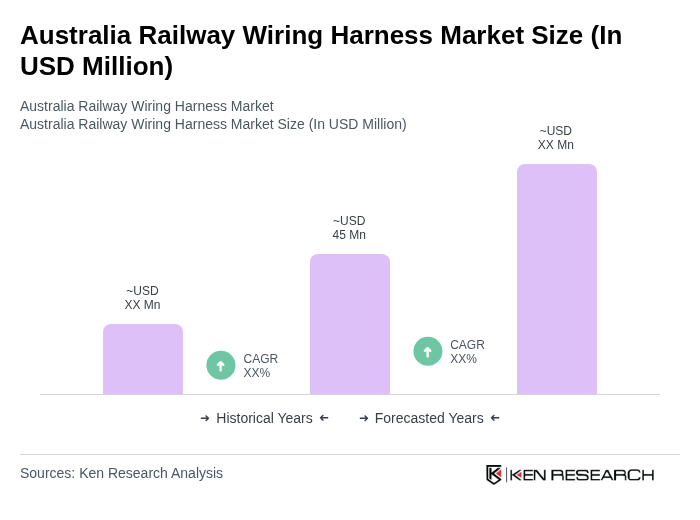
The Australia Railway Wiring Harness Market, worth USD 45 million, grows with demand for efficient rail systems, urban transit projects in Sydney, Melbourne, and Brisbane.

Region:Global

Author(s):Shubham

Product Code:KRAD3025

Pages:94

Published On:January 2026
About the Report

Base Year 2024

Australia Railway Wiring Harness Market Overview

  • The Australia Railway Wiring Harness Market is valued at USD 45 million, based on a five-year historical analysis. This growth is primarily driven by the increasing demand for efficient and reliable railway systems, coupled with government investments in infrastructure development and modernization of existing rail networks. The rising focus on safety and technological advancements in railway operations further propels the market.
  • Key cities such as Sydney, Melbourne, and Brisbane dominate the market due to their extensive rail networks and ongoing urban transit projects. These metropolitan areas are investing heavily in public transportation systems, which increases the demand for advanced wiring harness solutions that enhance operational efficiency and passenger safety.
  • The Rail Safety National Law, 2012 issued by the Office of the National Rail Safety Regulator (ONRSR), governs rail safety across participating jurisdictions in Australia. This binding instrument requires rail operators to implement safety management systems that include standards for electrical systems and components such as wiring harnesses, mandating risk assessments, compliance audits, and certification for safety-critical equipment to prevent failures in power transmission and signaling.
Australia Railway Wiring Harness Market Size

Australia Railway Wiring Harness Market Segmentation

By Train Type:The market is segmented into various train types, including High-Speed Rail, Light Rail/Tram, Metro/Monorail, and Locomotive & Freight Cars. Each of these segments plays a crucial role in the overall market dynamics, with specific applications and requirements influencing their growth.
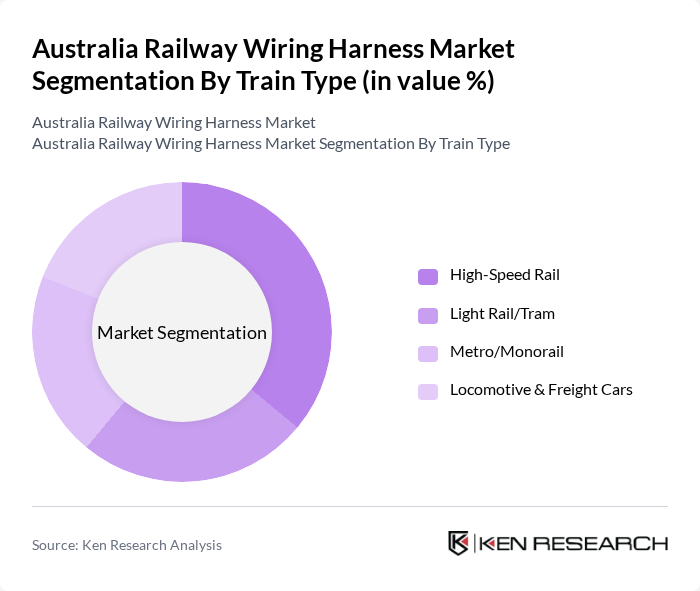
Australia Railway Wiring Harness Market segmentation by Train Type.

The High-Speed Rail segment is currently dominating the market due to the increasing investments in high-speed rail projects across Australia. This segment benefits from the growing need for faster and more efficient transportation solutions, which are essential for urban connectivity. The demand for advanced wiring harnesses in high-speed trains is driven by the need for enhanced safety features, reliability, and performance, making it a key focus area for manufacturers.

By Application:The market is further segmented by application into HVAC, Engine & Traction Systems, Lighting, and Infotainment Connectivity. Each application has distinct requirements and contributes differently to the overall market growth.
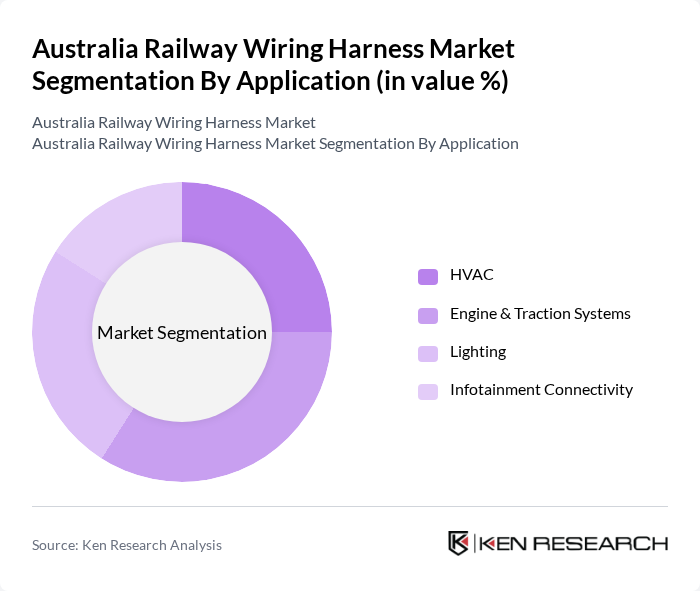
Australia Railway Wiring Harness Market segmentation by Application.

The Engine & Traction Systems application is leading the market due to the critical role it plays in the performance and efficiency of railway operations. As rail operators focus on enhancing the power and reliability of their trains, the demand for sophisticated wiring harnesses in engine and traction systems has surged. This segment is essential for ensuring optimal performance and safety in railway operations, making it a priority for manufacturers and suppliers.

Australia Railway Wiring Harness Market Competitive Landscape

The Australia Railway Wiring Harness Market is characterized by a dynamic mix of regional and international players. Leading participants such as TE Connectivity, Prysmian Group, Nexans, Taihan Electric Wire Co. Ltd., Furukawa Electric Co., Ltd., Leoni AG, Samvardhana Motherson Group, Hitachi Metals, Ltd., HUBER+SUHNER, LS Cable & System Ltd., NKT A/S, General Cable, Amphenol Corporation, Molex, Rosenberger contribute to innovation, geographic expansion, and service delivery in this space.

TE Connectivity

1941

Schaffhausen, Switzerland

Prysmian Group

1879

Milano, Italy

Nexans

1897

Paris, France

Taihan Electric Wire Co. Ltd.

1955

Seoul, South Korea

Furukawa Electric Co., Ltd.

1884

Tokyo, Japan

Company

Establishment Year

Headquarters

Revenue (USD Million)

Revenue Growth Rate (CAGR %)

Market Share (%)

Geographic Presence (Number of Countries)

Product Portfolio Breadth

R&D Investment as % of Revenue

Australia Railway Wiring Harness Market Industry Analysis

Growth Drivers

  • Increasing Investment in Railway Infrastructure:The Australian government allocated AUD 16 billion for railway infrastructure projects in future, reflecting a commitment to enhancing transport networks. This investment is expected to boost the demand for railway wiring harnesses, as modernized systems require advanced electrical components. Additionally, the Australian Infrastructure Plan emphasizes the need for sustainable transport solutions, further driving the market for wiring harnesses that support efficient railway operations and safety enhancements.
  • Rising Demand for Efficient and Reliable Transportation:With Australia’s population projected to reach 27 million by future, the demand for efficient public transport systems is surging. The Australian Bureau of Statistics reported that rail transport usage increased by 11% in urban areas in future. This trend necessitates the development of reliable railway systems, which in turn drives the need for high-quality wiring harnesses that ensure operational efficiency and safety in rail transport.
  • Technological Advancements in Wiring Harness Manufacturing:The adoption of advanced manufacturing technologies, such as automation and robotics, is transforming the wiring harness production landscape in Australia. In future, the industry is expected to invest approximately AUD 600 million in these technologies, enhancing production efficiency and reducing costs. This shift not only improves the quality of wiring harnesses but also supports the growing demand for customized solutions in the railway sector, fostering market growth.

Market Challenges

  • High Initial Investment Costs:The railway wiring harness market faces significant challenges due to high initial investment costs, which can exceed AUD 1.2 million for new projects. This financial barrier can deter smaller companies from entering the market, limiting competition and innovation. Additionally, the need for specialized equipment and skilled labor further escalates costs, making it difficult for new entrants to establish a foothold in the industry.
  • Stringent Regulatory Requirements:Compliance with Australian Standards for railway safety imposes rigorous regulatory requirements on manufacturers. The Australian Transport Safety Bureau reported that non-compliance can lead to penalties exceeding AUD 250,000. These stringent regulations necessitate continuous investment in quality assurance and testing processes, which can strain resources for manufacturers, particularly smaller firms, and hinder their ability to compete effectively in the market.

Australia Railway Wiring Harness Market Future Outlook

The future of the Australia railway wiring harness market appears promising, driven by ongoing investments in infrastructure and technological advancements. As the government continues to prioritize rail transport, the integration of smart technologies and IoT solutions is expected to enhance operational efficiency. Furthermore, the shift towards sustainable practices will likely encourage the development of eco-friendly wiring harnesses, positioning the market for significant growth in the coming years as demand for modernized rail systems increases.

Market Opportunities

  • Expansion of High-Speed Rail Networks:The Australian government plans to invest AUD 12 billion in high-speed rail projects by future. This expansion presents a significant opportunity for wiring harness manufacturers to supply advanced electrical systems that meet the demands of high-speed rail technology, enhancing connectivity and reducing travel times across major cities.
  • Adoption of Smart Railway Technologies:The increasing focus on smart railway technologies, such as predictive maintenance and real-time monitoring, is creating new opportunities for wiring harness innovation. With an estimated investment of AUD 1.2 billion in smart technologies by future, manufacturers can develop specialized wiring solutions that support these advancements, improving safety and operational efficiency in rail transport.

Scope of the Report

SegmentSub-Segments
By Train Type

High-Speed Rail

Light Rail/Tram

Metro/Monorail

Locomotive & Freight Cars

By Application

HVAC

Engine & Traction Systems

Lighting

Infotainment Connectivity

By Wire Material

Copper

Copper-Clad Aluminium

Optical Fibre

Others

By Insulation Type

PVC

Halogen-Free Flame-Retardant (HFFR)

Others

By Component

Wire

Connector

Terminal

Others

By Voltage

Low Voltage

Medium Voltage

High Voltage

By Region

New South Wales

Victoria

Queensland

Western Australia

Others

Key Target Audience

Investors and Venture Capitalist Firms

Government and Regulatory Bodies (e.g., Australian Transport Safety Bureau, Department of Infrastructure, Transport, Regional Development and Communications)

Manufacturers and Producers

Railway Operators and Service Providers

Infrastructure Development Companies

Supply Chain and Logistics Companies

Industry Associations (e.g., Australasian Railway Association)

Financial Institutions and Banks

Players Mentioned in the Report:

TE Connectivity

Prysmian Group

Nexans

Taihan Electric Wire Co. Ltd.

Furukawa Electric Co., Ltd.

Leoni AG

Samvardhana Motherson Group

Hitachi Metals, Ltd.

HUBER+SUHNER

LS Cable & System Ltd.

NKT A/S

General Cable

Amphenol Corporation

Molex

Rosenberger

Table of Contents

Market Assessment Phase

1. Executive Summary and Approach


2. Australia Railway Wiring Harness Market Overview

2.1 Key Insights and Strategic Recommendations

2.2 Australia Railway Wiring Harness Market Overview

2.3 Definition and Scope

2.4 Evolution of Market Ecosystem

2.5 Timeline of Key Regulatory Milestones

2.6 Value Chain & Stakeholder Mapping

2.7 Business Cycle Analysis

2.8 Policy & Incentive Landscape


3. Australia Railway Wiring Harness Market Analysis

3.1 Growth Drivers

3.1.1 Increasing investment in railway infrastructure
3.1.2 Rising demand for efficient and reliable transportation
3.1.3 Technological advancements in wiring harness manufacturing
3.1.4 Government initiatives promoting rail transport

3.2 Market Challenges

3.2.1 High initial investment costs
3.2.2 Stringent regulatory requirements
3.2.3 Competition from alternative transportation modes
3.2.4 Supply chain disruptions

3.3 Market Opportunities

3.3.1 Expansion of high-speed rail networks
3.3.2 Adoption of smart railway technologies
3.3.3 Increasing focus on sustainability and eco-friendly solutions
3.3.4 Collaborations with technology providers

3.4 Market Trends

3.4.1 Growing emphasis on safety and reliability
3.4.2 Integration of IoT in railway systems
3.4.3 Shift towards modular wiring harness designs
3.4.4 Rising demand for lightweight materials

3.5 Government Regulation

3.5.1 Compliance with Australian Standards for railway safety
3.5.2 Environmental regulations impacting manufacturing processes
3.5.3 Regulations on material sourcing and recycling
3.5.4 Policies promoting public transport investment

4. SWOT Analysis


5. Stakeholder Analysis


6. Porter's Five Forces Analysis


7. Australia Railway Wiring Harness Market Market Size, 2019-2024

7.1 By Value

7.2 By Volume

7.3 By Average Selling Price


8. Australia Railway Wiring Harness Market Segmentation

8.1 By Train Type

8.1.1 High-Speed Rail
8.1.2 Light Rail/Tram
8.1.3 Metro/Monorail
8.1.4 Locomotive & Freight Cars

8.2 By Application

8.2.1 HVAC
8.2.2 Engine & Traction Systems
8.2.3 Lighting
8.2.4 Infotainment Connectivity

8.3 By Wire Material

8.3.1 Copper
8.3.2 Copper-Clad Aluminium
8.3.3 Optical Fibre
8.3.4 Others

8.4 By Insulation Type

8.4.1 PVC
8.4.2 Halogen-Free Flame-Retardant (HFFR)
8.4.3 Others

8.5 By Component

8.5.1 Wire
8.5.2 Connector
8.5.3 Terminal
8.5.4 Others

8.6 By Voltage

8.6.1 Low Voltage
8.6.2 Medium Voltage
8.6.3 High Voltage

8.7 By Region

8.7.1 New South Wales
8.7.2 Victoria
8.7.3 Queensland
8.7.4 Western Australia
8.7.5 Others

9. Australia Railway Wiring Harness Market Competitive Analysis

9.1 Market Share of Key Players

9.2 Cross Comparison of Key Players

9.2.1 Company Name
9.2.2 Revenue (USD Million)
9.2.3 Revenue Growth Rate (CAGR %)
9.2.4 Market Share (%)
9.2.5 Geographic Presence (Number of Countries)
9.2.6 Product Portfolio Breadth
9.2.7 R&D Investment as % of Revenue
9.2.8 Customer Retention Rate (%)
9.2.9 Certifications & Compliance Standards
9.2.10 Strategic Partnerships & Collaborations

9.3 SWOT Analysis of Top Players

9.4 Pricing Analysis

9.5 Detailed Profile of Major Companies

9.5.1 TE Connectivity
9.5.2 Prysmian Group
9.5.3 Nexans
9.5.4 Taihan Electric Wire Co. Ltd.
9.5.5 Furukawa Electric Co., Ltd.
9.5.6 Leoni AG
9.5.7 Samvardhana Motherson Group
9.5.8 Hitachi Metals, Ltd.
9.5.9 HUBER+SUHNER
9.5.10 LS Cable & System Ltd.
9.5.11 NKT A/S
9.5.12 General Cable
9.5.13 Amphenol Corporation
9.5.14 Molex
9.5.15 Rosenberger

10. Australia Railway Wiring Harness Market End-User Analysis

10.1 Procurement Behavior of Key Ministries

10.1.1 Ministry of Transport
10.1.2 Ministry of Infrastructure
10.1.3 Ministry of Environment
10.1.4 Others

10.2 Corporate Spend on Infrastructure & Energy

10.2.1 Investment Trends in Rail Infrastructure
10.2.2 Budget Allocations for Rail Projects
10.2.3 Corporate Partnerships
10.2.4 Others

10.3 Pain Point Analysis by End-User Category

10.3.1 Safety Concerns
10.3.2 Reliability Issues
10.3.3 Cost Management
10.3.4 Others

10.4 User Readiness for Adoption

10.4.1 Training and Support Needs
10.4.2 Technology Adoption Rates
10.4.3 Infrastructure Compatibility
10.4.4 Others

10.5 Post-Deployment ROI and Use Case Expansion

10.5.1 Performance Metrics
10.5.2 User Feedback Mechanisms
10.5.3 Future Expansion Plans
10.5.4 Others

11. Australia Railway Wiring Harness Market Future Size, 2025-2030

11.1 By Value

11.2 By Volume

11.3 By Average Selling Price


Go-To-Market Strategy Phase

1. Whitespace Analysis + Business Model Canvas

1.1 Market Gaps Identification

1.2 Value Proposition Development

1.3 Revenue Streams

1.4 Cost Structure Analysis

1.5 Key Partnerships

1.6 Customer Segments

1.7 Channels


2. Marketing and Positioning Recommendations

2.1 Branding Strategies

2.2 Product USPs


3. Distribution Plan

3.1 Urban Retail vs Rural NGO Tie-ups


4. Channel & Pricing Gaps

4.1 Underserved Routes

4.2 Pricing Bands


5. Unmet Demand & Latent Needs

5.1 Category Gaps

5.2 Consumer Segments


6. Customer Relationship

6.1 Loyalty Programs

6.2 After-sales Service


7. Value Proposition

7.1 Sustainability

7.2 Integrated Supply Chains


8. Key Activities

8.1 Regulatory Compliance

8.2 Branding

8.3 Distribution Setup


9. Entry Strategy Evaluation

9.1 Domestic Market Entry Strategy

9.1.1 Product Mix
9.1.2 Pricing Band
9.1.3 Packaging

9.2 Export Entry Strategy

9.2.1 Target Countries
9.2.2 Compliance Roadmap

10. Entry Mode Assessment

10.1 JV

10.2 Greenfield

10.3 M&A

10.4 Distributor Model


11. Capital and Timeline Estimation

11.1 Capital Requirements

11.2 Timelines


12. Control vs Risk Trade-Off

12.1 Ownership vs Partnerships


13. Profitability Outlook

13.1 Breakeven Analysis

13.2 Long-term Sustainability


14. Potential Partner List

14.1 Distributors

14.2 JVs

14.3 Acquisition Targets


15. Execution Roadmap

15.1 Phased Plan for Market Entry

15.1.1 Market Setup
15.1.2 Market Entry
15.1.3 Growth Acceleration
15.1.4 Scale & Stabilize

15.2 Key Activities and Milestones

15.2.1 Milestone Planning
15.2.2 Activity Tracking

Research Methodology

ApproachModellingSample

Phase 1: Approach1

Desk Research

  • Industry reports from Australian transport and logistics associations
  • Government publications on railway infrastructure and investment plans
  • Market analysis from trade journals focusing on electrical components in railways

Primary Research

  • Interviews with engineering managers at railway operators and manufacturers
  • Surveys with procurement specialists in the railway wiring harness sector
  • Field interviews with installation and maintenance teams in railway projects

Validation & Triangulation

  • Cross-validation of data from multiple industry sources and expert opinions
  • Triangulation of market size estimates using historical growth rates and current trends
  • Sanity checks through feedback from a panel of industry experts and stakeholders

Phase 2: Market Size Estimation1

Top-down Assessment

  • Analysis of national railway expenditure and infrastructure development budgets
  • Segmentation of the market by application areas such as passenger and freight services
  • Incorporation of government initiatives promoting rail transport and electrification

Bottom-up Modeling

  • Volume estimates based on historical sales data from leading wiring harness manufacturers
  • Cost analysis derived from supplier pricing and installation expenses
  • Estimation of market size based on projected growth in railway projects and electrification

Forecasting & Scenario Analysis

  • Multi-variable regression analysis considering factors like rail traffic growth and technological advancements
  • Scenario modeling based on potential changes in government policy and investment levels
  • Development of baseline, optimistic, and pessimistic forecasts through 2030

Phase 3: CATI Sample Composition1

Scope Item/SegmentSample SizeTarget Respondent Profiles
Passenger Rail Wiring Harnesses100Project Managers, Electrical Engineers
Freight Rail Wiring Solutions80Supply Chain Managers, Operations Directors
Railway Electrification Projects70Infrastructure Planners, Technical Consultants
Maintenance and Repair Services60Maintenance Supervisors, Field Technicians
Railway Safety and Compliance90Safety Officers, Compliance Managers

Frequently Asked Questions

What is the current value of the Australia Railway Wiring Harness Market?

The Australia Railway Wiring Harness Market is valued at approximately USD 45 million, reflecting a five-year historical analysis. This valuation is driven by increased demand for efficient railway systems and government investments in infrastructure development.

Which cities are the primary markets for railway wiring harnesses in Australia?

What regulatory framework governs railway safety in Australia?

What are the main applications of railway wiring harnesses?

Other Adjacent Reports

KSA Railway Signaling Market

South Africa Railway Electrification Market

Egypt Train Control Systems Market

Philippines Railway Rolling Stock Market

APAC automotive wiring harness market Size, Share, Growth Drivers, Trends, Opportunities & Forecast 2025–2030UAE Aerospace Wiring Harness Market

Thailand Cable Manufacturing Market

South Africa Electrical Connectors Market

Thailand Railway Infrastructure Market

Kuwait smart transportation market size, share, growth drivers, trends, opportunities & forecast 2025–2030

Why Buy From Us?

Refine Robust Result (RRR) Framework

What makes us stand out is that our consultants follow Robust, Refine and Result (RRR) methodology. Robust for clear definitions, approaches and sanity checking, Refine for differentiating respondents' facts and opinions, and Result for presenting data with story.

Our Reach Is Unmatched

We have set a benchmark in the industry by offering our clients with syndicated and customized market research reports featuring coverage of entire market as well as meticulous research and analyst insights.

Shifting the Research Paradigm

While we don't replace traditional research, we flip the method upside down. Our dual approach of Top Bottom & Bottom Top ensures quality deliverable by not just verifying company fundamentals but also looking at the sector and macroeconomic factors.

More Insights-Better Decisions

With one step in the future, our research team constantly tries to show you the bigger picture. We help with some of the tough questions you may encounter along the way: How is the industry positioned? Best marketing channel? KPI's of competitors? By aligning every element, we help maximize success.

Transparency and Trust

Our report gives you instant access to the answers and sources that other companies might choose to hide. We elaborate each steps of research methodology we have used and showcase you the sample size to earn your trust.

Round the Clock Support

If you need any support, we are here! We pride ourselves on universe strength, data quality, and quick, friendly, and professional service.

Why Clients Choose Us?

400000+
Reports in repository
150+
Consulting projects a year
100+
Analysts
8000+
Client Queries in 2022








