About the Report
Base Year 2024Australia Sports Equipment and Outdoor Gear Market Overview
- The Australia Sports Equipment and Outdoor Gear Market is valued at approximately AUD 12.3 billion, based on a five-year historical analysis. This growth is primarily driven by increasing health consciousness among consumers, a rise in outdoor activities, and the growing popularity of fitness and athleisure trends. The market has seen a surge in demand for innovative and high-quality sports equipment and outdoor gear, catering to both recreational and professional users. Key drivers include the integration of smart technology in fitness equipment, the adoption of eco-friendly materials, and the expansion of online retail channels, which have made products more accessible to a broader consumer base .
- Key cities such as Sydney, Melbourne, and Brisbane dominate the market due to their large populations, active lifestyles, and access to various sports facilities. These urban centers have a vibrant sports culture, supported by numerous events and activities that encourage participation in sports and outdoor recreation, thus driving demand for related equipment and gear .
- The Australian government has introduced sustainability-focused regulations impacting the sports equipment industry. The Product Stewardship (Voluntary Accreditation of Voluntary Arrangements) Instrument 2022, issued by the Department of Climate Change, Energy, the Environment and Water, encourages manufacturers to reduce waste, improve recyclability, and increase the use of eco-friendly materials in sports and outdoor gear. These measures aim to foster a more sustainable market and enhance consumer awareness regarding environmental impacts .

Australia Sports Equipment and Outdoor Gear Market Segmentation
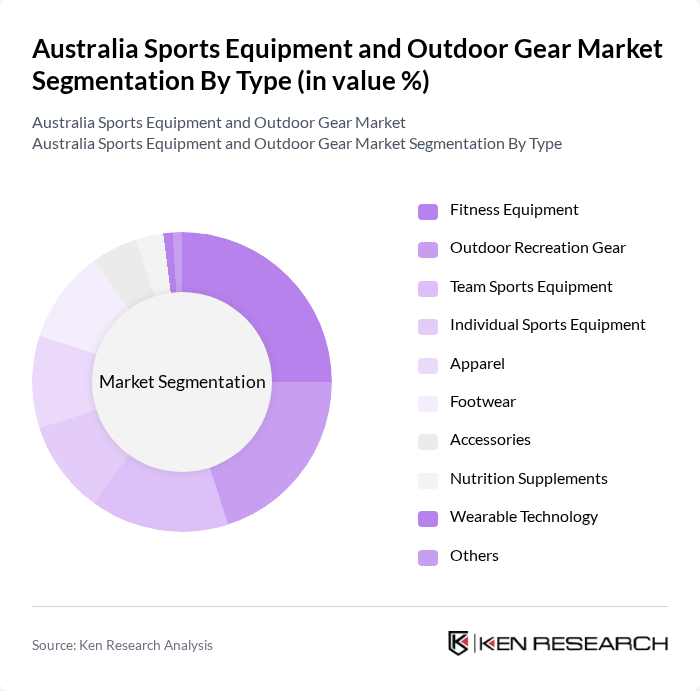
By Type:The market is segmented into various types of products, including fitness equipment, outdoor recreation gear, team sports equipment, individual sports equipment, apparel, footwear, accessories, nutrition supplements, wearable technology, and others. Each sub-segment caters to different consumer needs and preferences, reflecting the diverse interests in sports and outdoor activities. Fitness equipment remains the largest segment, driven by the popularity of home workouts, gym memberships, and advancements in smart fitness technology. Outdoor recreation gear is also significant, supported by the growing interest in camping, hiking, and adventure sports .
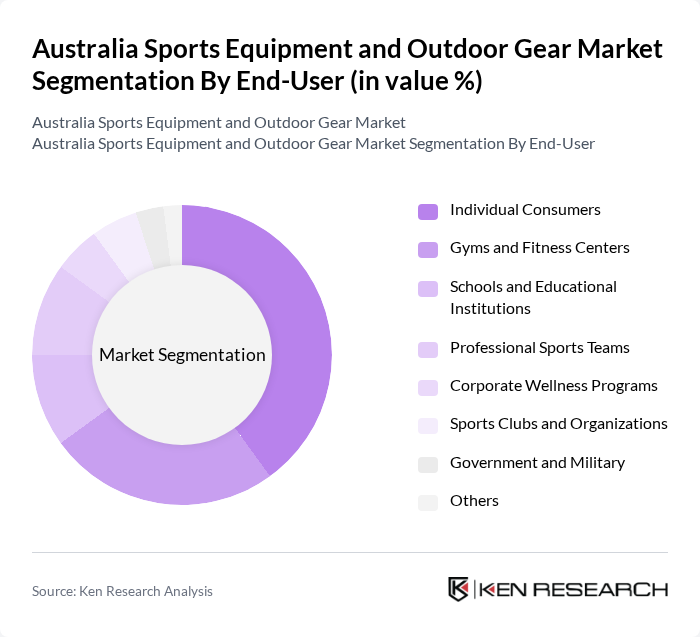
By End-User:The end-user segmentation includes individual consumers, gyms and fitness centers, schools and educational institutions, professional sports teams, corporate wellness programs, sports clubs and organizations, government and military, and others. This segmentation highlights the diverse applications of sports equipment and outdoor gear across various sectors. Individual consumers represent the largest share, reflecting the strong culture of personal fitness and recreational activity in Australia. Gyms and fitness centers are also significant buyers, followed by educational institutions and professional teams .
Australia Sports Equipment and Outdoor Gear Market Competitive Landscape
The Australia Sports Equipment and Outdoor Gear Market is characterized by a dynamic mix of regional and international players. Leading participants such as Nike, Inc., Adidas Australia Pty Ltd., Puma Australia Pty Ltd., Super Retail Group Limited, Decathlon (Australia) Pty Ltd., The North Face, Inc., Columbia Sportswear Company, Asics Oceania Pty Ltd., Kookaburra Sport Pty Ltd., Kathmandu Holdings Limited, Lorna Jane Pty Ltd., Lululemon Athletica Inc., Wilson Sporting Goods Co., New Balance Athletics, Inc., Gymshark Ltd. contribute to innovation, geographic expansion, and service delivery in this space.
Australia Sports Equipment and Outdoor Gear Market Industry Analysis
Growth Drivers
- Increasing Participation in Sports and Outdoor Activities:The Australian Bureau of Statistics reported that approximately 60% of Australians aged 15 and over participated in sports or outdoor activities in future, a figure that translates to around 12 million individuals. This growing engagement is driven by a cultural emphasis on active lifestyles, supported by community programs and local events. The increase in participation directly correlates with heightened demand for sports equipment and outdoor gear, fostering market growth.
- Rising Health Consciousness Among Consumers:A future survey by the Australian Institute of Health and Welfare indicated that 70% of Australians are actively seeking ways to improve their health and fitness. This trend has led to increased spending on sports equipment, with the average household investing approximately AUD 1,200 annually on fitness-related products. The focus on health and wellness is driving consumers to purchase quality gear, thereby propelling market expansion in the sports equipment sector.
- Growth of E-commerce Platforms for Sports Equipment:The e-commerce sector in Australia saw a remarkable growth of 25% in future, with online sales of sports equipment reaching AUD 1.5 billion. This shift towards online shopping is facilitated by the convenience and variety offered by digital platforms. As consumers increasingly prefer purchasing gear online, brands are investing in e-commerce strategies, enhancing accessibility and driving sales in the sports equipment market.
Market Challenges
- Intense Competition Among Established Brands:The Australian sports equipment market is characterized by fierce competition, with major players like Nike, Adidas, and Under Armour dominating. In future, these brands collectively held over 60% market share, making it challenging for new entrants to gain traction. This competitive landscape pressures companies to innovate continuously and invest heavily in marketing, which can strain resources and impact profitability.
- Fluctuating Raw Material Prices:The sports equipment industry is significantly affected by the volatility of raw material prices, particularly for synthetic materials and metals. In future, the price of rubber increased by 15%, while steel prices rose by 10%, impacting production costs. These fluctuations can lead to increased retail prices, potentially reducing consumer demand and squeezing profit margins for manufacturers in the sports equipment sector.
Australia Sports Equipment and Outdoor Gear Market Future Outlook
The future of the Australia sports equipment and outdoor gear market appears promising, driven by ongoing trends in health consciousness and technological advancements. As more Australians prioritize fitness, the demand for innovative and high-quality gear is expected to rise. Additionally, the integration of smart technology into sports equipment will likely enhance user experience, further stimulating market growth. Companies that adapt to these trends will be well-positioned to capitalize on emerging opportunities in the sector.
Market Opportunities
- Expansion of Eco-friendly and Sustainable Products:With increasing consumer awareness regarding environmental issues, the demand for eco-friendly sports equipment is on the rise. In future, sales of sustainable products grew by 20%, indicating a shift in consumer preferences. Companies that invest in sustainable materials and practices can tap into this growing market segment, enhancing brand loyalty and attracting environmentally conscious consumers.
- Growth in Adventure Tourism:The adventure tourism sector in Australia is projected to reach AUD 1.2 billion by future, driven by a surge in outdoor activities such as hiking, camping, and rock climbing. This growth presents significant opportunities for sports equipment manufacturers to develop specialized gear tailored for adventure enthusiasts, thereby expanding their product offerings and capturing a larger market share.
Scope of the Report
| Segment | Sub-Segments |
|---|---|
| By Type | Fitness Equipment Outdoor Recreation Gear Team Sports Equipment Individual Sports Equipment Apparel Footwear Accessories Nutrition Supplements Wearable Technology Others |
| By End-User | Individual Consumers Gyms and Fitness Centers Schools and Educational Institutions Professional Sports Teams Corporate Wellness Programs Sports Clubs and Organizations Government and Military Others |
| By Sales Channel | Online Retail Specialty Stores Department Stores Direct Sales Wholesale Distributors Others |
| By Price Range | Budget Mid-Range Premium Luxury |
| By Brand Loyalty | Brand Loyal Customers Price-Sensitive Customers Quality-Focused Customers First-Time Buyers Others |
| By Product Lifecycle Stage | Introduction Stage Growth Stage Maturity Stage Decline Stage |
| By Distribution Mode | Direct Distribution Indirect Distribution Hybrid Distribution |
Key Target Audience
Investors and Venture Capitalist Firms
Government and Regulatory Bodies (e.g., Australian Sports Commission, Department of Industry, Science, Energy and Resources)
Manufacturers and Producers
Distributors and Retailers
Outdoor Recreation Organizations
Sports Associations and Federations
Event Organizers and Promoters
Financial Institutions
Players Mentioned in the Report:
Nike, Inc.
Adidas Australia Pty Ltd.
Puma Australia Pty Ltd.
Super Retail Group Limited
Decathlon (Australia) Pty Ltd.
The North Face, Inc.
Columbia Sportswear Company
Asics Oceania Pty Ltd.
Kookaburra Sport Pty Ltd.
Kathmandu Holdings Limited
Lorna Jane Pty Ltd.
Lululemon Athletica Inc.
Wilson Sporting Goods Co.
New Balance Athletics, Inc.
Gymshark Ltd.
Table of Contents
Market Assessment Phase
1. Executive Summary and Approach
2. Australia Sports Equipment and Outdoor Gear Market Overview
2.1 Key Insights and Strategic Recommendations
2.2 Australia Sports Equipment and Outdoor Gear Market Overview
2.3 Definition and Scope
2.4 Evolution of Market Ecosystem
2.5 Timeline of Key Regulatory Milestones
2.6 Value Chain & Stakeholder Mapping
2.7 Business Cycle Analysis
2.8 Policy & Incentive Landscape
3. Australia Sports Equipment and Outdoor Gear Market Analysis
3.1 Growth Drivers
3.1.1 Increasing Participation in Sports and Outdoor Activities
3.1.2 Rising Health Consciousness Among Consumers
3.1.3 Growth of E-commerce Platforms for Sports Equipment
3.1.4 Government Initiatives Promoting Outdoor Activities
3.2 Market Challenges
3.2.1 Intense Competition Among Established Brands
3.2.2 Fluctuating Raw Material Prices
3.2.3 Regulatory Compliance and Safety Standards
3.2.4 Seasonal Demand Variability
3.3 Market Opportunities
3.3.1 Expansion of Eco-friendly and Sustainable Products
3.3.2 Growth in Adventure Tourism
3.3.3 Technological Advancements in Sports Equipment
3.3.4 Increasing Popularity of Fitness Apps and Wearables
3.4 Market Trends
3.4.1 Shift Towards Online Shopping for Sports Gear
3.4.2 Customization and Personalization of Equipment
3.4.3 Rise of Athleisure Wear
3.4.4 Integration of Smart Technology in Equipment
3.5 Government Regulation
3.5.1 Safety Standards for Sports Equipment
3.5.2 Environmental Regulations on Manufacturing
3.5.3 Import Tariffs on Outdoor Gear
3.5.4 Regulations on Marketing to Minors
4. SWOT Analysis
5. Stakeholder Analysis
6. Porter's Five Forces Analysis
7. Australia Sports Equipment and Outdoor Gear Market Market Size, 2019-2024
7.1 By Value
7.2 By Volume
7.3 By Average Selling Price
8. Australia Sports Equipment and Outdoor Gear Market Segmentation
8.1 By Type
8.1.1 Fitness Equipment
8.1.2 Outdoor Recreation Gear
8.1.3 Team Sports Equipment
8.1.4 Individual Sports Equipment
8.1.5 Apparel
8.1.6 Footwear
8.1.7 Accessories
8.1.8 Nutrition Supplements
8.1.9 Wearable Technology
8.1.10 Others
8.2 By End-User
8.2.1 Individual Consumers
8.2.2 Gyms and Fitness Centers
8.2.3 Schools and Educational Institutions
8.2.4 Professional Sports Teams
8.2.5 Corporate Wellness Programs
8.2.6 Sports Clubs and Organizations
8.2.7 Government and Military
8.2.8 Others
8.3 By Sales Channel
8.3.1 Online Retail
8.3.2 Specialty Stores
8.3.3 Department Stores
8.3.4 Direct Sales
8.3.5 Wholesale Distributors
8.3.6 Others
8.4 By Price Range
8.4.1 Budget
8.4.2 Mid-Range
8.4.3 Premium
8.4.4 Luxury
8.5 By Brand Loyalty
8.5.1 Brand Loyal Customers
8.5.2 Price-Sensitive Customers
8.5.3 Quality-Focused Customers
8.5.4 First-Time Buyers
8.5.5 Others
8.6 By Product Lifecycle Stage
8.6.1 Introduction Stage
8.6.2 Growth Stage
8.6.3 Maturity Stage
8.6.4 Decline Stage
8.7 By Distribution Mode
8.7.1 Direct Distribution
8.7.2 Indirect Distribution
8.7.3 Hybrid Distribution
9. Australia Sports Equipment and Outdoor Gear Market Competitive Analysis
9.1 Market Share of Key Players
9.2 Cross Comparison of Key Players
9.2.1 Company Name
9.2.2 Group Size (Large, Medium, or Small as per industry convention)
9.2.3 Revenue (AUD, latest fiscal year)
9.2.4 Revenue Growth Rate (YoY %)
9.2.5 Market Share (%)
9.2.6 Market Penetration Rate
9.2.7 Customer Retention Rate
9.2.8 Pricing Strategy (Value, Mid, Premium, Luxury)
9.2.9 Product Diversification Index
9.2.10 Brand Equity Score
9.2.11 Distribution Network Efficiency
9.2.12 Innovation Rate (New Product Launches/Year)
9.2.13 Sustainability Initiatives (ESG Score/Green Product Share)
9.2.14 Online vs Offline Sales Ratio
9.3 SWOT Analysis of Top Players
9.4 Pricing Analysis
9.5 Detailed Profile of Major Companies
9.5.1 Nike, Inc.
9.5.2 Adidas Australia Pty Ltd.
9.5.3 Puma Australia Pty Ltd.
9.5.4 Super Retail Group Limited
9.5.5 Decathlon (Australia) Pty Ltd.
9.5.6 The North Face, Inc.
9.5.7 Columbia Sportswear Company
9.5.8 Asics Oceania Pty Ltd.
9.5.9 Kookaburra Sport Pty Ltd.
9.5.10 Kathmandu Holdings Limited
9.5.11 Lorna Jane Pty Ltd.
9.5.12 Lululemon Athletica Inc.
9.5.13 Wilson Sporting Goods Co.
9.5.14 New Balance Athletics, Inc.
9.5.15 Gymshark Ltd.
10. Australia Sports Equipment and Outdoor Gear Market End-User Analysis
10.1 Procurement Behavior of Key Ministries
10.1.1 Government Procurement Policies
10.1.2 Budget Allocation for Sports and Recreation
10.1.3 Supplier Selection Criteria
10.2 Corporate Spend on Infrastructure & Energy
10.2.1 Investment in Sports Facilities
10.2.2 Funding for Outdoor Programs
10.2.3 Sponsorship of Sports Events
10.3 Pain Point Analysis by End-User Category
10.3.1 Equipment Accessibility Issues
10.3.2 Quality Concerns Among Consumers
10.3.3 Price Sensitivity in Purchases
10.4 User Readiness for Adoption
10.4.1 Awareness of New Products
10.4.2 Willingness to Invest in Quality
10.4.3 Trends in Online Shopping
10.5 Post-Deployment ROI and Use Case Expansion
10.5.1 Measurement of Equipment Performance
10.5.2 User Feedback Mechanisms
10.5.3 Opportunities for Upselling
11. Australia Sports Equipment and Outdoor Gear Market Future Size, 2025-2030
11.1 By Value
11.2 By Volume
11.3 By Average Selling Price
Go-To-Market Strategy Phase
1. Whitespace Analysis + Business Model Canvas
1.1 Market Gaps Identification
1.2 Value Proposition Development
1.3 Revenue Streams Analysis
1.4 Cost Structure Evaluation
1.5 Key Partnerships Exploration
1.6 Customer Segments Definition
1.7 Channels for Delivery
2. Marketing and Positioning Recommendations
2.1 Branding Strategies
2.2 Product USPs
2.3 Target Audience Identification
2.4 Communication Strategy
2.5 Digital Marketing Tactics
3. Distribution Plan
3.1 Urban Retail Strategies
3.2 Rural NGO Tie-ups
3.3 E-commerce Integration
3.4 Logistics and Supply Chain Management
4. Channel & Pricing Gaps
4.1 Underserved Routes
4.2 Pricing Bands Analysis
4.3 Competitor Pricing Comparison
5. Unmet Demand & Latent Needs
5.1 Category Gaps Identification
5.2 Consumer Segments Analysis
5.3 Emerging Trends Exploration
6. Customer Relationship
6.1 Loyalty Programs Development
6.2 After-sales Service Enhancements
6.3 Customer Feedback Mechanisms
7. Value Proposition
7.1 Sustainability Initiatives
7.2 Integrated Supply Chains
7.3 Unique Selling Points
8. Key Activities
8.1 Regulatory Compliance
8.2 Branding Efforts
8.3 Distribution Setup
9. Entry Strategy Evaluation
9.1 Domestic Market Entry Strategy
9.1.1 Product Mix Considerations
9.1.2 Pricing Band Strategy
9.1.3 Packaging Innovations
9.2 Export Entry Strategy
9.2.1 Target Countries Identification
9.2.2 Compliance Roadmap Development
10. Entry Mode Assessment
10.1 Joint Ventures
10.2 Greenfield Investments
10.3 Mergers & Acquisitions
10.4 Distributor Model Evaluation
11. Capital and Timeline Estimation
11.1 Capital Requirements Analysis
11.2 Timelines for Implementation
12. Control vs Risk Trade-Off
12.1 Ownership Considerations
12.2 Partnerships Evaluation
13. Profitability Outlook
13.1 Breakeven Analysis
13.2 Long-term Sustainability Strategies
14. Potential Partner List
14.1 Distributors Identification
14.2 Joint Ventures Opportunities
14.3 Acquisition Targets
15. Execution Roadmap
15.1 Phased Plan for Market Entry
15.1.1 Market Setup
15.1.2 Market Entry
15.1.3 Growth Acceleration
15.1.4 Scale & Stabilize
15.2 Key Activities and Milestones
15.2.1 Milestone Planning
15.2.2 Activity Tracking
Research Methodology
Phase 1: Approach1
Desk Research
- Analysis of industry reports from Australian sports equipment and outdoor gear associations
- Review of government publications on outdoor recreation and sports participation statistics
- Examination of market trends through academic journals and trade publications focused on sports and outdoor activities
Primary Research
- Interviews with product managers at leading sports equipment manufacturers
- Surveys conducted with retailers specializing in outdoor gear and sports equipment
- Focus groups with consumers engaged in outdoor activities to gather insights on preferences and purchasing behavior
Validation & Triangulation
- Cross-validation of findings through comparison with historical sales data and market growth rates
- Triangulation of insights from primary interviews with secondary data sources to ensure consistency
- Sanity checks through expert panel reviews comprising industry veterans and market analysts
Phase 2: Market Size Estimation1
Top-down Assessment
- Estimation of market size based on national sports participation rates and outdoor activity trends
- Segmentation of the market by product categories such as apparel, footwear, and equipment
- Incorporation of demographic data to assess potential market growth among different age groups
Bottom-up Modeling
- Collection of sales data from key retailers and manufacturers in the sports equipment sector
- Estimation of average selling prices across various product categories to derive revenue figures
- Analysis of consumer spending patterns on outdoor gear and sports equipment through surveys
Forecasting & Scenario Analysis
- Utilization of time-series analysis to project future market trends based on historical data
- Scenario modeling based on potential impacts of economic conditions and consumer behavior shifts
- Development of multiple forecasts (baseline, optimistic, and pessimistic) to account for uncertainties in the market
Phase 3: CATI Sample Composition1
| Scope Item/Segment | Sample Size | Target Respondent Profiles |
|---|---|---|
| Retail Sales of Sports Equipment | 60 | Store Managers, Sales Representatives |
| Outdoor Gear Consumer Insights | 50 | Outdoor Enthusiasts, Recreational Users |
| Market Trends in Sports Apparel | 40 | Brand Managers, Product Designers |
| Impact of E-commerce on Sports Equipment Sales | 55 | E-commerce Managers, Digital Marketing Specialists |
| Consumer Preferences in Outdoor Activities | 45 | Active Lifestyle Participants, Fitness Coaches |
Frequently Asked Questions
What is the current value of the Australia Sports Equipment and Outdoor Gear Market?
The Australia Sports Equipment and Outdoor Gear Market is valued at approximately AUD 12.3 billion, reflecting a significant growth trend driven by increased health consciousness and outdoor activities among consumers.
What factors are driving growth in the Australian sports equipment market?
Which cities are the largest markets for sports equipment in Australia?
How is the Australian government influencing the sports equipment market?
Other Regional/Country Reports
Other Adjacent Reports
Bahrain Sports Apparel Market
Egypt Fitness Equipment Market
Mexico Outdoor Recreation Gear Market
Indonesia Sports Nutrition Market
South Africa Wearable Technology Market
Oman Athleisure Wear Market
Philippines Sports Footwear Market
Kuwait Gym and Fitness Center Market
Bahrain Adventure Tourism Market
Germany E-commerce Sports Retail Market
Why Buy From Us?

What makes us stand out is that our consultants follow Robust, Refine and Result (RRR) methodology. Robust for clear definitions, approaches and sanity checking, Refine for differentiating respondents' facts and opinions, and Result for presenting data with story.

We have set a benchmark in the industry by offering our clients with syndicated and customized market research reports featuring coverage of entire market as well as meticulous research and analyst insights.

While we don't replace traditional research, we flip the method upside down. Our dual approach of Top Bottom & Bottom Top ensures quality deliverable by not just verifying company fundamentals but also looking at the sector and macroeconomic factors.

With one step in the future, our research team constantly tries to show you the bigger picture. We help with some of the tough questions you may encounter along the way: How is the industry positioned? Best marketing channel? KPI's of competitors? By aligning every element, we help maximize success.

Our report gives you instant access to the answers and sources that other companies might choose to hide. We elaborate each steps of research methodology we have used and showcase you the sample size to earn your trust.

If you need any support, we are here! We pride ourselves on universe strength, data quality, and quick, friendly, and professional service.