About the Report
Base Year 2024Australia Sustainable Aviation Fuel (SAF) Market Overview
- The Australia Sustainable Aviation Fuel (SAF) Market is valued at USD 1.1 billion, based on a five-year historical analysis. Growth is driven by rising government initiatives to reduce carbon emissions, increasing consumer demand for environmentally friendly travel, and the aviation sector’s investments in SAF production technologies and infrastructure. Australia’s push for domestic SAF production, including new facilities and feedstock development, is accelerating market expansion .
- Key market activity is concentrated in major cities such as Sydney, Melbourne, and Brisbane, which lead due to their extensive aviation networks and proximity to industrial hubs. These cities host leading airlines and fuel suppliers, supporting SAF adoption. The presence of research and development centers and industry partnerships in these urban areas further strengthens their competitive position in the SAF market .
- In 2023, the Australian government released the “Sustainable Aviation Fuel Roadmap” by CSIRO, outlining a national strategy for SAF development and commercialization. The roadmap includes funding of AUD 50 million through the Australian Renewable Energy Agency (ARENA) to support innovation in SAF technologies, and sets out pathways for establishing blending mandates to ensure a minimum percentage of SAF in aviation fuel supplies, advancing the transition to greener aviation .
 Market.png "Australia Sustainable Aviation Fuel (SAF) Market Size")
Australia Sustainable Aviation Fuel (SAF) Market Segmentation
By Type:The market is segmented into biofuels, synthetic fuels, hydrogen-based fuels, and waste-based fuels. Each type offers distinct characteristics and applications, serving different aviation industry needs. Biofuels, particularly those produced from hydroprocessed esters and fatty acids (HEFA), dominate due to compatibility with existing jet engines and infrastructure. Synthetic fuels, including power-to-liquid and Fischer-Tropsch products, are gaining traction as technology matures. Hydrogen-based and waste-derived fuels represent emerging segments, with ongoing research to improve scalability and cost-effectiveness .
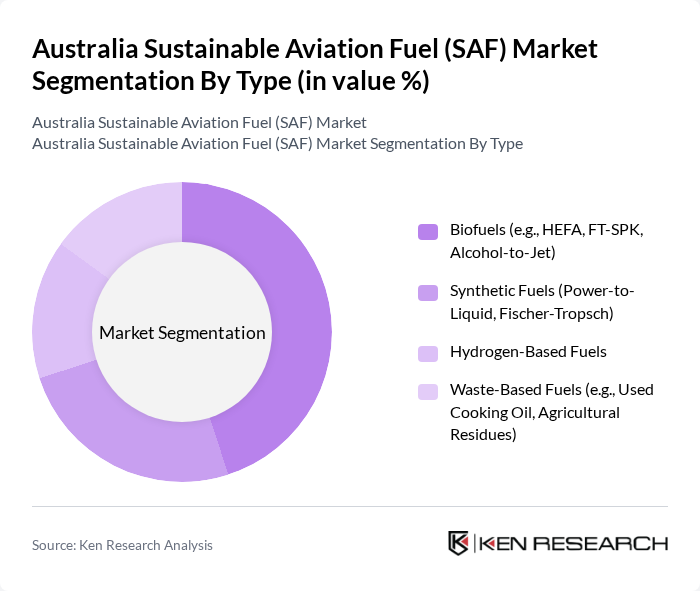
The biofuels segment leads the market, supported by the availability of feedstocks such as used cooking oil and agricultural residues, and by advancements in production technology. Airlines prefer biofuels for their ability to reduce greenhouse gas emissions and their drop-in compatibility with current aviation infrastructure. Ongoing research and investment are further enhancing the efficiency and cost-competitiveness of biofuels, making them the preferred option for airlines aiming to achieve sustainability targets .
By End-User:End-user segments include commercial airlines, cargo airlines, private aviation, and government & military. Each segment has unique fuel requirements and sustainability objectives. Commercial airlines are the largest consumers of SAF, driven by regulatory compliance and corporate sustainability commitments. Cargo airlines are increasingly adopting SAF as supply chains and logistics operators prioritize emissions reduction. Private aviation and government/military sectors are also incorporating SAF, though at a smaller scale .
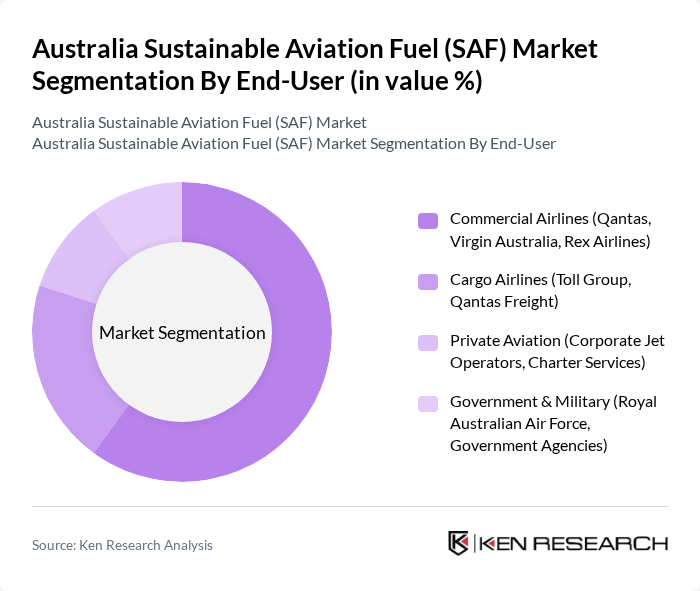
Commercial airlines are the primary end-users of sustainable aviation fuel, motivated by sustainability targets and regulatory requirements to reduce carbon emissions. Leading airlines such as Qantas and Virgin Australia have made significant investments in SAF procurement and partnerships. The cargo airline segment is expanding as logistics providers recognize the importance of decarbonizing their operations. Private aviation and government/military use of SAF is growing, supported by pilot programs and public sector commitments .
Australia Sustainable Aviation Fuel (SAF) Market Competitive Landscape
The Australia Sustainable Aviation Fuel (SAF) Market is characterized by a dynamic mix of regional and international players. Leading participants such as Qantas Airways Limited, Virgin Australia Airlines Pty Ltd, Rex Airlines Pty Ltd, Shell Australia Pty Ltd, BP Australia Pty Ltd, Ampol Limited, Viva Energy Australia Pty Ltd, LanzaJet Inc., Gevo, Inc., World Energy, LLC, Neste Oyj, Renewable Energy Group, Inc., Velocys plc, Aemetis, Inc., Licella Holdings Ltd contribute to innovation, geographic expansion, and service delivery in this space.
Australia Sustainable Aviation Fuel (SAF) Market Industry Analysis
Growth Drivers
- Increasing Environmental Regulations:Australia has set ambitious emission reduction targets, aiming for a 26-28% reduction by 2030 compared to 2005 levels. The government is enforcing stricter regulations on aviation emissions, which has led to a surge in demand for Sustainable Aviation Fuel (SAF). In future, the Australian government plans to allocate AUD 50 million to support SAF initiatives, fostering a regulatory environment that encourages the adoption of cleaner fuels in the aviation sector.
- Rising Demand for Low-Carbon Solutions:The Australian aviation sector is projected to consume approximately 6 to 7 billion liters of jet fuel annually, with a significant portion expected to transition to low-carbon alternatives. This shift is driven by both consumer preferences and corporate sustainability commitments. Major airlines, including Qantas and Virgin Australia, are investing in SAF, with Qantas aiming for 10% of its fuel to be SAF in future, reflecting a growing market for low-carbon solutions.
- Technological Advancements in Fuel Production:Innovations in SAF production technologies, such as the development of advanced biofuels and synthetic fuels, are enhancing production efficiency. In future, Australia is expected to see a 15% increase in SAF production capacity due to new facilities and partnerships. Companies like Bioenergy Australia are leading initiatives to improve feedstock conversion rates, making SAF more viable and accessible for the aviation industry, thus driving market growth.
Market Challenges
- High Production Costs:The production cost of SAF remains a significant barrier, averaging AUD 2.50 to AUD 3.00 per liter, compared to conventional jet fuel priced around AUD 1.20 per liter in future. This price disparity poses challenges for airlines looking to adopt SAF, as they face pressure to maintain competitive ticket prices. Without substantial subsidies or incentives, the high costs could hinder widespread SAF adoption in the aviation sector.
- Limited Infrastructure for Distribution:The current infrastructure for SAF distribution in Australia is underdeveloped, with only a few airports equipped to handle SAF. In future, only 5 out of 30 major airports are expected to have SAF supply chains in place. This lack of infrastructure limits the availability of SAF for airlines, making it difficult for them to integrate SAF into their operations and meet sustainability targets effectively.
Australia Sustainable Aviation Fuel (SAF) Market Future Outlook
The future of the Australia Sustainable Aviation Fuel market appears promising, driven by increasing investments in technology and infrastructure. As airlines commit to sustainability goals, the demand for SAF is expected to rise significantly. By future, the Australian government aims to have established a comprehensive SAF supply chain, enhancing accessibility. Additionally, collaboration among stakeholders, including airlines, fuel producers, and government bodies, will be crucial in overcoming existing challenges and fostering a robust SAF ecosystem in the aviation sector.
Market Opportunities
- Expansion of Airport Infrastructure:The Australian government plans to invest AUD 100 million in airport infrastructure upgrades by future, facilitating SAF distribution. This investment will enable more airports to support SAF operations, increasing its availability and encouraging airlines to adopt cleaner fuels, ultimately driving market growth.
- Partnerships with Airlines:Collaborations between SAF producers and airlines are expected to flourish, with initiatives like Qantas' partnership with biofuel producers. These partnerships can lead to innovative fuel sourcing strategies, enhancing SAF supply and reducing costs, thereby creating a more sustainable aviation sector in Australia.
Scope of the Report
| Segment | Sub-Segments |
|---|---|
| By Type | Biofuels (e.g., HEFA, FT-SPK, Alcohol-to-Jet) Synthetic Fuels (Power-to-Liquid, Fischer-Tropsch) Hydrogen-Based Fuels Waste-Based Fuels (e.g., Used Cooking Oil, Agricultural Residues) |
| By End-User | Commercial Airlines (Qantas, Virgin Australia, Rex Airlines) Cargo Airlines (Toll Group, Qantas Freight) Private Aviation (Corporate Jet Operators, Charter Services) Government & Military (Royal Australian Air Force, Government Agencies) |
| By Application | Domestic Flights International Flights Charter Services Emergency & Humanitarian Flights |
| By Distribution Channel | Direct Sales (Producer to Airline) Partnerships with Airlines Fuel Suppliers (Viva Energy, Ampol) Airport Refueling Infrastructure |
| By Investment Source | Private Investments (Venture Capital, Corporate) Government Funding (ARENA, CEFC) International Grants (UN, ICAO, IATA) Strategic Joint Ventures |
| By Policy Support | Subsidies Tax Exemptions Renewable Energy Certificates (RECs) Blending Mandates & Quotas |
| By Technology | Fischer-Tropsch Synthesis (FT-SPK) Hydroprocessed Esters and Fatty Acids (HEFA-SPK) Alcohol-to-Jet Technology (ATJ-SPK) Gasification & Pyrolysis |
Key Target Audience
Investors and Venture Capitalist Firms
Government and Regulatory Bodies (e.g., Australian Renewable Energy Agency, Department of Infrastructure, Transport, Regional Development, Communications and the Arts)
Manufacturers and Producers of Sustainable Aviation Fuel
Airline Operators and Aviation Companies
Fuel Suppliers and Distributors
Environmental NGOs and Advocacy Groups
Industry Associations (e.g., Australian Airports Association, Aviation Australia)
Financial Institutions and Banks with Green Investment Portfolios
Players Mentioned in the Report:
Qantas Airways Limited
Virgin Australia Airlines Pty Ltd
Rex Airlines Pty Ltd
Shell Australia Pty Ltd
BP Australia Pty Ltd
Ampol Limited
Viva Energy Australia Pty Ltd
LanzaJet Inc.
Gevo, Inc.
World Energy, LLC
Neste Oyj
Renewable Energy Group, Inc.
Velocys plc
Aemetis, Inc.
Licella Holdings Ltd
Table of Contents
Market Assessment Phase
1. Executive Summary and Approach
2. Australia Sustainable Aviation Fuel (SAF) Market Overview
2.1 Key Insights and Strategic Recommendations
2.2 Australia Sustainable Aviation Fuel (SAF) Market Overview
2.3 Definition and Scope
2.4 Evolution of Market Ecosystem
2.5 Timeline of Key Regulatory Milestones
2.6 Value Chain & Stakeholder Mapping
2.7 Business Cycle Analysis
2.8 Policy & Incentive Landscape
3. Australia Sustainable Aviation Fuel (SAF) Market Analysis
3.1 Growth Drivers
3.1.1 Increasing Environmental Regulations
3.1.2 Rising Demand for Low-Carbon Solutions
3.1.3 Technological Advancements in Fuel Production
3.1.4 Support from Government Initiatives
3.2 Market Challenges
3.2.1 High Production Costs
3.2.2 Limited Infrastructure for Distribution
3.2.3 Competition from Conventional Fuels
3.2.4 Regulatory Compliance Complexity
3.3 Market Opportunities
3.3.1 Expansion of Airport Infrastructure
3.3.2 Partnerships with Airlines
3.3.3 Investment in Research and Development
3.3.4 Growing Consumer Awareness
3.4 Market Trends
3.4.1 Shift Towards Renewable Energy Sources
3.4.2 Increased Collaboration Among Stakeholders
3.4.3 Adoption of Circular Economy Principles
3.4.4 Focus on Carbon Offsetting Programs
3.5 Government Regulation
3.5.1 Emission Reduction Targets
3.5.2 SAF Certification Standards
3.5.3 Tax Incentives for SAF Production
3.5.4 International Agreements on Aviation Emissions
4. SWOT Analysis
5. Stakeholder Analysis
6. Porter's Five Forces Analysis
7. Australia Sustainable Aviation Fuel (SAF) Market Market Size, 2019-2024
7.1 By Value
7.2 By Volume
7.3 By Average Selling Price
8. Australia Sustainable Aviation Fuel (SAF) Market Segmentation
8.1 By Type
8.1.1 Biofuels (e.g., HEFA, FT-SPK, Alcohol-to-Jet)
8.1.2 Synthetic Fuels (Power-to-Liquid, Fischer-Tropsch)
8.1.3 Hydrogen-Based Fuels
8.1.4 Waste-Based Fuels (e.g., Used Cooking Oil, Agricultural Residues)
8.2 By End-User
8.2.1 Commercial Airlines (Qantas, Virgin Australia, Rex Airlines)
8.2.2 Cargo Airlines (Toll Group, Qantas Freight)
8.2.3 Private Aviation (Corporate Jet Operators, Charter Services)
8.2.4 Government & Military (Royal Australian Air Force, Government Agencies)
8.3 By Application
8.3.1 Domestic Flights
8.3.2 International Flights
8.3.3 Charter Services
8.3.4 Emergency & Humanitarian Flights
8.4 By Distribution Channel
8.4.1 Direct Sales (Producer to Airline)
8.4.2 Partnerships with Airlines
8.4.3 Fuel Suppliers (Viva Energy, Ampol)
8.4.4 Airport Refueling Infrastructure
8.5 By Investment Source
8.5.1 Private Investments (Venture Capital, Corporate)
8.5.2 Government Funding (ARENA, CEFC)
8.5.3 International Grants (UN, ICAO, IATA)
8.5.4 Strategic Joint Ventures
8.6 By Policy Support
8.6.1 Subsidies
8.6.2 Tax Exemptions
8.6.3 Renewable Energy Certificates (RECs)
8.6.4 Blending Mandates & Quotas
8.7 By Technology
8.7.1 Fischer-Tropsch Synthesis (FT-SPK)
8.7.2 Hydroprocessed Esters and Fatty Acids (HEFA-SPK)
8.7.3 Alcohol-to-Jet Technology (ATJ-SPK)
8.7.4 Gasification & Pyrolysis
9. Australia Sustainable Aviation Fuel (SAF) Market Competitive Analysis
9.1 Market Share of Key Players
9.2 Cross Comparison of Key Players
9.2.1 Company Name
9.2.2 Group Size (Large, Medium, or Small as per industry convention)
9.2.3 Revenue Growth Rate (Year-on-Year %)
9.2.4 Market Penetration Rate (SAF volume supplied, % of total jet fuel market)
9.2.5 Customer Retention Rate (Repeat contracts, partnership renewals)
9.2.6 Pricing Strategy (Premium vs. parity to conventional jet fuel)
9.2.7 Production Capacity Utilization (Actual vs. installed SAF capacity)
9.2.8 Sustainability Index (Lifecycle GHG reduction, feedstock traceability)
9.2.9 Innovation Rate (Patents filed, new SAF pathways commercialized)
9.2.10 Operational Efficiency (Yield per tonne feedstock, supply chain reliability)
9.3 SWOT Analysis of Top Players
9.4 Pricing Analysis
9.5 Detailed Profile of Major Companies
9.5.1 Qantas Airways Limited
9.5.2 Virgin Australia Airlines Pty Ltd
9.5.3 Rex Airlines Pty Ltd
9.5.4 Shell Australia Pty Ltd
9.5.5 BP Australia Pty Ltd
9.5.6 Ampol Limited
9.5.7 Viva Energy Australia Pty Ltd
9.5.8 LanzaJet Inc.
9.5.9 Gevo, Inc.
9.5.10 World Energy, LLC
9.5.11 Neste Oyj
9.5.12 Renewable Energy Group, Inc.
9.5.13 Velocys plc
9.5.14 Aemetis, Inc.
9.5.15 Licella Holdings Ltd
10. Australia Sustainable Aviation Fuel (SAF) Market End-User Analysis
10.1 Procurement Behavior of Key Ministries
10.1.1 Government Procurement Policies
10.1.2 Budget Allocations for Sustainable Fuels
10.1.3 Collaboration with Private Sector
10.2 Corporate Spend on Infrastructure & Energy
10.2.1 Investment in SAF Infrastructure
10.2.2 Energy Transition Budgets
10.2.3 Partnerships for Infrastructure Development
10.3 Pain Point Analysis by End-User Category
10.3.1 Cost of Transitioning to SAF
10.3.2 Availability of SAF
10.3.3 Regulatory Compliance Challenges
10.4 User Readiness for Adoption
10.4.1 Awareness of SAF Benefits
10.4.2 Training and Education Needs
10.4.3 Infrastructure Readiness
10.5 Post-Deployment ROI and Use Case Expansion
10.5.1 Measurement of Environmental Impact
10.5.2 Financial Performance Metrics
10.5.3 Opportunities for Scaling Use Cases
11. Australia Sustainable Aviation Fuel (SAF) Market Future Size, 2025-2030
11.1 By Value
11.2 By Volume
11.3 By Average Selling Price
Go-To-Market Strategy Phase
1. Whitespace Analysis + Business Model Canvas
1.1 Market Gaps Identification
1.2 Business Model Development
2. Marketing and Positioning Recommendations
2.1 Branding Strategies
2.2 Product USPs
3. Distribution Plan
3.1 Urban Retail vs Rural NGO Tie-ups
4. Channel & Pricing Gaps
4.1 Underserved Routes
4.2 Pricing Bands
5. Unmet Demand & Latent Needs
5.1 Category Gaps
5.2 Consumer Segments
6. Customer Relationship
6.1 Loyalty Programs
6.2 After-Sales Service
7. Value Proposition
7.1 Sustainability
7.2 Integrated Supply Chains
8. Key Activities
8.1 Regulatory Compliance
8.2 Branding
8.3 Distribution Setup
9. Entry Strategy Evaluation
9.1 Domestic Market Entry Strategy
9.1.1 Product Mix
9.1.2 Pricing Band
9.1.3 Packaging
9.2 Export Entry Strategy
9.2.1 Target Countries
9.2.2 Compliance Roadmap
10. Entry Mode Assessment
10.1 JV
10.2 Greenfield
10.3 M&A
10.4 Distributor Model
11. Capital and Timeline Estimation
11.1 Capital Requirements
11.2 Timelines
12. Control vs Risk Trade-Off
12.1 Ownership vs Partnerships
13. Profitability Outlook
13.1 Breakeven Analysis
13.2 Long-Term Sustainability
14. Potential Partner List
14.1 Distributors
14.2 JVs
14.3 Acquisition Targets
15. Execution Roadmap
15.1 Phased Plan for Market Entry
15.1.1 Market Setup
15.1.2 Market Entry
15.1.3 Growth Acceleration
15.1.4 Scale & Stabilize
15.2 Key Activities and Milestones
15.2.1 Activity Planning
15.2.2 Milestone Tracking
Research Methodology
Phase 1: Approach1
Desk Research
- Analysis of government reports on renewable energy and aviation policies in Australia
- Review of industry publications and white papers on sustainable aviation fuel (SAF) trends
- Examination of market data from aviation authorities and environmental agencies
Primary Research
- Interviews with key stakeholders in the aviation sector, including airline executives and fuel suppliers
- Surveys targeting sustainability officers in major Australian airlines and airports
- Field interviews with researchers and academics specializing in biofuels and aviation technology
Validation & Triangulation
- Cross-validation of findings through multiple data sources, including trade publications and government statistics
- Triangulation of insights from interviews with quantitative data from market reports
- Sanity checks conducted through expert panel discussions and feedback sessions
Phase 2: Market Size Estimation1
Top-down Assessment
- Estimation of the total addressable market for SAF based on national aviation fuel consumption data
- Segmentation of the market by aircraft type and fuel usage patterns
- Incorporation of government incentives and targets for SAF adoption in aviation
Bottom-up Modeling
- Collection of data on production capacities and operational costs from SAF producers
- Analysis of pricing models for SAF compared to traditional jet fuels
- Volume estimates based on projected growth rates in air travel and SAF adoption
Forecasting & Scenario Analysis
- Development of forecasting models incorporating factors such as carbon pricing and regulatory changes
- Scenario analysis based on varying levels of SAF adoption and technological advancements
- Projections for market growth through 2030 under different policy and economic conditions
Phase 3: CATI Sample Composition1
| Scope Item/Segment | Sample Size | Target Respondent Profiles |
|---|---|---|
| Airline Fuel Procurement | 90 | Fuel Managers, Procurement Officers |
| Aviation Regulatory Bodies | 45 | Policy Makers, Regulatory Analysts |
| SAF Production Facilities | 60 | Plant Managers, Operations Directors |
| Environmental NGOs | 40 | Sustainability Advocates, Research Analysts |
| Airports and Ground Services | 55 | Airport Operations Managers, Ground Service Providers |
Frequently Asked Questions
What is the current value of the Australia Sustainable Aviation Fuel (SAF) Market?
The Australia Sustainable Aviation Fuel (SAF) Market is valued at approximately USD 1.1 billion, driven by government initiatives, consumer demand for eco-friendly travel, and investments in SAF production technologies and infrastructure.
What are the main types of sustainable aviation fuels available in Australia?
Which cities in Australia are leading in SAF market activity?
What government initiatives support the development of SAF in Australia?
Other Regional/Country Reports
Indonesia Sustainable Aviation Fuel (SAF) Market
Malaysia Sustainable Aviation Fuel (SAF) Market
KSA Sustainable Aviation Fuel (SAF) Market
APAC Sustainable Aviation Fuel (SAF) Market
SEA Sustainable Aviation Fuel (SAF) Market
Other Adjacent Reports
South Africa Synthetic Fuels Market
KSA Hydrogen-Based Fuels Market
Indonesia Waste-Based Fuels Market
India Aviation Infrastructure MarketOman Commercial Airlines Market
Qatar Cargo Airlines Market
Kuwait Private Aviation Market
North America Renewable Energy Market Outlook to 2030: Size, Share, Growth and TrendsBelgium Carbon Emission Reduction Market
Why Buy From Us?

What makes us stand out is that our consultants follow Robust, Refine and Result (RRR) methodology. Robust for clear definitions, approaches and sanity checking, Refine for differentiating respondents' facts and opinions, and Result for presenting data with story.

We have set a benchmark in the industry by offering our clients with syndicated and customized market research reports featuring coverage of entire market as well as meticulous research and analyst insights.

While we don't replace traditional research, we flip the method upside down. Our dual approach of Top Bottom & Bottom Top ensures quality deliverable by not just verifying company fundamentals but also looking at the sector and macroeconomic factors.

With one step in the future, our research team constantly tries to show you the bigger picture. We help with some of the tough questions you may encounter along the way: How is the industry positioned? Best marketing channel? KPI's of competitors? By aligning every element, we help maximize success.

Our report gives you instant access to the answers and sources that other companies might choose to hide. We elaborate each steps of research methodology we have used and showcase you the sample size to earn your trust.

If you need any support, we are here! We pride ourselves on universe strength, data quality, and quick, friendly, and professional service.