About the Report
Base Year 2024Bahrain Aerostructures Market Overview
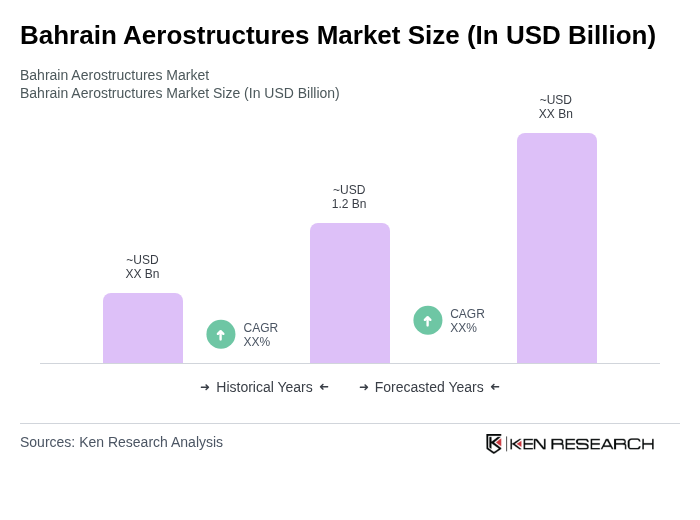
- The Bahrain Aerostructures Market is valued at USD 1.2 billion, based on a five-year historical analysis. This growth is primarily driven by the increasing demand for commercial and military aircraft, coupled with the expansion of the aerospace manufacturing sector in the region. The market is also supported by investments in infrastructure and technology, enhancing the capabilities of local manufacturers.
- Key players in this market include Bahrain Airport Company, Gulf Air, and various international aerospace firms. Bahrain's strategic location as a logistics hub and its commitment to developing a robust aerospace ecosystem contribute to its dominance in the aerostructures market. The presence of skilled labor and favorable government policies further bolster its competitive edge.
- In 2023, the Bahraini government implemented a new regulation aimed at enhancing the aerospace manufacturing sector. This regulation includes tax incentives for companies investing in research and development, as well as grants for workforce training programs. The initiative is designed to attract foreign investment and promote local production capabilities in the aerostructures industry.
Bahrain Aerostructures Market Segmentation
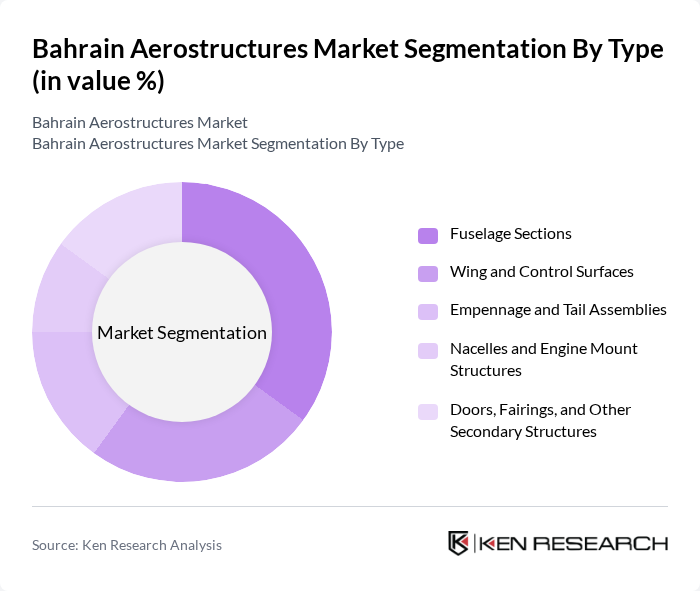
By Type:The aerostructures market can be segmented into various types, including fuselage sections, wing and control surfaces, empennage and tail assemblies, nacelles and engine mount structures, and doors, fairings, and other secondary structures. Among these, fuselage sections are currently dominating the market due to their critical role in aircraft design and safety. The increasing production rates of commercial aircraft have led to a higher demand for fuselage components, which are essential for structural integrity and aerodynamics.
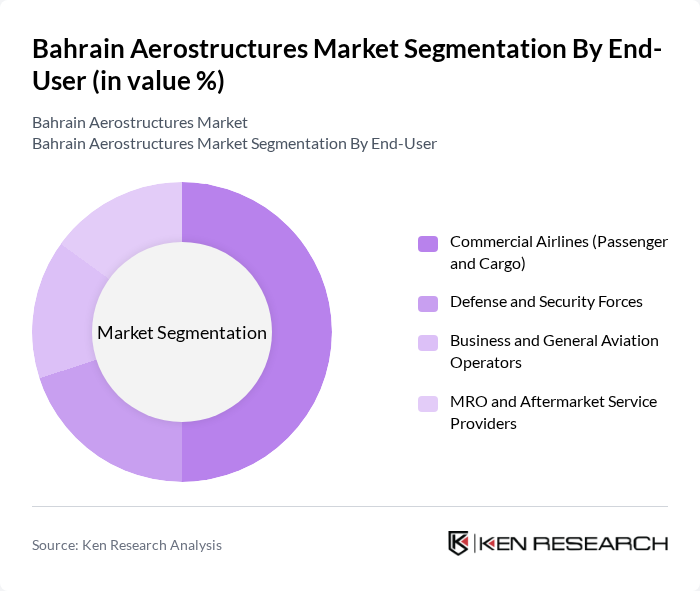
By End-User:The end-user segmentation includes commercial airlines (passenger and cargo), defense and security forces, business and general aviation operators, and MRO and aftermarket service providers. The commercial airlines segment is leading the market, driven by the resurgence of air travel post-pandemic and the need for fleet modernization. Airlines are increasingly investing in new aircraft to enhance operational efficiency and meet environmental standards, thus boosting demand for aerostructures.
Bahrain Aerostructures Market Competitive Landscape
The Bahrain Aerostructures Market is characterized by a dynamic mix of regional and international players. Leading participants such as Bahrain Airport Company (BAC), Bahrain Airport Services (BAS), Gulf Air, Arab Shipbuilding and Repair Yard (ASRY), Roboze S.p.A., Lockheed Martin Corporation, Airbus SE, The Boeing Company, Spirit AeroSystems Holdings, Inc., Leonardo S.p.A., Rolls-Royce plc, Safran S.A., Raytheon Technologies Corporation, Northrop Grumman Corporation, Embraer S.A. contribute to innovation, geographic expansion, and service delivery in this space.
Bahrain Aerostructures Market Industry Analysis
Growth Drivers
- Increasing Demand for Lightweight Materials:The global aerospace industry is projected to require over 1.5 million tons of lightweight materials in the future, driven by the need for fuel efficiency and reduced emissions. Bahrain's aerostructures sector is aligning with this trend, as lightweight composites and alloys are increasingly utilized in aircraft manufacturing. The Bahrain Economic Development Board reported a 20% increase in local production of these materials, reflecting a robust response to international demand and sustainability goals.
- Expansion of the Aviation Sector in Bahrain:Bahrain's aviation sector is expected to grow significantly, with passenger traffic projected to reach 15 million in the future, up from 12 million previously. This growth is supported by the expansion of Bahrain International Airport and the establishment of new airlines. The government’s commitment to enhancing air connectivity is expected to stimulate demand for aerostructures, creating opportunities for local manufacturers to supply components for both commercial and military aircraft.
- Government Investments in Aerospace Infrastructure:The Bahraini government has allocated approximately $1 billion for aerospace infrastructure development in the future. This investment includes the construction of new facilities and upgrades to existing ones, aimed at attracting foreign direct investment. The Bahrain Economic Development Board has reported that these initiatives are expected to create over 5,000 jobs in the aerospace sector, further driving the demand for local aerostructures manufacturing capabilities.
Market Challenges
- High Initial Capital Investment:Establishing aerostructures manufacturing facilities in Bahrain requires substantial initial capital, estimated at around $500 million for a mid-sized operation. This high barrier to entry can deter potential investors and limit the growth of local companies. Additionally, the need for advanced machinery and technology further escalates costs, making it challenging for new entrants to compete effectively in the market.
- Limited Skilled Workforce:The aerospace sector in Bahrain faces a shortage of skilled labor, with only 2,000 professionals currently employed in the industry. This gap is projected to widen as the sector grows, with an estimated need for an additional 1,500 skilled workers in the future. The lack of specialized training programs and educational institutions focused on aerospace engineering exacerbates this challenge, hindering the sector's ability to meet increasing demand.
Bahrain Aerostructures Market Future Outlook
The Bahrain aerostructures market is poised for significant growth, driven by increasing demand for lightweight materials and government investments in aerospace infrastructure. As the aviation sector expands, local manufacturers are likely to benefit from enhanced production capabilities and partnerships with international firms. Furthermore, the focus on sustainable aviation practices and technological advancements in manufacturing processes will shape the future landscape, fostering innovation and competitiveness in the market.
Market Opportunities
- Growth in MRO Services:The Maintenance, Repair, and Overhaul (MRO) market in Bahrain is expected to reach $300 million in the future, driven by the increasing number of aircraft in operation. This growth presents a significant opportunity for local aerostructures manufacturers to provide essential components and services, enhancing their market presence and profitability.
- Partnerships with International Aerospace Firms:Collaborations with global aerospace companies can facilitate technology transfer and access to advanced manufacturing techniques. Such partnerships are projected to increase local production capabilities by 30% in the future, enabling Bahrain to position itself as a competitive player in the regional aerospace supply chain.
Scope of the Report
| Segment | Sub-Segments |
|---|---|
| By Type | Fuselage Sections Wing and Control Surfaces Empennage and Tail Assemblies Nacelles and Engine Mount Structures Doors, Fairings, and Other Secondary Structures |
| By End-User | Commercial Airlines (Passenger and Cargo) Defense and Security Forces Business and General Aviation Operators MRO and Aftermarket Service Providers |
| By Material | Aluminum and Aluminum-Lithium Alloys Carbon Fiber Reinforced Composites Titanium and High-Temperature Alloys Steel and Other Metallic Alloys Advanced Polymers and Hybrid Materials |
| By Manufacturing Process | Additive Manufacturing and Rapid Prototyping Machining and Subtractive Processes Forming, Fabrication, and Assembly Surface Treatment and Finishing |
| By Application | Fixed-Wing Commercial Aircraft Military Fighter and Transport Aircraft Helicopters and Rotary-Wing Platforms UAVs and Drones Space and Emerging Aerial Platforms |
| By Supply Chain Stage | Raw Material and Semi-Finished Product Suppliers Component and Sub-Assembly Manufacturers Final Assembly, Integration, and Testing MRO, Upgrade, and Retrofit Services |
| By Policy Support | Industrial and Investment Incentives Tax and Customs Relief Schemes R&D and Innovation Grants Workforce Development and Training Programs |
Key Target Audience
Investors and Venture Capitalist Firms
Government and Regulatory Bodies (e.g., Bahrain Civil Aviation Authority, Ministry of Transportation and Telecommunications)
Aerospace Manufacturers and Producers
Suppliers and Component Manufacturers
Aerospace Engineering Firms
Industry Associations (e.g., Bahrain Aerospace Association)
Financial Institutions and Banks
Logistics and Supply Chain Companies
Players Mentioned in the Report:
Bahrain Airport Company (BAC)
Bahrain Airport Services (BAS)
Gulf Air
Arab Shipbuilding and Repair Yard (ASRY)
Roboze S.p.A.
Lockheed Martin Corporation
Airbus SE
The Boeing Company
Spirit AeroSystems Holdings, Inc.
Leonardo S.p.A.
Rolls-Royce plc
Safran S.A.
Raytheon Technologies Corporation
Northrop Grumman Corporation
Embraer S.A.
Table of Contents
Market Assessment Phase
1. Executive Summary and Approach
2. Bahrain Aerostructures Market Overview
2.1 Key Insights and Strategic Recommendations
2.2 Bahrain Aerostructures Market Overview
2.3 Definition and Scope
2.4 Evolution of Market Ecosystem
2.5 Timeline of Key Regulatory Milestones
2.6 Value Chain & Stakeholder Mapping
2.7 Business Cycle Analysis
2.8 Policy & Incentive Landscape
3. Bahrain Aerostructures Market Analysis
3.1 Growth Drivers
3.1.1 Increasing demand for lightweight materials
3.1.2 Expansion of the aviation sector in Bahrain
3.1.3 Government investments in aerospace infrastructure
3.1.4 Technological advancements in manufacturing processes
3.2 Market Challenges
3.2.1 High initial capital investment
3.2.2 Limited skilled workforce
3.2.3 Regulatory compliance complexities
3.2.4 Global supply chain disruptions
3.3 Market Opportunities
3.3.1 Growth in MRO (Maintenance, Repair, and Overhaul) services
3.3.2 Partnerships with international aerospace firms
3.3.3 Development of new aerostructures for emerging aircraft
3.3.4 Investment in R&D for innovative materials
3.4 Market Trends
3.4.1 Shift towards sustainable aviation practices
3.4.2 Increasing automation in manufacturing
3.4.3 Adoption of digital technologies in design and production
3.4.4 Focus on enhancing supply chain resilience
3.5 Government Regulation
3.5.1 Compliance with international aviation safety standards
3.5.2 Incentives for local manufacturing
3.5.3 Environmental regulations for emissions
3.5.4 Export control regulations on aerospace technologies
4. SWOT Analysis
5. Stakeholder Analysis
6. Porter's Five Forces Analysis
7. Bahrain Aerostructures Market Market Size, 2019-2024
7.1 By Value
7.2 By Volume
7.3 By Average Selling Price
8. Bahrain Aerostructures Market Segmentation
8.1 By Type
8.1.1 Fuselage Sections
8.1.2 Wing and Control Surfaces
8.1.3 Empennage and Tail Assemblies
8.1.4 Nacelles and Engine Mount Structures
8.1.5 Doors, Fairings, and Other Secondary Structures
8.2 By End-User
8.2.1 Commercial Airlines (Passenger and Cargo)
8.2.2 Defense and Security Forces
8.2.3 Business and General Aviation Operators
8.2.4 MRO and Aftermarket Service Providers
8.3 By Material
8.3.1 Aluminum and Aluminum-Lithium Alloys
8.3.2 Carbon Fiber Reinforced Composites
8.3.3 Titanium and High-Temperature Alloys
8.3.4 Steel and Other Metallic Alloys
8.3.5 Advanced Polymers and Hybrid Materials
8.4 By Manufacturing Process
8.4.1 Additive Manufacturing and Rapid Prototyping
8.4.2 Machining and Subtractive Processes
8.4.3 Forming, Fabrication, and Assembly
8.4.4 Surface Treatment and Finishing
8.5 By Application
8.5.1 Fixed-Wing Commercial Aircraft
8.5.2 Military Fighter and Transport Aircraft
8.5.3 Helicopters and Rotary-Wing Platforms
8.5.4 UAVs and Drones
8.5.5 Space and Emerging Aerial Platforms
8.6 By Supply Chain Stage
8.6.1 Raw Material and Semi-Finished Product Suppliers
8.6.2 Component and Sub-Assembly Manufacturers
8.6.3 Final Assembly, Integration, and Testing
8.6.4 MRO, Upgrade, and Retrofit Services
8.7 By Policy Support
8.7.1 Industrial and Investment Incentives
8.7.2 Tax and Customs Relief Schemes
8.7.3 R&D and Innovation Grants
8.7.4 Workforce Development and Training Programs
9. Bahrain Aerostructures Market Competitive Analysis
9.1 Market Share of Key Players
9.2 Cross Comparison of Key Players
9.2.1 Company Name
9.2.2 Global Group Size (Large, Medium, or Small)
9.2.3 Bahrain Aerostructures Revenue (USD Million)
9.2.4 Bahrain Revenue Growth Rate (CAGR, %)
9.2.5 Share of Bahrain in MENA Aerostructures Revenue (%)
9.2.6 Order Backlog and Program Exposure (Number of Active Aircraft Platforms)
9.2.7 Installed Production Capacity in Bahrain (Units or Tons per Year)
9.2.8 Capacity Utilization Rate (%)
9.2.9 R&D Intensity (% of Revenue Spent on R&D)
9.2.10 Localization Ratio (Share of Local Content in Bahrain, %)
9.2.11 On-Time Delivery Performance (%)
9.2.12 Key Bahrain Customers (Airlines, Defense, MRO)
9.3 SWOT Analysis of Top Players
9.4 Pricing Analysis
9.5 Detailed Profile of Major Companies
9.5.1 Bahrain Airport Company (BAC)
9.5.2 Bahrain Airport Services (BAS)
9.5.3 Gulf Air
9.5.4 Arab Shipbuilding and Repair Yard (ASRY)
9.5.5 Roboze S.p.A.
9.5.6 Lockheed Martin Corporation
9.5.7 Airbus SE
9.5.8 The Boeing Company
9.5.9 Spirit AeroSystems Holdings, Inc.
9.5.10 Leonardo S.p.A.
9.5.11 Rolls-Royce plc
9.5.12 Safran S.A.
9.5.13 Raytheon Technologies Corporation
9.5.14 Northrop Grumman Corporation
9.5.15 Embraer S.A.
10. Bahrain Aerostructures Market End-User Analysis
10.1 Procurement Behavior of Key Ministries
10.1.1 Ministry of Transportation
10.1.2 Ministry of Defense
10.1.3 Ministry of Industry and Commerce
10.1.4 Others
10.2 Corporate Spend on Infrastructure & Energy
10.2.1 Investment in Aviation Infrastructure
10.2.2 Spending on Maintenance and Upgrades
10.2.3 Budget Allocation for R&D
10.2.4 Others
10.3 Pain Point Analysis by End-User Category
10.3.1 Cost Management
10.3.2 Quality Assurance
10.3.3 Timely Delivery
10.3.4 Compliance with Regulations
10.4 User Readiness for Adoption
10.4.1 Awareness of New Technologies
10.4.2 Training and Skill Development
10.4.3 Financial Readiness
10.4.4 Others
10.5 Post-Deployment ROI and Use Case Expansion
10.5.1 Measurement of ROI
10.5.2 Expansion into New Applications
10.5.3 Long-term Maintenance Considerations
10.5.4 Others
11. Bahrain Aerostructures Market Future Size, 2025-2030
11.1 By Value
11.2 By Volume
11.3 By Average Selling Price
Go-To-Market Strategy Phase
1. Whitespace Analysis + Business Model Canvas
1.1 Market Gaps Identification
1.2 Business Model Development
2. Marketing and Positioning Recommendations
2.1 Branding Strategies
2.2 Product USPs
3. Distribution Plan
3.1 Urban Retail Strategies
3.2 Rural NGO Tie-ups
4. Channel & Pricing Gaps
4.1 Underserved Routes
4.2 Pricing Bands
5. Unmet Demand & Latent Needs
5.1 Category Gaps
5.2 Consumer Segments
6. Customer Relationship
6.1 Loyalty Programs
6.2 After-sales Service
7. Value Proposition
7.1 Sustainability Initiatives
7.2 Integrated Supply Chains
8. Key Activities
8.1 Regulatory Compliance
8.2 Branding Efforts
8.3 Distribution Setup
9. Entry Strategy Evaluation
9.1 Domestic Market Entry Strategy
9.1.1 Product Mix
9.1.2 Pricing Band
9.1.3 Packaging
9.2 Export Entry Strategy
9.2.1 Target Countries
9.2.2 Compliance Roadmap
10. Entry Mode Assessment
10.1 Joint Ventures
10.2 Greenfield Investments
10.3 Mergers & Acquisitions
10.4 Distributor Model
11. Capital and Timeline Estimation
11.1 Capital Requirements
11.2 Timelines
12. Control vs Risk Trade-Off
12.1 Ownership vs Partnerships
13. Profitability Outlook
13.1 Breakeven Analysis
13.2 Long-term Sustainability
14. Potential Partner List
14.1 Distributors
14.2 Joint Ventures
14.3 Acquisition Targets
15. Execution Roadmap
15.1 Phased Plan for Market Entry
15.1.1 Market Setup
15.1.2 Market Entry
15.1.3 Growth Acceleration
15.1.4 Scale & Stabilize
15.2 Key Activities and Milestones
15.2.1 Milestone Planning
15.2.2 Activity Tracking
Research Methodology
Phase 1: Approach1
Desk Research
- Industry reports from aviation authorities and trade associations in Bahrain
- Market analysis publications focusing on aerostructures and aerospace manufacturing
- Government publications detailing infrastructure developments and investments in the aerospace sector
Primary Research
- Interviews with executives from leading aerostructures manufacturers in Bahrain
- Surveys targeting engineers and project managers involved in aerospace projects
- Field interviews with regulatory bodies overseeing aerospace manufacturing standards
Validation & Triangulation
- Cross-validation of data through multiple industry reports and expert opinions
- Triangulation of findings from primary interviews with secondary data sources
- Sanity checks conducted through expert panel discussions and feedback sessions
Phase 2: Market Size Estimation1
Top-down Assessment
- Analysis of Bahrain's overall aerospace market size and growth trends
- Segmentation of the aerostructures market by aircraft type and manufacturing processes
- Incorporation of government initiatives and foreign investments in the aerospace sector
Bottom-up Modeling
- Estimation of production volumes based on existing aerostructures facilities in Bahrain
- Cost analysis derived from operational expenses of key manufacturers
- Volume x cost calculations for various aerostructures components and assemblies
Forecasting & Scenario Analysis
- Multi-factor regression analysis considering global aerospace demand and local production capabilities
- Scenario modeling based on potential changes in regulatory frameworks and trade agreements
- Development of baseline, optimistic, and pessimistic forecasts through 2030
Phase 3: CATI Sample Composition1
| Scope Item/Segment | Sample Size | Target Respondent Profiles |
|---|---|---|
| Aerostructures Manufacturing | 110 | Production Managers, Operations Directors |
| Aerospace Supply Chain Management | 85 | Supply Chain Analysts, Procurement Managers |
| Regulatory Compliance in Aerospace | 55 | Compliance Officers, Quality Assurance Managers |
| Research & Development in Aerostructures | 65 | R&D Engineers, Product Development Managers |
| Market Trends and Forecasting | 75 | Market Analysts, Business Development Executives |
Frequently Asked Questions
What is the current value of the Bahrain Aerostructures Market?
The Bahrain Aerostructures Market is valued at approximately USD 1.2 billion, reflecting a robust growth trajectory driven by increasing demand for both commercial and military aircraft, as well as advancements in the aerospace manufacturing sector.
Who are the key players in the Bahrain Aerostructures Market?
What factors are driving growth in the Bahrain Aerostructures Market?
What challenges does the Bahrain Aerostructures Market face?
Other Regional/Country Reports
Indonesia Aerostructures Market
Malaysia Aerostructures Market
KSA Aerostructures Market
APAC Aerostructures Market
SEA Aerostructures Market
Other Adjacent Reports
Mexico Aircraft Manufacturing Market
UAE Aerospace Composites MarketIndia Aviation MRO Market Outlook to 2028Thailand Aerospace Materials Market
Global Military Aircraft Market Outlook to 2030Indonesia Commercial Aviation Market
Indonesia Aerospace Engineering Market
Brazil Aircraft Components Market
Kuwait Avionics Systems Market
Brazil Aerospace Supply Chain Market
Why Buy From Us?

What makes us stand out is that our consultants follow Robust, Refine and Result (RRR) methodology. Robust for clear definitions, approaches and sanity checking, Refine for differentiating respondents' facts and opinions, and Result for presenting data with story.

We have set a benchmark in the industry by offering our clients with syndicated and customized market research reports featuring coverage of entire market as well as meticulous research and analyst insights.

While we don't replace traditional research, we flip the method upside down. Our dual approach of Top Bottom & Bottom Top ensures quality deliverable by not just verifying company fundamentals but also looking at the sector and macroeconomic factors.

With one step in the future, our research team constantly tries to show you the bigger picture. We help with some of the tough questions you may encounter along the way: How is the industry positioned? Best marketing channel? KPI's of competitors? By aligning every element, we help maximize success.

Our report gives you instant access to the answers and sources that other companies might choose to hide. We elaborate each steps of research methodology we have used and showcase you the sample size to earn your trust.

If you need any support, we are here! We pride ourselves on universe strength, data quality, and quick, friendly, and professional service.