About the Report
Base Year 2024Bahrain Construction Market Overview
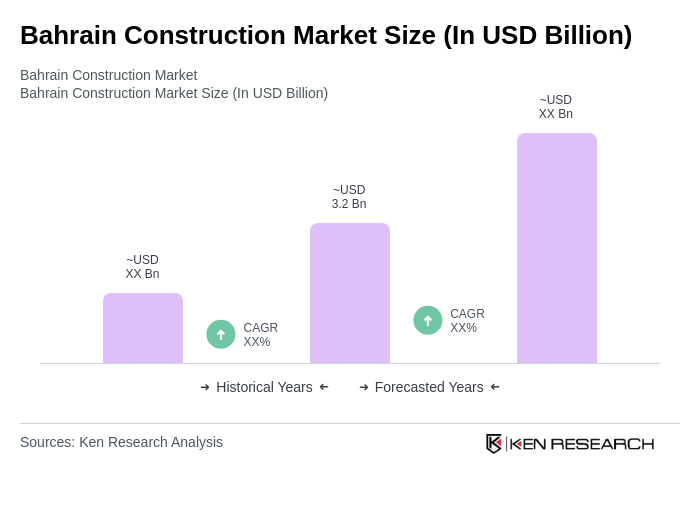
- The Bahrain Construction Market is valued at USD 3.2 billion, based on a five-year historical analysis. This growth is primarily driven by significant investments in infrastructure, residential, and commercial projects, alongside government initiatives aimed at enhancing urban development and sustainability. The market has seen a steady increase in demand for construction services, fueled by population growth and economic diversification efforts.
- Key cities such as Manama and Muharraq dominate the Bahrain Construction Market due to their strategic locations and ongoing urbanization projects. Manama, as the capital, is a hub for commercial activities and government projects, while Muharraq is witnessing rapid development in residential and infrastructure sectors, making them focal points for construction investments.
- In 2023, the Bahraini government advanced permitting reforms and digitalization to streamline the construction permit process through its national eGovernment and Urban Planning platforms; Bahrain ranks competitively on procedures and timelines for construction permits in regional benchmarks, and authorities report faster processing to improve the business environment and attract investment.
Bahrain Construction Market Segmentation
By Type:The construction market in Bahrain can be segmented into various types, including Residential Construction, Commercial Construction, Industrial Construction, Infrastructure (Transport, Utilities, Energy & Water), Institutional (Education, Healthcare, Public Buildings), Oil & Gas and Petrochemicals, and Renovation, Maintenance & Facility Upgrades. Among these, Infrastructure projects are currently dominating the market due to the government's focus on enhancing transportation networks and utilities to support economic growth. The increasing demand for efficient public services and connectivity is driving investments in this segment.

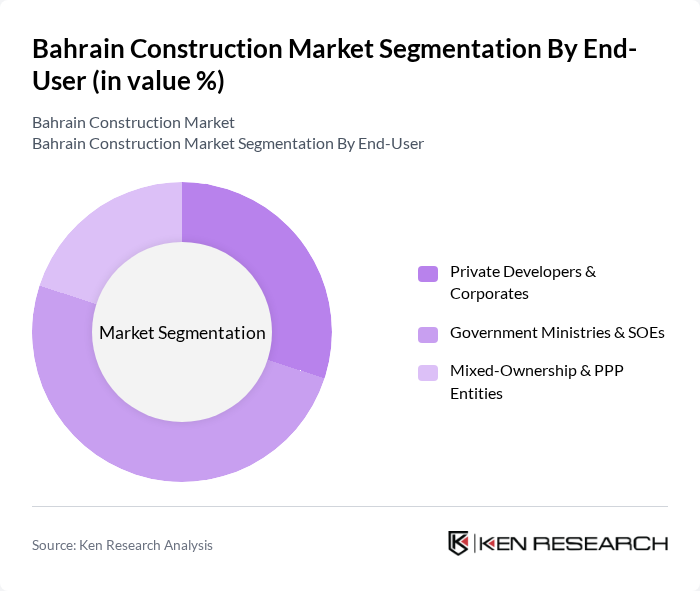
By End-User:The end-user segmentation of the construction market includes Private Developers & Corporates, Government Ministries & SOEs, and Mixed-Ownership & PPP Entities. The Government Ministries & SOEs segment is currently leading the market, driven by substantial public sector investments in infrastructure and social projects. This trend reflects the government's commitment to enhancing public services and facilities, which is crucial for the overall development of the country.
Bahrain Construction Market Competitive Landscape
The Bahrain Construction Market is characterized by a dynamic mix of regional and international players. Leading participants such as Cebarco Bahrain (Cebarco WCT W.L.L.), Nass Corporation B.S.C., Kooheji Contractors, Almoayyed Contracting Group, Ahmed Mansoor Al A'ali Co. B.S.C. (AMA Group), GP Zachariades (Overseas) Ltd., Haji Hassan Group, Mohamed Abdulmohsin Al-Kharafi & Sons (Kharafi National) – Bahrain, Downton Construction Co. W.L.L., Haji Hassan Readymix (Bahrain Ready Mix Concrete Co.), Aradous Contracting & Maintenance, Al Ghanah Group, Ahmed Al Quraishi Contracting (AAQ), International Trading & Contracting Co. (ITCC) – Bahrain, RAMSIS Engineering W.L.L. (RAFCO Group) contribute to innovation, geographic expansion, and service delivery in this space.
Additional validated insights: - Tendering momentum: The value of tenders awarded surged significantly in consecutive years, reflecting strong project pipeline mobilization and supportive public spending. - Policy and investment drivers: Strategic Projects Plan and investments in transport and utilities underpin infrastructure dominance and support broader economic diversification.
Bahrain Construction Market Industry Analysis
Growth Drivers
- Increased Government Spending on Infrastructure:The Bahraini government allocated approximately BHD 1.5 billion (USD 4 billion) for infrastructure projects in future, focusing on transportation and utilities. This investment aims to enhance connectivity and support economic growth. The government’s commitment to infrastructure development is evident in the ongoing construction of the Bahrain Metro, which is projected to cost around BHD 1.2 billion (USD 3.2 billion) and is expected to significantly improve public transport efficiency.
- Rising Population and Urbanization:Bahrain's population is projected to reach 1.7 million by future, driven by both natural growth and immigration. This demographic shift is fueling demand for residential and commercial properties. Urbanization rates are increasing, with over 90% of the population living in urban areas, leading to a surge in housing projects. The government anticipates a need for 50,000 new housing units by future to accommodate this growth, further stimulating the construction sector.
- Foreign Direct Investment in Real Estate:In future, Bahrain is expected to attract around BHD 800 million (USD 2.1 billion) in foreign direct investment (FDI) in the real estate sector. This influx is driven by favorable investment laws and incentives for foreign investors. Notable projects include the development of luxury residential complexes and commercial spaces, which are anticipated to create thousands of jobs and enhance the overall economic landscape, thereby boosting the construction market.
Market Challenges
- Fluctuating Material Costs:The construction industry in Bahrain faces significant challenges due to fluctuating material costs, which have risen by approximately 15% in the past year. Factors such as global supply chain disruptions and increased demand for raw materials contribute to this volatility. These rising costs can lead to project delays and budget overruns, impacting the overall profitability of construction firms and potentially deterring new investments in the sector.
- Skilled Labor Shortages:The construction sector in Bahrain is experiencing a shortage of skilled labor, with estimates indicating a gap of around 20,000 workers by future. This shortage is exacerbated by the rapid pace of construction projects and the need for specialized skills in areas such as project management and engineering. The lack of a robust training infrastructure further complicates the situation, leading to increased labor costs and project delays as firms struggle to find qualified personnel.
Bahrain Construction Market Future Outlook
The future of the Bahrain construction market appears promising, driven by ongoing government initiatives and a focus on sustainable development. The anticipated growth in infrastructure spending, coupled with urbanization trends, is expected to create a robust demand for construction services. Additionally, the integration of technology in construction processes will likely enhance efficiency and safety. As the market evolves, stakeholders must adapt to emerging trends, ensuring they remain competitive and responsive to changing consumer needs and regulatory requirements.
Market Opportunities
- Green Building Initiatives:The Bahraini government is promoting green building initiatives, with an investment of BHD 200 million (USD 530 million) allocated for sustainable construction projects in future. This focus on eco-friendly practices presents opportunities for construction firms to innovate and differentiate themselves in the market, aligning with global sustainability trends and attracting environmentally conscious investors.
- Smart City Developments:Bahrain is investing BHD 300 million (USD 800 million) in smart city projects aimed at enhancing urban living through technology. These developments will create opportunities for construction companies to engage in high-tech infrastructure projects, including smart transportation systems and energy-efficient buildings, positioning them at the forefront of the evolving urban landscape.
Scope of the Report
| Segment | Sub-Segments |
|---|---|
| By Type | Residential Construction Commercial Construction Industrial Construction Infrastructure (Transport, Utilities, Energy & Water) Institutional (Education, Healthcare, Public Buildings) Oil & Gas and Petrochemicals Renovation, Maintenance & Facility Upgrades |
| By End-User | Private Developers & Corporates Government Ministries & SOEs Mixed-Ownership & PPP Entities |
| By Application | Housing (Affordable, Mid-income, Luxury) Commercial & Hospitality (Retail, Offices, Hotels) Transport & Logistics (Roads, Bridges, Ports, Airports) Energy & Utilities (Power, Water, Sewage, Renewables) |
| By Investment Source | Domestic Investment Foreign Direct Investment (FDI) Public-Private Partnerships (PPP) |
| By Project Size | Small Scale Projects Medium Scale Projects Large & Mega Projects |
| By Construction Method | Traditional Construction Modular & Prefabricated Construction Design-Build & EPC Contracts |
| By Policy Support | Government Subsidies Tax Incentives Regulatory Support |
Key Target Audience
Investors and Venture Capitalist Firms
Government and Regulatory Bodies (e.g., Ministry of Works, Municipalities Affairs and Urban Planning)
Real Estate Developers
Construction Contractors and Subcontractors
Architectural and Engineering Firms
Material Suppliers and Manufacturers
Infrastructure and Utility Providers
Financial Institutions and Banks
Players Mentioned in the Report:
Cebarco Bahrain (Cebarco WCT W.L.L.)
Nass Corporation B.S.C.
Kooheji Contractors
Almoayyed Contracting Group
Ahmed Mansoor Al A'ali Co. B.S.C. (AMA Group)
GP Zachariades (Overseas) Ltd.
Haji Hassan Group
Mohamed Abdulmohsin Al-Kharafi & Sons (Kharafi National) Bahrain
Downton Construction Co. W.L.L.
Haji Hassan Readymix (Bahrain Ready Mix Concrete Co.)
Aradous Contracting & Maintenance
Al Ghanah Group
Ahmed Al Quraishi Contracting (AAQ)
International Trading & Contracting Co. (ITCC) Bahrain
RAMSIS Engineering W.L.L. (RAFCO Group)
Table of Contents
Market Assessment Phase
1. Executive Summary and Approach
2. Bahrain Construction Market Overview
2.1 Key Insights and Strategic Recommendations
2.2 Bahrain Construction Market Overview
2.3 Definition and Scope
2.4 Evolution of Market Ecosystem
2.5 Timeline of Key Regulatory Milestones
2.6 Value Chain & Stakeholder Mapping
2.7 Business Cycle Analysis
2.8 Policy & Incentive Landscape
3. Bahrain Construction Market Analysis
3.1 Growth Drivers
3.1.1 Increased Government Spending on Infrastructure
3.1.2 Rising Population and Urbanization
3.1.3 Foreign Direct Investment in Real Estate
3.1.4 Development of Economic Zones
3.2 Market Challenges
3.2.1 Fluctuating Material Costs
3.2.2 Regulatory Compliance Issues
3.2.3 Skilled Labor Shortages
3.2.4 Economic Diversification Pressures
3.3 Market Opportunities
3.3.1 Green Building Initiatives
3.3.2 Smart City Developments
3.3.3 Public-Private Partnerships
3.3.4 Expansion of Renewable Energy Projects
3.4 Market Trends
3.4.1 Adoption of Sustainable Construction Practices
3.4.2 Digital Transformation in Construction
3.4.3 Modular and Prefabricated Construction
3.4.4 Increased Focus on Safety Standards
3.5 Government Regulation
3.5.1 Building Code Revisions
3.5.2 Environmental Impact Assessments
3.5.3 Labor Law Updates
3.5.4 Licensing and Permitting Processes
4. SWOT Analysis
5. Stakeholder Analysis
6. Porter's Five Forces Analysis
7. Bahrain Construction Market Market Size, 2019-2024
7.1 By Value
7.2 By Volume
7.3 By Average Selling Price
8. Bahrain Construction Market Segmentation
8.1 By Type
8.1.1 Residential Construction
8.1.2 Commercial Construction
8.1.3 Industrial Construction
8.1.4 Infrastructure (Transport, Utilities, Energy & Water)
8.1.5 Institutional (Education, Healthcare, Public Buildings)
8.1.6 Oil & Gas and Petrochemicals
8.1.7 Renovation, Maintenance & Facility Upgrades
8.2 By End-User
8.2.1 Private Developers & Corporates
8.2.2 Government Ministries & SOEs
8.2.3 Mixed-Ownership & PPP Entities
8.3 By Application
8.3.1 Housing (Affordable, Mid-income, Luxury)
8.3.2 Commercial & Hospitality (Retail, Offices, Hotels)
8.3.3 Transport & Logistics (Roads, Bridges, Ports, Airports)
8.3.4 Energy & Utilities (Power, Water, Sewage, Renewables)
8.4 By Investment Source
8.4.1 Domestic Investment
8.4.2 Foreign Direct Investment (FDI)
8.4.3 Public-Private Partnerships (PPP)
8.5 By Project Size
8.5.1 Small Scale Projects
8.5.2 Medium Scale Projects
8.5.3 Large & Mega Projects
8.6 By Construction Method
8.6.1 Traditional Construction
8.6.2 Modular & Prefabricated Construction
8.6.3 Design-Build & EPC Contracts
8.7 By Policy Support
8.7.1 Government Subsidies
8.7.2 Tax Incentives
8.7.3 Regulatory Support
9. Bahrain Construction Market Competitive Analysis
9.1 Market Share of Key Players
9.2 Cross Comparison of Key Players
9.2.1 Company Name
9.2.2 Group Size (Large, Medium, or Small as per industry convention)
9.2.3 Backlog (BHD) and Book-to-Bill Ratio
9.2.4 Annual Revenue Growth (Bahrain operations)
9.2.5 Bid-win Ratio (Tenders Won/Awarded)
9.2.6 Project On-time Completion Rate
9.2.7 Safety Performance (TRIR/LTI frequency)
9.2.8 Cash Conversion Cycle (Days)
9.2.9 Working Capital/Revenue (%)
9.2.10 Workforce Size and % Skilled/Certified
9.2.11 Prequalification Status with Key Ministries/SOEs
9.2.12 PPP/EPC Capabilities and Average Project Size
9.3 SWOT Analysis of Top Players
9.4 Pricing Analysis
9.5 Detailed Profile of Major Companies
9.5.1 Cebarco Bahrain (Cebarco WCT W.L.L.)
9.5.2 Nass Corporation B.S.C.
9.5.3 Kooheji Contractors
9.5.4 Almoayyed Contracting Group
9.5.5 Ahmed Mansoor Al A'ali Co. B.S.C. (AMA Group)
9.5.6 GP Zachariades (Overseas) Ltd.
9.5.7 Haji Hassan Group
9.5.8 Mohamed Abdulmohsin Al-Kharafi & Sons (Kharafi National) – Bahrain
9.5.9 Downton Construction Co. W.L.L.
9.5.10 Haji Hassan Readymix (Bahrain Ready Mix Concrete Co.)
9.5.11 Aradous Contracting & Maintenance
9.5.12 Al Ghanah Group
9.5.13 Ahmed Al Quraishi Contracting (AAQ)
9.5.14 International Trading & Contracting Co. (ITCC) – Bahrain
9.5.15 RAMSIS Engineering W.L.L. (RAFCO Group)
10. Bahrain Construction Market End-User Analysis
10.1 Procurement Behavior of Key Ministries
10.1.1 Ministry of Works
10.1.2 Ministry of Housing
10.1.3 Ministry of Transportation
10.2 Corporate Spend on Infrastructure & Energy
10.2.1 Investment Trends
10.2.2 Budget Allocations
10.2.3 Project Prioritization
10.3 Pain Point Analysis by End-User Category
10.3.1 Delays in Project Approvals
10.3.2 Cost Overruns
10.3.3 Quality Assurance Issues
10.4 User Readiness for Adoption
10.4.1 Technology Adoption Rates
10.4.2 Training and Development Needs
10.4.3 Infrastructure Readiness
10.5 Post-Deployment ROI and Use Case Expansion
10.5.1 Performance Metrics
10.5.2 Long-term Sustainability
10.5.3 Expansion Opportunities
11. Bahrain Construction Market Future Size, 2025-2030
11.1 By Value
11.2 By Volume
11.3 By Average Selling Price
Go-To-Market Strategy Phase
1. Whitespace Analysis + Business Model Canvas
1.1 Market Gaps Identification
1.2 Business Model Framework
2. Marketing and Positioning Recommendations
2.1 Branding Strategies
2.2 Product USPs
3. Distribution Plan
3.1 Urban Retail vs Rural NGO Tie-ups
4. Channel & Pricing Gaps
4.1 Underserved Routes
4.2 Pricing Bands
5. Unmet Demand & Latent Needs
5.1 Category Gaps
5.2 Consumer Segments
6. Customer Relationship
6.1 Loyalty Programs
6.2 After-sales Service
7. Value Proposition
7.1 Sustainability
7.2 Integrated Supply Chains
8. Key Activities
8.1 Regulatory Compliance
8.2 Branding
8.3 Distribution Setup
9. Entry Strategy Evaluation
9.1 Domestic Market Entry Strategy
9.1.1 Product Mix
9.1.2 Pricing Band
9.1.3 Packaging
9.2 Export Entry Strategy
9.2.1 Target Countries
9.2.2 Compliance Roadmap
10. Entry Mode Assessment
10.1 Joint Ventures
10.2 Greenfield Investments
10.3 Mergers & Acquisitions
10.4 Distributor Model
11. Capital and Timeline Estimation
11.1 Capital Requirements
11.2 Timelines
12. Control vs Risk Trade-Off
12.1 Ownership vs Partnerships
13. Profitability Outlook
13.1 Breakeven Analysis
13.2 Long-term Sustainability
14. Potential Partner List
14.1 Distributors
14.2 Joint Ventures
14.3 Acquisition Targets
15. Execution Roadmap
15.1 Phased Plan for Market Entry
15.1.1 Market Setup
15.1.2 Market Entry
15.1.3 Growth Acceleration
15.1.4 Scale & Stabilize
15.2 Key Activities and Milestones
15.2.1 Activity Planning
15.2.2 Milestone Tracking
Research Methodology
Phase 1: Approach1
Desk Research
- Analysis of government publications and reports on construction regulations in Bahrain
- Review of industry reports from local construction associations and chambers of commerce
- Examination of market trends through academic journals and publications focused on the Bahrain construction sector
Primary Research
- Interviews with key stakeholders including project managers and construction firm executives
- Surveys targeting architects and engineers involved in major construction projects
- Field visits to ongoing construction sites to gather firsthand insights on operational challenges
Validation & Triangulation
- Cross-validation of data through multiple sources including government statistics and industry reports
- Triangulation of findings from interviews, surveys, and desk research to ensure consistency
- Sanity checks conducted through expert panel reviews comprising industry veterans
Phase 2: Market Size Estimation1
Top-down Assessment
- Estimation of total construction spending in Bahrain based on national economic indicators
- Segmentation of the market by construction type, including residential, commercial, and infrastructure
- Incorporation of government infrastructure projects and their projected impact on market size
Bottom-up Modeling
- Collection of project-level data from major construction firms operating in Bahrain
- Analysis of average project costs and timelines to establish a baseline for market size
- Volume estimates based on the number of active projects and their respective budgets
Forecasting & Scenario Analysis
- Multi-factor regression analysis incorporating economic growth, population trends, and urbanization rates
- Scenario modeling based on potential changes in government policy and investment in infrastructure
- Development of baseline, optimistic, and pessimistic forecasts through 2030
Phase 3: CATI Sample Composition1
| Scope Item/Segment | Sample Size | Target Respondent Profiles |
|---|---|---|
| Residential Construction Projects | 110 | Project Managers, Site Supervisors |
| Commercial Building Developments | 85 | Architects, Construction Executives |
| Infrastructure Projects (Roads, Bridges) | 75 | Government Officials, Civil Engineers |
| Green Building Initiatives | 60 | Sustainability Consultants, Project Developers |
| Construction Material Suppliers | 90 | Supply Chain Managers, Procurement Officers |
Frequently Asked Questions
What is the current value of the Bahrain Construction Market?
The Bahrain Construction Market is valued at approximately USD 3.2 billion, driven by investments in infrastructure, residential, and commercial projects, alongside government initiatives focused on urban development and sustainability.
Which cities are the main hubs for construction in Bahrain?
What recent reforms have been implemented in Bahrain's construction permitting process?
What types of construction projects dominate the Bahrain market?
Why Buy From Us?

What makes us stand out is that our consultants follow Robust, Refine and Result (RRR) methodology. Robust for clear definitions, approaches and sanity checking, Refine for differentiating respondents' facts and opinions, and Result for presenting data with story.

We have set a benchmark in the industry by offering our clients with syndicated and customized market research reports featuring coverage of entire market as well as meticulous research and analyst insights.

While we don't replace traditional research, we flip the method upside down. Our dual approach of Top Bottom & Bottom Top ensures quality deliverable by not just verifying company fundamentals but also looking at the sector and macroeconomic factors.

With one step in the future, our research team constantly tries to show you the bigger picture. We help with some of the tough questions you may encounter along the way: How is the industry positioned? Best marketing channel? KPI's of competitors? By aligning every element, we help maximize success.

Our report gives you instant access to the answers and sources that other companies might choose to hide. We elaborate each steps of research methodology we have used and showcase you the sample size to earn your trust.

If you need any support, we are here! We pride ourselves on universe strength, data quality, and quick, friendly, and professional service.