About the Report
Base Year 2024Bahrain Flame Detector Market Overview
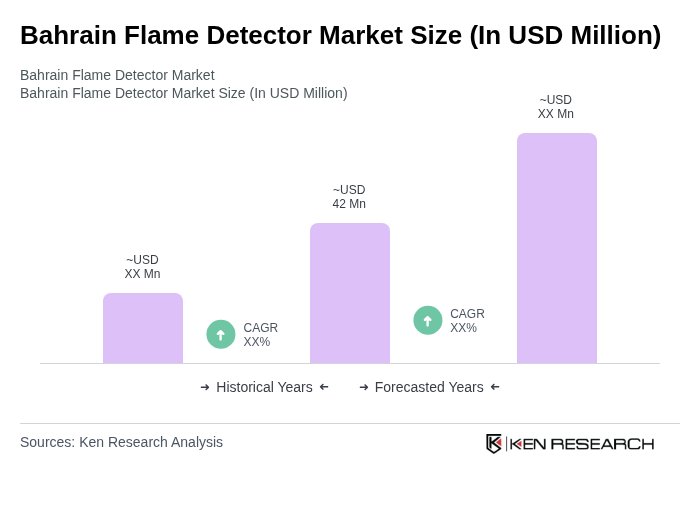
- The Bahrain Flame Detector Market is valued at USD 42 million, based on a five-year historical analysis. This growth is primarily driven by increasing safety regulations, heightened awareness of fire hazards, the expansion of industrial sectors such as oil and gas, and the rising adoption of advanced multi-sensor flame detection technologies which enhance accuracy and reduce false alarms in high-risk environments.
- Key cities such as Manama and Muharraq dominate the market due to their concentration of industrial activities and infrastructure development. The presence of major oil and gas companies in these regions further fuels demand for flame detection systems, making them critical hubs for market growth.
- The Civil Defence Law No. 23 of 2017 issued by the Kingdom of Bahrain mandates the installation of flame detectors in high-risk facilities, particularly in the oil and gas sector, requiring compliance through certified equipment installation, regular inspections, and adherence to international standards like NFPA for fire detection systems in hazardous areas.
Bahrain Flame Detector Market Segmentation
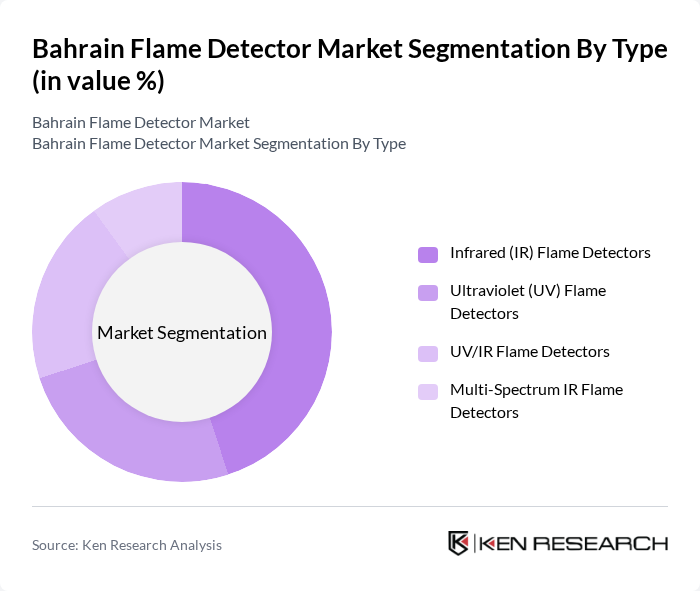
By Type:The flame detector market can be segmented into various types, including Infrared (IR) Flame Detectors, Ultraviolet (UV) Flame Detectors, UV/IR Flame Detectors, and Multi-Spectrum IR Flame Detectors. Among these, Infrared (IR) Flame Detectors are leading the market due to their high sensitivity and reliability in detecting flames in various industrial environments. The increasing adoption of IR detectors in oil and gas facilities, where rapid detection is crucial, has significantly contributed to their dominance. The trend towards automation and integration with other safety systems further enhances their appeal.
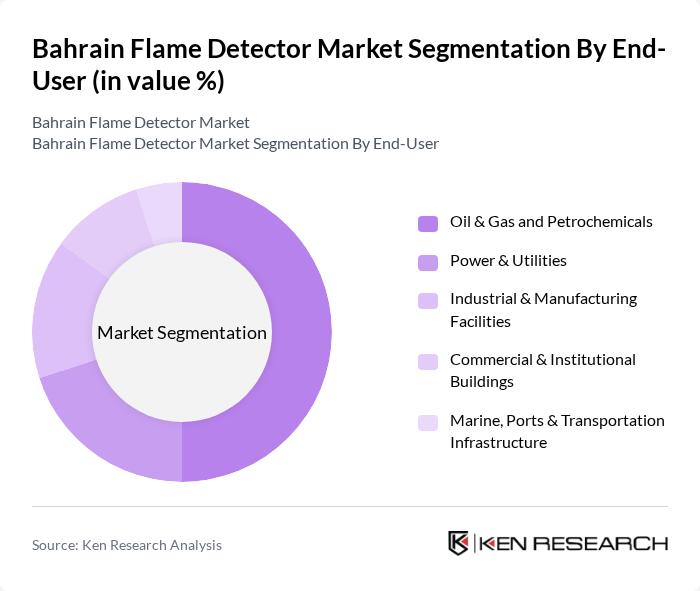
By End-User:The end-user segmentation includes Oil & Gas and Petrochemicals, Power & Utilities, Industrial & Manufacturing Facilities, Commercial & Institutional Buildings, and Marine, Ports & Transportation Infrastructure. The Oil & Gas and Petrochemicals sector is the dominant end-user, driven by the critical need for fire safety in high-risk environments. The stringent safety regulations and the high value of assets in this sector necessitate the deployment of advanced flame detection systems, making it a key driver of market growth.
Bahrain Flame Detector Market Competitive Landscape
The Bahrain Flame Detector Market is characterized by a dynamic mix of regional and international players. Leading participants such as Honeywell International Inc. (Honeywell Fire, Honeywell Analytics), Johnson Controls International plc (incl. Tyco Fire & Security), Siemens AG (Siemens Smart Infrastructure / Fire Safety), Emerson Electric Co. (Emerson Automation Solutions), MSA Safety Incorporated, Teledyne Gas & Flame Detection (Teledyne Technologies), Spectrex, Inc. (A Halma Company), Drägerwerk AG & Co. KGaA, SENSE-WARE Fire and Gas Detection B.V., R. STAHL AG, SICK AG, Schneider Electric SE, Bosch Building Technologies, NAFFCO (National Fire Fighting Manufacturing FZCO), Gulf Security & Safety Companies (Local System Integrators / Distributors) contribute to innovation, geographic expansion, and service delivery in this space.
Bahrain Flame Detector Market Industry Analysis
Growth Drivers
- Increasing Industrial Safety Regulations:Bahrain's industrial sector is witnessing a surge in safety regulations, with the Bahrain Civil Defence implementing stricter fire safety standards. In future, the government plans to allocate approximately BHD 6 million to enhance fire safety compliance across industries. This regulatory push is expected to drive the demand for flame detectors, as companies seek to meet compliance requirements and avoid penalties, thereby fostering a safer working environment.
- Rising Demand for Fire Safety Systems in Commercial Buildings:The commercial real estate sector in Bahrain is projected to grow by 5% in future, leading to increased investments in fire safety systems. With over 1,300 commercial buildings currently operational, the demand for advanced flame detection systems is expected to rise significantly. This trend is driven by the need for enhanced safety measures to protect assets and ensure the safety of occupants, thereby boosting market growth.
- Technological Advancements in Flame Detection:The flame detection technology landscape is evolving rapidly, with innovations such as multi-spectral detection systems gaining traction. In future, the market for advanced flame detection technologies is expected to reach BHD 4 million, driven by the integration of IoT and AI capabilities. These advancements enhance detection accuracy and response times, making flame detectors more appealing to industries focused on improving safety and operational efficiency.
Market Challenges
- High Initial Investment Costs:The adoption of advanced flame detection systems often requires significant upfront investments, which can deter smaller businesses. In future, the average cost of installing a comprehensive flame detection system is estimated at BHD 18,000. This financial barrier can limit market penetration, particularly among SMEs that may prioritize cost over safety, thereby hindering overall market growth in Bahrain.
- Limited Awareness of Advanced Flame Detection Technologies:Despite the benefits of modern flame detection systems, there remains a knowledge gap among potential users. In future, approximately 65% of businesses in Bahrain are expected to lack awareness of the latest technologies available. This limited understanding can result in underutilization of advanced systems, impacting the overall effectiveness of fire safety measures and slowing market adoption rates.
Bahrain Flame Detector Market Future Outlook
The Bahrain flame detector market is poised for significant growth, driven by increasing industrial safety regulations and technological advancements. As the government continues to enforce stringent fire safety standards, businesses will increasingly invest in advanced flame detection systems. Additionally, the integration of IoT and AI technologies is expected to enhance system capabilities, making them more attractive to various sectors. This evolving landscape presents opportunities for innovation and expansion, particularly in high-risk industries such as oil and gas.
Market Opportunities
- Expansion of the Oil and Gas Sector in Bahrain:The oil and gas sector is projected to grow by 4% in future, creating a substantial demand for enhanced fire safety measures. This growth presents an opportunity for flame detector manufacturers to cater to the specific needs of this high-risk industry, potentially increasing market share and revenue.
- Adoption of Smart Building Technologies:With the rise of smart building initiatives, the demand for integrated fire safety solutions is expected to increase. In future, investments in smart building technologies are anticipated to reach BHD 3 million, providing a lucrative opportunity for flame detector companies to innovate and offer solutions that align with modern building management systems.
Scope of the Report
| Segment | Sub-Segments |
|---|---|
| By Type | Infrared (IR) Flame Detectors Ultraviolet (UV) Flame Detectors UV/IR Flame Detectors Multi-Spectrum IR Flame Detectors |
| By End-User | Oil & Gas and Petrochemicals Power & Utilities Industrial & Manufacturing Facilities Commercial & Institutional Buildings Marine, Ports & Transportation Infrastructure |
| By Industry Vertical | Upstream Oil & Gas (Onshore/Offshore) Refineries & Petrochemical Plants LNG Terminals & Storage Facilities Chemical Processing & Fertilizers Metals, Mining & Heavy Industries |
| By Technology | Conventional (Standalone / Analog) Flame Detectors Addressable & Networked Flame Detectors Wireless & IoT-Enabled Flame Detectors SIL-Certified and ATEX / IECEx-Certified Flame Detectors |
| By Application | Process Area & Equipment Protection Tank Farms, Loading Racks & Pipelines Control Rooms, Substations & MCC Areas Warehouses, Logistics Yards & Airports/Ports |
| By Investment Source | CAPEX Projects in Oil & Gas and Petrochemicals OPEX-led Maintenance, Retrofit & Upgrade Spending Government and State-Owned Enterprise Projects PPP and Private Industrial Investments |
| By Policy Support | Compliance with Bahrain Civil Defence Codes & NFPA Standards Industrial Safety & Major Hazard Regulations Insurance-Driven Fire Protection Requirements Environmental and ESG-Linked Safety Investments |
Key Target Audience
Investors and Venture Capitalist Firms
Government and Regulatory Bodies (e.g., Bahrain Civil Defence, Ministry of Interior)
Manufacturers and Producers
Distributors and Retailers
Fire Safety Equipment Suppliers
Oil and Gas Industry Stakeholders
Construction and Engineering Firms
Insurance Companies
Players Mentioned in the Report:
Honeywell International Inc. (Honeywell Fire, Honeywell Analytics)
Johnson Controls International plc (incl. Tyco Fire & Security)
Siemens AG (Siemens Smart Infrastructure / Fire Safety)
Emerson Electric Co. (Emerson Automation Solutions)
MSA Safety Incorporated
Teledyne Gas & Flame Detection (Teledyne Technologies)
Spectrex, Inc. (A Halma Company)
Dragerwerk AG & Co. KGaA
SENSE-WARE Fire and Gas Detection B.V.
R. STAHL AG
SICK AG
Schneider Electric SE
Bosch Building Technologies
NAFFCO (National Fire Fighting Manufacturing FZCO)
Gulf Security & Safety Companies (Local System Integrators / Distributors)
Table of Contents
Market Assessment Phase
1. Executive Summary and Approach
2. Bahrain Flame Detector Market Overview
2.1 Key Insights and Strategic Recommendations
2.2 Bahrain Flame Detector Market Overview
2.3 Definition and Scope
2.4 Evolution of Market Ecosystem
2.5 Timeline of Key Regulatory Milestones
2.6 Value Chain & Stakeholder Mapping
2.7 Business Cycle Analysis
2.8 Policy & Incentive Landscape
3. Bahrain Flame Detector Market Analysis
3.1 Growth Drivers
3.1.1 Increasing industrial safety regulations
3.1.2 Rising demand for fire safety systems in commercial buildings
3.1.3 Technological advancements in flame detection
3.1.4 Growing awareness of fire hazards among consumers
3.2 Market Challenges
3.2.1 High initial investment costs
3.2.2 Limited awareness of advanced flame detection technologies
3.2.3 Stringent regulatory compliance requirements
3.2.4 Competition from alternative fire detection systems
3.3 Market Opportunities
3.3.1 Expansion of the oil and gas sector in Bahrain
3.3.2 Increasing investments in infrastructure development
3.3.3 Adoption of smart building technologies
3.3.4 Potential for export to neighboring markets
3.4 Market Trends
3.4.1 Integration of IoT in flame detection systems
3.4.2 Shift towards wireless flame detection solutions
3.4.3 Growing focus on sustainability and energy efficiency
3.4.4 Emergence of advanced analytics in fire safety management
3.5 Government Regulation
3.5.1 Implementation of fire safety standards by the Bahrain Civil Defence
3.5.2 Mandatory installation of flame detectors in high-risk industries
3.5.3 Incentives for adopting advanced fire safety technologies
3.5.4 Regular audits and inspections by regulatory bodies
4. SWOT Analysis
5. Stakeholder Analysis
6. Porter's Five Forces Analysis
7. Bahrain Flame Detector Market Market Size, 2019-2024
7.1 By Value
7.2 By Volume
7.3 By Average Selling Price
8. Bahrain Flame Detector Market Segmentation
8.1 By Type
8.1.1 Infrared (IR) Flame Detectors
8.1.2 Ultraviolet (UV) Flame Detectors
8.1.3 UV/IR Flame Detectors
8.1.4 Multi-Spectrum IR Flame Detectors
8.2 By End-User
8.2.1 Oil & Gas and Petrochemicals
8.2.2 Power & Utilities
8.2.3 Industrial & Manufacturing Facilities
8.2.4 Commercial & Institutional Buildings
8.2.5 Marine, Ports & Transportation Infrastructure
8.3 By Industry Vertical
8.3.1 Upstream Oil & Gas (Onshore/Offshore)
8.3.2 Refineries & Petrochemical Plants
8.3.3 LNG Terminals & Storage Facilities
8.3.4 Chemical Processing & Fertilizers
8.3.5 Metals, Mining & Heavy Industries
8.4 By Technology
8.4.1 Conventional (Standalone / Analog) Flame Detectors
8.4.2 Addressable & Networked Flame Detectors
8.4.3 Wireless & IoT-Enabled Flame Detectors
8.4.4 SIL-Certified and ATEX / IECEx-Certified Flame Detectors
8.5 By Application
8.5.1 Process Area & Equipment Protection
8.5.2 Tank Farms, Loading Racks & Pipelines
8.5.3 Control Rooms, Substations & MCC Areas
8.5.4 Warehouses, Logistics Yards & Airports/Ports
8.6 By Investment Source
8.6.1 CAPEX Projects in Oil & Gas and Petrochemicals
8.6.2 OPEX-led Maintenance, Retrofit & Upgrade Spending
8.6.3 Government and State-Owned Enterprise Projects
8.6.4 PPP and Private Industrial Investments
8.7 By Policy Support
8.7.1 Compliance with Bahrain Civil Defence Codes & NFPA Standards
8.7.2 Industrial Safety & Major Hazard Regulations
8.7.3 Insurance-Driven Fire Protection Requirements
8.7.4 Environmental and ESG-Linked Safety Investments
9. Bahrain Flame Detector Market Competitive Analysis
9.1 Market Share of Key Players
9.2 Cross Comparison of Key Players
9.2.1 Company Name
9.2.2 Bahrain Flame Detector Revenue (USD Million)
9.2.3 Bahrain Market Share (%)
9.2.4 3-Year CAGR in Bahrain Flame Detector Sales (%)
9.2.5 Installed Base in Bahrain (Number of Detectors / Sites)
9.2.6 Project Pipeline in Bahrain (Awarded & Bid Projects)
9.2.7 Product Portfolio Breadth (Technology & Certification Coverage)
9.2.8 Average Selling Price Positioning (Premium / Mid / Value)
9.2.9 Local Presence (Offices, Service Centers, Authorized Partners)
9.2.10 After-Sales SLA Performance (Uptime, Response Time)
9.2.11 Key End-User Penetration (Oil & Gas, Petrochem, Power, Commercial)
9.2.12 R&D and New Product Launches Relevant to GCC/Bahrain
9.3 SWOT Analysis of Top Players
9.4 Pricing Analysis
9.5 Detailed Profile of Major Companies
9.5.1 Honeywell International Inc. (Honeywell Fire, Honeywell Analytics)
9.5.2 Johnson Controls International plc (incl. Tyco Fire & Security)
9.5.3 Siemens AG (Siemens Smart Infrastructure / Fire Safety)
9.5.4 Emerson Electric Co. (Emerson Automation Solutions)
9.5.5 MSA Safety Incorporated
9.5.6 Teledyne Gas & Flame Detection (Teledyne Technologies)
9.5.7 Spectrex, Inc. (A Halma Company)
9.5.8 Drägerwerk AG & Co. KGaA
9.5.9 SENSE-WARE Fire and Gas Detection B.V.
9.5.10 R. STAHL AG
9.5.11 SICK AG
9.5.12 Schneider Electric SE
9.5.13 Bosch Building Technologies
9.5.14 NAFFCO (National Fire Fighting Manufacturing FZCO)
9.5.15 Gulf Security & Safety Companies (Local System Integrators / Distributors)
10. Bahrain Flame Detector Market End-User Analysis
10.1 Procurement Behavior of Key Ministries
10.1.1 Ministry of Interior
10.1.2 Ministry of Industry, Commerce and Tourism
10.1.3 Ministry of Works, Municipalities Affairs and Urban Planning
10.1.4 Others
10.2 Corporate Spend on Infrastructure & Energy
10.2.1 Investment in Fire Safety Infrastructure
10.2.2 Budget Allocation for Emergency Services
10.2.3 Corporate Social Responsibility Initiatives
10.2.4 Others
10.3 Pain Point Analysis by End-User Category
10.3.1 Industrial Sector
10.3.2 Commercial Sector
10.3.3 Government Sector
10.3.4 Others
10.4 User Readiness for Adoption
10.4.1 Awareness of Flame Detection Technologies
10.4.2 Training and Skill Development
10.4.3 Financial Readiness
10.4.4 Others
10.5 Post-Deployment ROI and Use Case Expansion
10.5.1 Cost Savings from Reduced Fire Incidents
10.5.2 Enhanced Safety Compliance
10.5.3 Opportunities for Technology Upgrades
10.5.4 Others
11. Bahrain Flame Detector Market Future Size, 2025-2030
11.1 By Value
11.2 By Volume
11.3 By Average Selling Price
Go-To-Market Strategy Phase
1. Whitespace Analysis + Business Model Canvas
1.1 Market Gaps Identification
1.2 Business Model Development
2. Marketing and Positioning Recommendations
2.1 Branding Strategies
2.2 Product USPs
3. Distribution Plan
3.1 Urban Retail Strategies
3.2 Rural NGO Tie-ups
4. Channel & Pricing Gaps
4.1 Underserved Routes
4.2 Pricing Bands
5. Unmet Demand & Latent Needs
5.1 Category Gaps
5.2 Consumer Segments
6. Customer Relationship
6.1 Loyalty Programs
6.2 After-sales Service
7. Value Proposition
7.1 Sustainability Initiatives
7.2 Integrated Supply Chains
8. Key Activities
8.1 Regulatory Compliance
8.2 Branding Efforts
8.3 Distribution Setup
9. Entry Strategy Evaluation
9.1 Domestic Market Entry Strategy
9.1.1 Product Mix
9.1.2 Pricing Band
9.1.3 Packaging
9.2 Export Entry Strategy
9.2.1 Target Countries
9.2.2 Compliance Roadmap
10. Entry Mode Assessment
10.1 Joint Ventures
10.2 Greenfield Investments
10.3 Mergers & Acquisitions
10.4 Distributor Model
11. Capital and Timeline Estimation
11.1 Capital Requirements
11.2 Timelines
12. Control vs Risk Trade-Off
12.1 Ownership vs Partnerships
13. Profitability Outlook
13.1 Breakeven Analysis
13.2 Long-term Sustainability
14. Potential Partner List
14.1 Distributors
14.2 Joint Ventures
14.3 Acquisition Targets
15. Execution Roadmap
15.1 Phased Plan for Market Entry
15.1.1 Market Setup
15.1.2 Market Entry
15.1.3 Growth Acceleration
15.1.4 Scale & Stabilize
15.2 Key Activities and Milestones
15.2.1 Milestone Planning
15.2.2 Activity Tracking
Research Methodology
Phase 1: Approach1
Desk Research
- Industry reports from Bahrain's Ministry of Industry and Commerce
- Market analysis publications from local fire safety associations
- Statistical data from Bahrain's National Bureau of Statistics
Primary Research
- Interviews with fire safety engineers and consultants in Bahrain
- Surveys with facility managers in high-risk industries
- Field visits to industrial sites utilizing flame detection systems
Validation & Triangulation
- Cross-validation of findings with regional market trends and forecasts
- Triangulation of data from government reports and industry insights
- Sanity checks through expert panels comprising fire safety professionals
Phase 2: Market Size Estimation1
Top-down Assessment
- Analysis of Bahrain's overall fire safety equipment market size
- Segmentation by industry verticals such as oil & gas, manufacturing, and hospitality
- Incorporation of government regulations and safety mandates impacting market growth
Bottom-up Modeling
- Volume estimates based on installations of flame detectors across sectors
- Cost analysis derived from pricing models of leading flame detector manufacturers
- Estimation of replacement cycles and maintenance costs for existing systems
Forecasting & Scenario Analysis
- Multi-variable regression analysis considering economic growth and safety regulations
- Scenario planning based on potential changes in industrial safety standards
- Baseline, optimistic, and pessimistic forecasts through 2030
Phase 3: CATI Sample Composition1
| Scope Item/Segment | Sample Size | Target Respondent Profiles |
|---|---|---|
| Oil & Gas Sector Flame Detection | 100 | Safety Managers, Operations Directors |
| Manufacturing Facility Safety Systems | 80 | Plant Managers, Safety Compliance Officers |
| Hospitality Industry Fire Safety | 60 | Facility Managers, Risk Assessment Specialists |
| Commercial Building Fire Detection | 70 | Building Managers, Fire Safety Inspectors |
| Public Sector Fire Safety Initiatives | 50 | Government Safety Officials, Policy Makers |
Frequently Asked Questions
What is the current value of the Bahrain Flame Detector Market?
The Bahrain Flame Detector Market is valued at approximately USD 42 million, reflecting a five-year historical analysis. This growth is driven by increasing safety regulations and the expansion of industrial sectors, particularly in oil and gas.
What factors are driving the growth of the Bahrain Flame Detector Market?
Which cities in Bahrain are leading in flame detector demand?
What regulations impact the installation of flame detectors in Bahrain?
Other Regional/Country Reports
Indonesia Flame Detector Market
Malaysia Flame Detector Market
KSA Flame Detector Market
APAC Flame Detector Market
SEA Flame Detector Market
Other Adjacent Reports
UAE Gas Detection Systems Market
Bahrain Industrial Safety Equipment Market
Japan Oil and Gas Safety Solutions Market
Singapore Emergency Lighting Systems Market
Egypt Smoke Detection Devices Market
Singapore Hazardous Area Monitoring Market
Saudi Arabia Building Automation Systems Market Size, Share, Trends & Forecast 2025–2030Egypt IoT Safety Solutions Market
Indonesia Fire Alarm Systems Market
Why Buy From Us?

What makes us stand out is that our consultants follow Robust, Refine and Result (RRR) methodology. Robust for clear definitions, approaches and sanity checking, Refine for differentiating respondents' facts and opinions, and Result for presenting data with story.

We have set a benchmark in the industry by offering our clients with syndicated and customized market research reports featuring coverage of entire market as well as meticulous research and analyst insights.

While we don't replace traditional research, we flip the method upside down. Our dual approach of Top Bottom & Bottom Top ensures quality deliverable by not just verifying company fundamentals but also looking at the sector and macroeconomic factors.

With one step in the future, our research team constantly tries to show you the bigger picture. We help with some of the tough questions you may encounter along the way: How is the industry positioned? Best marketing channel? KPI's of competitors? By aligning every element, we help maximize success.

Our report gives you instant access to the answers and sources that other companies might choose to hide. We elaborate each steps of research methodology we have used and showcase you the sample size to earn your trust.

If you need any support, we are here! We pride ourselves on universe strength, data quality, and quick, friendly, and professional service.