About the Report
Base Year 2024Bahrain IP Camera Market Overview
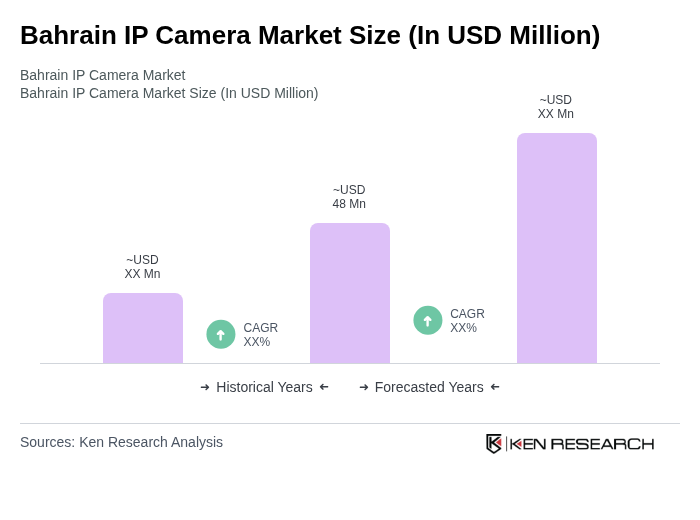
- The Bahrain IP Camera Market is valued at USD 48 million, based on a five-year historical analysis and regional allocation from the GCC video surveillance camera market. This growth is primarily driven by increasing security concerns, rapid urbanization, the proliferation of smart city projects, and advancements in AI-powered surveillance technologies, leading to a higher demand for modern surveillance solutions across residential, commercial, and government sectors .
- Key cities such asManamaandMuharraqdominate the market due to their rapid urban development and significant investments in infrastructure. The concentration of commercial activities, hospitality projects, and government-led smart infrastructure initiatives in these urban centers further enhances the demand for IP cameras, making them pivotal in the national market landscape .
- TheMinisterial Order No. 51 of 2016 issued by the Ministry of Interiorregulates the installation of surveillance cameras in public and private spaces in Bahrain. This binding regulation mandates the deployment of video surveillance systems in commercial establishments, hotels, malls, and public areas, specifying technical requirements, storage durations, and compliance obligations for operators, thereby driving the demand for IP cameras across the nation .
Bahrain IP Camera Market Segmentation
By Type:The market is segmented into various types of cameras, including Dome Cameras, Bullet Cameras, Box Style Cameras, PTZ Cameras, Thermal Cameras, Fisheye Cameras, Wireless Cameras, and Others. Each type serves different purposes and is preferred based on specific user requirements and installation environments. Dome cameras remain the most widely adopted due to their discreet design and suitability for both indoor and outdoor applications, while bullet and PTZ cameras are favored for perimeter and large-area monitoring .
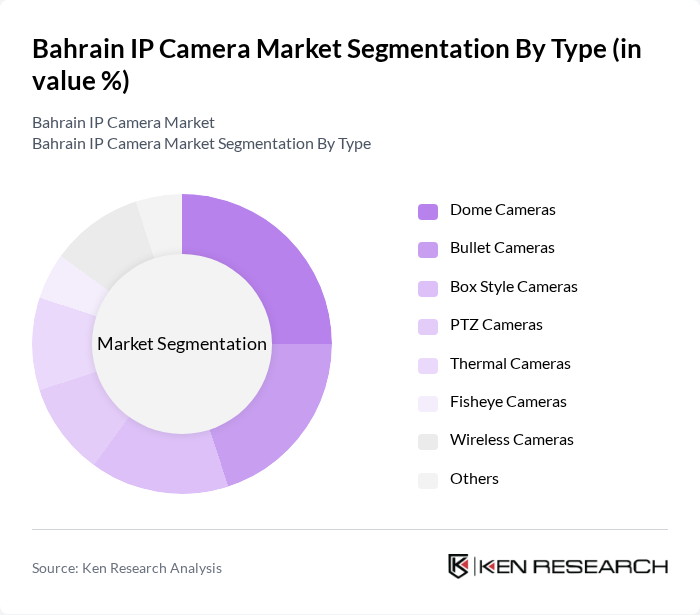
The dominant sub-segment in the market isDome Cameras, which are favored for their discreet design and versatility in various environments. Their ability to provide 360-degree coverage makes them ideal for both indoor and outdoor applications, particularly in retail, hospitality, and commercial settings. The increasing focus on aesthetic appeal, vandal resistance, and integration with AI-based analytics has led to a growing preference for dome cameras among consumers and businesses alike .
By End-User:The market is segmented by end-users, including Residential, Commercial, Industrial, Government & Utilities, BFSI, Healthcare, Logistics & Transportation, and Others. Each segment has unique requirements and preferences for surveillance solutions. The commercial and government sectors are the primary adopters, driven by regulatory compliance and public safety mandates .
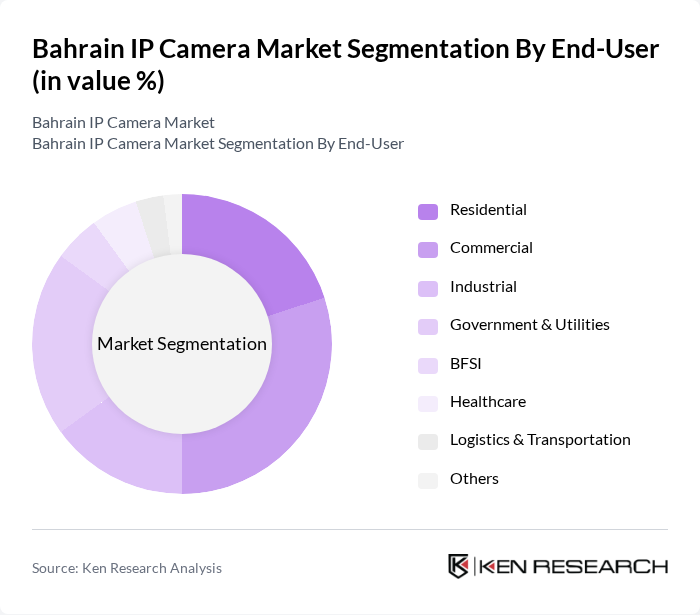
In the end-user segmentation, theCommercial sectorleads the market due to the high demand for security solutions in retail, offices, hospitality, and public spaces. The increasing need for enhanced security measures, loss prevention strategies, and compliance with government regulations drives the adoption of IP cameras. Additionally, government initiatives to improve public safety and the expansion of smart city projects further bolster the demand in this segment .
Bahrain IP Camera Market Competitive Landscape
The Bahrain IP Camera Market is characterized by a dynamic mix of regional and international players. Leading participants such as Hikvision, Dahua Technology, Axis Communications, Bosch Security Systems, Hanwha Vision, FLIR Systems, Panasonic i-PRO, Sony, Avigilon (Motorola Solutions), Vivotek, MOBOTIX, Genetec, Honeywell, Johnson Controls (Tyco), ADT Commercial contribute to innovation, geographic expansion, and service delivery in this space.
Bahrain IP Camera Market Industry Analysis
Growth Drivers
- Increasing Demand for Surveillance and Security Solutions:The Bahrain IP camera market is experiencing a surge in demand, driven by a reported 15% increase in crime rates over the past year. This has prompted both residential and commercial sectors to invest in advanced surveillance systems. The Ministry of Interior's initiatives to enhance public safety have also led to a projected increase in the installation of IP cameras, with an estimated 20,000 units expected to be deployed in future.
- Technological Advancements in IP Camera Features:The integration of high-definition video capabilities and smart analytics has revolutionized the IP camera market in Bahrain. In future, it is anticipated that 60% of new installations will feature AI-driven functionalities, such as facial recognition and motion detection. This technological evolution is supported by a 30% reduction in manufacturing costs for advanced features, making them more accessible to consumers and businesses alike.
- Government Initiatives for Smart City Projects:Bahrain's government is actively promoting smart city initiatives, with a budget allocation of approximately $500 million for urban development projects in future. This funding is expected to enhance infrastructure, including the installation of IP cameras for monitoring and security purposes. The collaboration between public and private sectors is projected to result in a 25% increase in smart surveillance systems across major urban areas in future.
Market Challenges
- High Initial Investment Costs:One of the significant barriers to the adoption of IP cameras in Bahrain is the high initial investment required. The average cost of a quality IP camera system can range from $1,000 to $5,000, depending on features and installation complexity. This upfront expense can deter small businesses and residential users, especially in a market where the average household income is around $30,000 annually, limiting affordability for many potential customers.
- Data Privacy and Security Concerns:Growing concerns regarding data privacy are impacting the IP camera market in Bahrain. With the implementation of stringent data protection laws, businesses face challenges in ensuring compliance while deploying surveillance systems. A survey indicated that 70% of consumers are worried about how their data is used, which could hinder the adoption of IP cameras. This apprehension necessitates robust security measures to build consumer trust and encourage market growth.
Bahrain IP Camera Market Future Outlook
The future of the Bahrain IP camera market appears promising, driven by technological advancements and increasing security needs. As the government continues to invest in smart city initiatives, the integration of IP cameras with IoT technologies is expected to enhance surveillance capabilities significantly. Additionally, the growing trend of remote monitoring solutions will likely attract more consumers, fostering a competitive landscape that encourages innovation and improved service offerings in the coming years.
Market Opportunities
- Expansion of E-commerce and Retail Sectors:The rapid growth of e-commerce in Bahrain, projected to reach $1 billion in sales in future, presents a significant opportunity for IP camera adoption. Retailers are increasingly investing in surveillance systems to enhance security and monitor customer behavior, leading to a potential increase in demand for IP cameras by 30% in this sector alone.
- Integration with IoT and Smart Home Technologies:The rising trend of smart home technologies in Bahrain is creating new opportunities for IP camera manufacturers. With an estimated 40% of households expected to adopt smart home devices in future, the integration of IP cameras with these systems can enhance user experience and security. This synergy is likely to drive a 20% increase in sales of IP cameras designed for smart home applications.
Scope of the Report
| Segment | Sub-Segments |
|---|---|
| By Type | Dome Cameras Bullet Cameras Box Style Cameras PTZ Cameras Thermal Cameras Fisheye Cameras Wireless Cameras Others |
| By End-User | Residential Commercial Industrial Government & Utilities BFSI Healthcare Logistics & Transportation Others |
| By Region | Northern Governorate Southern Governorate Capital Governorate Muharraq Governorate Others |
| By Technology | Analog Cameras IP Cameras HD Cameras K Cameras Infrared Cameras Others |
| By Application | Retail Security Traffic Monitoring Building Security Public Safety Industrial Surveillance Others |
| By Investment Source | Domestic Investment Foreign Direct Investment (FDI) Public-Private Partnerships (PPP) Government Schemes Others |
| By Policy Support | Subsidies Tax Exemptions Regulatory Compliance Support Others |
Key Target Audience
Investors and Venture Capitalist Firms
Government and Regulatory Bodies (e.g., Ministry of Interior, Telecommunications Regulatory Authority)
Manufacturers and Producers
Distributors and Retailers
Security Service Providers
Telecommunication Companies
Real Estate Developers
Construction Firms
Players Mentioned in the Report:
Hikvision
Dahua Technology
Axis Communications
Bosch Security Systems
Hanwha Vision
FLIR Systems
Panasonic i-PRO
Sony
Avigilon (Motorola Solutions)
Vivotek
MOBOTIX
Genetec
Honeywell
Johnson Controls (Tyco)
ADT Commercial
Table of Contents
Market Assessment Phase
1. Executive Summary and Approach
2. Bahrain IP Camera Market Overview
2.1 Key Insights and Strategic Recommendations
2.2 Bahrain IP Camera Market Overview
2.3 Definition and Scope
2.4 Evolution of Market Ecosystem
2.5 Timeline of Key Regulatory Milestones
2.6 Value Chain & Stakeholder Mapping
2.7 Business Cycle Analysis
2.8 Policy & Incentive Landscape
3. Bahrain IP Camera Market Analysis
3.1 Growth Drivers
3.1.1 Increasing demand for surveillance and security solutions
3.1.2 Technological advancements in IP camera features
3.1.3 Government initiatives for smart city projects
3.1.4 Rising concerns over public safety and crime rates
3.2 Market Challenges
3.2.1 High initial investment costs
3.2.2 Data privacy and security concerns
3.2.3 Limited awareness among end-users
3.2.4 Competition from traditional CCTV systems
3.3 Market Opportunities
3.3.1 Expansion of e-commerce and retail sectors
3.3.2 Integration with IoT and smart home technologies
3.3.3 Increasing adoption in the hospitality industry
3.3.4 Potential for cloud-based storage solutions
3.4 Market Trends
3.4.1 Shift towards wireless IP camera systems
3.4.2 Growing demand for AI-powered analytics
3.4.3 Increased focus on remote monitoring capabilities
3.4.4 Rising popularity of subscription-based services
3.5 Government Regulation
3.5.1 Data protection laws impacting surveillance
3.5.2 Licensing requirements for installation
3.5.3 Standards for video quality and storage
3.5.4 Compliance with international security protocols
4. SWOT Analysis
5. Stakeholder Analysis
6. Porter's Five Forces Analysis
7. Bahrain IP Camera Market Market Size, 2019-2024
7.1 By Value
7.2 By Volume
7.3 By Average Selling Price
8. Bahrain IP Camera Market Segmentation
8.1 By Type
8.1.1 Dome Cameras
8.1.2 Bullet Cameras
8.1.3 Box Style Cameras
8.1.4 PTZ Cameras
8.1.5 Thermal Cameras
8.1.6 Fisheye Cameras
8.1.7 Wireless Cameras
8.1.8 Others
8.2 By End-User
8.2.1 Residential
8.2.2 Commercial
8.2.3 Industrial
8.2.4 Government & Utilities
8.2.5 BFSI
8.2.6 Healthcare
8.2.7 Logistics & Transportation
8.2.8 Others
8.3 By Region
8.3.1 Northern Governorate
8.3.2 Southern Governorate
8.3.3 Capital Governorate
8.3.4 Muharraq Governorate
8.3.5 Others
8.4 By Technology
8.4.1 Analog Cameras
8.4.2 IP Cameras
8.4.3 HD Cameras
8.4.4 4K Cameras
8.4.5 Infrared Cameras
8.4.6 Others
8.5 By Application
8.5.1 Retail Security
8.5.2 Traffic Monitoring
8.5.3 Building Security
8.5.4 Public Safety
8.5.5 Industrial Surveillance
8.5.6 Others
8.6 By Investment Source
8.6.1 Domestic Investment
8.6.2 Foreign Direct Investment (FDI)
8.6.3 Public-Private Partnerships (PPP)
8.6.4 Government Schemes
8.6.5 Others
8.7 By Policy Support
8.7.1 Subsidies
8.7.2 Tax Exemptions
8.7.3 Regulatory Compliance Support
8.7.4 Others
9. Bahrain IP Camera Market Competitive Analysis
9.1 Market Share of Key Players
9.2 Cross Comparison of Key Players
9.2.1 Company Name
9.2.2 Market Share in Bahrain IP Camera Market
9.2.3 Revenue Growth Rate (Bahrain operations)
9.2.4 Market Penetration Rate (Number of Installations/Projects)
9.2.5 Product Portfolio Breadth (Number of IP Camera Models Offered)
9.2.6 Channel/Distribution Network Strength
9.2.7 Local Partnerships & System Integrator Relationships
9.2.8 Customer Retention Rate
9.2.9 Pricing Competitiveness (vs. Market Average)
9.2.10 Brand Recognition Score (Bahrain Market)
9.2.11 After-Sales Service Coverage
9.2.12 Compliance with Bahrain Regulatory Standards
9.3 SWOT Analysis of Top Players
9.4 Pricing Analysis
9.5 Detailed Profile of Major Companies
9.5.1 Hikvision
9.5.2 Dahua Technology
9.5.3 Axis Communications
9.5.4 Bosch Security Systems
9.5.5 Hanwha Vision
9.5.6 FLIR Systems
9.5.7 Panasonic i-PRO
9.5.8 Sony
9.5.9 Avigilon (Motorola Solutions)
9.5.10 Vivotek
9.5.11 MOBOTIX
9.5.12 Genetec
9.5.13 Honeywell
9.5.14 Johnson Controls (Tyco)
9.5.15 ADT Commercial
10. Bahrain IP Camera Market End-User Analysis
10.1 Procurement Behavior of Key Ministries
10.1.1 Ministry of Interior
10.1.2 Ministry of Works
10.1.3 Ministry of Education
10.1.4 Ministry of Health
10.2 Corporate Spend on Infrastructure & Energy
10.2.1 Investment in Security Infrastructure
10.2.2 Budget Allocation for Technology Upgrades
10.3 Pain Point Analysis by End-User Category
10.3.1 Security Concerns in Residential Areas
10.3.2 Need for Enhanced Surveillance in Commercial Spaces
10.4 User Readiness for Adoption
10.4.1 Awareness of IP Camera Benefits
10.4.2 Training and Support Requirements
10.5 Post-Deployment ROI and Use Case Expansion
10.5.1 Evaluation of Cost Savings
10.5.2 Opportunities for System Upgrades
11. Bahrain IP Camera Market Future Size, 2025-2030
11.1 By Value
11.2 By Volume
11.3 By Average Selling Price
Go-To-Market Strategy Phase
1. Whitespace Analysis + Business Model Canvas
1.1 Market Gaps Identification
2. Marketing and Positioning Recommendations
2.1 Branding Strategies
2.2 Product USPs
3. Distribution Plan
3.1 Urban Retail vs Rural NGO Tie-ups
4. Channel & Pricing Gaps
4.1 Underserved Routes
4.2 Pricing Bands
5. Unmet Demand & Latent Needs
5.1 Category Gaps
5.2 Consumer Segments
6. Customer Relationship
6.1 Loyalty Programs
6.2 After-sales Service
7. Value Proposition
7.1 Sustainability
7.2 Integrated Supply Chains
8. Key Activities
8.1 Regulatory Compliance
8.2 Branding
8.3 Distribution Setup
9. Entry Strategy Evaluation
9.1 Domestic Market Entry Strategy
9.1.1 Product Mix
9.1.2 Pricing Band
9.1.3 Packaging
9.2 Export Entry Strategy
9.2.1 Target Countries
9.2.2 Compliance Roadmap
10. Entry Mode Assessment
10.1 JV
10.2 Greenfield
10.3 M&A
10.4 Distributor Model
11. Capital and Timeline Estimation
11.1 Capital Requirements
11.2 Timelines
12. Control vs Risk Trade-Off
12.1 Ownership vs Partnerships
13. Profitability Outlook
13.1 Breakeven Analysis
13.2 Long-term Sustainability
14. Potential Partner List
14.1 Distributors
14.2 JVs
14.3 Acquisition Targets
15. Execution Roadmap
15.1 Phased Plan for Market Entry
15.1.1 Market Setup
15.1.2 Market Entry
15.1.3 Growth Acceleration
15.1.4 Scale & Stabilize
15.2 Key Activities and Milestones
15.2.1 Milestone Planning
Research Methodology
Phase 1: Approach1
Desk Research
- Analysis of market reports from industry associations and government publications
- Review of existing literature on IP camera technology and market trends
- Examination of import/export data and trade statistics specific to Bahrain
Primary Research
- Interviews with key stakeholders in the security and surveillance industry
- Surveys targeting end-users such as businesses and residential customers
- Focus groups with security consultants and system integrators
Validation & Triangulation
- Cross-validation of findings through multiple data sources and expert opinions
- Triangulation of market size estimates from both primary and secondary research
- Sanity checks conducted through expert panel discussions and feedback
Phase 2: Market Size Estimation1
Top-down Assessment
- Estimation of total addressable market based on national security spending
- Segmentation of market by application areas such as commercial, residential, and government
- Incorporation of growth rates from regional market trends and forecasts
Bottom-up Modeling
- Collection of sales data from leading IP camera manufacturers operating in Bahrain
- Estimation of average selling prices and unit sales across different segments
- Analysis of installation and maintenance service revenues associated with IP cameras
Forecasting & Scenario Analysis
- Development of growth scenarios based on technological advancements and market adoption rates
- Scenario planning considering regulatory changes and security threats
- Projections of market growth through 2030 under various economic conditions
Phase 3: CATI Sample Composition1
| Scope Item/Segment | Sample Size | Target Respondent Profiles |
|---|---|---|
| Commercial Sector IP Camera Usage | 85 | Facility Managers, Security Directors |
| Residential Security Solutions | 65 | Homeowners, Property Managers |
| Government Surveillance Initiatives | 50 | Public Safety Officials, Urban Planners |
| Retail Security Systems | 60 | Store Managers, Loss Prevention Officers |
| Installation and Maintenance Services | 40 | Service Technicians, Installation Managers |
Frequently Asked Questions
What is the current value of the Bahrain IP Camera Market?
The Bahrain IP Camera Market is valued at approximately USD 48 million, driven by increasing security concerns, urbanization, and advancements in AI-powered surveillance technologies across various sectors, including residential, commercial, and government.
What are the main drivers of growth in the Bahrain IP Camera Market?
Which cities in Bahrain are leading in IP camera adoption?
What types of IP cameras are most popular in Bahrain?
Other Regional/Country Reports
Indonesia IP Camera Market
Malaysia IP Camera Market
KSA IP Camera Market
APAC IP Camera Market
SEA IP Camera Market
Other Adjacent Reports
South Africa Video Surveillance Software Market
Germany Access Control Systems Market
South Korea Intrusion Detection Systems Market
Global Smart Home Security Market Size, Share & Forecast, By Product Type, Technology & Distribution Channel, 2026-2031Oman IoT Security Devices Market
Egypt AI Analytics Market
Brazil Cloud Storage Solutions Market
Malaysia Thermal Imaging Market
Asia Pacific Body-Worn Camera Market Size, Share & Forecast, By Product Type, Operation Mode & End User, 2025-2032UAE Network Video Recorder MarketWhy Buy From Us?

What makes us stand out is that our consultants follow Robust, Refine and Result (RRR) methodology. Robust for clear definitions, approaches and sanity checking, Refine for differentiating respondents' facts and opinions, and Result for presenting data with story.

We have set a benchmark in the industry by offering our clients with syndicated and customized market research reports featuring coverage of entire market as well as meticulous research and analyst insights.

While we don't replace traditional research, we flip the method upside down. Our dual approach of Top Bottom & Bottom Top ensures quality deliverable by not just verifying company fundamentals but also looking at the sector and macroeconomic factors.

With one step in the future, our research team constantly tries to show you the bigger picture. We help with some of the tough questions you may encounter along the way: How is the industry positioned? Best marketing channel? KPI's of competitors? By aligning every element, we help maximize success.

Our report gives you instant access to the answers and sources that other companies might choose to hide. We elaborate each steps of research methodology we have used and showcase you the sample size to earn your trust.

If you need any support, we are here! We pride ourselves on universe strength, data quality, and quick, friendly, and professional service.