Region:Middle East
Author(s):Shubham
Product Code:KRAC3679
Pages:87
Published On:January 2026
By Component:The components of the market include Power Sourcing Equipment (PSE) and Powered Devices (PD). The PSE segment is crucial as it supplies power to the connected devices, while the PD segment encompasses devices that receive power through the Ethernet cable. The increasing deployment of smart devices in commercial and residential settings, including IP surveillance, enterprise Wi?Fi, PoE LED lighting, and building automation endpoints, has led to a significant rise in the demand for both components.
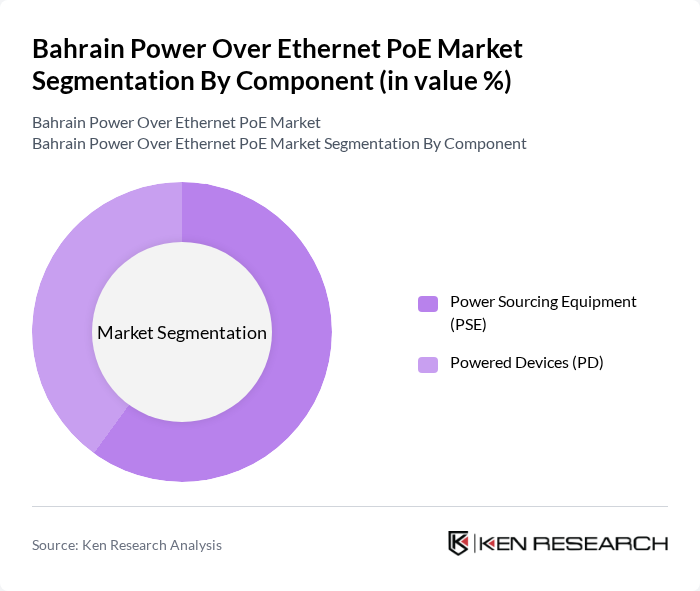
The Power Sourcing Equipment (PSE) segment is currently leading the market due to the growing need for efficient power management solutions in various applications, including IP cameras, wireless access points, PoE switches, and VoIP phones. The trend towards smart buildings and the increasing number of connected devices, particularly in commercial offices, education campuses, and healthcare facilities, have further fueled the demand for PSE. As organizations seek to streamline their operations, enable centralized power control, and reduce energy and installation costs, the adoption of PSE is expected to continue its upward trajectory.
By IEEE Standard:The market is segmented based on IEEE standards, including PoE (IEEE 802.3af), PoE+ (IEEE 802.3at), and PoE++ / 4PPoE (IEEE 802.3bt). Each standard offers different power levels, catering to various applications and device requirements, from lower?power VoIP phones and basic IP cameras to high?power wireless access points, pan?tilt?zoom cameras, and intelligent lighting. The increasing complexity and power needs of networked devices, especially in enterprise and industrial environments, necessitate the adoption of higher power standards, particularly in commercial settings.
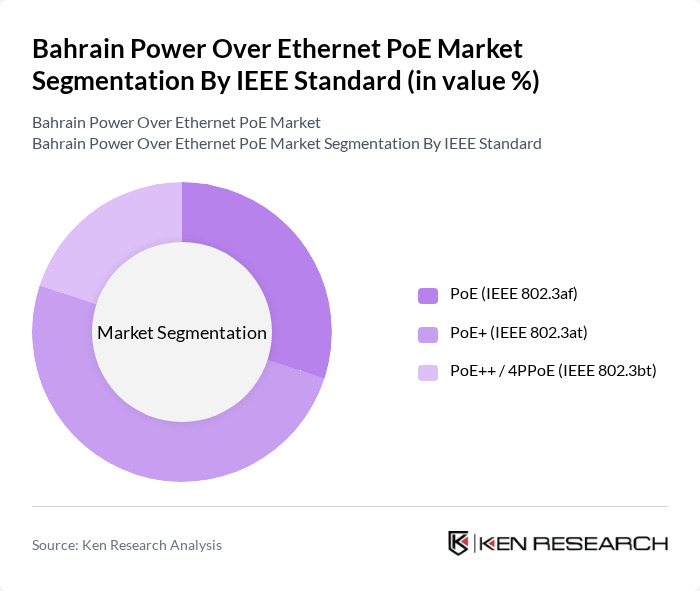
The PoE+ (IEEE 802.3at) standard is dominating the market due to its ability to deliver higher power levels, making it suitable for a wider range of devices, including high-performance IP cameras, multi?radio wireless access points, and more advanced building control endpoints. As businesses increasingly adopt advanced technologies that require more power and bandwidth, the demand for PoE+ solutions is expected to grow, while PoE++ / 4PPoE is gaining share in applications such as PoE LED lighting, conference systems, and digital signage. This trend is further supported by the need for efficient power distribution and granular control in smart buildings and IoT applications, where centralized, low?voltage power over structured cabling is preferred.
The Bahrain Power Over Ethernet PoE Market is characterized by a dynamic mix of regional and international players. Leading participants such as Cisco Systems, Inc., TP-Link Technologies Co., Ltd., NETGEAR, Inc., D-Link Corporation, Ubiquiti Inc., Aruba Networks (Hewlett Packard Enterprise), Huawei Technologies Co., Ltd., Siemens AG, Belden Inc., Extreme Networks, Inc., MikroTik, Allied Telesis, Inc., Juniper Networks, Inc., Avaya LLC, Panasonic Corporation contribute to innovation, geographic expansion, and service delivery in this space, primarily through PoE switches, injectors, access points, and PoE-enabled cameras and lighting solutions across global and Middle East markets.
The future of the Power over Ethernet market in Bahrain appears promising, driven by technological advancements and increasing investments in smart infrastructure. As the government continues to promote smart city initiatives, the integration of PoE systems is expected to gain momentum. Additionally, the growing focus on sustainability and energy efficiency will likely encourage more businesses to adopt PoE solutions, enhancing connectivity and reducing operational costs. The market is poised for significant growth as awareness and technological capabilities expand.
| Segment | Sub-Segments |
|---|---|
| By Component | Power Sourcing Equipment (PSE) Powered Devices (PD) |
| By IEEE Standard | PoE (IEEE 802.3af) PoE+ (IEEE 802.3at) PoE++ / 4PPoE (IEEE 802.3bt) |
| By Power Class / Wattage | Up to 15.4W (Type 1) >15.4W to 30W (Type 2) >30W to 60W (Type 3) >60W to 90W (Type 4) |
| By Application | IP Cameras & Video Surveillance Wireless Access Points & Small Cells VoIP Phones & Unified Communications PoE Lighting & Building Automation Others (Access Control, Sensors, Signage) |
| By End-Use Industry | Commercial (Offices, Hospitality, Retail) Industrial & Logistics Residential & Smart Homes Government, Education & Healthcare |
| By Installation Type | New Installations Retrofits / Upgrades |
| By Distribution Channel | Direct Sales (Vendors & System Integrators) Distributors & Value-Added Resellers Online / E-commerce Channels |
| Scope Item/Segment | Sample Size | Target Respondent Profiles |
|---|---|---|
| Commercial Building PoE Installations | 100 | Facility Managers, IT Directors |
| Residential PoE Adoption | 90 | Homeowners, Electrical Contractors |
| Industrial PoE Applications | 70 | Operations Managers, Electrical Engineers |
| Telecommunications Infrastructure | 80 | Network Administrators, Telecom Engineers |
| Government Energy Efficiency Programs | 50 | Policy Makers, Energy Consultants |
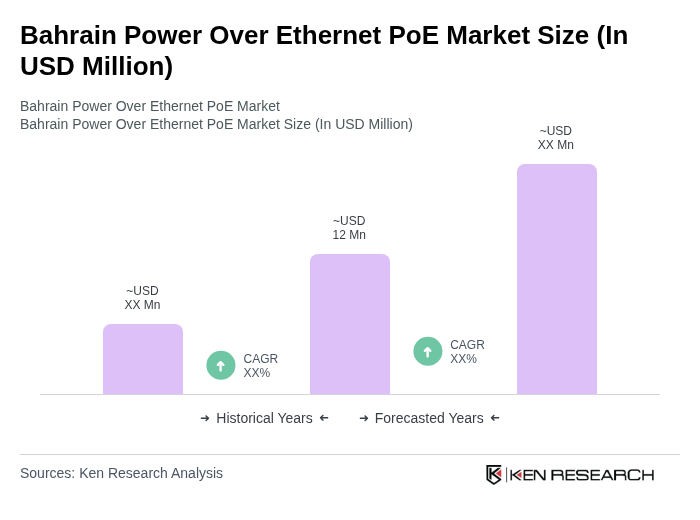
The Bahrain Power Over Ethernet (PoE) market is valued at approximately USD 12 million, reflecting a five-year historical analysis and trends in the adoption of PoE technologies across various sectors, including commercial and residential applications.

What makes us stand out is that our consultants follow Robust, Refine and Result (RRR) methodology. Robust for clear definitions, approaches and sanity checking, Refine for differentiating respondents' facts and opinions, and Result for presenting data with story.

We have set a benchmark in the industry by offering our clients with syndicated and customized market research reports featuring coverage of entire market as well as meticulous research and analyst insights.

While we don't replace traditional research, we flip the method upside down. Our dual approach of Top Bottom & Bottom Top ensures quality deliverable by not just verifying company fundamentals but also looking at the sector and macroeconomic factors.

With one step in the future, our research team constantly tries to show you the bigger picture. We help with some of the tough questions you may encounter along the way: How is the industry positioned? Best marketing channel? KPI's of competitors? By aligning every element, we help maximize success.

Our report gives you instant access to the answers and sources that other companies might choose to hide. We elaborate each steps of research methodology we have used and showcase you the sample size to earn your trust.

If you need any support, we are here! We pride ourselves on universe strength, data quality, and quick, friendly, and professional service.













